ISO 27001 vs SOC 2 (2026): Which to Get First — and Why the Sequence Isn't Symmetric
TL;DR — the short version
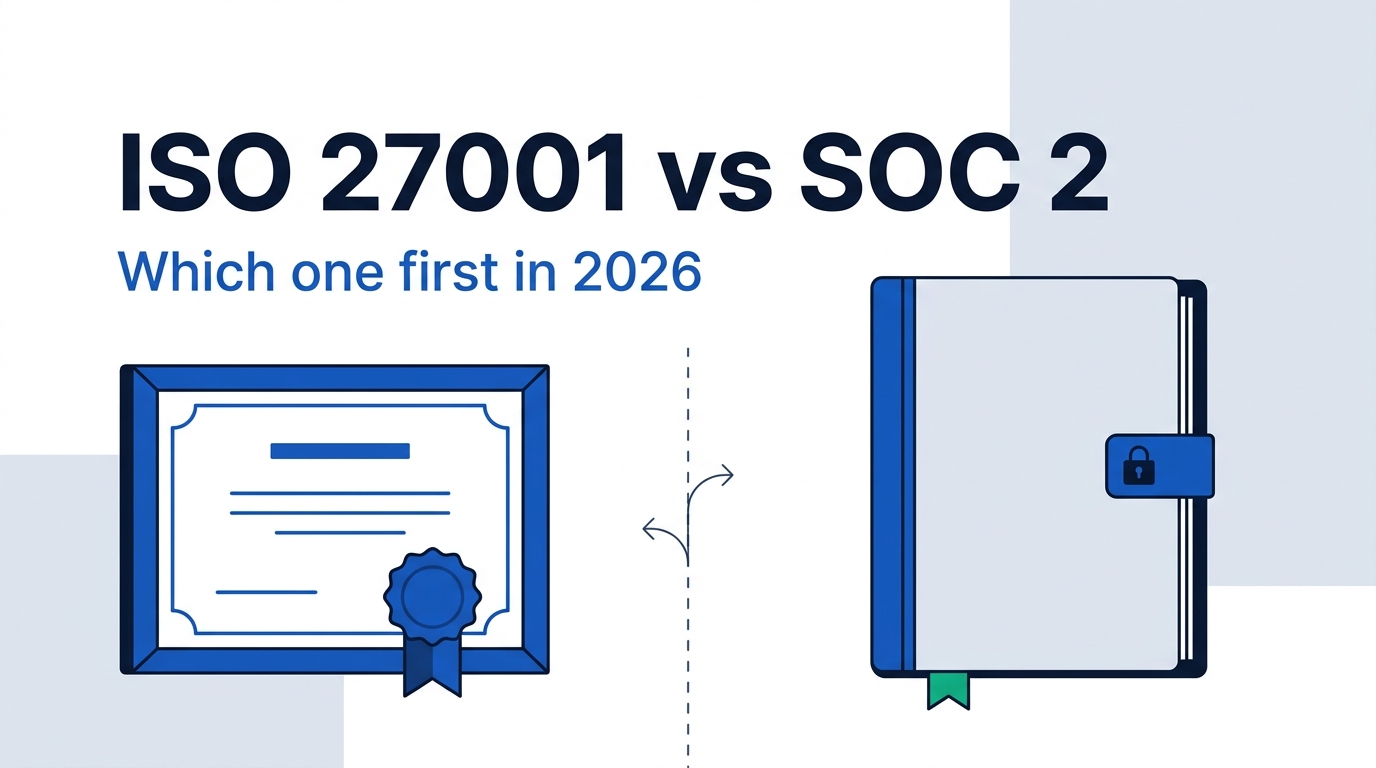
If one market is clearly bigger, take the credential that market asks for. If it isn't clear, take ISO 27001 first — not because it's better, but because going ISO → SOC 2 is cheaper than going SOC 2 → ISO.
The standard advice — "SOC 2 for North America, ISO 27001 for everywhere else" — is correct and insufficient. It answers the market question and ignores three others that decide the outcome just as often: what artifact your buyer's procurement team can actually consume, the management-system runway ISO imposes that no budget can shorten, and the fact that the two frameworks do not carry over equally in both directions.
Practical default: if you need a signable artifact inside one quarter to unblock a specific deal, start with a SOC 2 Type I and accept that you will pay more later to add ISO. If your horizon is 12 months or more and you intend to hold both, start the ISO 27001 management system first and fold SOC 2 into it — the risk assessment, internal audit, and management review you build for ISO satisfy a meaningful slice of SOC 2's CC1–CC4 criteria, while the reverse is far less true.
The two things you are actually choosing between
One is a management system. The other is an opinion about a period of time.
Most confusion in this decision comes from treating ISO 27001 and SOC 2 as two flavors of the same thing. They are not the same category of object.
ISO 27001 is a certification of a management system. An accredited certification body assesses whether you have built and are running an Information Security Management System (ISMS) that conforms to the standard's clauses 4–10, and whether the Annex A controls you declared applicable are implemented. If you pass, you receive a certificate. It is valid for three years, subject to annual surveillance audits.
SOC 2 is not a certification at all. It is an attestation engagement performed by a licensed CPA firm under AICPA standards. There is no certifying body and no certificate. What you receive is a report containing the auditor's opinion on whether your controls meet the Trust Services Criteria — either as designed on a single date (Type I) or as operating across a defined observation window (Type II). Anyone who tells you they are "SOC 2 certified" is using shorthand for something that does not exist.
That distinction is not pedantry. It propagates into every practical difference below — what you can publish, how often you have to redo it, and what a buyer's security team does with it when you hand it over.
| Dimension | ISO 27001:2022 | SOC 2 (TSC 2017 / 2022 PoF) |
|---|---|---|
| What it is | Certification of an ISMS | CPA attestation report |
| Issued by | Accredited certification body | Licensed CPA firm |
| Governing body | ISO / IEC | AICPA |
| Control set | Clauses 4–10 (mandatory) + 93 Annex A controls in 4 themes | 33 common criteria (CC1–CC9), plus optional TSC categories |
| Scope flexibility | Controls can be excluded with documented justification in the Statement of Applicability | Security (CC) is mandatory; Availability, Confidentiality, Processing Integrity, Privacy are opt-in |
| Output artifact | Public certificate + scope statement | Restricted-use report, typically 40–100+ pages |
| Can you publish it? | Yes — certificate and mark are public | No — shared under NDA (a SOC 3 is the public variant) |
| Validity | 3 years, with surveillance audits in years 2 and 3 | Covers a stated period only; practically 12 months |
| Recurring obligation | Annual surveillance; full recertification at year 3 | Full re-examination every year, indefinitely |
| Prerequisite before final audit | Internal audit and management review must already be complete | None for Type I; observation window elapsed for Type II |
| Primary demand region | EU, UK, APAC, Middle East | US, Canada |
Annex A control counts per ISO/IEC 27001:2022; criteria counts per the AICPA 2017 Trust Services Criteria with 2022 revised points of focus. Sources listed at the end.
Read that table once more with a procurement lens rather than a security lens, and the sequencing question starts to answer itself. The rest of this article works through the three inputs that the geography rule leaves out.
§ 02Input 1: What your buyer's procurement workflow can actually consume
A certificate is a fact anyone can check. A report is a document you have to keep re-delivering.
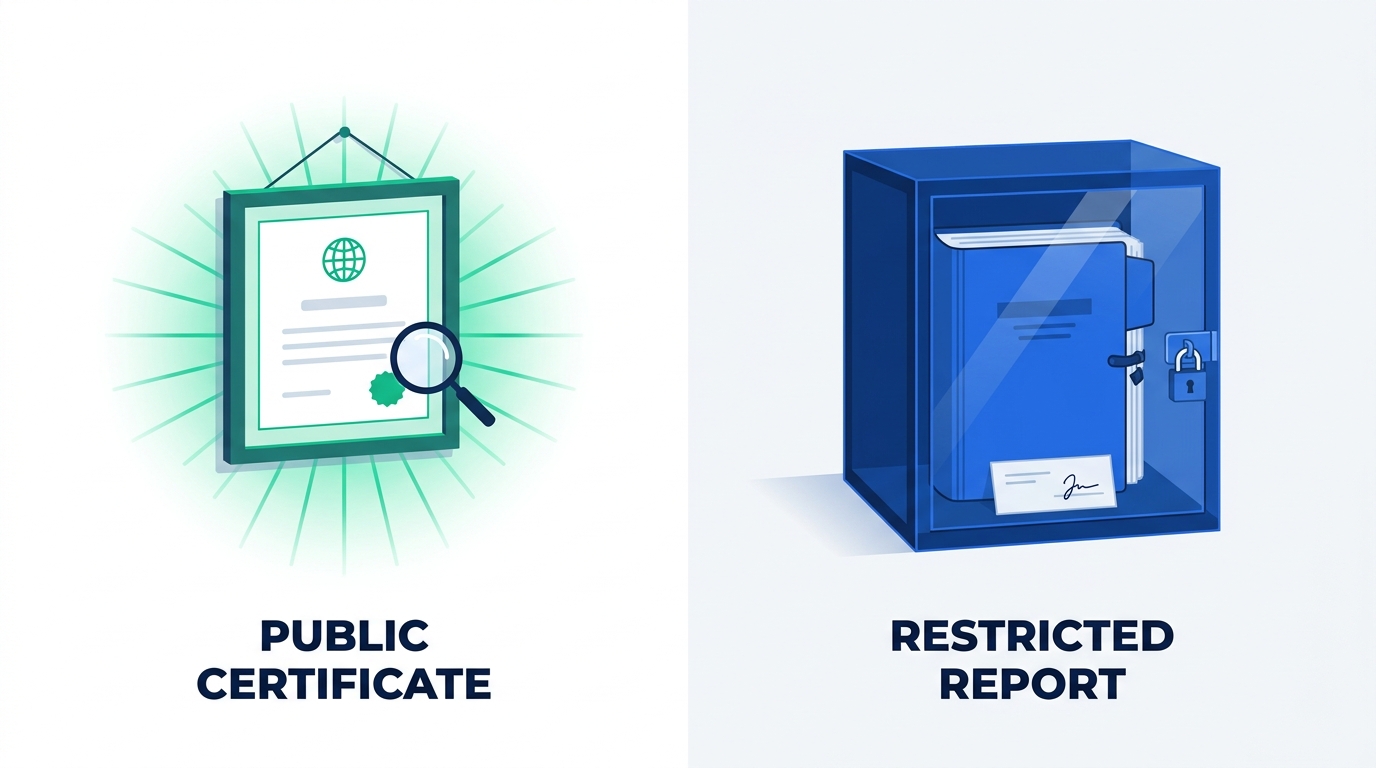
Your ISO 27001 certificate is a public artifact. It carries a certificate number, a named certification body, an accreditation mark, an expiry date, and a scope statement. A prospect's vendor risk analyst can verify it against the certification body's register without contacting you, without an NDA, and without a meeting. For a self-serve or product-led motion, that is the whole point: the credential does its work while nobody is in the room.
A SOC 2 report is the opposite kind of object. It is restricted-use by design. Every prospect that wants it needs an NDA executed first, then the report delivered, then — usually — a reviewer who reads the exceptions in Section 4 and comes back with questions. That is a recurring per-deal cost paid in legal and sales-engineering hours, not a one-time cost paid to an auditor.
The period-of-coverage problem nobody budgets for
Here is the part that catches teams out. A SOC 2 Type II report does not say "this company is secure." It says "these controls operated effectively between date X and date Y." The moment you pass date Y, the report starts aging out of the window your buyers care about.
The instrument for covering that gap is a bridge letter (also called a gap letter) — a signed statement from management, not the auditor, asserting that nothing material changed since the report period ended. It is management's word, with no independent assurance attached. Industry practice caps bridge letters at roughly 90 days, and enterprise procurement teams increasingly enforce that ceiling. Buyers in regulated verticals — financial services, healthcare — often decline to accept them at all.
If your audit period ends December 31 and your report is issued in late February, you have a two-month window where the only thing you can hand a prospect is your own attestation about yourself. Miss the next audit cycle and that window widens past the 90-day norm — at which point a deal can stall on a document you cannot produce. ISO 27001 has no equivalent failure mode: the certificate is either valid or it is not, and it stays valid for three years.
None of this makes SOC 2 the weaker choice. In the US mid-market and enterprise, the SOC 2 report is what the security questionnaire is built around, and no amount of ISO certification substitutes for it. The point is narrower: the recurring operational cost of the two credentials is different in kind, and only one of them scales without sales involvement.
ISO 27001 certificate
One-to-many artifact
- Published on your site; verifiable by anyone
- No NDA, no per-deal delivery step
- Three-year validity, no gap letters
- Scope statement is public — so a narrow scope is visible to everyone
- Says little about specific controls; buyers who want detail still send a questionnaire
SOC 2 report
One-to-one artifact
- NDA required before every delivery
- Contains the auditor's tested detail and any exceptions
- Answers most of a security questionnaire outright
- Ages continuously; needs bridge letters between cycles
- Re-examined every single year — there is no "surveillance-lite" year
If you sell to US enterprises through a sales-led motion where NDAs are routine anyway, the delivery overhead is close to free — you are already in that workflow. If you sell into Europe, or self-serve, or to buyers who evaluate you before they ever talk to you, the public certificate is doing work the report cannot do.
§ 03Input 2: The ISMS runway you cannot buy your way out of
ISO 27001's floor isn't set by your auditor's calendar. It's set by a loop that has to run at least once.
Ask a compliance automation vendor how fast you can get ISO 27001 and you will hear a number between three and six months. Ask a certification body and the number moves. The reason is a requirement people skim past: the internal audit and the management review of the ISMS must be completed before the Stage 2 audit. You cannot present a management system for certification that has never been through its own review cycle.
That is a structural gate, not a scheduling inconvenience. To hold an internal audit you need controls that have been operating long enough to produce evidence. To hold a management review you need internal audit findings, risk treatment status, and performance data to review. Each of those depends on the one before it, and none of them can be run in parallel with the certification audit.
What the two calendars actually look like
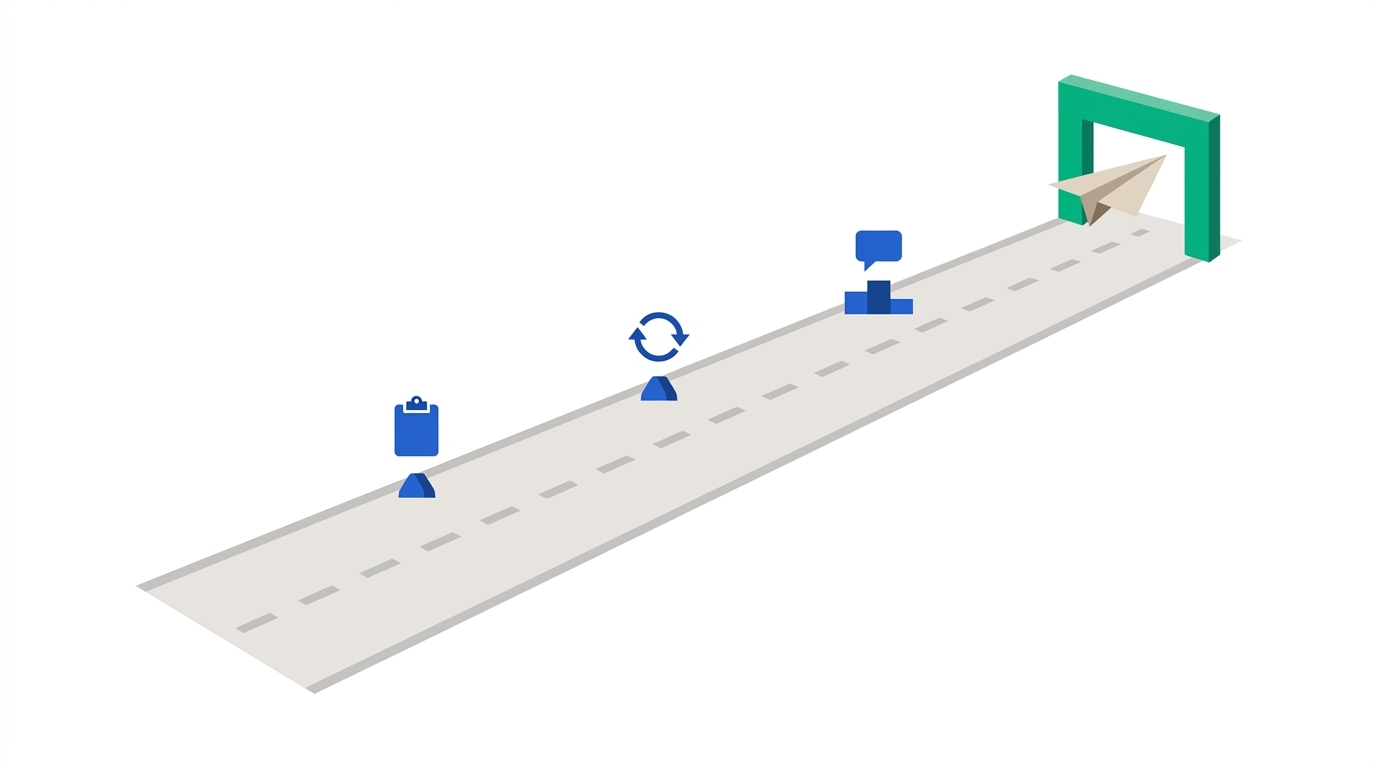
Define the ISMS boundary, run the risk assessment, produce the risk treatment plan, and document the SoA justifying every one of the 93 Annex A controls as applicable or excluded.
Policies, technical controls, and evidence collection go live. This is where compliance automation genuinely compresses the calendar — it does not compress what comes next.
An independent internal audit of the ISMS, then a documented management review covering performance, findings, and improvement decisions. Both must be finished before a certification body will schedule Stage 2.
Documentation review. The auditor checks whether the ISMS is designed and documented well enough to be worth testing. Nonconformities here push Stage 2 out.
Evidence testing against the SoA. Assuming no major nonconformities, the certificate follows within a few weeks. Realistic first-time total: 9–15 months.
Now the SOC 2 Type I path, for contrast:
Decide which Trust Services Criteria beyond Security you are in for, stand up the controls, remediate what the readiness assessment surfaces.
Two to five weeks of fieldwork testing control design as of a single date, then two to six weeks for the report. No observation window, no internal audit prerequisite, no management review. First-time total is commonly 3–6 months, and a focused team with a narrow scope can land it in two to three.
The Type I buys you a document to put in front of buyers while the Type II window runs. First windows are usually three months, extending to six or twelve on renewal.
SOC 2 Type I is the fastest route from zero to a document a buyer will accept — because it is the only one of the four artifacts here with no mandatory elapsed-time component. ISO 27001 has a management-system cycle that must complete first; SOC 2 Type II has an observation window that must elapse. If a named deal is blocked this quarter, that is the entire argument, and it beats every other consideration in this article.
One caveat worth stating plainly: a Type I is a weaker signal than a Type II, and sophisticated buyers know it. It attests to design on one day, not operation over time. Treat it as a bridge to the Type II, not a destination. Our full breakdown of SOC 2 certification cost and timeline works through how the two types stack in a first-year budget.
§ 04Input 3: The overlap is real, but it is not symmetric
Both directions are cheaper than starting over. One direction is meaningfully cheaper than the other.
Every comparison guide tells you the two frameworks overlap heavily, and they do — published mappings put shared control substance somewhere in the 60–80% range depending on how you scope and how you count. That figure is used to justify a comforting conclusion: pick either one, the second is cheap.
That conclusion is roughly right and directionally misleading, because the overlap is not evenly distributed. The two frameworks share their technical control layer almost completely and their governance layer only partially — and the governance requirements sit on the ISO side.
Read the bottom three rows carefully. ISO 27001 requires a documented risk assessment methodology, a risk treatment plan, a Statement of Applicability, an internal audit programme, and a management review. SOC 2 requires a risk assessment process under CC3 and monitoring under CC4 — but it does not require a Statement of Applicability, it does not require a formal internal audit function, and it does not require a management review as ISO defines one.
So the carry-over runs downhill in one direction:
ISO 27001 → SOC 2
- Your risk assessment and treatment plan largely answer CC3
- Internal audit and management review evidence supports CC1 and CC4 well
- Annex A implementation maps onto most of CC5–CC9
- Main new work: scoping TSC categories, aligning evidence to the auditor's testing periods, and running the observation window
SOC 2 → ISO 27001
- Technical controls carry over cleanly — that part is genuinely cheap
- But the entire management system is new work: ISMS scope, risk methodology, SoA across all 93 controls, internal audit programme, management review
- Those are exactly the items behind the hard gate before Stage 2
- Net effect: you inherit the controls but not the runway
This is the single most under-reported fact in the "which first" debate. If you are confident you will end up holding both credentials, and no specific deal is blocking you this quarter, starting with ISO 27001 lowers the combined cost — you build the governance scaffolding once, on the framework that actually demands it, and SOC 2 largely reads that scaffolding as evidence. Reverse the order and you pay for the scaffolding as a second project.
Teams running both usually converge on a shared evidence layer to avoid collecting the same artifacts twice. If you are evaluating that tooling, we compared the market in best SOC 2 automation tools and looked at what to do when your current platform stops fitting in Secureframe alternatives.
Related articles

Technology consultant with 10+ years in the Japanese tech industry. Specializing in SaaS evaluation, workflow automation, and B2B tool integration.