ISO 27001 vs SOC 2 (2026): Which to Get First — and the 36-Month Math Behind the Answer
Every guide to this question ends at the same sentence: "ask your customers which one they want." That is true, and it is where the useful advice usually stops. It does not tell you what to do when half your pipeline is in Frankfurt and half is in Boston, what the second framework actually costs after the first one is done, or how many months you will wait before you have a document a procurement team will accept.
This article answers those three questions with numbers. It uses published 2026 audit pricing, the actual mechanics of each framework's audit cycle, and a worked 36-month cost model for both possible sequences. The conclusion is not the one most comparison pages reach.
The verdict
Let the revenue decide the framework, then let the calendar decide the order. Count your last 20 security reviews, weight them by deal value, and whichever framework your buyers name more often is the one you start. That part is genuinely simple, and Section 02 turns it into a scoring sheet.
The part nobody makes simple is what happens after. SOC 2 gets you a sellable artifact faster; ISO 27001 costs meaningfully less to keep. In the model in Section 04, a 50-person SaaS company that runs SOC 2 first and adds ISO 27001 later spends roughly $197,000 over 36 months. The same company running ISO 27001 first spends roughly $169,000 — but waits about six months longer for its first usable certificate.
And the "80% overlap" figure that every vendor page repeats is a control-mapping statistic, not a budget statistic. Adding the second framework costs roughly half of a standalone program, not a fifth of one. Section 05 explains why the two numbers differ — and why the carry-over is not symmetric: ISO's governance layer largely satisfies SOC 2, while SOC 2 leaves you building ISO's management system from scratch.
- Fastest to a document you can send a buyerSOC 2 Type I (~8–14 weeks)
- Cheapest over three yearsISO 27001
- Default for a US-majority pipelineSOC 2 Type II
- Default for an EU/UK-majority pipelineISO 27001
- Realistic cost of the second framework~50% of standalone
01The two things you are actually choosing between
A certificate and a report are different objects. That difference drives everything downstream.
Before the money, one distinction that is not pedantic. ISO/IEC 27001 is a certification. SOC 2 is not.
ISO 27001 is an international standard published by ISO and IEC. An accredited certification body audits your information security management system (ISMS) against the standard's mandatory clauses 4–10 and checks that the Annex A controls you declared applicable are actually implemented. If you pass, it issues a certificate with an expiry date. The certificate is a short document. It says you passed. Nobody outside the audit sees the detail.
SOC 2 is an attestation engagement performed by a licensed CPA firm under criteria set by the AICPA. There is no certificate and no issuing authority. What you receive is a report — often 40 to 100+ pages — containing the auditor's opinion on whether your controls meet the Trust Services Criteria, either as designed on a single date (Type I) or as operating across a defined observation window (Type II), plus your description of your system and, in a Type II, a test-by-test account of what the auditor examined and every exception they found. Saying "we are SOC 2 certified" is technically wrong, and sophisticated buyers notice.
This is not trivia. It shapes the buying experience on the other side of the table. A European procurement team wants a certificate number it can verify against an accreditation registry and file. A US enterprise security team wants to read the control detail and see the exceptions. You are not choosing between two grades of the same thing — you are choosing which kind of evidence you can produce.
| Dimension | ISO/IEC 27001:2022 | SOC 2 (Type II) |
|---|---|---|
| Object produced | Certificate (pass/fail) | Attestation report with opinion |
| Issued by | Accredited certification body | Licensed CPA firm |
| Governing body | ISO / IEC, via national accreditation | AICPA (criteria only; no registry) |
| Prescribed controls | Clauses 4–10 (mandatory) + 93 Annex A controls, 4 themes | None fixed — you define controls against the Trust Services Criteria (33 common criteria, CC1–CC9) |
| Scope flexibility | Annex A controls can be excluded with documented justification in the Statement of Applicability | Security (common criteria) mandatory; Availability, Confidentiality, Processing Integrity and Privacy are opt-in |
| Management system required | Yes — ISMS, risk method, SoA, internal audit, management review | No formal management system mandated |
| Can you publish it? | Yes — certificate, number and scope statement are public | No — restricted-use, shared under NDA (SOC 3 is the public variant) |
| Validity | 3 years | Covers a stated period only; goes stale after ~12 months |
| Interim years | Surveillance audit in years 2 and 3 | Full re-audit every year |
| Gap coverage between cycles | Certificate remains valid | Requires a management bridge letter (max ~90 days) |
| Prerequisite before final audit | Internal audit and management review already complete | None for Type I; observation window elapsed for Type II |
| Typical time to first artifact | ~6–12 months | Type I ~2–4 mo; Type II ~9–15 mo |
| Recognized primarily in | EU, UK, APAC, global tenders | US, Canada |
| Internal hours, first cycle | ~200–500 h | ~150–400 h |
Annex A control counts per ISO/IEC 27001:2022; criteria counts per the AICPA 2017 Trust Services Criteria with 2022 revised points of focus. Sources listed at the end.
Two rows deserve a flag. The validity row is the single biggest structural difference and the one most comparison articles bury. And the management system row is why ISO 27001 feels heavier to a young engineering-led company: the standard does not only ask whether your controls work, it asks whether you have a documented, governed process for deciding which controls you need — including a Statement of Applicability, a completed internal audit, and a management review, all of which must exist before your Stage 2 audit.
02The question that actually decides it
Not "which is better." Which one is written in the emails already sitting in your CRM.
Neither framework makes you more secure than the other in any measurable way, and no credible dataset shows one preventing breaches better. They are commercial instruments. You buy one to unblock revenue. So the decision input is not a feature table — it is your own pipeline.
Here is a concrete way to run it. Pull your last 20 security questionnaires, vendor reviews, or procurement holds. Score each one, then weight each score by the annual contract value of the deal attached to it. A single 400k enterprise deal that explicitly demands a SOC 2 Type II report should outweigh six 15k deals whose buyers are relaxed about it.
| Signal observed in the deal | ISO | SOC 2 |
|---|---|---|
| Questionnaire names "ISO/IEC 27001 certificate" explicitly | +3 | — |
| Questionnaire names "SOC 2 Type II report" explicitly | — | +3 |
| Buyer is an EU financial entity (DORA applies to them) | +3 | — |
| Buyer is EU public sector, or bidding into an EU tender | +3 | — |
| Buyer cites NIS2 supply-chain duties or a vendor register | +2 | — |
| Buyer HQ in EU / UK / EEA | +2 | — |
| Buyer HQ in US / Canada | — | +2 |
| Buyer's security team wants to read control detail, not a pass/fail | — | +2 |
| Buyer is a US public company, or their external auditor asked | — | +3 |
| Deal also involves HIPAA or PCI DSS scope | — | +1 |
| Buyer accepts either, or has not asked yet | 0 | 0 |
Total each column, multiply each deal's score by its ACV, and compare. In most pipelines the answer is not close, and you can stop reading here and go start that program. The exercise takes an afternoon and replaces a quarter of argument.
You have a genuine tie, and the tiebreaker is operational rather than commercial:
- Under deal pressure right now? SOC 2. A Type I is the only artifact in this comparison you can obtain in weeks rather than quarters.
- Optimizing a three-year budget? ISO 27001. The surveillance model is materially cheaper than an annual re-audit.
- Thin documentation discipline, no one owning governance? SOC 2 first. The ISMS machinery — internal audit, management review, corrective action — is real recurring work that a five-person team feels acutely.
- Already run ISO 9001, or planning ISO 42001 for AI governance? ISO 27001. They share the Annex SL management-system structure and can run on a single audit cycle with one certification body.
- Selling to both markets within 18 months regardless? Start with the cheaper one to maintain — ISO — and layer SOC 2 on when a US deal forces it.
03The artifact clock: how fast can you unblock the deal
Cost matters at board level. Time matters at deal level — and the two frameworks fail this test very differently.
When a deal is held up by a security review, the only question that matters is how many weeks until you can send something. The frameworks are not close on this, and the reason is structural.
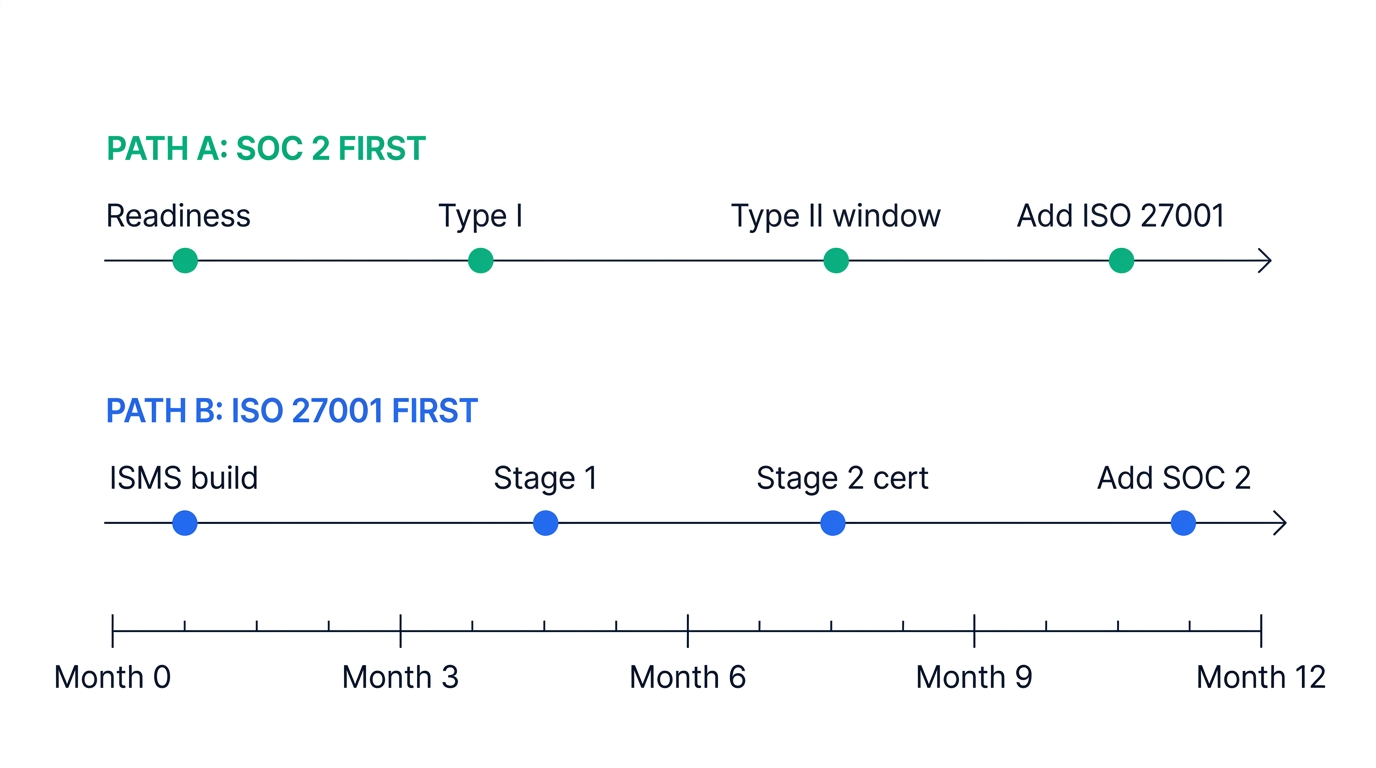
SOC 2 has a two-step exit. A Type I tests whether your controls are designed correctly at a single point in time. It requires no observation period, which is why it can be completed in 4–6 weeks with a compliance platform and a prepared team — some teams have gone from kickoff to report in under two weeks, though 8–14 weeks is the honest planning number for a company starting cold. A Type II then tests whether those controls actually operated over a window, typically 3–6 months for a first report and 12 months thereafter. So SOC 2 gives you something imperfect but real, early, and then upgrades it.
ISO 27001 has no equivalent halfway artifact. There is no partial certificate. Stage 1 is a documentation review — the auditor checks that your scope, risk methodology, Statement of Applicability, internal audit and management review exist. Stage 2 is the evidence audit. The standard sets no explicit minimum operating period, but Stage 2 requires proof the ISMS has actually run, including at least one completed internal audit and one management review, which in practice means your ISMS needs roughly three months of history before Stage 2 is even schedulable. Realistically that is six to twelve months from a standing start to a certificate in hand.
The ISMS runway you cannot buy your way out of
Ask a compliance automation vendor how fast you can get ISO 27001 and you will hear an optimistic number. Ask a certification body and the number moves. The reason is a requirement people skim past: the internal audit (clause 9.2) and the management review (clause 9.3) must be completed before Stage 2. You cannot present a management system for certification that has never been through its own review cycle.
That is a structural gate, not a scheduling inconvenience. To hold an internal audit you need controls that have operated long enough to produce evidence. To hold a management review you need audit findings, risk treatment status and performance data to review. Each step depends on the one before it, and none can run in parallel with the certification audit. Automation compresses the implementation phase; it does not compress the gate.
| Phase | What happens | Indicative timing |
|---|---|---|
| Scope, risk, SoA | Define the ISMS boundary, run the risk assessment, produce the risk treatment plan, and document the Statement of Applicability for all 93 Annex A controls | months 0–2 |
| Implement and operate | Policies, technical controls and evidence collection go live — the phase automation genuinely shortens | months 2–5 |
| Hard gate | Internal audit of the ISMS, then a documented management review of performance, findings and improvement decisions | ~3 months of ISMS history |
| Stage 1 | Documentation review; nonconformities here push Stage 2 out | after the gate |
| Stage 2 → certificate | Evidence testing against the SoA; certificate follows if there are no major nonconformities | ~months 6–12 |
The SOC 2 Type I path has none of those prerequisites: scope the Trust Services Criteria, implement, close the gaps a readiness assessment surfaces, then fieldwork tests control design as of a single date. No observation window, no internal audit, no management review. That is why it is the only artifact in this comparison with no mandatory elapsed-time component — and if a named deal is blocked this quarter, that single fact outweighs everything else in this article.
A Type I is a bridge, not a destination. As of 2026, most enterprise security questionnaires ask specifically for Type II, and for Fortune 500 or regulated buyers a Type I is generally not accepted as a substitute. Use it to keep a deal warm while your observation window runs — do not budget as though it closes the requirement. If you plan to stop at Type I, you have bought a delay, not a credential.
There is a mirror-image weakness on the SOC 2 side, and it is the detail that most surprises teams in year two.
Who has to be in the room: delivering each artifact
Time-to-artifact is only half of the clock. The other half is what it costs to put that artifact in front of each new prospect.
An ISO 27001 certificate is a public, one-to-many artifact. It carries a certificate number, a named certification body, an accreditation mark, an expiry date and a scope statement. A prospect's vendor-risk analyst can verify it against the certification body's register without contacting you, without an NDA and without a meeting. For a self-serve or product-led motion, that is the whole point: the credential works while nobody from your side is in the room. The flip side is that the scope statement is public too, so a narrow scope is visible to everyone who looks.
A SOC 2 report is a one-to-one artifact, restricted-use by design. Every prospect that wants it needs an NDA executed first, then the report delivered, then — usually — a reviewer who reads the exceptions and comes back with questions. That is a recurring per-deal cost paid in legal and sales-engineering hours, not a one-time cost paid to an auditor. If you want something public, the AICPA's SOC 3 is the general-use summary, but it does not carry the control detail that security reviewers are actually asking for.
None of this makes SOC 2 the weaker choice. In US mid-market and enterprise sales, the SOC 2 report is what the security questionnaire is built around, and its tested detail answers much of that questionnaire outright. If you sell through a sales-led motion where NDAs are routine anyway, the delivery overhead is close to free. If you sell into Europe, self-serve, or to buyers who evaluate you before they ever talk to you, the public certificate is doing work the report cannot do.
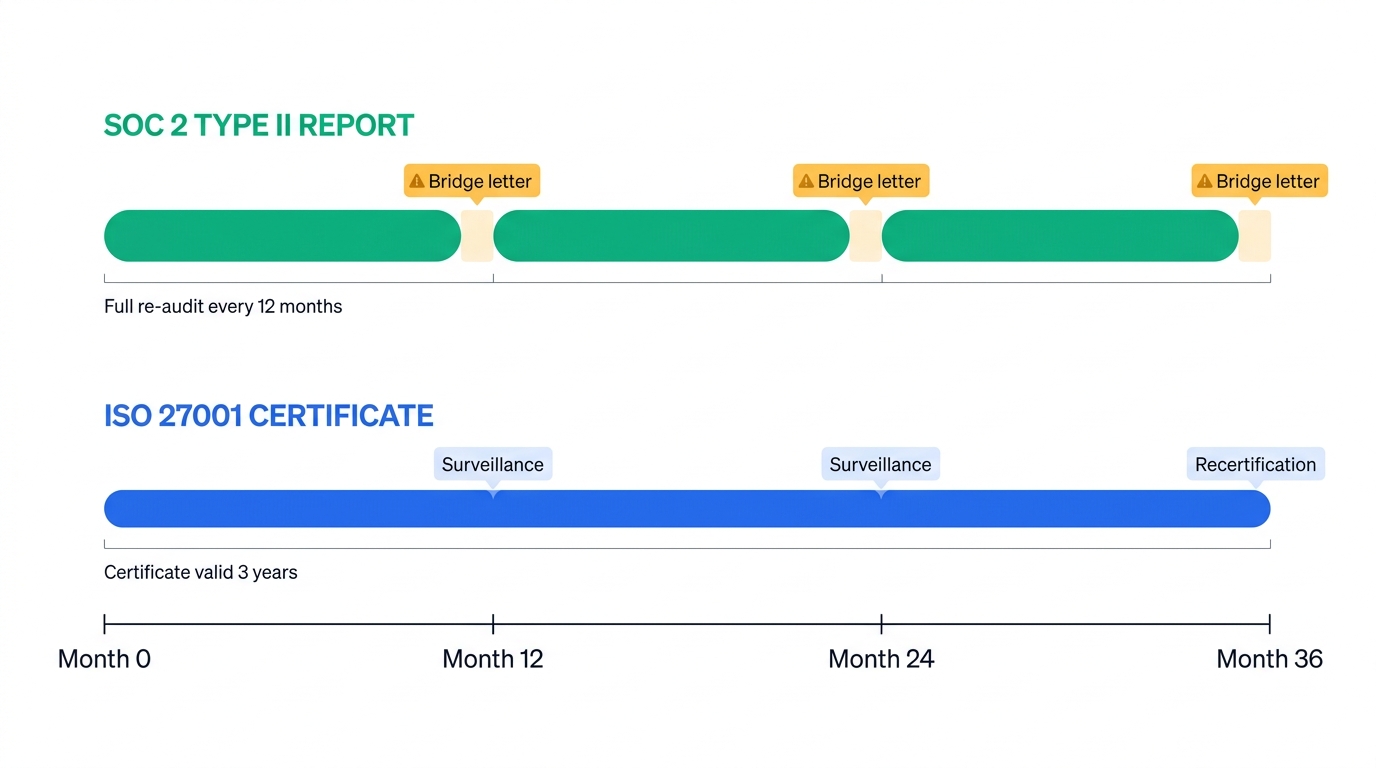
A SOC 2 Type II report covers a defined window — say January 1 to June 30. Fieldwork and reporting then take another two to three months. By the time a prospect asks for it in March of the following year, your report's period ended nine months ago and your next one is mid-audit. The accepted patch is a bridge letter (also called a gap letter): a signed management assertion that nothing material changed since the period end. It is standard practice and widely accepted for gaps under about 90 days — but note what it is. It is your own management's claim, not an independent opinion. You will produce one most years, and some buyers will push back — buyers in regulated verticals such as financial services and healthcare often decline to accept them at all, and a missed audit cycle can stretch the gap past the 90-day norm and stall a deal on a document you cannot produce.
An ISO 27001 certificate simply remains valid for its three-year term. There is no gap and no letter. If your buyers are the kind who re-verify vendors on a fixed annual cycle, this is a quiet but real operational advantage.
04The 36-month money
First-year price tags are the wrong comparison. The cost curves cross after the first renewal.
Almost every published comparison quotes a single first-year range for each framework and stops. That hides the actual economics, because the two frameworks renew on completely different models: ISO 27001 charges you a full audit once every three years with two cheap surveillance visits in between; SOC 2 charges you a full audit every single year, forever.
Below is a worked model rather than a survey. It prices a specific, common company against published 2026 ranges so the arithmetic is inspectable and you can substitute your own quotes. We have covered the single-framework version of this in more depth in our breakdown of SOC 2 certification cost and timeline; this section is about what changes when a second framework enters the picture.
US-headquartered B2B SaaS company, ~50 employees, one product, one cloud environment. SOC 2 scoped to the Security criterion only. ISO 27001 scoped to the product and its supporting corporate functions. Both programs run on a compliance automation platform. An annual third-party penetration test is included in both paths because most enterprise buyers ask for one regardless of framework. Internal salary time is excluded — add roughly 200–500 hours per first cycle. Figures are mid-range point estimates drawn from published 2026 pricing, rounded to the nearest thousand.
Path A — SOC 2 first, ISO 27001 added in year 2
| Line item | Year 1 | Year 2 | Year 3 |
|---|---|---|---|
| Compliance platform | 12,000 | 12,000 | 13,000 |
| Readiness / policy work | 8,000 | — | — |
| Penetration test | 8,000 | 8,000 | 8,000 |
| SOC 2 Type I audit | 15,000 | — | — |
| SOC 2 Type II audit | 28,000 | 26,000 | 26,000 |
| ISO gap remediation | — | 10,000 | — |
| ISO Stage 1 + Stage 2 | — | 16,000 | — |
| ISO surveillance audit | — | — | 7,000 |
| Annual total | 71,000 | 72,000 | 54,000 |
36-month total: approximately $197,000. First sendable artifact at roughly month 3 (Type I). Both credentials in hand by roughly month 22.
Path B — ISO 27001 first, SOC 2 added in year 2
| Line item | Year 1 | Year 2 | Year 3 |
|---|---|---|---|
| Compliance platform | 12,000 | 12,000 | 13,000 |
| ISMS build / consultant | 15,000 | — | — |
| Penetration test | 8,000 | 8,000 | 8,000 |
| ISO Stage 1 audit | 5,000 | — | — |
| ISO Stage 2 audit | 12,000 | — | — |
| ISO surveillance audit | — | 7,000 | 7,000 |
| SOC 2 gap remediation | — | 8,000 | — |
| SOC 2 Type II audit | — | 28,000 | 26,000 |
| Annual total | 52,000 | 63,000 | 54,000 |
36-month total: approximately $169,000. First sendable artifact at roughly month 9 (certificate). Both credentials in hand by roughly month 24.
What the model actually says
| Scenario | 36-mo cost | First artifact |
|---|---|---|
| ISO 27001 only | ~107,000 | ~month 9 |
| SOC 2 only | ~164,000 | ~month 3 |
| Path B — ISO first, then SOC 2 | ~169,000 | ~month 9 |
| Path A — SOC 2 first, then ISO | ~197,000 | ~month 3 |
Three findings fall straight out of this, and none of them are the usual conclusion:
- ISO 27001 alone is dramatically cheaper to run than SOC 2 alone — roughly $57,000 less over three years in this model. The gap is almost entirely the renewal model: SOC 2 buys a fresh full audit every year while ISO buys two surveillance visits. Note the asymmetry does not persist forever; ISO recertification lands in year 4 and costs roughly what the initial certification did, so the honest framing is that ISO is cheaper across a three-year cycle, not permanently cheaper.
- Order changes the total by about $28,000, and it is not free either way. Path A is more expensive because it front-loads the framework with the expensive renewal and then pays that renewal three times. If both frameworks are genuinely inevitable and no deal is currently blocked, starting with ISO is the cheaper sequence.
- You are buying speed with money. Path A costs about $28,000 more and delivers a sendable artifact roughly six months sooner. Whether that is a good trade is not a compliance question — it is a sales question. If six months of unblocked pipeline is worth more than $28,000 to you, Path A is correct, and for most venture-backed companies chasing US enterprise logos it obviously is.
Headcount and scope drive audit fees harder than anything else. Published 2026 ISO 27001 audit-day rates run roughly $1,400–$2,500 in the US and £1,000–£1,800 in the UK, and a small organization typically needs three to six audit days for initial certification — larger or multi-site scopes climb quickly. SOC 2 Type II audit fees widen from roughly $15,000 at the low end (single criterion, under 50 employees, specialist firm) to well past $60,000 once you add criteria such as Availability or Confidentiality. Adding Trust Services Criteria you do not need is the fastest way to break this model. Get quotes; do not budget from ranges.
05The overlap illusion
Why "80% of the controls overlap" does not mean the second framework costs 20%.
Search this topic and you will meet the 80% figure within about ninety seconds. It appears on nearly every vendor page. It is not wrong, but it is routinely used to answer a question it does not answer.
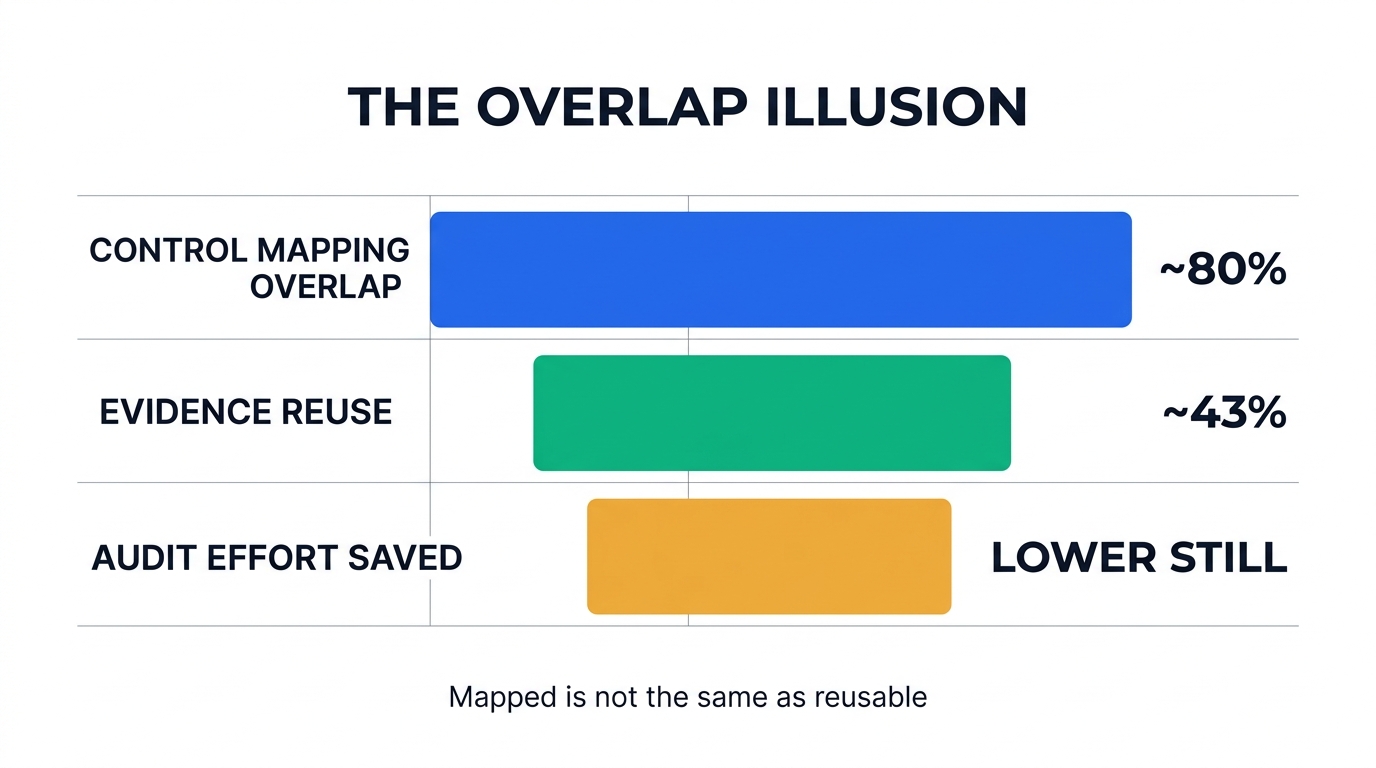
There are at least three distinct things being measured, and they are not interchangeable:
- Control mapping overlap (~65–80%). The share of requirements in one framework that have a conceptual counterpart in the other. Both want access control, encryption, incident response, change management, vendor risk, awareness training, and logging. This number is real and it is the one everyone quotes.
- Evidence reuse (~43%). The share of the artifacts you actually hand an auditor that satisfy both frameworks without rework. A-LIGN's benchmarking puts this at roughly 43% — less than half of what the mapping figure implies. This is the number closest to a budget input.
- Audit effort saved. Lower still, because the two audits are performed by different parties under different rules. Your CPA firm cannot rely on your certification body's work, and vice versa. Sampling, testing, and interviews happen twice regardless of how well the controls map.
The gap between 80% and 43% is where compliance budgets go wrong, and the reason is that the mapping compares control intent while the audit consumes evidence in a specific form. "We review access quarterly" maps cleanly across both frameworks. But ISO wants that review traced to a risk assessment, reflected in your Statement of Applicability, and covered by an internal audit and management review; SOC 2 wants a population, a sample, and evidence that the control operated on specific dates within a stated window. Same control, two incompatible evidence packages.
Then there is the part that does not map at all. The entire ISO management system has no SOC 2 counterpart. Scope definition, the risk assessment methodology, the Statement of Applicability, internal audit, management review, corrective action, continual improvement — a SOC 2 program does not produce any of these, so a company going from SOC 2 to ISO builds them from zero. In the other direction, a certified ISO shop still has to write a formal system description and support a period-of-time test regime it has never run.
The carry-over runs downhill
The overlap is also not evenly distributed. The two frameworks share their technical control layer almost completely and their governance layer only partially — and the governance requirements sit on the ISO side. SOC 2 does require a risk assessment process (CC3) and monitoring activities (CC4), but it does not require a Statement of Applicability, a formal internal audit function, or a management review as ISO defines one.
| Control area | Carry-over between frameworks |
|---|---|
| Access control, encryption, logging, change management, vendor management | Near-total, in both directions |
| Incident response, business continuity, HR security, physical security | High, in both directions |
| Risk assessment and treatment (ISO clause 6 → SOC 2 CC3) | ISO's artifact satisfies SOC 2; SOC 2 does not produce ISO's equivalent |
| Internal audit + management review (ISO clauses 9.2, 9.3) | No SOC 2 equivalent |
| Statement of Applicability, ISMS scope, continual improvement | No SOC 2 equivalent |
ISO 27001 → SOC 2
- Your risk assessment and treatment plan largely answer CC3
- Internal audit and management review evidence supports CC1 and CC4
- Annex A implementation maps onto most of CC5–CC9
- Main new work: choosing TSC categories, aligning evidence to the auditor's testing periods, writing the system description, and running the observation window
SOC 2 → ISO 27001
- Technical controls carry over cleanly — that part is genuinely cheap
- The entire management system is new work: ISMS scope, risk methodology, SoA across all 93 controls, internal audit programme, management review
- Those are exactly the items behind the hard gate before Stage 2
- Net effect: you inherit the controls but not the runway
In the cash model below, this asymmetry is partly hidden, because external fees are driven by audit days and the model deliberately excludes internal salary time. It shows up where the model does not look: in the hours your team spends building governance scaffolding, and in the calendar. Going ISO → SOC 2, you build that scaffolding once, on the framework that demands it, and SOC 2 largely reads it as evidence. Going SOC 2 → ISO, you pay for it as a second project and wait through the internal-audit gate again.
Our model bears this out arithmetically. Adding ISO to a running SOC 2 program cost $26,000 against $52,000 standalone; adding SOC 2 to a running ISO program cost $36,000 against roughly $71,000 standalone. Both land near a 50% saving — much closer to the 43% evidence-reuse benchmark than to the 80% headline.
Roughly half off the second framework is still a large number, and it is worth engineering for. Two things capture most of it: run both programs on one platform with a shared control library so evidence is collected once and mapped to both (our comparison of the leading SOC 2 automation tools covers which platforms handle multi-framework mapping well), and where possible use a single firm accredited for both so one fieldwork cycle feeds two engagements. Bundled engagements are commonly quoted at 20–35% below two separate ones. Plan the second framework before you finish the first, while your evidence pipeline is still being designed — retrofitting a mapping after the fact is where the saving evaporates.
06Pros and cons, honestly
Both are defensible choices. Here is what you give up either way.
ISO 27001
Pros
- Certificate valid three years — no annual expiry cliff, no bridge letters
- Materially cheaper across a three-year cycle
- The default credential in the EU, UK and much of APAC, and the one referenced in EU regulatory conversations
- Independently verifiable via the accreditation chain — procurement can check it without reading a report
- Builds a governance system that ports directly to ISO 42001, ISO 27701 and other Annex SL standards
- Recognized in over 160 countries through the IAF mutual recognition arrangement
- Public, one-to-many artifact — no NDA or per-deal delivery step
- Its governance layer carries over into SOC 2's CC1–CC4 when you add the second framework
Cons
- No halfway artifact — nothing to show a buyer until Stage 2 clears
- Highest documentation burden: SoA, risk method, internal audit, management review
- Requires a permanent governance owner; the ISMS is recurring work, not a project
- The certificate reveals nothing about control detail, which frustrates US security reviewers
- Year-4 recertification resets the cost to near-initial levels
- Non-accredited certification bodies exist and their certificates get rejected
- Internal audit and management review must be complete before Stage 2 — a time floor money cannot shorten
- The scope statement is public, so a narrow scope is visible to every buyer
SOC 2
Pros
- Type I gives you a real artifact in weeks — the only fast option here
- The expected credential for US and Canadian enterprise buyers
- You define your own controls, so the framework flexes to your architecture
- The report's control detail answers security-questionnaire questions directly, often shortening reviews
- No management-system overhead: no SoA, no mandated internal audit programme
- Scope is dial-able — start with Security only, add criteria when a buyer asks
Cons
- Full re-audit every year, permanently — the most expensive renewal model here
- Report covers a past window only; you will issue bridge letters most years
- Not a certification, and there is no registry to verify against
- Weak recognition outside North America
- Control flexibility cuts both ways — a thin scope produces a thin report that sharp buyers notice
- Exceptions are printed in the report for every reader to see
- Restricted-use: every prospect needs an NDA before you can send it
- Leaves ISO's management system to be built from scratch if you add ISO later
07Four profiles, four different answers
Where the general rule breaks, and what to do instead.
Pipeline is 90% North American. A six-figure deal is sitting in security review right now. Runway makes a twelve-month program hard to justify.
SOC 2 Type I immediately, Type II on a 3-month window. Revisit ISO only when EU revenue is real.
Buyers are German, Dutch and Nordic mid-market and enterprise. Several are in scope for NIS2; one is a financial entity under DORA. US pipeline is early and opportunistic.
ISO 27001, and do not hedge. SOC 2 will not satisfy these buyers and costs more to keep.
Roughly half US, half Europe, by both count and contract value. Nothing is blocked today, but both markets will demand evidence within the year. This is the case the scoring sheet ties.
ISO 27001 first, SOC 2 in year 2 — the cheaper sequence — provided no deal is currently blocked. If one is, invert it.
Buyers are asking about training data, model risk and human oversight alongside the usual security questions. A-LIGN's 2026 benchmark found 80% of companies using AI now field customer questions about AI risk management, while a third have no AI compliance strategy at all.
ISO 27001 first, then ISO 42001 on the same cycle and certification body. The shared Annex SL structure makes this the cheapest route to both.
Profile D deserves an extra note, because it is the fastest-moving part of this decision. ISO 42001 is the AI management system standard, and it is built on the same Plan-Do-Check-Act skeleton as ISO 27001 — an organization with a working ISMS can reuse its risk assessment, internal audit, incident response and performance monitoring machinery directly, and align both audit cycles under one certification body. If AI governance is on your roadmap at all, that structural compatibility is a genuine reason to weight the decision toward ISO that has nothing to do with geography. We cover the tooling side of this in our review of AI governance platforms for the EU AI Act era.
08What actually changed by 2026
Four developments that shift the calculus versus advice written even eighteen months ago.
All ISO 27001:2013 certificates are now dead
The three-year transition to ISO/IEC 27001:2022 closed on 31 October 2025. Certificates issued against the 2013 revision are no longer valid. Practically, this means two things: any ISO 27001 program you start today is a :2022 program with the restructured Annex A (93 controls across four themes rather than 114 across fourteen), and any vendor certificate you are handed should be checked for both its revision and its expiry date. Older mapping spreadsheets built against the 2013 control set are obsolete.
EU enforcement stopped being theoretical
NIS2 obligations extend down the supply chain, which is the mechanism by which a directive aimed at large European entities reaches a small US software vendor: your customer is regulated, so your customer's contract regulates you. Transposition into national law has now happened across the majority of member states, with the first administrative penalties issued in early 2026 and obligations continuing to phase in through October 2026. DORA has applied to EU financial entities since January 2025 and moved into active enforcement during 2026. Neither regulation names ISO 27001 as mandatory — that is worth stating plainly, because vendor marketing often implies otherwise. What has happened is that ISO 27001 has become the practical shorthand European buyers use when they need to evidence supplier diligence, which strengthens it as a commercial instrument in exactly the segment where it was already dominant.
Multi-framework is now the norm, not the exception
A-LIGN's 2026 Compliance Benchmark Report, drawn from 1,043 global respondents surveyed in August–September 2025, found that 97% of organizations now conduct at least two audits annually, and 74% of large enterprises manage four or more. A quarter cited managing multiple concurrent audits as their single greatest challenge. This reframes the question. For most companies with real enterprise ambitions, "which one first" is a sequencing question with a known second step — not a permanent either/or. That is precisely why the ordering math in Section 04 is worth an afternoon.
Report quality became a differentiator buyers notice
The same benchmark found 80% of respondents rating compliance report quality as "extremely important," up from 70% a year earlier, and 83% reporting clear quality differences between audit providers, up from 72%. A cheap audit from a firm nobody recognizes is a false economy in both frameworks — but it is a sharper risk on the ISO side, for the reason in the next section.
09Five ways teams waste money here
Every one of these is common, and every one is avoidable before you sign anything.
- Buying a non-accredited ISO 27001 certificate. Some bodies issue ISO 27001 "certificates" without accreditation under any IAF Multilateral Recognition Arrangement signatory. They are priced 50–70% below accredited options, which is exactly why they sell. Sophisticated procurement teams check the accreditation chain, and an unaccredited certificate fails that check — leaving you to pay twice. Before signing, confirm your certification body is accredited by an IAF MLA signatory such as ANAB or UKAS, and verify it on the accreditation body's own register rather than the certifier's website.
- Scoping too wide on the first pass. Every added Trust Services Criterion, subsidiary, office and product line adds audit days, and audit days are the unit both frameworks bill in. Start with the narrowest scope that satisfies the buyers in your scoring sheet. You can widen at renewal; you cannot easily un-widen.
- Choosing the SOC 2 observation window badly. A 12-month first window is a common and expensive mistake — it delays your report by three quarters for no commercial gain. Three months is the minimum most auditors accept; six is the common first choice. Also align the window's end date with your buyers' review cycles, or you will spend year two writing bridge letters into a gap that better planning would have avoided.
- Buying the platform before deciding the scope. Compliance automation is genuinely useful and it is where most of the legitimate multi-framework saving comes from. But platform pricing keys off framework count and headcount, and teams routinely buy a two-framework plan before they have established that they need two frameworks. Run the scoring sheet first. If you are already on a platform and unhappy, our guide to Secureframe alternatives covers the switching mechanics.
- Treating either program as a project with an end date. ISO's internal audit and management review recur annually and the certification body will ask for them. SOC 2's evidence must exist continuously across the observation window — controls that operated for the first two months and lapsed will surface as exceptions printed in the report your prospects read. The failure mode is identical in both: a heroic sprint to the first artifact, followed by decay, followed by a painful second year.
10Frequently asked questions
The questions searchers ask most on this topic, answered directly.
Is SOC 2 harder than ISO 27001?
Generally no — ISO 27001 is the heavier lift for most first-time organizations, because it requires a formal management system on top of the security controls themselves. You need a defined ISMS scope, a documented risk assessment methodology, a Statement of Applicability justifying every one of the 93 Annex A controls you did or did not apply, plus a completed internal audit and management review before your Stage 2 audit can proceed. SOC 2 mandates none of that.
The caveat is that "harder" depends on what you are measuring and where you start. A SOC 2 Type II covering four or five Trust Services Criteria, tested across a 12-month window, is a serious undertaking that can exceed a narrowly scoped ISO 27001 program in both effort and cost. And SOC 2's flexibility is a double-edged tool: because you define your own controls, a weak program produces a weak report, and experienced buyers read the exceptions section. ISO gives you a checklist; SOC 2 gives you a blank page.
Is ISO 27001 outdated?
No. The current revision is ISO/IEC 27001:2022, and it restructured Annex A substantially — 93 controls organized into four themes (organizational, people, physical, technological), replacing the 114 controls across fourteen domains in the 2013 version, and adding controls for threat intelligence, cloud services, data leakage prevention and secure coding.
What is genuinely outdated is the 2013 revision. Its transition period closed on 31 October 2025, and certificates issued against it are no longer valid. If you encounter a vendor certificate referencing :2013, or a control-mapping spreadsheet built on the fourteen-domain structure, that material is obsolete. The standard itself is actively maintained and, if anything, more commercially relevant in 2026 than it was five years ago, given European regulatory pressure and the arrival of the closely related ISO 42001.
Is ISO 27001 equivalent to SOC 2?
No, and no buyer treats them as interchangeable even though their controls overlap heavily. They produce different objects: ISO 27001 yields a certificate from an accredited body confirming you passed, while SOC 2 yields a CPA firm's attestation report describing your system, the auditor's opinion, and the specific tests performed. One is a verifiable pass/fail credential; the other is a detailed document to be read.
Control-level overlap is commonly cited at 65–80%, which is why holding one meaningfully reduces the work for the other. But overlap is not equivalence — roughly 43% of evidence transfers cleanly between them by A-LIGN's benchmarking, and the entire ISO management system layer has no SOC 2 counterpart at all. In practice, an ISO certificate will not close a US enterprise questionnaire that specifies a SOC 2 Type II report, and a SOC 2 report will not satisfy a European buyer who has been told to file a certificate number.
Is SOC 2 legally required?
No. SOC 2 is not law anywhere. It is a voluntary attestation framework maintained by the AICPA, a professional body, not a regulator. No statute compels a company to obtain one and no government agency enforces it.
It is, however, frequently required contractually, which produces much the same effect on your ability to sell. US enterprise procurement and vendor risk programs routinely make a current SOC 2 Type II report a condition of signing, and once it is in a master services agreement it is a binding commercial obligation. The same is true of ISO 27001: neither NIS2 nor DORA names it as mandatory, but European buyers subject to those regimes increasingly require it of suppliers as their own way of evidencing diligence. Both frameworks are enforced by contracts, not statutes.
Can we publish our SOC 2 report on our trust page?
No. A SOC 2 report is restricted-use: it is intended for customers and prospects with a need to know, which is why it is normally shared under NDA. If you want a public artifact, the AICPA's SOC 3 report is the general-use version — it carries the auditor's opinion without the detailed control descriptions and test results.
An ISO 27001 certificate works the other way. The certificate, its number, the certification body and the scope statement are all meant to be displayed and checked, which is a real advantage for self-serve and product-led sales where nobody is available to execute an NDA.
Can we get both at the same time instead of sequencing them?
Yes, and it is often the cheapest route to both — but it is the slowest route to your first artifact, which is usually the wrong trade for a company with a blocked deal. A combined engagement through one firm accredited for both is commonly quoted at 20–35% below two separate engagements, and running a single evidence pipeline mapped to both frameworks avoids the retrofit work that destroys most of the theoretical saving.
The practical constraint is bandwidth rather than money. A-LIGN's 2026 benchmark found managing concurrent audits to be the single most-cited compliance challenge, ahead of staffing. If one person owns compliance part-time alongside another job, running both cold starts simultaneously tends to produce two late programs rather than one on-time one. Parallel works when you have a dedicated owner and no immediate deal pressure; otherwise sequence, and design the second framework's evidence requirements into the first program from day one.
11How we evaluated this
What this analysis is, and what it is not.
This comparison was researched in August 2026 using published primary standards documentation, EU legislative texts, and 2026 audit pricing data from certification bodies, CPA firms and compliance platforms. It was updated in September 2026 to add the artifact-delivery, ISMS-runway and directional carry-over analysis. Framework mechanics — validity periods, audit stages, observation-window rules, the Annex A control structure, the Trust Services Criteria structure — were verified against ISO, AICPA and accreditation-body sources rather than vendor summaries, because vendor pages consistently blur the certification/attestation distinction.
The 36-month cost model in Section 04 is a constructed model, not survey data. It applies published 2026 price ranges to one clearly specified company profile so that the arithmetic is inspectable and you can substitute your own quotes. Point estimates sit near the middle of published ranges; every assumption is stated in Section 04. Internal salary time is deliberately excluded and is not a small number — budget 200–500 hours for a first ISO cycle and 150–400 for a first SOC 2 Type II. Treat the model as a way to compare two sequences against each other, not as a quote. Actual pricing varies substantially with headcount, scope, criteria count, cloud complexity and region.
Where sources disagreed — and on control overlap they disagree considerably, from 43% to 80% depending on what is being counted — we have reported the range and explained what each figure measures rather than picking the most quotable one. Based on our research, no evidence was found that either framework demonstrably reduces breach incidence relative to the other, and we make no such claim. StackScout has no commercial relationship with any certification body, audit firm or compliance platform named in this article.
References and sources
- ISO/IEC 27001:2022 — Information security management systems, official standard page. iso.org/standard/27001
- AICPA — SOC 2 Trust Services Criteria and reporting guidance. aicpa-cima.com
- Directive (EU) 2022/2555 (NIS2), consolidated text. eur-lex.europa.eu/eli/dir/2022/2555
- Regulation (EU) 2022/2554 (DORA), consolidated text. eur-lex.europa.eu/eli/reg/2022/2554
- International Accreditation Forum — Multilateral Recognition Arrangement. iaf.nu/en/iaf-mla
- A-LIGN, 2026 Compliance Benchmark Report (1,043 respondents, surveyed Aug–Sep 2025). a-lign.com/resources/2026-compliance-benchmark-report
- ANSI National Accreditation Board — accredited certification body directory. anabpd.ansi.org
- UKAS — accredited certification body search. ukas.com/find-an-organisation
- AICPA — 2017 Trust Services Criteria (with revised points of focus, 2022). aicpa-cima.com
- ISO/IEC 42001:2023 — Artificial intelligence management system, official standard page. iso.org/standard/42001

Technology consultant with 10+ years in the Japanese tech industry. Specializing in SaaS evaluation, workflow automation, and B2B tool integration.