TL;DR: Quick Verdict
Deel — Owned German entity, AÜG-licensed, 4–5 day onboarding, all-in-one HRIS. Best for teams that need speed and depth at scale. $599/mo per employee.
Remote.com — Direct entity model, strongest termination/KSchG handling, IP protection included. Best for risk-averse teams in a regulated industry. $699/mo per employee (list price, October 2026).
RemoFirst — From $199/mo, 24-hour onboarding, covers 185+ countries. Best for startups with one or two German hires and a tight budget. Verify Germany-specific pricing before signing.
G-P (Globalization Partners) — Premium EOR for complex, high-stakes Germany hires. Dedicated legal team, 25+ years of precedent. Lists EOR from $599/mo per employee, with volume discounts by proposal.
Germany is one of the most attractive hiring markets in Europe — and one of the most legally complex. Between the AÜG staffing law, the 18-month assignment cap, mandatory works council consultation, and employer social contributions of roughly 21–23% on top of gross salary, getting German employment wrong is expensive.
An Employer of Record (EOR) handles all of that on your behalf — acting as the legal employer while your new hire works for you. But not every EOR handles German law equally well. Some rely on local partners rather than their own entity. Some don't fully disclose how they navigate the AÜG license requirement. And the "advertised price" never includes what you'll actually pay in total employer costs.
We spent 40+ hours comparing the six most-used EOR providers for Germany. Here's what we found — including the true all-in cost most comparison articles won't tell you.
EOR Providers for Germany: At a Glance
| Provider | Price / mo | Entity Model | AÜG Licensed | Onboarding | Best For |
|---|---|---|---|---|---|
| Deel | $599 | Owned Entity | Yes | 4–5 days | Best overall |
| Remote.com | $699‡ | Owned Entity | Yes | 5–7 days | Compliance-first |
| RemoFirst | From $199* | Partner Model | Yes | 24 hrs | Budget startups |
| Oyster HR | $699 | Direct+ | Yes | 48 hrs | First-time intl. hire |
| G-P | From $599 | Owned Entity | Yes | 5–10 days | Enterprise / complex |
| WorkMotion | $549† | Local Entity (DE) | Yes | 3–5 days | German-market depth |
Prices are list prices from each provider's official pricing page, checked October 9, 2026. *RemoFirst's pricing FAQ says its EOR fee "starts at $199 per employee/month and may vary based on local country requirements"; Germany quotes have been reported at €399 (~$430–450), so confirm during your demo. †WorkMotion's pricing page lists EOR "Starting at €499 / $549" per talent per month; confirm the exact Germany quote during your demo. ‡Remote's pricing page now displays $699/mo; the $599 annual-billing rate it showed earlier in 2026 no longer appears, so ask whether annual pricing is still available. Oyster lists $699 with "annual discounts available"; G-P lists "Starting at USD 599" with volume discounts. Not in our six, but often shortlisted: Multiplier lists $459/mo on annual contracts and $499/mo on monthly contracts (Core plan).
Why Germany Is Different: What Every EOR Buyer Must Know
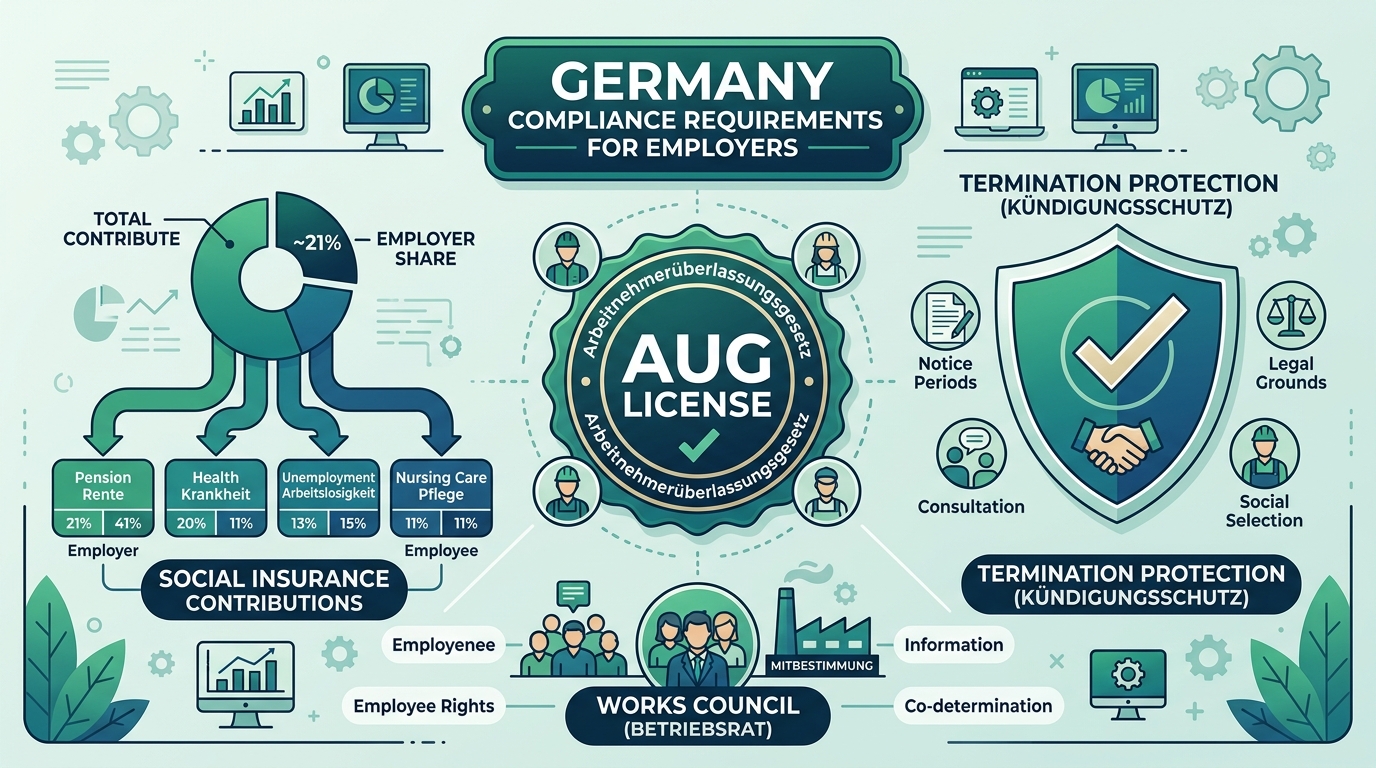
Key Germany compliance requirements that every EOR must handle on your behalf
Most EOR comparison articles treat all countries the same. Germany isn't the same. Before you evaluate any provider, you need to understand three legal realities that Germany-specific EOR arrangements must navigate.
1. The AÜG License and the 18-Month Rule
Germany's Arbeitnehmerüberlassungsgesetz (AÜG) — the Temporary Employment Act — governs how staffing and EOR arrangements work. Any EOR operating in Germany must hold a valid AÜG license issued by the Federal Employment Agency (Bundesagentur für Arbeit).
The 18-Month Cap
Under AÜG, a worker may not be assigned to the same end client for more than 18 consecutive months. This applies per individual employee, not per role. After 18 months, the employee either transitions to a new assignment, takes a break of more than 3 months (shorter breaks are counted toward the cap), or must be converted to a direct employment relationship with you. Reputable EORs proactively track this and alert you before the deadline. Ask any EOR you're evaluating exactly how they manage the 18-month clock.
⚠ Consequence of AÜG Violation
Breaching the 18-month rule triggers automatic employment transfer — the worker becomes your direct employee by operation of law unless they formally opt to stay with the EOR (see the AÜG contract section) — plus fines of up to €30,000 per violation and back-payments for any missed social contributions.
2. Employer Social Insurance Contributions (~21–23%)
Germany's Sozialversicherung (social insurance) system requires employers to contribute roughly 21–23% of gross salary on top of what you pay the employee. This covers:
- Pension (Rentenversicherung): 9.3% employer share
- Health insurance (Krankenversicherung): ~8.75% employer share (7.3% base rate plus half of the 2026 average 2.9% Zusatzbeitrag)
- Unemployment insurance (Arbeitslosenversicherung): 1.3% employer share
- Long-term care (Pflegeversicherung): 1.8% employer share (1.3% in Saxony)
- Accident insurance (Unfallversicherung): 1–2% depending on industry
This is not included in any EOR's platform fee. It's in addition to it. See the true cost section for a worked example.
3. Termination Protection and Works Councils
Germany's Kündigungsschutzgesetz (KSchG) — the Dismissal Protection Act — applies to employees who have worked for more than 6 months in a company with 10+ employees. After that threshold, you cannot terminate without one of three socially justified reasons: operational necessity, personal incapacity, or misconduct. Severance isn't legally mandated but is typically 0.5 months' salary per year of service in disputes.
Companies with 5 or more employees may elect a Betriebsrat (works council), which has co-determination rights over working hours, overtime policies, and health & safety measures. Critically, dismissals without works council consultation are void immediately under German law. A good EOR will have processes to manage this consultation — ask specifically how they handle it.
How the AÜG Shapes Your EOR Contract in Germany
In Germany, "employer of record" is not a legal category of its own. If your hire works inside your team and takes instructions from you, the arrangement is Arbeitnehmerüberlassung (temporary agency work) under the AÜG. Section 1(1) of the Act defines it this way: workers are leased out when they are "eingegliedert" (integrated) into the client's work organization and "seinen Weisungen unterliegen" (subject to its instructions). That describes a standard EOR setup. (For how other countries classify the same model, see our explainer What is an employer of record and how does it work?)
That classification puts specific requirements into the paperwork, not just into the provider's licence file. Here's what the statute says and what to check before you sign:
| AÜG rule | Where it is | What to check in your EOR contract |
|---|---|---|
| Licence required | § 1(1) sentence 1 | Ask for a copy of the German employing entity's Erlaubnis from the Bundesagentur für Arbeit |
| Only the actual employer may lease | § 1(1) sentence 3 | The entity named as Verleiher must be the one that employs your hire, which matters if the provider uses a local partner |
| Label and name before day one | § 1(1) sentences 5–6 | The contract expressly calls the arrangement Arbeitnehmerüberlassung, and your hire is named against it before they start |
| 18-month maximum per client | § 1(1b) | How the provider tracks the clock, including prior assignments to you through other agencies |
| Equal treatment | § 8 | How pay is benchmarked against your comparable staff, and from which month |
| Your works council's say | § 14(3) | If you have a German site with a Betriebsrat, it must be consulted before the hire starts |
Mislabeled contracts: the risk sits with you
A generic "services agreement" that never uses the word Arbeitnehmerüberlassung is a red flag. Under § 9(1) no. 1a, the employment contract between the provider and your hire is void if the arrangement wasn't expressly labeled as agency work and the worker wasn't specified in advance. Under § 10(1), an employment relationship between you and the worker is then deemed to exist. The same consequences follow if the provider has no licence (§ 9(1) no. 1) or the 18-month cap is exceeded (§ 9(1) no. 1b).
The worker can block the transfer with a written Festhaltenserklärung (a declaration that they want to stay employed by the provider) within one month. It only counts if the worker first presents it in person at an Agentur für Arbeit, and it must reach the provider or you no later than the third day after that (§ 9(2)). Don't build your plan on that escape hatch. Labeling and naming failures are also administrative offences carrying fines of up to €30,000 (§ 16(1) nos. 1c–1e, § 16(2)).
The 18-month clock doesn't reset when you switch providers
Section 1(1b) caps the assignment of the same worker to the same client at 18 consecutive months, and the cap binds both sides: the provider may not lease the worker longer, and you may not let them work longer. Earlier assignments to you by "the same or another" agency count in full if the gaps between them are three months or less. Moving a German employee from one EOR to another therefore doesn't buy you time. A collective agreement in your sector can set a different maximum. Without one, the Federal Employment Agency's information sheet puts it simply: an assignment "ist grundsätzlich auf 18 Monate begrenzt" (is generally limited to 18 months).
Equal pay: budget for it, at month nine at the latest
Section 8(1) starts from equal treatment: during the assignment, your hire is entitled to the essential working conditions, including pay, of a comparable employee in your business. A collective agreement for agency work can deviate from that, but under § 8(4) only for the first nine months on pay, unless the agreement steps pay up, by month 15 at the latest, to a level it defines as equivalent to the sector's pay for comparable workers. The BA information sheet confirms that pay must be equal "spätestens nach 9 Monaten" (after 9 months at the latest). Failing to grant equal conditions carries fines of up to €500,000 (§ 16(1) no. 7a, § 16(2)). If you already employ comparable staff in Germany, give your EOR their pay data at the start. Otherwise a mid-assignment pay increase can catch your budget off guard.
What the licence itself tells you
According to the BA information sheet, a licence is first granted for one year and can become indefinite after three consecutive years of licensed operation, and no leasing may happen before the licence is granted. A provider holding an indefinite licence has been operating legally in Germany for at least three years, which is a useful signal when comparing newer entrants. To compare providers on the questions beyond Germany (entity model, deposits, exit terms), use our EOR selection framework alongside the table above.
Sources for this section
Arbeitnehmerüberlassungsgesetz §§ 1, 8, 9, 10, 14, and 16 (gesetze-im-internet.de, Federal Ministry of Justice) and the Bundesagentur für Arbeit information sheet on temporary agency work (dok_ba034970), both checked October 9, 2026. This is not legal advice. Have German employment counsel review your contract for a specific hire.
Detailed Provider Reviews
Deel is the most comprehensive EOR platform in the market, and for Germany specifically, it checks every box that matters: an owned legal entity, a valid AÜG license, and a proprietary HRIS that tracks the 18-month assignment window automatically.
Onboarding in Germany runs 4–5 business days — one of the fastest among providers with owned entities. The platform handles locally compliant contracts, statutory benefits, payroll in EUR, and tax filings through a single dashboard. For teams already using Deel for contractors or in other countries, adding German EOR employees is seamless.
Deel's German legal team handles works council notifications and KSchG-compliant termination processes. As of October 2026, Deel's pricing page lists $599/mo per EOR employee. Larger contracts are negotiated case by case. There are no setup fees or minimum employee requirements.
One note: while Deel is strong across the board, complex termination disputes in Germany — especially those involving long-tenured employees or active works councils — may benefit from G-P's deeper dedicated legal team. For most companies, Deel's coverage is more than sufficient.
If you're deciding between Deel and Remote specifically, we cover that comparison in depth: Deel vs Remote for Germany: Which EOR Actually Complies with German Labor Law.
Pros
- Owned entity in Germany, not a partner
- AÜG-licensed with 18-month tracking built in
- Fastest onboarding among owned-entity providers (4–5 days)
- All-in-one: EOR + HRIS + contractor + payroll
- No minimums, no long-term contract required
Cons
- $599/mo is expensive for single-hire experiments
- Complex terminations may need G-P's depth
- Some users report slower support for Germany-specific edge cases
No minimums. Get a quote and start onboarding in under a week.
Remote's central competitive claim is simple: they own their legal entities in every country they operate. No third-party partners, no markup layers, no accountability gaps. For Germany — where employment law is unforgiving — that direct-entity commitment matters.
Remote's Germany coverage includes full AÜG licensing, a dedicated in-house legal team that handles KSchG-compliant terminations, and IP Guard included in every contract at no extra cost (country-specific IP protection language that's particularly important for tech companies). Onboarding runs 5–7 business days, slightly slower than Deel, but Remote argues that the extra time is spent on contract compliance review, not bureaucracy.
At $699/mo (the only EOR price Remote's pricing page displays as of October 2026, $100 above Deel's list price), Remote wins on legal depth for complex situations: long-tenured employees, works council-heavy workplaces, and regulated industries (fintech, healthcare, government contracting). The break-even for entity setup versus Remote EOR sits around 12–15 employees in Germany — below that threshold, Remote's model is almost always cheaper than incorporation.
Remote's pricing page also says it does not charge the extra deposits some providers require for PTO above the legal minimum, removed probation periods, or severance accruals. If you're hiring at scale, compare negotiated quotes from both Remote and Deel rather than list prices.
Pros
- 100% owned entities — no third-party partners
- Strongest KSchG termination handling in the market
- IP Guard included at no extra cost
- Works council consultation process built in
- Free API + Zapier integrations
Cons
- 5–7 day onboarding is slower than Deel
- $699/mo list price is $100 above Deel
- Platform is less feature-rich than Deel for HRIS use
Direct entity model. IP protection included. No hidden partner layers.
RemoFirst is the budget leader in EOR. Their advertised starting price of $199/mo covers 185+ countries and is about one-third of Deel's $599 list price — but RemoFirst's own FAQ says the fee "may vary based on local country requirements." For Germany, be aware: RemoFirst uses a local partner model rather than an owned entity, and real-world quotes for Germany have been reported at €399 (~$430–450) per month — not $199.
The partner model isn't inherently bad, but it introduces a layer of distance between you and the entity actually employing your staff. This matters when something goes wrong: a contested termination, a works council dispute, or an AÜG compliance question. RemoFirst holds an AÜG license and covers the 18-month tracking, but their depth of in-country German legal support is thinner than Deel or Remote.
Where RemoFirst genuinely excels is onboarding speed (24 hours in many cases), support responsiveness (consistently praised in reviews), and simplicity. For a startup hiring its first German engineer who wants a fast, low-overhead employment relationship with manageable monthly costs, RemoFirst is worth a demo — just get the Germany-specific pricing in writing before you sign.
Pros
- Lowest stated price in the market ($199/mo)
- 24-hour onboarding — fastest of any provider
- Highly rated support responsiveness
- Covers 185+ countries from one platform
Cons
- Partner model in Germany, not an owned entity
- Germany may be quoted at €399, not $199
- Thinner legal depth for complex German cases
- Limited HRIS features vs. Deel or Remote
- Less customization in employment contracts
Get the actual Germany quote — don't assume the $199 base price applies.
At $699/mo (with "annual discounts available," per its pricing page), Oyster HR shares the top list price with Remote, and it justifies the premium with what it calls a "Direct+" model for Germany: a structure that combines an owned compliance entity with locally compliant employment contracts and a dedicated People Partner for complex situations.
Oyster covers Germany, France, the UK, Netherlands, Spain, Portugal, and Poland through its Direct+ infrastructure — no partner in the middle for these key markets. Onboarding takes 48 hours, and Oyster's platform is consistently cited as the cleanest UX in the EOR category. For an HR team handling its first international hire, the guided onboarding experience reduces the learning curve significantly.
One notable downside: Oyster's pricing page states that it requires a refundable deposit for EOR team members. If the deposit is set at one month's gross salary, a German engineer earning €6,000/mo means €6,000 tied up until it is refunded. Ask for the Germany deposit amount and refund timing in writing. For cash-conscious startups, this is a meaningful consideration. Oyster also runs a startup program advertising savings of up to $1,200 on EOR subscription fees.
Pros
- Direct+ entity for Germany (no partners)
- Best-in-class UX for HR teams new to global hiring
- Dedicated People Partner for compliance questions
- Conservative compliance approach — fewer grey-area risks
Cons
- $699/mo list price (tied with Remote, $100 above Deel)
- Refundable deposit required per EOR employee
- Fewer integrations than Deel
Globalization Partners has been in the EOR market longer than most of its competitors and built its reputation on handling the markets that other providers avoid or handle poorly. Germany is one of G-P's core strengths.
G-P's German legal team routinely handles the most complex termination scenarios: Sozialauswahl (social selection criteria) calculations that weigh tenure, age, dependents, and disability status; multi-party works council consultations; and collective bargaining agreement compliance for specific industries. No other EOR matches G-P's depth in this area.
The tradeoff used to be opaque pricing. As of October 2026, G-P's pricing page lists EOR "Starting at USD 599 per employee/month" with volume discounts, but the final price still comes through a proposal rather than self-serve checkout. G-P's FAQ says there is no minimum contract length for EOR hires; in Germany, that does not override the AÜG's 18-month cap per client, so ask how G-P structures long-running German assignments. Onboarding takes 5–10 business days, the slowest in this comparison. For a three-person Germany pilot, G-P is almost certainly overkill. For a 50-person Germany expansion with union involvement or regulatory complexity, it may be the only defensible choice.
Pros
- Deepest German legal expertise in the market
- 25+ years of EOR precedent globally
- Owned entity in Germany
- Best for complex terminations and Sozialauswahl
- Enterprise SLAs and dedicated CSM
Cons
- Final price only via proposal; no self-serve checkout
- Sales-led process is slower than Deel or Remote
- Volume discounts depend on negotiation
- Slowest onboarding (5–10 days)
The True Cost of Hiring in Germany Through EOR
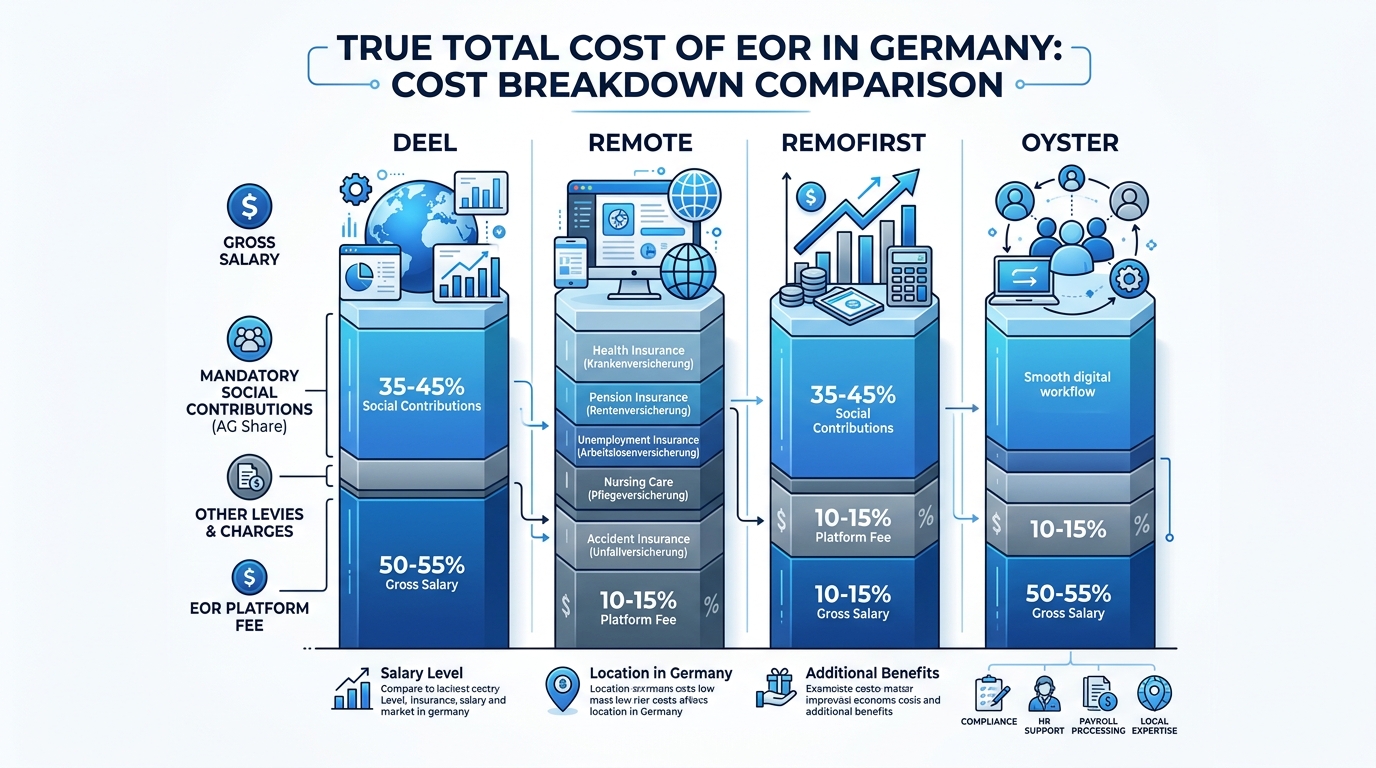
The platform fee is only part of what you'll pay. Germany's employer social contributions add 21–23% on top.
Every EOR provider charges a platform fee (the $199–$699/mo list prices above). What almost no EOR article makes explicit is that Germany's employer social contributions add approximately 21–23% of gross salary on top of that — and this is a legal obligation, not an EOR choice.
Here's a worked example for a German software engineer earning €6,000/month gross salary (a reasonable mid-range engineering comp in Munich or Berlin):
Total employer cost example: €6,000/month gross salary
| Cost Component | Amount / mo | Notes |
|---|---|---|
| Employee gross salary | €6,000 | What employee receives pre-tax |
| Pension (employer share, 9.3%) | €558 | Rentenversicherung |
| Health insurance (~8.75% avg) | €525 | Krankenversicherung |
| Unemployment (1.3%) | €78 | Arbeitslosenversicherung |
| Long-term care (1.8%) | €108 | Pflegeversicherung |
| Accident insurance (~1.5%) | €90 | Varies by industry |
| Subtotal: social contributions | ~€1,359 (22.7%) | |
| EOR platform fee (e.g. Deel, $599) | ~€550 (~$599) | Varies by provider |
| Total monthly employer cost | ~€7,909 | ~32% above gross salary |
The practical takeaway: for a €6,000/mo German employee, your all-in monthly cost is approximately €7,850–€8,050 — roughly 32% above gross salary. This should be the number you use for budget planning, not the EOR platform fee.
EOR vs. Setting Up a GmbH: When to Make the Switch
EOR is the right choice for most companies in Germany — until it isn't. Here's a simple decision framework:
Stick with EOR if…
Fewer than 12–15 employees in Germany, and/or still validating the market
Evaluate GmbH setup if…
12–15+ employees, or you need your own German bank account, IP ownership, or client contracts in your entity name
Switch urgently if…
Approaching the 18-month AÜG cap and the employee is too critical to risk an accidental employment transfer
Always GmbH if…
Government contracts, heavily regulated industries (financial services, healthcare), or your German operation is its own revenue center
GmbH incorporation typically takes 4–8 weeks and costs €2,000–€5,000 in legal and notary fees, plus a minimum share capital of €25,000 (though only €12,500 must be paid in at formation). The break-even against EOR at $599/mo per employee is roughly 12–15 employees — at that scale, the GmbH setup cost amortizes within a few months.
An EOR also doesn't remove corporate tax exposure: if your German hire negotiates and signs contracts for you, you may still create a taxable presence. See EOR compliance mistakes that trigger permanent establishment risk before you give a German employee a sales or country-manager role.
If you want a deep-dive on Compliance Automation and how to keep your German entity audit-ready once you set it up, see our comparison of Vanta vs Drata for compliance automation.
How We Evaluated These EOR Providers
We evaluated each provider across the following criteria, weighted toward Germany-specific performance:
- Legal entity model: owned entity vs. partner network in Germany
- AÜG compliance: license status, 18-month cap tracking, documentation
- Works council handling: consultation process, co-determination support
- KSchG termination: in-house legal team, Sozialauswahl capability
- True all-in pricing: platform fee + social contribution transparency
- Onboarding speed: time from signed contract to first payroll run
- Platform quality: HRIS features, integrations, UX
- Support quality: G2 and Trustpilot scores, response time data
Our research was originally conducted in May–June 2026, refreshed in August 2026 to re-verify German employer social contribution rates, and refreshed again on October 9, 2026 to re-check every provider's list price on its official pricing page and to check the AÜG section against the statute text and the Federal Employment Agency's information sheet. Pricing is based on publicly available information. All figures should be confirmed directly with providers before signing. For a provider-agnostic version of these criteria, see our 7-question framework for choosing an EOR provider.
Frequently Asked Questions
Yes. Using an Employer of Record in Germany is legal, provided the EOR holds a valid AÜG (Arbeitnehmerüberlassungsgesetz) license from the Federal Employment Agency. All major EOR providers in this comparison — Deel, Remote, RemoFirst, Oyster, and G-P — hold this license. Verify this for any provider you use.
For most companies, Deel is the best overall choice: owned German entity, AÜG-licensed, 4–5 day onboarding, strong HRIS. For compliance-heavy situations or complex terminations, Remote.com is the stronger pick. For enterprise scale and maximum legal depth, G-P.
Budget approximately 31–33% above the employee's gross salary for total employer cost. For a €6,000/mo employee using Deel EOR, expect ~€7,850–€8,050/mo all-in: €6,000 gross + ~€1,360 in social contributions + ~€550 EOR platform fee. This is not unique to EOR — it's Germany's statutory employer contribution requirement.
Under Germany's AÜG law, an employee cannot remain assigned to the same end client for more than 18 consecutive months. Before that deadline, you have three options: (1) direct-hire the employee, (2) the employee takes a break of more than three months before a new assignment to you, or (3) your EOR restructures the arrangement. The best EOR providers proactively alert you at 12–15 months so you have time to plan. Ignoring the deadline risks an involuntary employment transfer and fines.
The works council, if one exists, sits at your EOR provider's German entity (since the EOR is the legal employer, not you). However, works councils in Germany have co-determination rights over certain employment decisions. For dismissals in particular, the works council must be consulted before any termination — a process your EOR should manage on your behalf. Ask any EOR you're evaluating specifically how they handle Betriebsrat consultation.
Yes, and it's relatively straightforward if you have a German GmbH or are willing to set one up. The EOR typically handles the offboarding and can assist with the transition. Most EOR providers do not charge a conversion fee, though some have it in their contract — check before signing. Conversion is particularly relevant as you approach the 18-month AÜG window.

Technology consultant with 10+ years in the Japanese tech industry. Specializing in SaaS evaluation, workflow automation, and B2B tool integration.