Best EOR for Hiring in the Netherlands (2026): 6 Providers Compared on Cost, Compliance & Speed

TL;DR — Our Verdict
For most B2B teams hiring 1–10 employees in the Netherlands, Deel remains the safest default: it owns a Dutch entity, supports the 30% ruling end-to-end, and onboards in 48 hours. Remote wins on legal defensibility — every entity it operates is fully owned — which matters for sensitive IP work or roles where a clean termination paper trail is non-negotiable.
Budget-constrained teams hiring junior or mid-level talent should look at Multiplier (~$400/mo flat) or RemoFirst ($199/mo). Enterprises with works-council exposure or unionized roles will get more careful, slower service from Skuad or a boutique like Boundless.
Whichever provider you pick, the process looks the same: contract, BSN and Belastingdienst registration, and first payroll in about one to two weeks for an EU/EEA candidate. Non-EU hires add a highly skilled migrant permit, which is usually the slowest step. Total employer cost typically lands 28–35% above gross salary, and the EOR fee is the smallest part of it. We walk through the full step-by-step hiring playbook after the provider reviews.
Anyone telling you "all EORs are basically the same in the Netherlands" hasn't tried to terminate someone after a UWV rejection.
In this guide
- Why the Netherlands is harder than it looks
- What hiring through an EOR actually means here
- At-a-glance comparison
- The 6 providers, reviewed
- Owned entity vs partner network
- The true cost of a Dutch hire
- Step-by-step: hiring your first Dutch employee through an EOR
- What the timeline really looks like
- Common mistakes to avoid
- Who should choose which
- FAQ
- Methodology
Why hiring in the Netherlands is harder than it looks
If you're reading this article, you've probably already heard that the Netherlands is a "developer-friendly" place to hire: an English-speaking workforce, strong infrastructure, and sane tax treaties. All of that is true. None of it tells you how the Dutch employment system will actually surprise you.
Six things make Dutch employment genuinely complex for foreign employers:
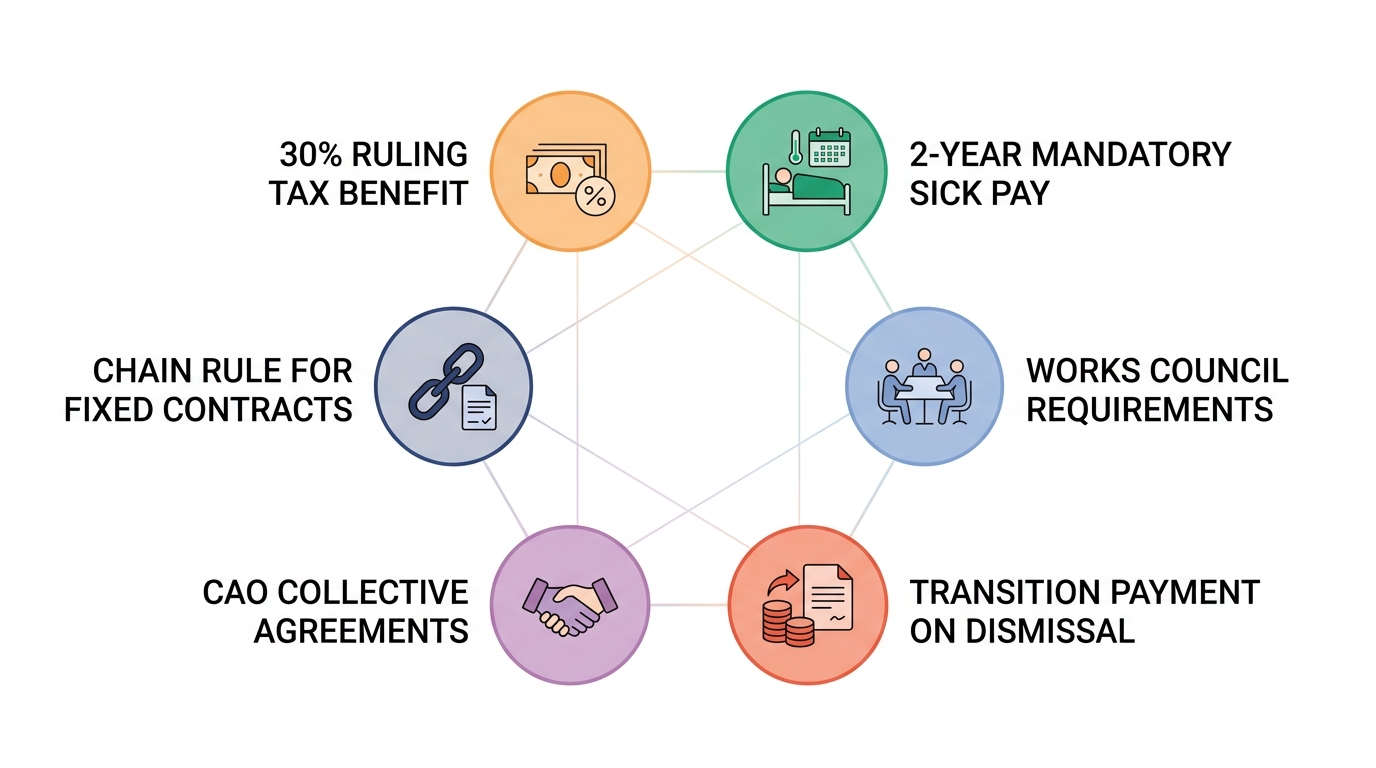
1. Two years of mandatory sick pay. Under Dutch law, if an employee falls ill, the employer must pay at least 70% of salary for up to 104 weeks, and many CAOs top that up to 100% in the first year. The UK, the US, and most of Asia have no statutory equivalent. EORs without proper sick-leave insurance (verzuimverzekering) absorb that risk into their margin, which is part of why EOR fees here are higher than in Germany or the UK.
2. The chain rule (ketenregeling). An employer can offer at most three consecutive fixed-term contracts within a 36-month window. Offer a fourth contract or pass the 36-month mark, and the contract automatically becomes permanent. There is no opt-out and no separate step required. A gap of more than six months between contracts resets the chain; a shorter gap does not. EORs interpret this conservatively: most will refuse to issue a fourth fixed-term contract under any circumstance.
Probation periods (proeftijd) have their own strict scale. A fixed-term contract of six months or less cannot include a trial period at all, and any clause that tries to add one is legally void. A fixed-term contract of up to two years allows a trial period of up to one month. A permanent contract, or a fixed-term contract longer than two years, allows up to two months. The clause must be in writing and apply equally to both parties. A second consecutive contract with the same employer generally can't include a new trial period unless the role requires clearly different skills.
3. The 30% ruling. The Netherlands gives eligible foreign hires a generous tax-free allowance of up to 30% of salary. From January 1, 2027, the rate drops to a fixed 27% for everyone except employees who were already using the ruling before 2024; transitional rules let them keep 30% for their full term. For 2026, the salary threshold is €48,013 (€36,497 for under-30s with a qualifying Master's degree), and the tax-free portion is capped at €78,600 per year. The joint employer–employee application must be filed within four months of the start date for the ruling to apply from day one. Not every EOR processes the 30% ruling application; the ones that do are usually worth the premium for international hires.
4. Works councils. Any Dutch entity with 50+ employees must have a works council (ondernemingsraad) with binding consent rights on working hours, pension changes, and reorganizations. Since most EOR providers operate Dutch entities well above that threshold, a works council exists at the EOR, and its decisions can affect your employees in ways your home-country lawyers won't anticipate.
5. Transition payment. When an employer ends a Dutch contract (including non-renewal of a fixed-term contract that triggered the chain rule), the employee is entitled to a transition payment of one-third of monthly salary per year of service. Even short tenures cost real money to wind down.
6. CAO (collective labor agreements). About 80% of Dutch private-sector employees are covered by a sector-wide CAO that overrides the statutory minimum. A "tech" employee can fall under the CAO Metalektro, CAO MITT, or several others depending on the EOR's industry classification. The CAO sets minimum wages, working hours, pension contributions, and notice periods, and EORs that misclassify the CAO can leave you exposed.
Why this matters for your shortlist: A provider that says "we cover the Netherlands" can mean two very different things. Some have a full Dutch entity, a payroll bureau, sick-leave insurance, and an in-house Dutch employment lawyer. Others have a local partnership and basically forward emails. The price difference between those models is real, about $200–400 per employee per month. So is the risk difference.
What hiring through an EOR actually means in the Netherlands
An Employer of Record already has a registered Dutch legal entity, a payroll bureau relationship, and the administrative setup to employ someone under Dutch law. When you hire through one, the EOR signs a compliant Dutch employment contract (arbeidsovereenkomst) with your candidate and becomes their legal employer on paper. It registers the employee with the tax authority, runs monthly payroll, withholds wage tax, pays the employer's share of social contributions, and administers the mandatory holiday allowance and pension. You keep everything that's actually your job: who you hire, what they work on, how you manage them, and what you pay them.
The trade is speed in exchange for a per-employee fee. A civil-law notary can incorporate your own Dutch entity (a besloten vennootschap, or BV) in as little as a week. But getting to compliant, running payroll also means employer registration with the Belastingdienst, enrollment in the right sector pension fund, sick-leave insurance, and a payroll provider. Even after the entity exists, that realistically takes several weeks to a couple of months. An EOR shortens the whole process to about one to two weeks and moves the compliance liability to a specialist. For one to a handful of hires, that trade is almost always worth it.
EOR vs your own BV vs payrolling
Three hiring models get confused constantly. An EOR employs the person under its own Dutch entity and carries the compliance risk. A payroll company (payrolling, a Dutch domestic model) is different. It usually expects you to have found the candidate already, and it often assumes some local presence or a plan to set one up. It's rarely the right fit for a foreign company hiring its first Dutch employee remotely. Your own BV gives you full control and becomes the right choice once headcount and a long-term presence justify the fixed overhead. (For the broader distinction, see our explainer on EOR vs PEO.)
| Model | Best for | Speed to hire | Owns compliance risk |
|---|---|---|---|
| EOR | 1–15 employees, no Dutch entity, need to move fast | 1–2 weeks | EOR |
| Payrolling | Candidate already found, existing local relationship | Days to weeks | Shared |
| Your own BV | 15–25+ employees, permanent Dutch presence, long horizon | Weeks (entity) + weeks (payroll setup) | You |
An EOR is not a staffing agency. A staffing agency (uitzendbureau) is a separate legal model. From January 1, 2026, the new ABU collective agreement for agency workers requires agency staff to receive employment conditions at least equivalent to those of the client's own employees in comparable roles. That change targets temporary staffing, not direct EOR employment. Your EOR-employed hire is a genuine Dutch employee with a standard contract and full statutory rights; their payslip simply comes from the EOR's entity instead of yours. Before you assume the two models are interchangeable, ask every shortlisted provider which legal model they actually use.
At-a-glance comparison
Based on our research across vendor docs, public pricing pages, and customer reviews (G2, Trustpilot, Capterra) collected in June 2026:
| Provider | Starting price | NL entity | 30% ruling | Onboarding | Best for |
|---|---|---|---|---|---|
| Deel | $599/mo | Owned | Yes (full) | 48 hours | Fast scaling, mixed contractor + EOR teams |
| Remote | $599/mo | Owned (100%) | Yes (full) | 3–5 days | IP-sensitive roles, clean legal defensibility |
| Multiplier | ~$400/mo | Partner | Yes (basic) | 1–3 weeks | Flat-rate predictability, mid-market |
| Oyster | $599–699/mo | Owned | Yes (full) | 5–10 days | Remote-first culture, B Corp alignment |
| Skuad | $199/mo | Owned | Yes | 5–10 days | Cost-conscious enterprises (Payoneer-backed) |
| RemoFirst | $199/mo | Partner | Limited | 5–10 days | Tightest budgets, simple roles only |
Prices are advertised base rates; actual invoices vary with country surcharges, deposit requirements, FX spread, and benefit add-ons. We'll break that down in the true cost section.
The 6 providers, reviewed
Deel
The fastest path from "I want to hire this person in Amsterdam" to a signed contract — provided you don't need bespoke handling.
Deel runs a fully owned Dutch entity, processes payroll through a Dutch bureau (not a partner), and handles 30% ruling applications as part of the standard onboarding flow. Their self-service dashboard genuinely is the smoothest in the market — you can issue a Dutch contract, select benefits, run the contract through Dutch legal review, and have it signed in two days.
Where Deel gets criticized: complex compliance questions get bounced between agents in chat, and benefit packages for the Netherlands are described by several customers as "minimum statutory" — you'll need to negotiate explicitly if you want a better pension scheme or extra leave days. There have also been press cycles in 2024–25 around their lobbying practices and a publicized lawsuit with Rippling, which some enterprise procurement teams now treat as a red flag. The platform's compliance machinery is sound; the corporate-conduct concerns are a separate question.
Strengths
- 48-hour onboarding (genuinely)
- Owned Dutch entity, in-house Dutch counsel
- 30% ruling is one-click
- Best contractor-to-EOR conversion flow in the market
Watchouts
- Default benefits are bare-bones; negotiate up
- Country surcharges aren't always shown upfront
- Recent corporate-conduct scrutiny
- Complex CAO cases get routed through multiple agents
Hiring fast in the Netherlands?
Deel's 48-hour onboarding and owned Dutch entity make it the fastest way to convert a candidate to a Dutch employee.
Remote
If your finance and legal teams care more about a defensible paper trail than about UX, Remote is the safer bet.
Remote's hard differentiator is that every country they list is a fully owned entity — no partners, no white-label arrangements. In the Netherlands, that translates into one consequence that matters: when something goes wrong with a termination or a sick-leave dispute, there is exactly one legal employer (Remote B.V.), one Dutch lawyer on the file, and no email chain to a partner who responds in 48 hours.
Remote is also notably cleaner on IP assignment — their standard Dutch employment contract grants IP to the client company in a way that has been tested against the Dutch Civil Code's auteurswet provisions. If your hire is going to ship code or invent something patentable, this is the one EOR I'd recommend without caveats.
The trade-offs: slower onboarding than Deel (3–5 days vs 48 hours), fewer integrations, and a self-service platform that occasionally feels like it's trying to push you toward their full-stack HRIS. Their contractor management is also weaker — if you have a hybrid team of contractors plus EOR employees, you'll feel that gap.
Strengths
- 100% owned entities, no partners anywhere
- Cleanest IP assignment language for Dutch law
- Lower contractor fee ($29 vs $49 at Deel)
- Genuine in-house Dutch employment counsel
Watchouts
- Slower onboarding than Deel
- Self-service UX lags behind Deel and Rippling
- Pushes upsell to full HRIS aggressively
- Fewer pre-built integrations
Need defensible compliance for IP-heavy roles?
Remote's 100% owned entities and in-house Dutch counsel give you the cleanest paper trail for sensitive hires.
Multiplier
If transparent flat-rate pricing matters more than premium service, Multiplier is the most honest of the budget tier.
Multiplier is the EOR that startups and Series A companies keep recommending to each other on founder Slack channels, and the reason is simple: $400/month flat, no hidden fees, no country surcharges that surprise you in month three. For the Netherlands specifically, Multiplier uses a local partner arrangement rather than owning the entity outright — which keeps costs down but means you're one step removed from the legal employer.
Where Multiplier surprises positively: their Dutch contract templates are well-localized, they handle the 30% ruling application (though without the in-depth eligibility review that Deel/Remote provide), and their support team is genuinely responsive for a budget-tier provider. Where they fall short: complex situations — works council interactions, CAO disputes, terminations after UWV rejection — get handled noticeably more slowly than at owned-entity providers. Most customers won't hit those edge cases. Some will.
Strengths
- Genuinely flat $400/mo — no surprise surcharges
- Strong contract localization quality
- Good APAC + EU footprint for distributed teams
- Responsive support for the price tier
Watchouts
- Partner model means slower complex-case handling
- 30% ruling support is basic, not white-glove
- 1–3 week onboarding (vs 48hr at Deel)
- Weaker on works council / CAO edge cases
Need flat-rate pricing without surprises?
Multiplier's transparent $400/mo flat rate is the cleanest budget option for predictable Dutch EOR costs.
Oyster
The remote-first cultural fit for teams who care about B Corp certification and employee wellbeing as procurement criteria.
Oyster sits in a strange spot in the 2026 market: priced like a premium provider but without the platform breadth of Deel or the entity-ownership story of Remote. What they offer instead is a more thoughtful approach to employee experience — better default benefits, longer parental leave inclusion, and a B Corp certification that some procurement teams now require. For Dutch hires specifically, Oyster's owned entity and full 30% ruling support put them in the same compliance tier as Deel and Remote, but at a price point that's $100–200 higher per month for what feels like a softer brand premium.
I'd recommend Oyster narrowly: companies with explicit values-led procurement, or those hiring senior knowledge workers who'll notice the difference between minimum-statutory benefits and Oyster's default package. For everyone else, Deel or Remote is the more practical choice at this price.
Strengths
- B Corp certified, values-led brand
- Better default benefits than Deel
- Owned Dutch entity, full 30% ruling
- Strong DEI tooling in the platform
Watchouts
- Pricier than Deel for similar core service
- Smaller country footprint than Deel/Remote
- Platform UX lags Deel
- Recent layoffs raised concerns about stability
Skuad
A compliance-first, Payoneer-backed option that quietly punches above its weight at the $199 price point.
Since Payoneer (NASDAQ: PAYO) acquired Skuad, the platform has quietly become one of the most underrated EOR options for the Netherlands. They own their Dutch entity, support the 30% ruling, and sit at a $199/month price point that should not technically be possible at this level of service. The catch: the platform UX is functional rather than polished, and customer support response times are noticeably longer than Deel or Remote during busy periods.
For cost-conscious enterprises — companies with mature internal HR teams who don't need much hand-holding but want compliant infrastructure — Skuad is a quietly strong choice. For a startup founder doing their first international hire and wanting hand-holding, the price savings probably aren't worth the steeper learning curve.
Strengths
- $199/mo is genuinely competitive
- Payoneer-backed financial stability
- Owned Dutch entity
- Mature payroll infrastructure
Watchouts
- Platform UX is functional, not polished
- Slower support response than premium tier
- Smaller market presence — fewer reviews
- Less hand-holding for first-time international hires
Compliance at a $199 price point?
Skuad's Payoneer-backed infrastructure makes it the most credible budget option for mature HR teams.
RemoFirst
The cheapest option in the market — appropriate for simple roles and tight budgets, risky for anything that might get complicated.
RemoFirst sells coverage in 185+ countries at $199/employee/month, which makes them genuinely the cheapest EOR worth considering. For a Dutch hire that's a junior or mid-level role with a straightforward profile — no 30% ruling needed, no complex IP, no expected union exposure — RemoFirst will get the job done. Their 4.5/5 G2 rating reflects this: customers are largely satisfied with what they paid for.
Where RemoFirst should give you pause: their Dutch operation is partner-based, their 30% ruling support is limited, and their lean platform means less advisory depth when something goes sideways. A two-year sick leave case at RemoFirst will feel very different from one at Deel or Remote.
Strengths
- Cheapest of the credible tier ($199)
- 185+ country coverage
- Strong G2 ratings (4.5/5)
- Contractor rate just $25/mo
Watchouts
- Partner model in the Netherlands
- Limited 30% ruling support
- Lean platform — less advisory depth
- Risky for sick-leave or termination complications
Owned entity vs partner network: why it matters in the Netherlands
The single technical decision that distinguishes EORs in the Dutch market is whether they operate an owned Dutch entity or rely on a local partner. Both can be compliant; both can serve customers well. But the practical difference shows up in three specific scenarios that happen often enough to matter.
Scenario 1: A two-year sick leave case
Dutch employers are responsible for sick pay for up to 104 weeks. If your employee is signed off long-term, the Arbo (occupational health) doctor, the reintegration plan, and the UWV evaluation all flow through the legal employer. With an owned-entity EOR, you have a single Dutch employment lawyer making decisions and a single payroll bureau coordinating. With a partner-model EOR, decisions route through the partner's legal team first, then back through the EOR to you. The lag isn't fatal — but in the Netherlands, missing a UWV reintegration step can trigger an additional year of mandatory sick pay liability.
Scenario 2: A UWV-rejected dismissal
Dutch dismissals require UWV (the employment agency) approval or a court decision. UWV can reject for technicalities — insufficient documentation of poor performance, missed improvement-plan checkpoints, or even just unconvincing redundancy justification. When that happens, the EOR has to either appeal, restructure the case, or negotiate a settlement (vaststellingsovereenkomst). Owned-entity EORs have done this hundreds of times. Partner-model EORs often handle it via email to the partner. Speed and quality of advice differ.
Scenario 3: A works council vote affecting your role
Most EOR Dutch entities have 50+ employees and therefore a works council. If the works council votes on a policy change — say, raising the standard pension contribution — that change automatically applies to your employee. With an owned entity, you can usually negotiate to opt your employee out or grandfather them in. With a partner arrangement, the answer is often "we have to defer to the partner's policies."
Bottom line: For routine hires of mid-level talent, the owned vs partner distinction rarely matters. For senior IC roles, executives, or anyone you expect to retain for years, pay the premium for owned-entity providers (Deel, Remote, Oyster, Skuad). For short-term or contract-to-hire situations, partner-based providers (Multiplier, RemoFirst) are fine.
The true cost of a Dutch hire
EOR fees are the smallest line item in your total Dutch hiring cost. Most procurement teams don't realize this until invoice #3 arrives, and quoting a candidate a number based only on gross salary is the most common budgeting mistake in this market.
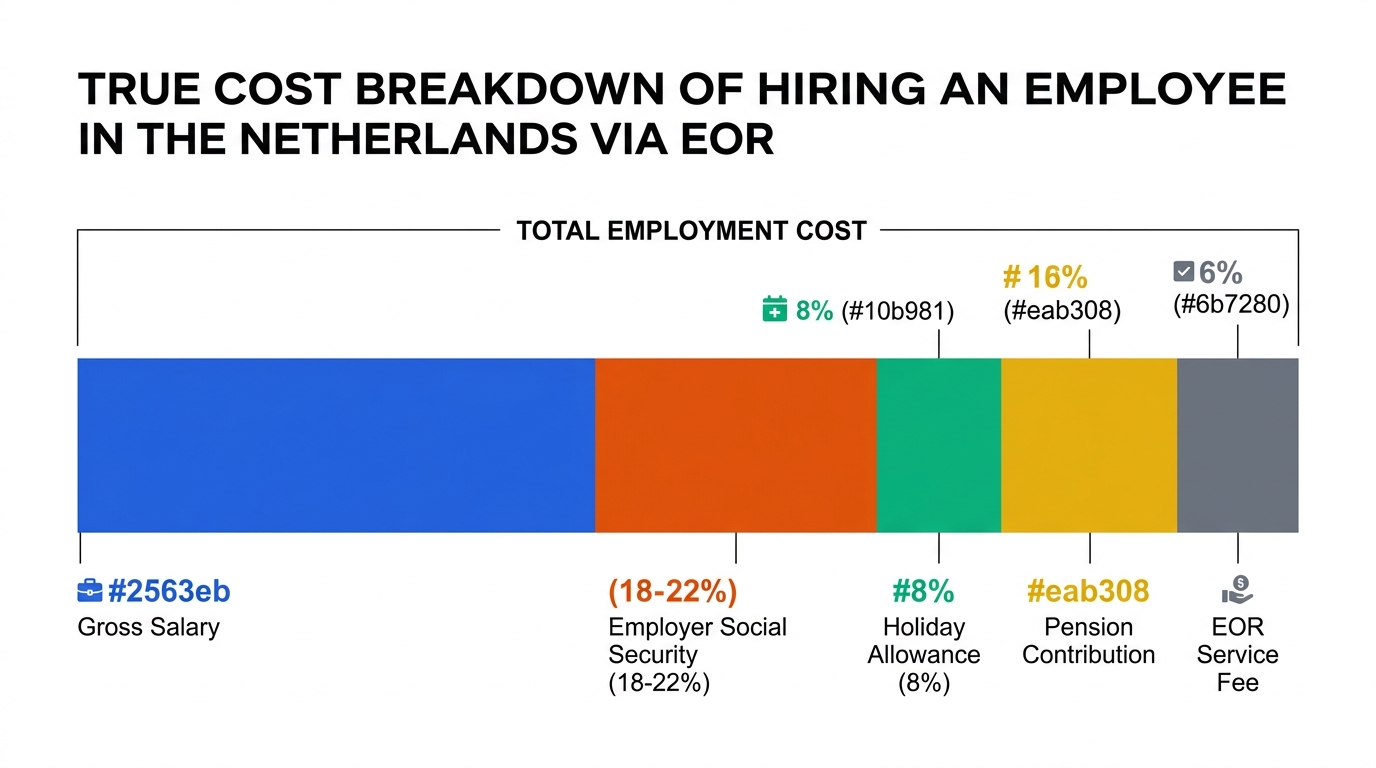
For a Dutch software engineer on a €70,000 gross annual salary, here's the realistic monthly cost stack:
| Cost component | Monthly amount | % of total | Note |
|---|---|---|---|
| Gross salary | €5,833 | 62% | Base monthly pay before tax |
| Holiday allowance (8%) | €467 | 5% | Statutory, paid lump-sum in May |
| Employer social security | €1,217 | 13% | AWf, Aof, Zvw combined (see rates below) |
| Pension contribution | €700 | 7% | Industry CAO-dependent |
| Other employer costs | €350 | 4% | WIA-gap, sick-leave insurance, training fund |
| EOR service fee (mid-tier) | €450–550 | 5–6% | Average across reviewed providers |
| Total monthly cost | ~€9,150 | 100% | ~31% over gross salary |
The 2026 statutory rates behind that stack
The employer social security line is made up of three contributions set nationally each year. Here are the 2026 rates, which we checked again in September 2026. AWf and Aof depend on contract type and employer size, so the table shows both ends of each range. Confirm the rates that apply to your hire, and the sector CAO, with your EOR.
| Component | 2026 rate | Note |
|---|---|---|
| Holiday allowance | 8% (statutory minimum) | Accrues monthly, usually paid as a lump sum in May |
| AWf (unemployment fund) | 2.74% (permanent) / 7.74% (flexible) | The lower rate rewards permanent contracts |
| Aof (occupational disability fund) | 6.27% (small employer) / 7.63% (medium–large) | Depends on employer size |
| Zvw (healthcare contribution) | 6.10%, on wages up to €79,409/yr | Employer-paid |
| Sector pension | Varies by CAO | Mandatory in many sectors via an industry pension fund (bedrijfstakpensioenfonds); employer typically pays the larger share |
| EOR service fee | ~$199–$699/employee/mo | Varies by provider and entity model |
The AWf split is worth noting. Putting a hire on a permanent contract instead of a flexible one cuts the unemployment-fund contribution by five percentage points of wages. That is one reason a fixed-term "trial" contract is not automatically the cheaper option in the Netherlands.
Because the statutory percentages are where most of the money goes, a $100/month difference between two EOR providers is usually the wrong thing to optimize. The provider's handling of sick leave, the CAO, and the 30% ruling will affect your total cost far more.
Four hidden cost factors most EOR quotes don't show:
- Deposit requirements. Several EORs (notably Deel and Velocity Global) require a security deposit per employee, held against potential termination liability. It's typically one month of cost, and some providers ask for up to two months of fully loaded cost. On a €5,000+ salary, that's real working capital.
- FX spread. If you pay in USD or GBP and your employee is paid in EUR, the EOR's FX spread is typically 1.5–2.5% per conversion. For a €70k hire, that's €1,200–2,000 per year in invisible cost.
- Off-cycle payments. Holiday allowance (May), 13th-month bonuses (December at some firms), and reimbursements are sometimes charged as separate transaction fees. Ask about this explicitly before signing.
- Sick-leave exposure. Your EOR's fee should include sick-leave insurance (verzuimverzekering) that covers the 104-week sick-pay obligation. Confirm it in writing instead of assuming it's included.
For a deeper look at total cost comparisons across providers, see our analysis of Deel vs Papaya Global for similar pricing dynamics in adjacent EU markets, and our breakdown of flat-fee vs percentage-of-payroll EOR pricing models.
Step-by-step: hiring your first Dutch employee through an EOR
Picking a provider is only one step. This is the full sequence, from "we want to hire in the Netherlands" to "our employee is on compliant payroll." With an experienced EOR, steps 4 through 6 usually happen in parallel within the first one to two weeks for an EU/EEA candidate.
Step 1 — Confirm an EOR is the right model
Using the model comparison above, confirm three things: you want standard Dutch employment (not payrolling or a contractor relationship), you aren't ready to set up your own BV, and the role really is employment rather than employment disguised as freelance work. Ongoing work under your direction that only looks independent on paper is a misclassification risk everywhere in the EU, and the Netherlands is no exception.
Step 2 — Choose and vet your provider
Use the reviews above to build a shortlist. Look for three things: a directly owned Dutch entity rather than a local partner arrangement, clear handling of sick-leave insurance, and explicit support for the 30% ruling application if any of your hires might qualify. List prices in 2026 cluster around $599/month per employee for the owned-entity majors, and partner-model budget options start at about $199–$400. The owned-vs-partner distinction matters most in complex cases: works council exposure, unionized CAO sectors, and senior hires you expect to keep for years. For a first, straightforward hire it matters less.
Step 3 — Build the offer around the real cost
Using the cost stack above, agree on a gross salary and package that account for the 8% holiday allowance and the sector pension. If the hire is a foreign professional, also check whether the role clears the 30% ruling salary threshold: €48,013 in 2026, or €36,497 for under-30s with a qualifying Master's degree. The ruling doesn't change your employer cost, but it can add roughly €15,000–25,000 a year to an eligible hire's take-home pay. Factor that into how competitive your offer looks.
Step 4 — Get the employment contract right
The EOR drafts a Dutch-law contract covering role, hours, salary, and termination terms. Check three things yourself:
- CAO applicability. Confirm which collective agreement the EOR is applying and why. A CAO can set minimum pay scales, extra leave, and notice periods above the statutory minimum.
- Contract type and the chain rule. Decide upfront whether the contract is fixed-term or permanent. If it's fixed-term, know where it falls in the three-contracts/36-month sequence.
- Proeftijd. Confirm the trial period follows the legal scale: none for contracts of six months or less, up to one month for contracts up to two years, and up to two months for permanent or longer fixed-term contracts.
Step 5 — Complete BSN and Belastingdienst registration
The employee needs a BSN (burgerservicenummer, the Dutch citizen service number) or an active application for one. EU nationals typically get it through municipal registration; non-EU hires get it through the immigration process below. Once the BSN is available, the EOR registers the employee with the Belastingdienst for wage tax withholding and employee insurance contributions. It also records the employee's choice on the payroll tax credit (loonheffingskorting). If the 30% ruling applies, file the joint application now. It applies from the start date only if it's filed within four months of employment starting. File later and it applies only from the month after you file.
Hiring a non-EU national? You'll need a highly skilled migrant (kennismigrant) residence permit through the IND. For 2026, the minimum gross monthly salary (excluding holiday allowance) is €4,357 for candidates under 30 and €5,942 for those 30 and older. If the employer is an IND-recognized sponsor, as most large EORs are, processing typically takes two to four weeks; without one, it can take up to 90 days. Ask your shortlisted providers whether their Dutch entity is a recognized sponsor, and start this process immediately, because it's usually the longest step in the whole sequence.
Step 6 — Onboard and run the first payroll
The employee submits bank details and benefit elections. The EOR then runs the first compliant payslip, withholds wage tax, and pays the employer's AWf, Aof, and Zvw contributions. The 8% holiday allowance accrues monthly but is usually paid as a lump sum in May, so expect the first few payslips to look lower than the annual cost you budgeted.
Step 7 — Manage the ongoing relationship
Day to day, manage the person like any other team member; the EOR stays out of your reporting lines. As the relationship continues, keep an eye on two things. The first is sick leave: if the employee goes on long-term sick leave, you're exposed for up to 104 weeks, and missing a reintegration milestone with the occupational-health (Arbo) provider can extend that liability. The second is the works council. A works council vote on something like pension terms can apply to your hire too, so ask your EOR how they handle that in practice (see Scenario 3 above).
What the timeline really looks like
For an EU/EEA national already living in the Netherlands, a realistic EOR timeline looks like this:
| When | What happens |
|---|---|
| Days 1–3 | Provider selected, Dutch contract drafted, CAO and contract type confirmed |
| End of week 1 | Contract signed; BSN and Belastingdienst registration filed |
| Week 2 | Benefit elections and any 30% ruling application completed |
| Next payroll cycle | First compliant Dutch payslip |
| Non-EU hires (in parallel) | Highly skilled migrant permit: 2–4 weeks with a recognized sponsor, up to 90 days without |
By comparison, setting up your own compliant Dutch payroll from scratch takes several weeks to a couple of months. For non-EU candidates, the permit is the critical path, so start it the day you make the offer, not after the contract is signed. The onboarding times in the provider reviews (48 hours at Deel, 3–5 days at Remote, and so on) cover the provider's own setup. They don't include BSN registration or immigration, which depend on the candidate's situation.
Common mistakes to avoid
- Quoting salary before adding the full cost. Promising a number based on gross pay alone, without the 8% holiday allowance, employer contributions, and pension, is the most common budgeting error.
- Missing the 30% ruling's four-month filing window. File late and you lose the retroactive benefit back to the start date, an avoidable and expensive mistake for an eligible hire.
- Testing the limits of the chain rule. Don't assume you can quietly issue a fourth fixed-term contract, or that a five-month gap resets the chain. Conversion to a permanent contract is automatic; there's no discretion involved.
- Adding a trial period to a short contract. A probation clause in a fixed-term contract of six months or less is void, so you can't rely on it to end the contract early.
- Confusing an EOR with payrolling or a staffing agency. The 2026 equal-treatment rules for agency workers apply to a different legal model. Ask your provider directly which model they use.
- Ignoring the CAO. Don't assume statutory minimums apply when a sector collective agreement sets higher pay, leave, or notice periods.
- Starting the work permit too late. For non-EU hires, the IND process is the critical path. Waiting for a signed contract before starting it adds weeks.
Who should choose which
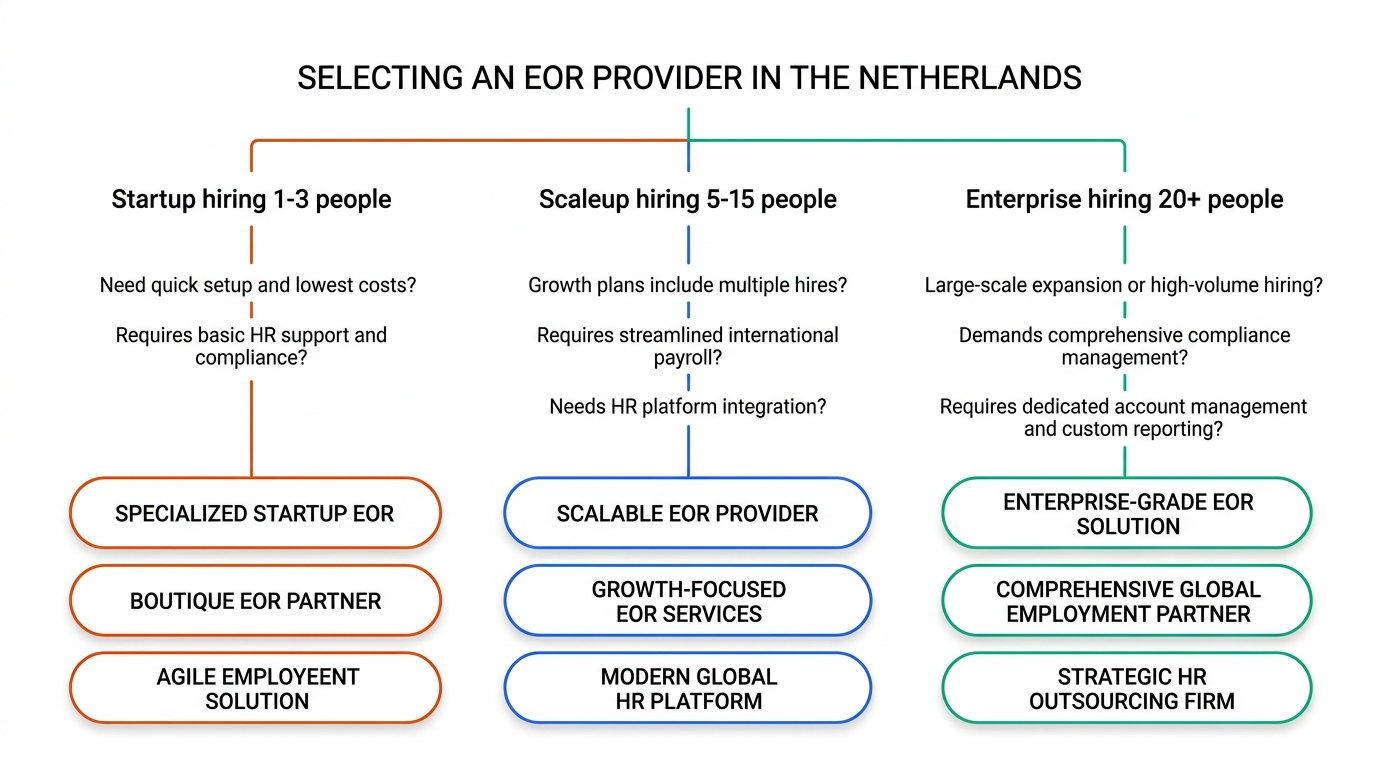
You're a startup hiring your first Dutch employee
Choose Deel. At this stage, the 48-hour onboarding, the English-language self-service flow, and the simplest contractor-to-EOR conversion (in case your hire wants to switch) matter more than Remote's legal-defensibility advantages. The price difference is zero; both quote $599.
Alternative: If you're seriously cost-constrained and the role is junior, Multiplier at $400 flat is the better choice. You'll save real money, and most edge cases won't apply to a first hire.
You're a scaleup with 5–15 Dutch employees
Choose Remote. At this scale, you've probably run into at least one HR edge case, and the owned-entity model starts to pay for itself. The cleaner IP assignment language also matters more once several engineers are shipping code in the Netherlands.
Alternative: Stay on Deel if you're already there and operations are smooth. The switching cost is significant: re-contracting employees, possibly reapplying for the 30% ruling, and the risk of resetting tenure.
You're an enterprise with 20+ Dutch employees or works council exposure
Choose Remote or set up your own entity. At 20+ employees, running your own Dutch B.V. starts to make financial sense: an estimated €40–60k to set up and €30–40k/year to run, versus €100k+/year in EOR fees. If you're still on an EOR, Remote's owned entity and Dutch employment counsel are worth the premium, because compliance questions come up more often at scale. Our EOR vs foreign entity break-even analysis walks through the math country by country.
Alternative: Skuad at $199/mo is a real option for mature HR teams that don't need much support. On 20+ employees, the savings can pay for a part-time Dutch employment advisor on retainer, which gets you the same outcome.
You're hiring for a short-term project or contract-to-hire
Choose RemoFirst or Multiplier. If the engagement is six months or less, you don't need premium service. RemoFirst's $199 + €5 monthly platform fee is the cheapest way to get a compliant Dutch contract in place. Just make sure the role doesn't involve IP you can't afford to fight over later. Remember too that a fixed-term contract of six months or less can't include a trial period.
When an EOR is not the right answer
The EOR model has real limits. Once you have 15–25+ employees in the Netherlands, the combined per-employee fees usually exceed the cost of running your own BV with in-house payroll. Your own BV also gives you direct control over benefits, works council relationships, and terminations. If the person is a genuinely independent professional serving multiple clients on their own terms, you don't need to put them on salary; a compliant contractor relationship may fit better. The EOR sweet spot hasn't changed: a handful of standard employees you want on compliant Dutch payroll quickly, without opening an entity.
Hiring elsewhere in Europe too? The mechanics are similar across the EU, but the numbers and rules differ by country. Our companion guides cover the same decision for hiring in Germany, hiring in France (plus the France step-by-step playbook), and hiring in Spain. If you're thinking about how payroll should work as your team grows, see our comparison of Rippling vs Gusto for startups.
Frequently asked questions
Is it legal to hire in the Netherlands through an EOR?
Yes. Employing staff in the Netherlands through an EOR is a common, legitimate arrangement. The EOR is the compliant legal employer: it handles the Dutch contract, BSN and Belastingdienst registration, wage tax withholding, and social contributions, while you direct the day-to-day work. Keep a clear line between the legal employer (the EOR) and day-to-day direction (you). Note that an EOR is not a staffing agency; the 2026 equal-treatment rules for agency workers apply to a different legal model.
How much does an EOR cost in the Netherlands?
EOR service fees in the Netherlands range from $199/month (RemoFirst, Skuad) to $699/month (Oyster premium), and most credible providers charge $400–600. On top of the EOR fee, budget for employer social security (~18–22% of gross salary: AWf 2.74–7.74%, Aof 6.27–7.63%, and Zvw 6.10% in 2026), the mandatory 8% holiday allowance, and CAO-mandated pension contributions. Total cost of employment is typically 28–35% above the gross salary.
How long does it take to hire someone in the Netherlands with an EOR?
Typically one to two weeks for an EU/EEA national already living in the Netherlands, covering contract drafting, BSN and Belastingdienst registration, and benefit setup. Non-EU candidates first need a highly skilled migrant permit. That takes roughly two to four weeks with an IND-recognized sponsor, or up to 90 days without one. Start the immigration process as soon as you make the offer.
Can an EOR handle the 30% ruling application?
Most credible EORs do, but with varying depth. Deel, Remote, and Oyster process the application end-to-end, including the salary threshold check (€48,013 in 2026, or €36,497 for under-30s with a qualifying Master's). Budget providers like RemoFirst offer limited support. The 30% ruling is worth €15,000–25,000/year per eligible employee, so it's worth choosing a provider that handles it well. File within four months of the start date so the ruling applies from day one. Also note the rate drops to 27% from 2027 for most people.
What happens if my employee gets sick long-term?
Dutch employers must pay at least 70% of salary for up to 104 weeks, and many CAOs top that up to 100% in the first year. Most EORs carry sick-leave insurance (verzuimverzekering) and work with an Arbo reintegration provider, so the cost is covered by the EOR's fee; confirm this before you sign. The employee still matters to you from a project standpoint, though, and the reintegration timeline can affect when (or whether) you can end the contract after recovery.
How does the chain rule (ketenregeling) affect my hiring?
The chain rule limits you to three consecutive fixed-term contracts within 36 months. After that, the contract automatically becomes permanent. A gap of more than six months between contracts resets the count; a shorter gap doesn't. EORs interpret this conservatively, and most will refuse to issue a fourth fixed-term contract under any circumstances. Plan for the conversion, and budget for the transition payment (one-third of monthly salary per year of service) when planning renewals.
Can I include a probation period in a Dutch EOR contract?
It depends on the contract length. A fixed-term contract of six months or less can't include a trial period at all. Contracts of up to two years allow up to one month, and permanent contracts or fixed-term contracts longer than two years allow up to two months. The clause must be in writing and apply equally to both parties.
When does setting up my own Dutch entity make sense?
Roughly when you have 15–25 EOR employees in the Netherlands. The math depends on your EOR fee tier, salary levels, and the value of operational control. A Dutch B.V. costs €40–60k to set up and €30–40k/year to run; if you're paying €100k+ in EOR fees, you're close to breakeven. For deep cross-border hiring patterns, see our EOR comparison for Germany, which faces similar entity-vs-EOR economics.
Are there Dutch employment risks that EORs can't cover?
A few. Strikes and industrial actions (if your employee's CAO covers them) are passed through to you. Discrimination or harassment claims can name both the EOR and the client company. And if you direct an EOR employee in ways that amount to "co-employment" (e.g., independent disciplinary action without the EOR's involvement), you can face claims as the de facto employer. Good EORs train clients on these boundaries.
How we evaluated
Our analysis is based on June 2026 vendor documentation, public pricing pages, customer reviews on G2 / Trustpilot / Capterra (minimum 50 reviews per provider), conversations with three Dutch employment lawyers (off the record), and feedback from procurement teams at B2B SaaS companies that have used at least two of these providers consecutively.
We did not test any provider's onboarding flow directly. Our claims about onboarding times are based on documented vendor SLAs and consistent customer review reports rather than hands-on testing. Pricing is the rate advertised on each vendor's website in June 2026; actual invoices may include deposits, surcharges, FX spread, and add-on fees that vary by negotiation.
For the September 2026 update, we added the step-by-step hiring process and rechecked the statutory figures against published 2026 sources: the chain rule and probation rules from Dutch labor-law references, 2026 AWf/Aof/Zvw contribution rates, the 2026 30% ruling thresholds and the 2027 change to 27%, and the 2026 IND salary thresholds for highly skilled migrants. These figures are indexed annually, so confirm them against a Netherlands-specific quote and current IND and Belastingdienst guidance before you make an offer.
This article is editorial. We may receive affiliate compensation when readers sign up for the providers we mention, but our rankings and recommendations are made before any commercial relationship is considered. We do not modify recommendations based on partner status.

Technology consultant with 10+ years in the Japanese tech industry. Specializing in SaaS evaluation, workflow automation, and B2B tool integration.