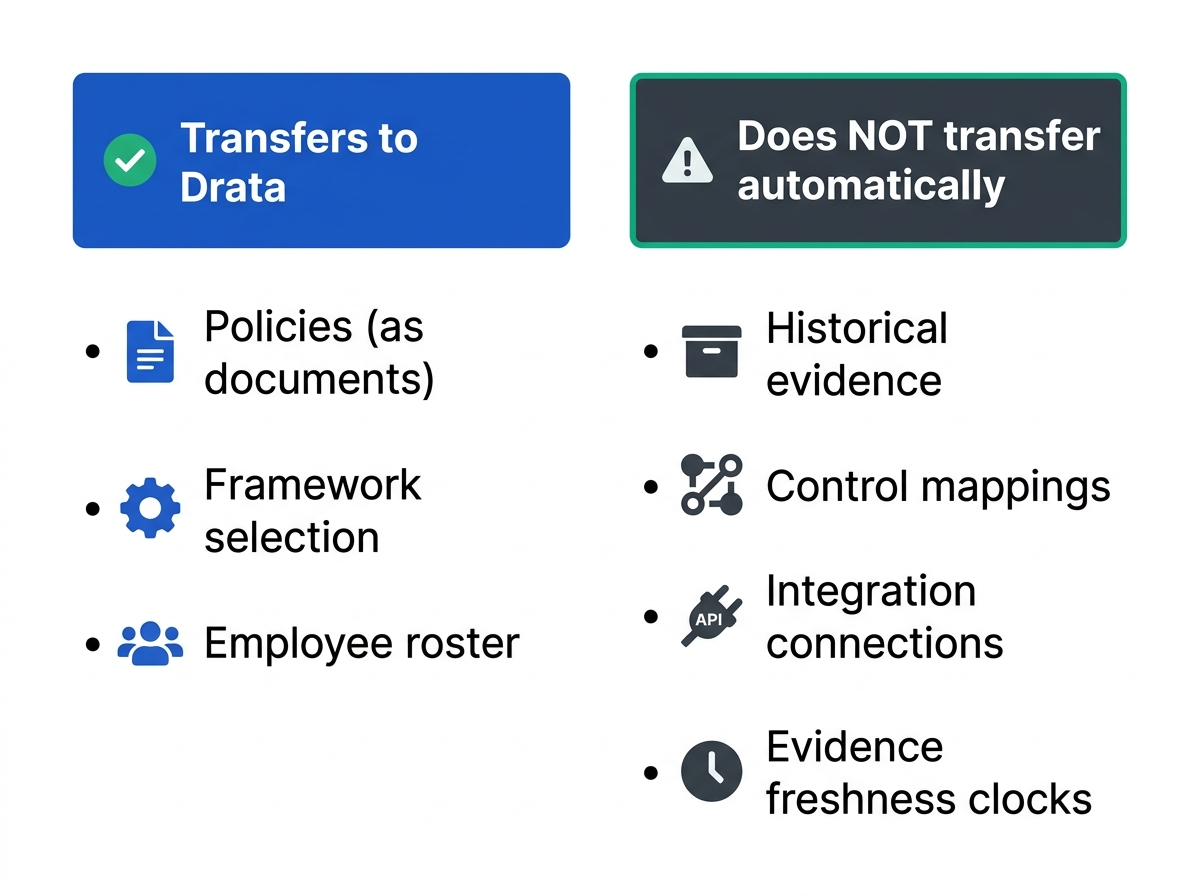
Migrating from Vanta to Drata isn't a data export and a login swap — it's closer to standing up a second compliance program while decommissioning the first. Budget 2 to 6 weeks of calendar time, more if you run multiple frameworks. Policies move over as documents; almost nothing else moves automatically. Control mappings, integration connections, and evidence-freshness timers all reset, and your historical evidence stays wherever you originally collected it.
The single biggest cost driver isn't the software — it's the 4 to 8 weeks most teams end up paying for both platforms at once, plus whatever notice period is written into your Vanta contract. Get the cutover timing wrong relative to your audit cycle, and you'll spend more time explaining a coverage gap to your auditor than you saved by switching.
| Question | Short answer |
|---|---|
| Typical migration timeline | 2–6 weeks, depending on framework count and integration complexity |
| Safest cutover window | Right after your current audit observation period closes, before the next one opens |
| Riskiest cutover window | Mid-cycle, while an auditor is actively testing controls for an active SOC 2 Type II period |
| What actually transfers | Policies (as documents), your framework selections, your employee roster |
| What doesn't transfer automatically | Historical evidence, control-to-framework mappings, integration connections, evidence "freshness" timers |
| Vanta contract notice needed | Typically 30 days before renewal per Vanta's Master Subscription Agreement — confirm your specific Order Form, since negotiated contracts can require more |
| Realistic overlap cost | Budget for 4–8 weeks of running both platforms in parallel before you decommission Vanta |
Why Teams Are Making This Switch in the First Place
Before the how-to, it's worth being honest about why this migration is on your desk at all. Almost nobody switches compliance automation platforms for fun — the trigger is usually a renewal quote, a support experience, or a multi-framework cost that got out of hand. Vanta and Drata are close enough in what they do (continuous control monitoring, automated evidence collection, framework mapping, auditor collaboration) that the decision usually comes down to pricing structure and day-to-day usability rather than a missing feature.
On pricing specifically, Vendr's procurement data (July 2026) puts Vanta's observed annual price range at $7,500–$56,781 (median around $20,000) against Drata's $9,649–$60,000 (median around $24,869) — Vanta actually wins on the low end, median, and high end of that dataset. Where the math flips is per-framework add-on cost: Vanta charges roughly $5,000 per additional framework, while Drata's is closer to $1,500. For a company running SOC 2 plus ISO 27001 plus HIPAA, that gap alone can be worth $10,000+ a year — which is the number that usually starts this conversation.
Why teams migrate to Drata
- Lower cost per additional framework (~$1,500 vs. ~$5,000/year on Vanta)
- Lower entry-tier price point (Foundation tier around $7,500/year)
- Newer agentic evidence-review workflows some teams find faster day to day
- A renewal-price reset — a fresh contract instead of a compounding increase
Why some teams stay on Vanta
- Wins on price at the median and high end of Vendr's dataset for single-framework accounts
- Sunk onboarding cost — integrations, policies, and auditor familiarity already in place
- A broader third-party integration marketplace in some categories
- No migration risk during an active observation period
Both platforms report similar patterns of steep renewal increases after year one — users on both sides describe 40–100% jumps once introductory discounts expire, and quotes that grow further once new frameworks are added. If your only complaint is price and you haven't actually pushed back on your renewal quote yet, it's worth negotiating that before committing to a migration — the switching cost below is real money, not just inconvenience.

Step-by-Step: The Vanta-to-Drata Cutover Playbook
1Decide your cutover timing before you touch anything
The single biggest determinant of how painful this migration feels is when you do it relative to your audit calendar — more than any technical step below. If you're in the middle of an active SOC 2 Type II observation period, don't start the migration now. Auditors test the operating effectiveness of controls over a continuous window, and switching evidence sources mid-period creates exactly the kind of gap an auditor is trained to flag.
The safe window opens the day your current observation period closes and ideally closes a few weeks before the next one begins, giving you buffer for the parallel-run step later. If business reasons force a mid-cycle switch anyway, plan to keep your Vanta evidence exports archived and hand your auditor both data sets for that window — don't try to backfill Drata evidence for a period Drata wasn't installed for.
2Audit and export your existing Vanta environment
Before you touch Drata, take a full inventory of what's actually running in Vanta: which frameworks are enabled, which controls map to which, every connected integration, your employee onboarding/offboarding tracking, open items in your risk register, and any active vendor assessments. Then export what you'll need later. Vanta's evidence tab lets you export the evidence list, a policy packet, and security awareness training records; its Exports section also produces an immutable copy of your latest automated test run — the "Workpaper" option is built specifically to meet auditor standards, so pull that for every framework before you start unwinding anything.
3Handle the Vanta contract exit
Find your actual renewal date and your actual notice requirement — don't assume it matches the boilerplate. Vanta's standard Master Subscription Agreement auto-renews for successive one-year terms unless you give notice of termination at least 30 days before the term ends, but negotiated Order Forms can specify longer windows (60–90 days isn't unusual). Miss that date and you can end up paying for a full extra year you no longer need.
Calendar a reminder at least 45–60 days out as a buffer, send written notice through whatever channel your contract specifies, and get written confirmation back. If you want to negotiate a pro-rated early exit or a shortened overlap instead of running to the contract's natural end, this is the point to raise it — not after you've already signed with Drata.
4Set up Drata and reconnect integrations one at a time
Drata's onboarding sprint — connecting integrations, customizing policies, and remediating the initial round of failing tests — typically runs 2 to 6 weeks; simple, single-framework environments can close in as few as three, while more complex, multi-framework setups usually land in the 4-to-6-week range.
None of your Vanta integration authorizations carry over — every connection has to be re-authorized from scratch in Drata. Prioritize your highest-evidence-volume connections first: cloud infrastructure (AWS, GCP, or Azure), identity (Okta or Google Workspace), and source control (GitHub or GitLab) typically cover the bulk of your automated tests and each usually takes under an hour to connect. HR and payroll integrations (Rippling, Gusto, or Deel) matter too, since employee onboarding/offboarding evidence feeds several controls — if you're also weighing HR platforms for other reasons, our Deel vs. Rippling comparison for engineering teams covers the integration and API angle in more depth. Budget real time for policy customization on top of the connections themselves — figure 4–8 hours per policy if your team hasn't done this before.
5Remap controls and frameworks — this is where most of the real work lives
Vanta and Drata don't use identical control taxonomies. A control that satisfies "encryption at rest" as a single item in Vanta's mapping might be split into two more granular controls in Drata's framework, or combined differently across frameworks. Nothing about this is broken — it's just a different structural approach — but it means someone on your team needs to walk each framework's control list and confirm it maps to an equivalent (not just similarly-named) control in Drata before you trust the automated pass/fail status.
This step is also where the framework-cost math from earlier becomes concrete: if you're running more than one framework, Drata's lower per-framework add-on price is realized here, as you re-enable each one and see the actual line-item cost on your new contract. If you haven't settled which certification to prioritize first, our breakdown of ISO 27001 vs. SOC 2 and which to get first walks through the sequencing math in more detail.
6Migrate policies and rebuild what doesn't transfer
Policies are the one category that genuinely moves across as documents — export them from Vanta and re-upload them into Drata's policy center. What doesn't come with them is the automated mapping from policy to control to framework; that linkage has to be rebuilt manually inside Drata, control by control.
Historical evidence — past automated test runs, past audit workpapers — stays in Vanta. It doesn't migrate, and once your access ends, it's gone unless you exported it in Step 2. Evidence "freshness" clocks also reset the day each integration reconnects in Drata, which means your day-one dashboard will show a wave of tests as stale or pending until the first automated collection cycle finishes. That's expected, not a regression — but it's worth warning your team and leadership in advance so nobody mistakes it for a compliance step backward.
Don't skip the parallel run. The teams that get burned by this migration almost always cut over to Drata and cancel Vanta on the same day. If a gap in evidence collection surfaces a week later, you've got no fallback and no clean record for the period in between.
7Run a parallel evidence-collection period
Keep both platforms live for 2–4 weeks before you decommission anything. This is the step that catches integration gaps, missing controls, or mapping errors while you still have Vanta as a safety net — and it's also the real "hidden cost" of this migration, more than any per-seat price difference between the two vendors. Budget for double billing during this window; treat it as the price of not discovering a coverage gap the hard way, mid-audit, six months from now.
8Brief your auditor and preserve the continuity narrative
Tell your auditor about the switch before the cutover, not after. Auditors evaluate operating effectiveness over a continuous observation window; if part of that window ran on Vanta and part on Drata, they need a clear, documented bridge showing continuous control coverage across the switch — not two disconnected data exports and an assumption that it's fine. Hand them the exported Vanta workpapers from Step 2 alongside Drata's evidence for the overlap period, and flag the exact cutover date in writing.
9Decommission Vanta
Once Drata has run a full evidence-collection cycle and your auditor has confirmed coverage, revoke Vanta's integration credentials across cloud, identity, and source control, pull any final documentation or workpapers you haven't already archived, and let your contract lapse or cancel per the notice timing you locked in during Step 3. Archive everything you exported per your framework's document retention requirements — most call for 3–7 years of audit evidence retention regardless of which vendor originally collected it.
Realistic Timeline: What 2–6 Weeks Actually Looks Like
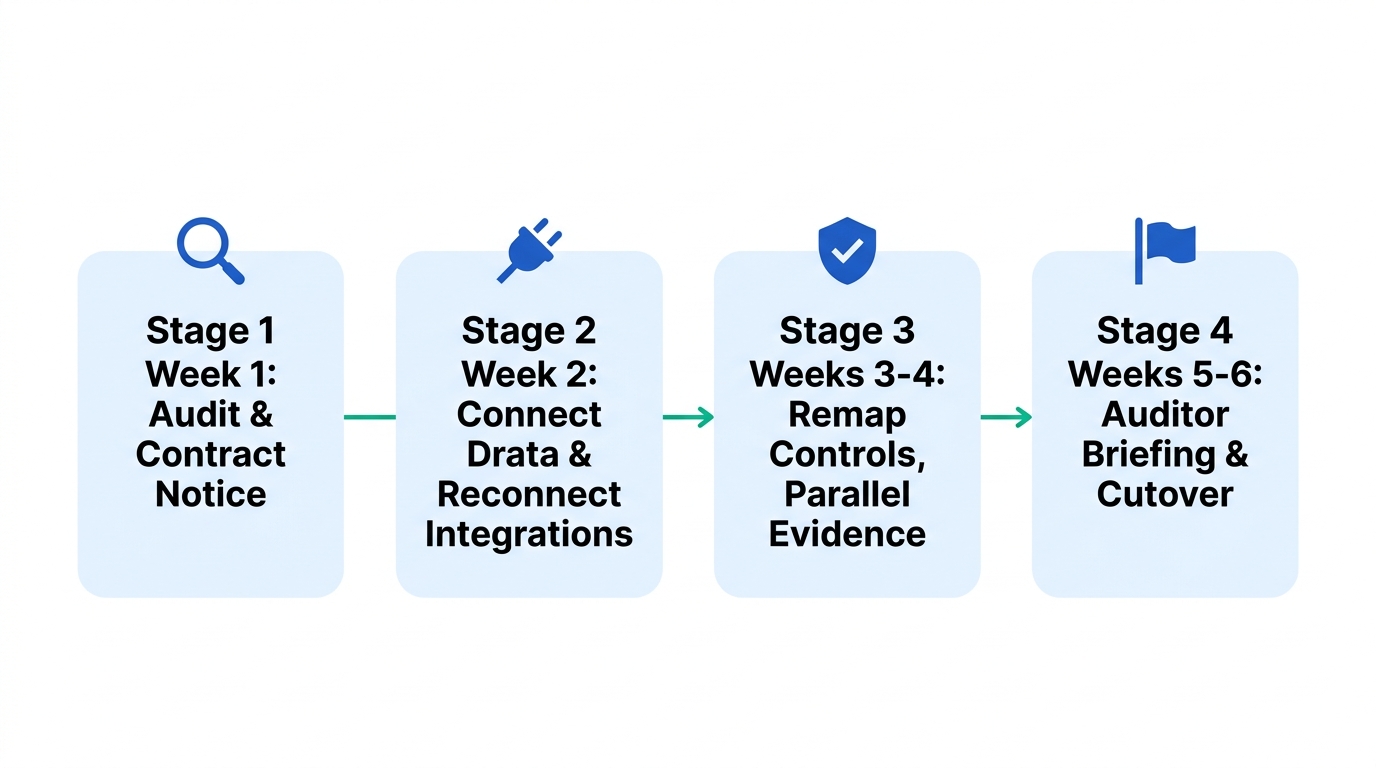
The "2 to 6 weeks" range hides a lot of variation depending on how many frameworks you run and how customized your integration stack is. Here's what a mid-complexity, single-framework migration typically looks like week by week:
| Timeframe | What's happening |
|---|---|
| Week 1 | Full Vanta environment audit and evidence export; contract notice sent to Vanta |
| Week 2 | Drata workspace set up; core integrations (infra, identity, source control) reconnected and re-authorized |
| Weeks 3–4 | Controls remapped per framework; policies re-uploaded; parallel evidence collection running on both platforms |
| Weeks 5–6 | Auditor briefed on the cutover and continuity plan; final coverage check; Vanta decommissioned |
Add 1–3 weeks per additional framework beyond your first, since each one needs its own control remap and its own verification pass — this is the main reason multi-framework migrations regularly stretch toward the 6-week end of the range rather than the 2-week end.
Common Mistakes to Avoid
- Switching mid-observation-period. The single most avoidable mistake — align your cutover to the boundary between audit cycles, not the middle of one.
- Assuming historical evidence copies over. It doesn't. Export everything you might need from Vanta before your access ends.
- Missing the Vanta notice deadline. Auto-renewal clauses don't send a reminder — you're on the hook for tracking your own cancellation window.
- Underestimating control-remapping time. This is manual work, not a button, and it scales with framework count, not headcount.
- Not warning stakeholders about the day-one "stale evidence" dashboard. A wall of pending tests on day one looks like a regression if nobody's been told to expect it.
- Looping in the auditor after the cutover instead of before. Auditors want to plan around a platform switch, not discover it in the evidence trail.
What This Migration Actually Costs
The software subscriptions themselves are only part of the bill. The real cost driver is the overlap period — and it's worth pricing that out before you commit to a start date.
| Vanta | Drata | |
|---|---|---|
| Observed annual price range (Vendr, July 2026) | $7,500–$56,781 (median ~$20,000) | $9,649–$60,000 (median ~$24,869) |
| Entry-level tier | ~$10,000/year (Essentials) | ~$7,500/year (Foundation) |
| Cost per additional framework | ~$5,000/year | ~$1,500/year |
| Reported renewal-increase pattern | 40–100% after first-year discounts expire | Similar complaints reported; framework add-ons can jump sharply at renewal |
Layer the migration mechanics on top of those numbers: a 4-week parallel-run period on a ~$20,000/year Vanta plan works out to roughly $1,500 of "overlap tax" on top of whatever you're paying Drata for the same period — before counting the internal engineering and compliance-team hours spent on control remapping and integration reconnects. None of that is a reason to avoid migrating if the per-framework math favors Drata for your situation; it's just the number that should go into the decision, not just the sticker price on either vendor's homepage.
Who Should Not Migrate Right Now
If you're inside an active observation period, wait — see Step 1. If price is your only complaint and you haven't pushed back on your Vanta renewal quote yet, try that first; a negotiated renewal is almost always cheaper than a full migration's overlap costs and internal hours. And if you're not actually committed to a one-to-one swap — you're genuinely shopping the whole category — it's worth widening the comparison before you commit to either vendor specifically. Our roundup of SOC 2 automation tools compared on price and integrations and our list of Secureframe alternatives both cover platforms outside the Vanta/Drata pair that may fit a smaller team or a narrower framework scope better.
Frequently Asked Questions
Which is better, Vanta or Drata?
Does Drata support the same frameworks I already have set up in Vanta?
How long does a Vanta-to-Drata migration actually take?
Can I run Vanta and Drata at the same time during the switch?
Will switching platforms disrupt an active SOC 2 audit?
Methodology
This guide was compiled from each vendor's own help-center documentation and legal terms (for contract and export mechanics), third-party procurement pricing data from Vendr covering July 2026 quotes, and independent 2026 comparison and migration write-ups cross-checked against those primary sources. Where pricing or contract terms are quoted, we've noted the source and date rather than presenting them as fixed — both vendors quote custom pricing per account, so treat the ranges here as a planning benchmark, not a substitute for your own quote.
References and further reading
- Vanta Help Center — Automated Test Evidence (exports and workpapers)
- Vanta Master Subscription Agreement (renewal and notice terms)
- Drata Help Center — Welcome to Drata (onboarding process)
- Vendr — Vanta Software Pricing & Plans 2026
- SOC2Auditors.org — Vanta vs Drata (2026): Pricing, Features & Honest Verdict

Technology consultant with 10+ years in the Japanese tech industry. Specializing in SaaS evaluation, workflow automation, and B2B tool integration.