HIPAA compliance software splits into two genuinely different categories, and most comparison lists blur them together. Healthcare-native tools — Medcurity, Compliancy Group, Clearwater — are built around the Security Risk Analysis (SRA) that OCR actually asks for during an investigation, with flat, published pricing starting under $500/year for small practices. Multi-framework GRC platforms — Vanta, Drata, Secureframe, Sprinto — treat HIPAA as one framework among many, layering continuous-controls monitoring on top, but at SOC-2-scale pricing ($7,500–$56,000+/year) that most single-framework healthcare orgs don't need.
If HIPAA is the only framework you'll ever need, a healthcare-native platform gets you an audit-ready SRA for a fraction of the cost. If you're a health-tech vendor that also has to pass SOC 2 or ISO 27001 for enterprise customers, a GRC platform's HIPAA module is worth the premium because it maps the same evidence across frameworks instead of duplicating the work.
| Platform | Built for | Reported starting price | Other frameworks | Best for |
|---|---|---|---|---|
| Medcurity | HIPAA only | $499/yr (SRA, 1–20 staff) | None (HIPAA-only, healthcare-native) | Small practices wanting transparent, flat pricing |
| Compliancy Group | HIPAA only | Custom quote (sales call) | None (HIPAA-only, healthcare-native) | Practices that want a guided coach, not a self-serve dashboard |
| Clearwater | HIPAA + HITRUST, enterprise | Custom quote (consulting-led) | HITRUST, NIST CSF | Hospitals and health systems with dedicated compliance staff |
| Vanta | Multi-framework GRC | ~$10,000/yr (Core) | SOC 2, ISO 27001, HITRUST, GDPR + ~20 more | Health-tech vendors that also need SOC 2 for enterprise deals |
| Drata | Multi-framework GRC | $7,500/yr (Essential, 1 framework) | SOC 2, ISO 27001, PCI DSS, GDPR + more | Teams running 3+ frameworks where per-framework add-ons matter |
| Secureframe | Multi-framework GRC | $7,500–$20,000/yr (Fundamentals) | SOC 2, ISO 27001, GDPR + more | SMB SaaS teams that want security training bundled in |
| Sprinto | Multi-framework GRC | ~$6,000–$8,000/yr (Starter) | SOC 2, ISO 27001, PCI DSS + more | Early-stage startups wanting guided, checklist-driven setup |
None of these vendors publish a single fixed rate card — the figures above are reported ranges from 2026 buyer guides and procurement data (sourced below), not official quotes. Treat them as a planning benchmark for your first sales call, not a price you're guaranteed.
"HIPAA Compliant Software" and "HIPAA Compliance Software" Are Two Different Purchases
A lot of confusion in this category starts with the search term itself. HIPAA compliant software usually means an operational tool — an EHR, a scheduling app, a form builder, an AI note-taker — that a covered entity or business associate signs a Business Associate Agreement (BAA) with in order to handle protected health information (PHI) directly. HIPAA compliance software, the category this article covers, is different: it's the platform your compliance team uses to run and document the Security Risk Analysis, track your own BAAs with vendors, manage policies, and produce the evidence trail an Office for Civil Rights (OCR) investigator or auditor would ask for.
The two categories overlap at the edges — some GRC platforms now bundle AI governance modules that touch on whether a downstream AI vendor is HIPAA-eligible — but buying the wrong one is a common, expensive mistake. If you're evaluating whether ChatGPT Enterprise or another AI tool is safe to use with PHI, that's a BAA and vendor-risk question, not a compliance-software purchase; see the FAQ below for where that line actually sits.
The Real Fork in the Road: Healthcare-Native Point Solution or Multi-Framework GRC Platform
Every "best HIPAA software" list we researched — Vanta's, the HIPAA Journal's, Medcurity's, Sprinto's — mixes two structurally different products into one ranking. Splitting them first makes the rest of the comparison make sense.
Healthcare-native (HIPAA only)
- Built specifically around the OCR audit protocol and the Security Rule's required/addressable specifications
- Flat, often published pricing — no per-employee or per-framework math
- Vendors: Medcurity, Compliancy Group, Clearwater (enterprise)
- Right fit if HIPAA is the only framework you will ever need
Multi-framework GRC
- HIPAA is one of 15–25+ frameworks the platform can map evidence to simultaneously
- Continuous-controls monitoring pulls evidence from cloud, identity, and HR tools automatically
- Vendors: Vanta, Drata, Secureframe, Sprinto
- Right fit if you also need SOC 2, ISO 27001, or HITRUST for enterprise sales
The giveaway that you're looking at the wrong category: if a vendor's homepage leads with "SOC 2, ISO 27001, HIPAA, PCI DSS, GDPR" in one sentence, you're looking at a GRC platform, not a HIPAA-native tool. That's not a knock on GRC platforms — for a health-tech SaaS company selling into hospital systems that require both a signed BAA and a SOC 2 report, they're the more efficient purchase. It's the wrong purchase, though, for a five-provider clinic that has no SOC 2 obligation and will never need one.
What a Security Risk Analysis Tool Actually Needs to Do
The Security Risk Analysis (SRA) required under 45 CFR §164.308(a)(1) is the single most-cited failure point in OCR enforcement actions — the agency has flagged an incomplete or missing SRA in the majority of its recent settlements. It's also the feature most loosely defined across this category, so it's worth being specific about what a real one covers, per the HIPAA Journal's vendor-evaluation guidance and OCR's own audit protocol: a full inventory of where PHI lives and flows (not just EHR systems — email, backup drives, and third-party SaaS all count), documented threats and vulnerabilities against each system, a likelihood-and-impact rating for each risk, and a remediation plan with owners and deadlines, not just a list of problems.
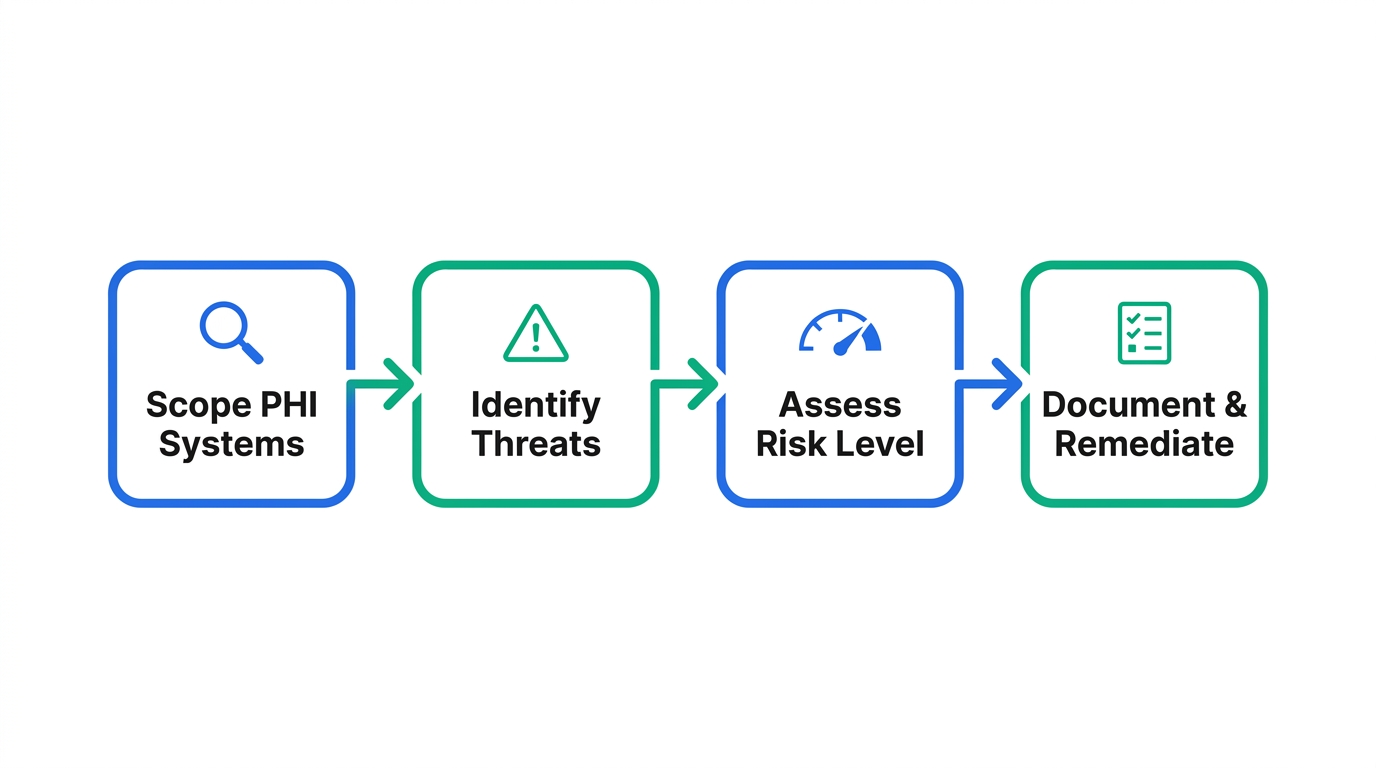
This is where the two categories genuinely diverge in depth, not just price. Medcurity's SRA tooling is purpose-built around this exact four-step flow and produces a document formatted the way OCR's audit protocol expects, with a template also covering SAFER Guides self-assessment for EHR-specific risk. Compliancy Group takes a more guided, coaching-led approach — a dedicated advisor walks your team through the same analysis rather than leaving you to self-serve a dashboard. GRC platforms like Vanta and Drata generate risk-register items automatically from failed automated tests, which is faster for infrastructure-level risks (an S3 bucket without encryption, an IAM policy that's too permissive) but weaker on the administrative and physical safeguards a manual SRA is supposed to catch — things like whether your front-desk workstation auto-locks or whether a terminated employee's badge access was actually revoked on day one.
BAA Tracking and Vendor Risk Management
Every covered entity now runs PHI through a growing list of cloud vendors — an EHR, a scheduling tool, a billing clearinghouse, increasingly an AI transcription or support tool — and each one needs a signed Business Associate Agreement before it touches PHI. As that vendor list grows, tracking which BAAs are signed, which are due for annual review, and which include an adequate breach-notification clause becomes its own compliance workload.
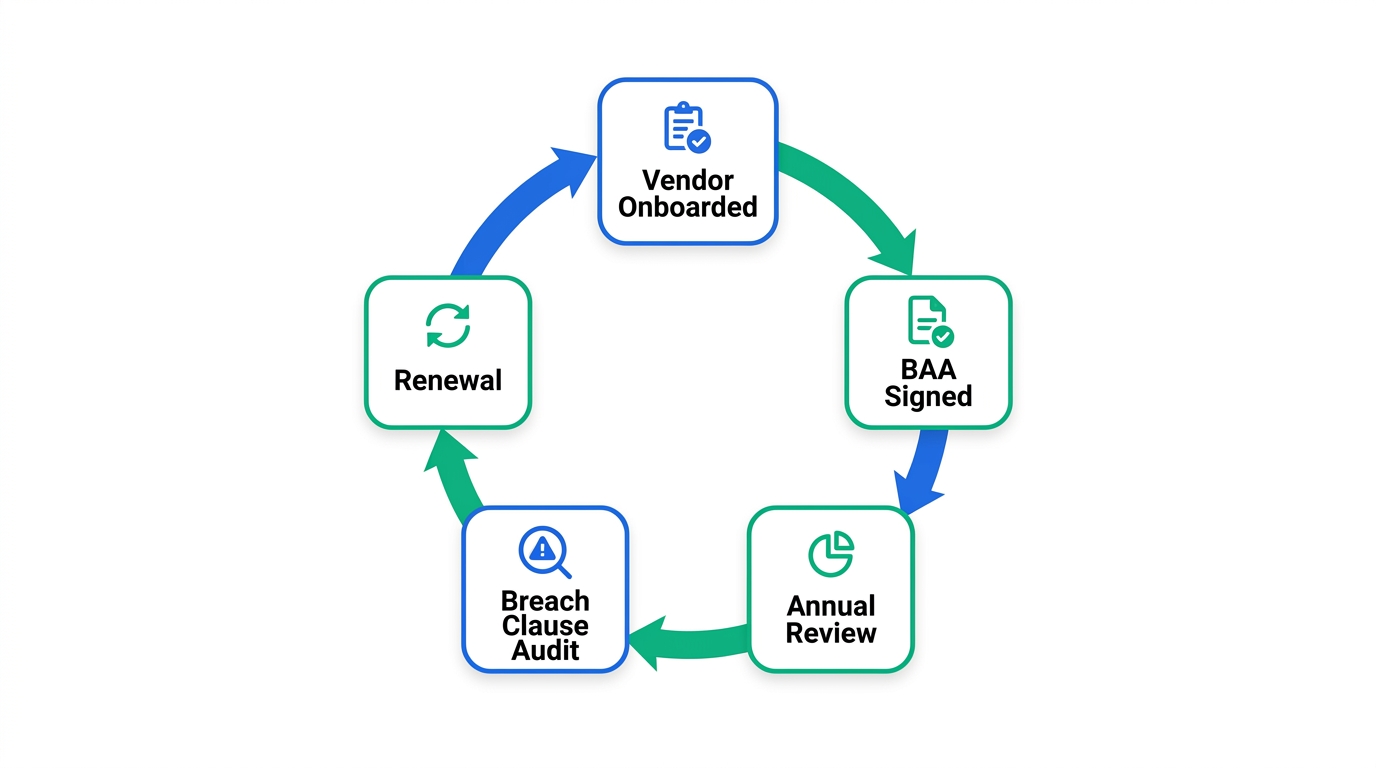
Medcurity bundles BAA management as a standalone $300/year line item, separate from the SRA itself, with reminders when a review is due. Compliancy Group centralizes BAA storage inside its "Guard" platform alongside training and incident logs. On the GRC side, Vanta and Drata both fold vendor risk into a broader third-party risk module that also screens vendors' own SOC 2 reports and security questionnaires — more thorough for enterprise vendor due diligence, but built around SOC 2 vendor risk conventions rather than the specific BAA-clause checklist a healthcare compliance officer needs (minimum necessary use, breach notification timing, subcontractor flow-down). If BAA tracking is your primary pain point rather than a nice-to-have, a healthcare-native tool's purpose-built checklist is likely to save more real time than a generic vendor-risk module.
Pricing Models: Flat-Rate HIPAA-Only vs. Per-Framework GRC
The pricing gap between the two categories is large enough to be the deciding factor on its own for a lot of buyers. Medcurity's published tiers run from $499/year for a small practice SRA (1–20 employees) up to $2,700/year for a 21–500+ employee organization with policies bundled in — a price a solo practice or small group can approve without a procurement process. Compliancy Group and Clearwater don't publish pricing and require a sales conversation, which buyer guides consistently flag as the biggest friction point for smaller practices comparing across vendors.
GRC platforms price on a different axis entirely: company headcount plus number of frameworks, not just "do you need HIPAA." Vanta's Core plan reportedly starts near $10,000/year and scales past $80,000/year for larger, multi-framework accounts, with audit fees ($10,000–$50,000) billed separately by whatever CPA firm actually issues your report. Drata's published AWS Marketplace listing puts its HIPAA framework fee at $7,500/year on top of a platform fee, with each additional framework (SOC 2, ISO 27001, GDPR) adding roughly $5,000–$7,500/year more. Sprinto and Secureframe sit closer to $6,000–$20,000/year at entry, with bundling multiple frameworks into one quote reportedly unlocking a 10–20% discount over buying them separately.
The practical takeaway: a healthcare-native tool is very likely cheaper if HIPAA is genuinely your only framework. A GRC platform starts making financial sense the moment you need two or more frameworks mapped from shared evidence — at that point, paying once for infrastructure that serves both is usually less than licensing two single-framework tools separately.
The Proposed 2026 HIPAA Security Rule Update — What to Build Toward Now
HHS's proposed overhaul of the HIPAA Security Rule — the first major rewrite in over two decades — has been pushed to HHS's Long-Term Actions agenda, with final action now expected around July 2027 rather than the originally targeted May 2026, after more than 100 hospital systems and provider associations, including Cleveland Clinic and the American Medical Association, formally asked HHS to withdraw or narrow it. That delay matters for buyers: none of this is in effect yet, and it may still change materially before it is.
What's worth planning for regardless of the exact final date: the proposal would eliminate the "addressable" designation entirely, making encryption of ePHI at rest and in transit, multi-factor authentication on all systems touching PHI, and a 72-hour internal incident-reporting window mandatory rather than optional based on a documented risk judgment. It would also add annual penetration testing and tighter oversight of business associates specifically. If you're choosing a platform now, ask each vendor directly whether their control library already treats these as tracked, evidenced items rather than optional recommendations — the platforms that already default to "required" here will need less rework whenever the rule does finalize, on whatever timeline that ends up being.
The 7 Platforms Reviewed
01 Medcurity
$499/yr (Small Practice SRA, 1–20 staff) · $2,700/yr (21–500+ staff, SRA + policies) · $300/yr add-on for BAA management · healthcare-only, no other frameworks
Medcurity is the closest thing this category has to a straightforward, no-sales-call purchase. Its core product is the Security Risk Analysis itself, structured around the four-step flow OCR's protocol expects, with add-on modules for BAA tracking, HIPAA training, and a SAFER Guides EHR self-assessment priced and sold separately rather than bundled into one opaque enterprise quote. That à la carte structure is also its main limitation — a growing organization that needs several modules at once can end up paying close to what a mid-tier GRC platform costs anyway, just split across line items.
Pros
- Published, flat pricing — no scoping call required to get a number
- SRA format built specifically around OCR's audit protocol
- Add-on modules (BAA, training, SAFER Guides) can be bought individually
Cons
- HIPAA only — no path to SOC 2 or ISO 27001 if you ever need one
- À la carte modules can add up for larger, multi-department organizations
- Smaller integration catalog than the GRC platforms
02 Compliancy Group
Custom quote (sales-assisted) · coaching-led onboarding · healthcare-only, no other frameworks
Compliancy Group's "Guard" platform centralizes policies, risk assessments, incident reporting, and training, but the differentiator buyers consistently cite is the assigned compliance coach who reviews your specific setup rather than a generic checklist. That's valuable for a practice with no in-house compliance expertise, and a real cost driver for a practice that already has someone capable of self-serving a tool like Medcurity. Because pricing isn't published, comparing it head-to-head against a transparent competitor takes an extra sales call most buyers would rather skip.
Pros
- Guided, human coaching model — strong fit for teams with no compliance staff
- Centralizes policies, training, and incident logs in one place
- Well-established in dental and small-practice healthcare segments
Cons
- No published pricing — every comparison starts with a sales call
- Coaching model costs more than self-serve tools for teams that don't need the hand-holding
- HIPAA only, same ceiling as Medcurity if you later need SOC 2
03 Clearwater
Custom, consulting-led engagement · works with 500+ healthcare organizations · covers HIPAA, HITRUST, NIST CSF
Clearwater sits at the enterprise end of the healthcare-native category — less a self-serve SaaS product and more a cyber-risk management practice with software behind it, built for organizations complex enough to need HITRUST certification alongside HIPAA. That depth is the point for a multi-facility health system, and overkill for a small practice or a single-product health-tech startup, both of which would be better served by Medcurity or a GRC platform.
Pros
- Deep healthcare-specific expertise across HIPAA, HITRUST, and NIST CSF
- Consulting-led model suits complex, multi-facility organizations
- Strong track record with large health systems and payers
Cons
- No published pricing, and likely the highest-cost option here
- More consulting engagement than lightweight software — slower to start
- Overkill for a single clinic or small practice
04 Vanta
~$10,000/yr (Core), scaling past $80,000/yr for multi-framework, larger accounts · audit fees separate ($10,000–$50,000) · HIPAA is one of ~20+ supported frameworks
Vanta treats HIPAA as one framework in a much larger continuous-monitoring platform, which is exactly right for a SaaS company selling into healthcare that also needs a SOC 2 report to close enterprise deals — one integration setup produces evidence mapped to both. It's the wrong tool, and a substantial overpay, for an organization that will only ever need HIPAA. We cover the platform in more depth, including the framework-add-on math against its closest competitor, in our Vanta-to-Drata migration guide.
Pros
- Widest integration catalog (400+) of any platform in this comparison
- One evidence set maps across HIPAA, SOC 2, ISO 27001, and more simultaneously
- Largest install base — least likely to need auditor hand-holding
Cons
- Priced for multi-framework programs, not single-framework HIPAA buyers
- Weaker on administrative/physical safeguard review than a manual SRA
- Audit fees are billed separately on top of the platform cost
05 Drata
$7,500/yr (Essential, 1 framework) · Foundation ~$15,000/yr (up to 50 FTE) · additional frameworks ~$5,000–$7,500/yr each
Drata's published AWS Marketplace pricing makes its per-framework economics unusually transparent for this category, and its evidence-mapping engine is generally reported as the most automated in day-to-day use. As with Vanta, HIPAA here is a module within a broader GRC platform rather than a purpose-built healthcare tool — strong for a multi-framework SaaS vendor, unnecessary cost for an organization that will only ever need the one framework.
Pros
- Transparent, published per-framework pricing (rare in this category)
- Lower incremental cost per additional framework than Vanta
- Frequently cited as the most automated day-to-day evidence collection
Cons
- Base platform fee still runs well above any healthcare-native option
- Best economics only materialize once you're running multiple frameworks
- Same generic-vendor-risk limitation as Vanta for BAA-specific tracking
06 Secureframe
$7,500–$20,000/yr (Fundamentals) · 300+ integrations · SOC 2, ISO 27001, HIPAA, GDPR + more
Secureframe's HIPAA support rides on the same continuous-monitoring engine as its SOC 2 product, with the addition of built-in security-awareness training that some competitors charge for separately. It lacks an out-of-the-box HITRUST framework, which matters if a hospital-system customer specifically requires HITRUST certification rather than HIPAA compliance alone — worth confirming before you buy if that's a live requirement.
Pros
- Security training bundled in rather than a separate purchase
- Broad integration catalog (300+) with daily testing cycles
- Competitive entry pricing relative to Vanta and Drata
Cons
- No out-of-the-box HITRUST framework — manual work to add it
- Still priced and structured for multi-framework buyers, not HIPAA-only
- Same generic vendor-risk approach as other GRC platforms for BAA tracking
07 Sprinto
~$6,000–$8,000/yr (Starter) · $11,000–$15,000/yr (multi-framework) · discounts reported for bundling HIPAA with SOC 2/ISO 27001 in one quote
Sprinto leans hardest into guided implementation of any platform here, walking a small team through setup step by step rather than assuming in-house GRC expertise — a reasonable trade for a startup's first compliance hire. That same guided structure can feel limiting once an organization has enough scale and internal process maturity to want more direct control over its control library, which is where buyer guides suggest teams eventually outgrow it toward Drata or Vanta.
Pros
- Lowest entry price among the multi-framework GRC platforms compared here
- Guided, checklist-driven onboarding suits a first-time compliance buyer
- Reported discount for bundling HIPAA into a multi-framework quote
Cons
- No published pricing beyond third-party-reported ranges
- Guided workflows can feel restrictive for larger, more mature teams
- Still a multi-framework GRC price point if HIPAA is genuinely your only need
Who Should Choose Which
A solo practice or small clinic with no SOC 2 or ISO 27001 obligation on the horizon should start with Medcurity — the published pricing alone makes it the easiest to get approved without a procurement cycle, and the SRA format is built for exactly the audit protocol OCR uses. A practice that wants a person walking them through the process rather than a self-serve tool should look at Compliancy Group instead, accepting the sales-call step to get there. A hospital system or multi-facility health organization that needs HITRUST-level rigor and has compliance staff to partner with a consulting team is better served by Clearwater than by stretching a small-practice tool past its design point.
A health-tech SaaS company that needs HIPAA and SOC 2 or ISO 27001 for enterprise sales should skip the healthcare-native tools entirely and go straight to a GRC platform — Vanta if you want the widest integration catalog and the platform most auditors already know, Drata if you're confident you'll add three or more frameworks and want to capture its lower per-framework pricing, Secureframe if bundled security-awareness training tips the decision, and Sprinto if you're a lean, early-stage team that wants the lowest entry price and guided setup in that category. If you're still deciding between the two market leaders specifically, our Vanta-to-Drata migration guide covers the pricing and control-mapping trade-offs in more depth, and our broader SOC 2 automation tools comparison covers platforms outside the pair that may fit a narrower budget.
One case none of the seven platforms above solves well on its own: an organization that needs to decide whether to get ISO 27001 or SOC 2 first alongside HIPAA. That sequencing question is worth settling before you shop compliance software, since it changes which category — healthcare-native or GRC — actually fits.
Frequently Asked Questions
What are the new HIPAA changes for 2026?
What is the best HIPAA compliant AI tool?
Is ChatGPT HIPAA compliant?
What is the best compliance software overall?
Do I need both a compliance platform and a BAA with my other software vendors?
Methodology
This comparison was compiled from each vendor's own pricing pages and help-center documentation where published, third-party 2026 buyer guides and procurement data (Vendr, Capterra) for platforms that don't publish pricing, OCR's audit protocol and the HIPAA Journal's vendor-evaluation criteria for what a Security Risk Analysis needs to cover, and primary reporting on the proposed 2026 HIPAA Security Rule update and its delay to 2027. Because most vendors in this category quote custom pricing per account, every dollar figure above should be treated as a reported range for planning purposes, not a guaranteed quote — confirm current pricing directly with each vendor before budgeting.
References and further reading
- HIPAA Journal — HIPAA Compliance Software, Updated for 2026 (evaluation criteria)
- Medcurity — HIPAA Compliance Software Pricing Guide (2026)
- Vendr — Vanta Software Pricing & Plans 2026
- HIPAAComplianceCost.com — Drata HIPAA Cost 2026 (AWS Marketplace pricing)
- Compliancy Group — The Proposed HIPAA Security Rule Update: What It Would Change
- Clark Hill — HIPAA Security Rule Update Delayed Until 2027
- HIPAA Journal — Is ChatGPT HIPAA Compliant? Updated for 2026

Technology consultant with 10+ years in the Japanese tech industry. Specializing in SaaS evaluation, workflow automation, and B2B tool integration.