Standard ChatGPT — Free, Plus, and Team — is never HIPAA compliant. OpenAI will not sign a Business Associate Agreement (BAA) for any of those plans, so protected health information (PHI) should never go into them.
ChatGPT Free, Plus, Team, and the consumer-facing "ChatGPT Health" feature — no BAA exists or ever will for these tiers.
ChatGPT for Healthcare, ChatGPT Enterprise provisioned as a Regulated Workspace, the OpenAI API with Modified Retention, and ChatGPT FedRAMP — all BAA-eligible once contracted and configured correctly.
ChatGPT for Clinicians (launched April 2026) — free for identity-verified individual US physicians, nurse practitioners, PAs, and pharmacists, with an optional BAA path.
Even after a BAA is signed, coverage is limited to a fixed allow-list of features, and your organization still owns the risk analysis, workforce training, and PHI-handling controls that HIPAA actually requires. For teams building a product rather than issuing seats, a purpose-built healthcare AI vendor or a hyperscaler route (Azure OpenAI, Claude via AWS Bedrock) often gets you a standing BAA faster than negotiating one directly with OpenAI.
Which ChatGPT Products Are Actually HIPAA-Eligible in 2026
"Is ChatGPT HIPAA compliant" is really two separate questions: which specific OpenAI product are you talking about, and has your organization actually signed the paperwork. OpenAI splits its lineup into eligible and non-eligible products, and the split is stricter than most teams assume — plain ChatGPT Enterprise, on its own, does not qualify.
| Product | HIPAA-eligible? | BAA path | Best for |
|---|---|---|---|
| ChatGPT Free / Plus / Team | Not eligible | None — never available | Nothing involving PHI, ever |
| ChatGPT Health (consumer) | Not eligible | None — explicitly consumer-only | Personal use outside a covered entity |
| ChatGPT Enterprise (default provisioning) | Not eligible | None unless reprovisioned as below | General business use without PHI |
| ChatGPT Enterprise (Regulated Workspace) | Eligible | Contact OpenAI sales, request explicitly | Orgs already standardized on ChatGPT Enterprise |
| ChatGPT for Healthcare (launched Jan. 2026) | Eligible | Sales-managed enterprise agreement | Hospitals, health systems, clinician-facing rollouts |
| ChatGPT for Clinicians (launched Apr. 2026) | Opt-in | Identity verification, then optional BAA | Individually verified US physicians, NPs, PAs, pharmacists |
| OpenAI API (Modified Retention) | Eligible | Email baa@openai.com directly | SaaS companies building a product on GPT models |
| ChatGPT FedRAMP / API FedRAMP | Eligible | Government-track agreement | Federal and gov-adjacent healthcare workloads |
The detail that trips up most B2B buyers: a company that has been on plain ChatGPT Enterprise for a year does not automatically have PHI coverage. OpenAI's own eligibility documentation is explicit that the workspace has to be provisioned as a "Regulated Workspace" specifically, and that a BAA request has to be raised with the sales team by name — it is not a checkbox an admin flips on their own. Skipping that step and assuming a paid Enterprise seat is "the compliant one" is the single most common mistake we found researching this question.
A Signed BAA Doesn't Mean What Most Teams Assume
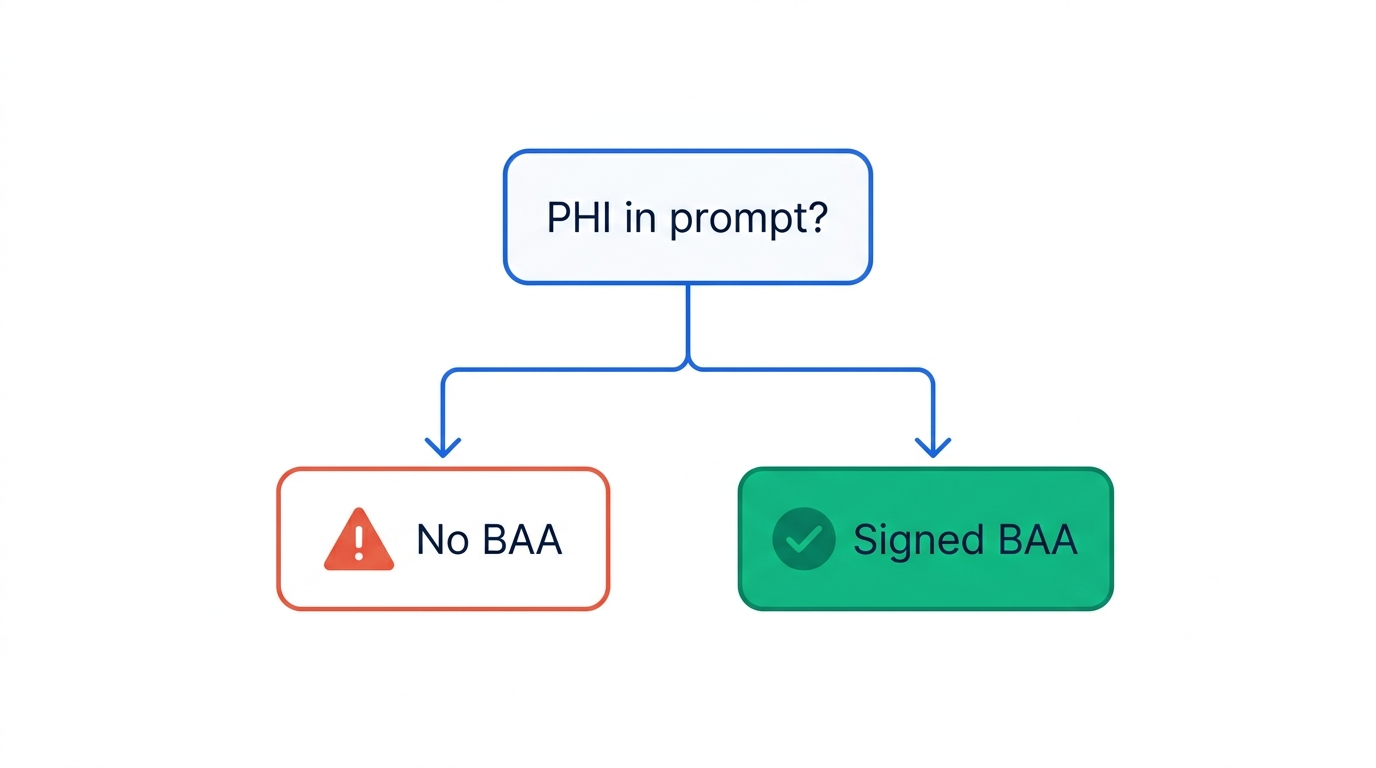
A Business Associate Agreement is a specific legal instrument: it's the contract that lets a "business associate" (OpenAI, in this case) lawfully create, receive, maintain, or transmit protected health information on behalf of a HIPAA-covered entity or another business associate. Without one, putting PHI into a vendor's tool is a HIPAA violation regardless of how secure that vendor's infrastructure actually is — the encryption doesn't matter if there's no contract.
That cuts the other way too. De-identified data that meets the Privacy Rule's Safe Harbor or Expert Determination standard is no longer PHI at all, and can technically be used with any AI tool, BAA or not. Some teams handle this by scrubbing the 18 HIPAA identifiers — names, dates, medical record numbers, and so on — out of a prompt before it ever reaches a general-purpose model. It's a legitimate workaround for narrow use cases, but it depends entirely on the de-identification actually being complete, and free-text clinical notes are notoriously easy to under-scrub.
How to Actually Get a BAA With OpenAI
There isn't one path — there are three, and they lead to different products depending on who you are.
-
Enterprise teams: ask sales for a Regulated Workspace
OpenAI does not publish per-seat pricing or a minimum seat count for ChatGPT Enterprise — both are quote-specific. If you're already evaluating or running Enterprise, you have to explicitly raise the BAA request during the sales conversation and confirm the workspace will be provisioned in its Regulated configuration. A generic Enterprise contract signed without that step does not include PHI coverage.
-
Hospitals and health systems: go straight to ChatGPT for Healthcare
Launched in January 2026, this is OpenAI's purpose-built product for hospitals, clinicians, and regulated healthcare environments, sold through a sales-managed enterprise agreement with BAA eligibility built into the offering rather than bolted on afterward.
-
Individual clinicians: verify identity for ChatGPT for Clinicians
OpenAI launched this free tier on April 23, 2026, for individually verified US physicians, nurse practitioners, physician assistants, and pharmacists. It adds an optional BAA path once identity is confirmed — a meaningfully lighter-weight process than a hospital-wide enterprise deal, but scoped to one clinician at a time rather than an organization.
-
Developers and SaaS teams: email baa@openai.com for the API
If you're building a product on top of GPT models rather than issuing ChatGPT seats, the API path with Modified Retention is the relevant one. Email OpenAI's dedicated BAA address with your company and use-case details; OpenAI states a 1–2 business day response time, and no enterprise agreement is required to start the conversation.
What the BAA Still Doesn't Cover
Signing a BAA is the beginning of compliant use, not the end of it. Two things catch teams off guard here.
Coverage is an allow-list, not a blanket
OpenAI's BAA covers a defined set of features — chat with uploaded files, voice, web search, Deep Research restricted to OpenAI's own index rather than third-party providers, Canvas, image generation, Projects, custom GPTs, and the desktop and mobile clients. Anything outside that list, including most third-party connectors, is switched off by default. An admin can turn additional features on for convenience, but doing so pulls that functionality outside the BAA's protection — it becomes the organization's risk to manage, not OpenAI's contractual obligation. Improved memory is a specific example worth flagging: it's disabled by default under ChatGPT for Healthcare, and OpenAI's own guidance says PHI should not be entered through it even if an admin re-enables it.
Your organization still does most of the work
What OpenAI's BAA covers
- No training on your inputs/outputs for BAA-eligible products
- Data ownership and retention controls on the allow-listed features
- A contractual commitment covering OpenAI's side of the relationship
What's still on you
- Your own HIPAA Security Risk Analysis
- Workforce training on what can and can't be pasted into a prompt
- Minimum-necessary enforcement at the point of use
- An inventory of every AI system touching PHI, plus 6-year log retention
- Runtime controls to catch PHI in outbound prompts before it leaves your network
The real failure mode isn't the contract — it's shadow IT. The most common HIPAA exposure involving ChatGPT isn't a misconfigured enterprise BAA; it's an individual clinician or staff member pasting patient information into their own personal ChatGPT Plus account because it's faster than the sanctioned tool. A signed enterprise BAA does nothing to stop that unless it's paired with policy, training, and — ideally — a technical block on unmanaged personal accounts.
Beyond ChatGPT: How the Alternatives Compare
ChatGPT isn't the only option, and for some B2B teams it isn't the fastest one. Here's how the main alternatives handle the same BAA question, based on each vendor's own documentation and published comparison pages as of September 2026.
| Option | BAA availability | Reported pricing signal | Best for |
|---|---|---|---|
| Anthropic Claude (Enterprise + API) | Direct BAA on Enterprise and developer platform tiers only — Claude.ai consumer and Teams excluded | Custom quote | Teams already standardized on Claude for other workflows |
| Claude via AWS Bedrock | BAA through AWS; data stays inside AWS and is never sent to Anthropic directly | AWS usage-based | AWS-native teams that want Claude without a separate Anthropic contract |
| Microsoft 365 Copilot | Already included in Microsoft's existing Data Protection Agreement — no separate signature | Included in eligible M365 licensing | Orgs already on Microsoft 365 Enterprise; note GitHub Copilot is explicitly excluded |
| Azure OpenAI Service | BAA under Microsoft Enterprise Agreement/CSP; text inputs covered, image/vision inputs not covered as of mid-2026 | Azure consumption-based | Teams building custom apps on GPT models inside an existing Azure/Microsoft contract |
| Hathr AI | BAA included on every plan; built on Claude, hosted on AWS GovCloud | ~$47/user/mo (vendor-reported) | Orgs needing GovCloud-level hosting for federal or defense-adjacent work |
| BastionGPT | BAA included on every plan; multi-model (GPT-5.5, Claude, Gemini 3 Pro) | From ~$20/user/mo (vendor-reported) | Private-sector clinics wanting a scribe plus a general assistant in one seat |
Treat the pricing column as a planning signal, not a quote — none of these vendors, including OpenAI, publish a single fixed rate card for their BAA-eligible tiers, and the figures above come from each vendor's own comparison pages rather than a neutral third party. Confirm current numbers directly with sales before you budget.
Which Path Actually Fits Your Team
You're an individual physician, NP, PA, or pharmacist
Start with ChatGPT for Clinicians. Identity verification is the only real gate, and the optional BAA path is scoped for exactly this situation without a procurement cycle.
You're a health-tech SaaS company building a product on GPT models
Go straight to the OpenAI API with Modified Retention and email baa@openai.com — you don't need an Enterprise seat license to get API-level PHI coverage, and the turnaround is measured in days, not a sales cycle.
You're a hospital or health system rolling out AI to many employees
ChatGPT for Healthcare or a Regulated Workspace on Enterprise are the two purpose-built options; both require a sales-managed agreement, so budget lead time accordingly and confirm Regulated Workspace provisioning explicitly.
You're already committed to Microsoft or AWS
Microsoft 365 Copilot's BAA is already inside your existing Data Protection Agreement, and Azure OpenAI or Claude on Bedrock let you stay inside a contract you've already negotiated — often the fastest route to a compliant setup precisely because there's no new vendor relationship to build.
Your primary need is clinical documentation, not general chat
A purpose-built vendor like Hathr AI or BastionGPT is usually a better fit than retrofitting a general-purpose assistant, since the product is designed around a clinical workflow and BAA-covered data handling from day one rather than added on top of a consumer tool.
Whichever path you pick, the AI vendor's BAA is only one leg of the stool. If your team is also trying to formalize the broader HIPAA program — the Security Risk Analysis, policy documentation, and audit trail an OCR investigator would actually ask for — that's a separate purchase from the AI tool itself; our comparison of HIPAA compliance software covers that category specifically. And if HIPAA is only one of several frameworks you're tracking, our decision framework for choosing a compliance automation platform walks through how to evaluate that purchase separately from any single vendor's BAA.
The Regulatory Backdrop: HIPAA Security Rule Changes Still Pending
Two threads worth watching heading into 2027 change how strict "compliant" will need to be, even though neither is final law yet. First, the HIPAA Security Rule update proposed by the Office for Civil Rights would make multifactor authentication and encryption — both at rest and in transit — mandatory rather than the current "addressable" (effectively optional) standard, alongside a 72-hour incident-reporting window and annual penetration testing. As of September 2026, this remains a proposed rule: after pushback from over 100 hospital systems and provider groups, OMB pushed final action from the original 2026 target to around July 2027. Second, the same update would expand what covered entities are required to demand from every business associate — including AI vendors — which means today's BAAs, ChatGPT's included, are likely to need updating once the rule lands rather than being a one-time signature you never revisit.
Neither change is enforceable yet, so nothing above requires immediate action. But if you're negotiating a multi-year AI vendor contract right now, it's worth asking the vendor how they plan to handle mandatory encryption and MFA requirements before you're locked into a BAA that doesn't anticipate them — a topic we expect to cover in a dedicated head-to-head comparison of ChatGPT for Healthcare and Claude Enterprise for hospital deployments once both products' 2027-readiness postures are clearer.
Frequently Asked Questions
What are the new HIPAA security rules in 2026?
Is WhatsApp HIPAA compliant in 2026?
Which chatbots are HIPAA compliant?
Which apps are HIPAA compliant?
Do I need an Enterprise ChatGPT plan just to get a BAA?
Methodology
This article was compiled from OpenAI's own HIPAA-eligibility and ChatGPT for Healthcare documentation, third-party analyses that quote and interpret that documentation in detail (IntuitionLabs, Witness AI, HIPAA Journal), vendor-published comparison and pricing pages for the alternative platforms named above, and primary reporting on the proposed 2026 HIPAA Security Rule update and its delay to 2027. Because OpenAI and most alternative vendors quote custom, account-specific pricing rather than a public rate card, every dollar figure above should be treated as a directional planning signal — confirm current terms directly with each vendor's sales team before budgeting or signing.
References and further reading
- OpenAI Help Center — HIPAA Eligible Products and Functionality
- HIPAA Journal — Is ChatGPT HIPAA Compliant? Updated for 2026
- IntuitionLabs — ChatGPT Enterprise BAA: Cost, Minimum Seats & How to Get One
- Witness AI — ChatGPT Enterprise and HIPAA: What a BAA Covers
- Strac — Is Microsoft Copilot HIPAA Compliant? 2026 Guide
- Hathr AI — Is Claude HIPAA Compliant? BAA Rules Explained
- CBIZ — 5 HIPAA Security Rule Changes in 2026 and How to Prepare
- HIPAA Journal — Is WhatsApp HIPAA Compliant?

Technology consultant with 10+ years in the Japanese tech industry. Specializing in SaaS evaluation, workflow automation, and B2B tool integration.