How to Choose a Compliance Automation Platform: A 2026 Decision Framework
Every guide on page one ranks vendors. None of them can rank them for you — not one of the major platforms publishes a price. Here is the buying sequence instead, built around the single number that predicts whether the platform will work: your evidence coverage ratio.
The short version
Compliance automation platforms all demo well. They all show you a dashboard going from red to green, a stack of policy templates, and a logo grid of integrations. Thirty days into an implementation, the companies that are happy and the companies that are not differ on things that never came up in the demo: how much of their evidence a human still has to upload, what the second framework costs, and whether their auditor accepts what the tool produces.
The reason vendor rankings can't settle this is structural. Pricing in this category is a function of your headcount, your framework count, which modules you enable, and your contract term — and none of it is published. A list that tells you platform X is "best value" is telling you about someone else's scope.
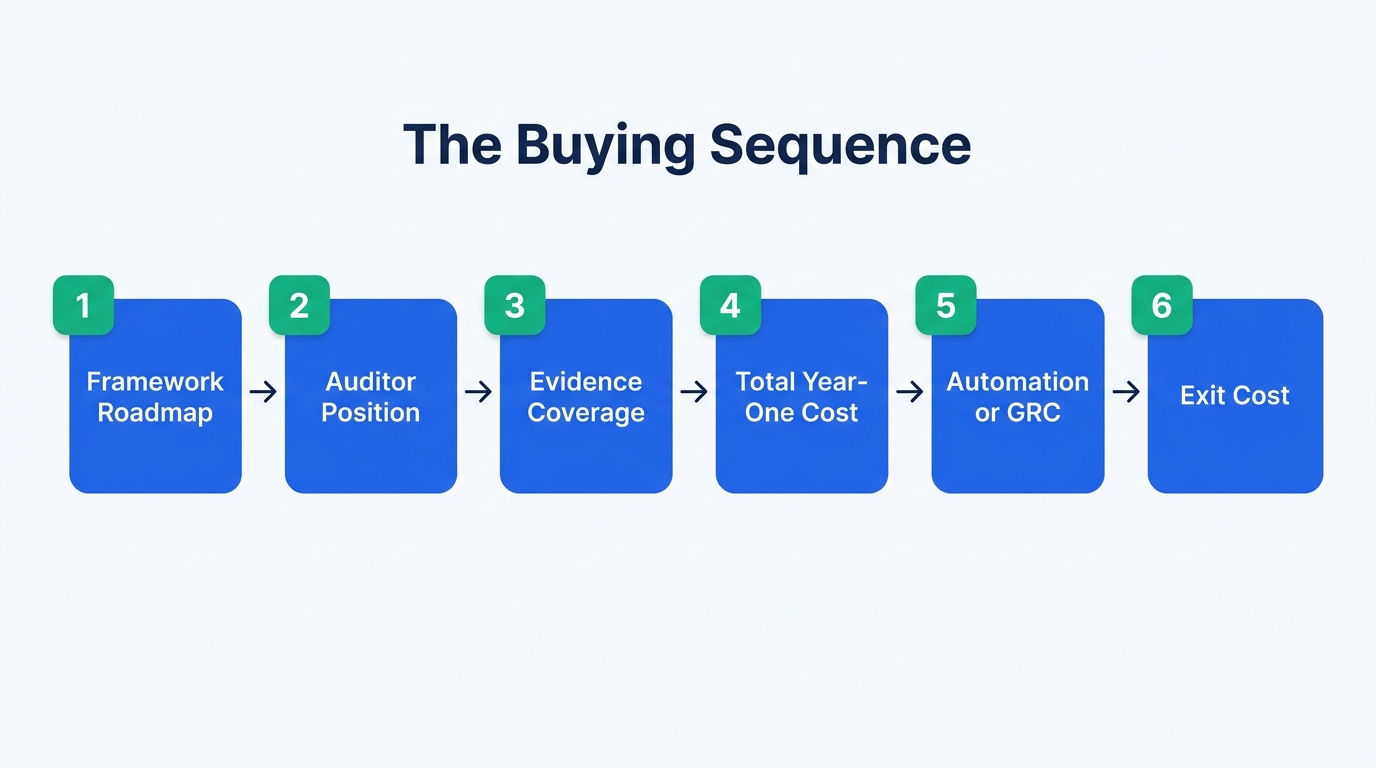
Work these six decisions in order. Each one eliminates candidates, and the early ones eliminate the most. Do not take a demo until you have finished decision three.
- Framework roadmap. What will you need in 36 months, not this quarter. If the answer is one framework forever, most of the platform is dead weight.
- Auditor position. Do you already have one? The platform cannot certify you, and this constrains your shortlist more than any feature.
- Evidence coverage ratio. The share of your in-scope controls the platform can evidence automatically from the systems you actually run. This is measurable before you sign, in about two hours.
- Total year-one cost. The license is usually the minority of the spend. Price the audit, the pen test, and your own engineering hours in the same model.
- Automation or GRC. Two different product categories that demo similarly. Buying the wrong one costs you a second purchase within 18 months.
- Exit cost. The real lock-in is not the contract. It is that historical evidence does not travel.
Why the rankings on page one can't answer your question
Search for this and you get ten variations of the same article: a numbered list of platforms, each with a paragraph of description and a "best for" tag. Some of them are good summaries of the market. None of them can tell you what to buy, for a specific and checkable reason.
As of August 2026, Vanta's pricing page lists four tiers — Essentials, Plus, Professional and Enterprise — and no dollar figure anywhere on the page; it routes you to "Get personalized pricing." Drata's pricing page lists no tiers and no dollar figure at all. The same is true across Secureframe, Sprinto and Thoropass. Every one of them prices on headcount, charges per additional framework, and varies with which modules you turn on and how long you commit.
Third-party figures do circulate — entry tiers reported in the $7,500–$15,000 range, median contract values reported roughly around $15,000 for Sprinto, $20,000 for Secureframe and Vanta, and $25,000 for Drata, with enterprise multi-framework packages running well past $80,000. Treat all of these as reported anecdotes rather than rates. Any article quoting a precise number like "$14,000 a year for Vanta" is reporting one company's contract, not a published price. Two written quotes for the same defined scope is the only way to make numbers comparable.
So the ranking question is unanswerable in the abstract, and the useful question is different: which decisions, made in which order, narrow the field to a shortlist you can actually evaluate? That is the rest of this article.
What frameworks will you need in 36 months?
The core structural value of a compliance automation platform is cross-mapping: you implement a control once, and it satisfies the equivalent requirement in every framework you hold. Access reviews, change management, encryption at rest — the same evidence answers SOC 2, ISO 27001 and a dozen others.
That value is real. It is also proportional to the number of frameworks you hold. With one framework and no plans for a second, cross-mapping is worth nothing, and you are paying for an engine you will never start. This is the first and most aggressive filter, and it points in a direction most buyers don't expect: a single-framework company should usually buy less platform than the market assumes.
Your roadmap is not a wish list. It is driven by customer contracts, by where you sell, and by regulatory dates you don't control. Those dates moved substantially in the last twelve months.
| Framework | Status and date | What it means for the buy |
|---|---|---|
| CMMC (US defense) | The 48 CFR rule became enforceable 10 Nov 2025, embedding CMMC into contract clauses. Phase 2, beginning 10 Nov 2026, adds Level 2 certification requirements to new and renewing contracts. | A hard commercial deadline. If you handle CUI, this dominates every other consideration and cuts the shortlist to the few platforms with credible CMMC and CUI scoping support. |
| EU AI Act | The Digital Omnibus was published in the Official Journal on 24 July 2026 and entered into force on 27 July 2026. High-risk obligations for standalone Annex III systems moved from 2 Aug 2026 to 2 Dec 2027; Annex I product-embedded systems moved to 2 Aug 2028. Article 50 transparency obligations were not deferred and still applied from 2 Aug 2026. | The panic timeline is gone. Do not buy an AI governance module in 2026 on the assumption of an August deadline — but do not assume nothing applies either, because transparency duties landed on schedule. |
| ISO/IEC 42001 | Published Dec 2023; adopted in Europe as EN ISO/IEC 42001:2026 with national adoption due Sept 2026. Roughly 350 organizations held certificates worldwide by spring 2026. ISO/IEC 42006, which sets certification-body competence requirements, was only published in July 2025. | Your bottleneck is accredited auditor capacity, not software. Accredited issuers as of April 2026 included Schellman, BSI, A-LIGN, DNV and SGS. Book the certification body before you worry about the tooling. |
| NIS2 | Binding since Oct 2024 regardless of national transposition. About two-thirds of member states had completed transposition by March 2026; by May 2026 the Commission had escalated infringement proceedings against seven member states to the CJEU. | ISO 27001:2022 covers roughly 70% of Article 21, so ISO is the efficient base layer — but national transpositions add obligations the standard does not touch. Cross-mapping helps; it does not finish the job. |
| DORA | Applicable to financial entities since Jan 2025, now in its first real supervisory enforcement cycle, with regulators signalling action on incident-reporting failures. | Incident reporting workflow and third-party register depth become gating features, not nice-to-haves. Most SOC 2-first platforms are thin here. |
Dates and statuses above reflect published regulatory and standards-body sources as of August 2026. Regulatory timelines in this category have moved more than once; re-verify against the primary source before making a dated commitment.
Count your second framework, not your first. If you cannot name a specific second framework, a specific customer or regulator demanding it, and a plausible quarter, then cross-mapping is worth zero to you today and should carry zero weight in your scoring.
Framework sequencing is its own decision with real cost consequences, and it is worth settling before you shop — we worked through the ordering question in detail in ISO 27001 vs SOC 2: which to get first. Similarly, if your driver is a single regulated framework rather than a portfolio, the buying logic changes shape entirely; our HIPAA compliance software comparison covers the case where a healthcare-native point solution beats a multi-framework platform.
Get the price of frameworks two and three before you sign framework one
Per-framework pricing is the industry standard. What varies is when you find out. Asking for the ISO 27001 add-on price while you are still negotiating your SOC 2 contract gets you a number in the deal; asking eight months later gets you a number set by a renewals team that knows your evidence is already inside their product. This single question is worth more than most feature comparisons, and it costs nothing to ask.
Where you sit relative to an auditor
Here is the fact that reorders most shortlists: the platform cannot certify you. Not as a limitation of any particular product — as a rule of the attestation system itself.
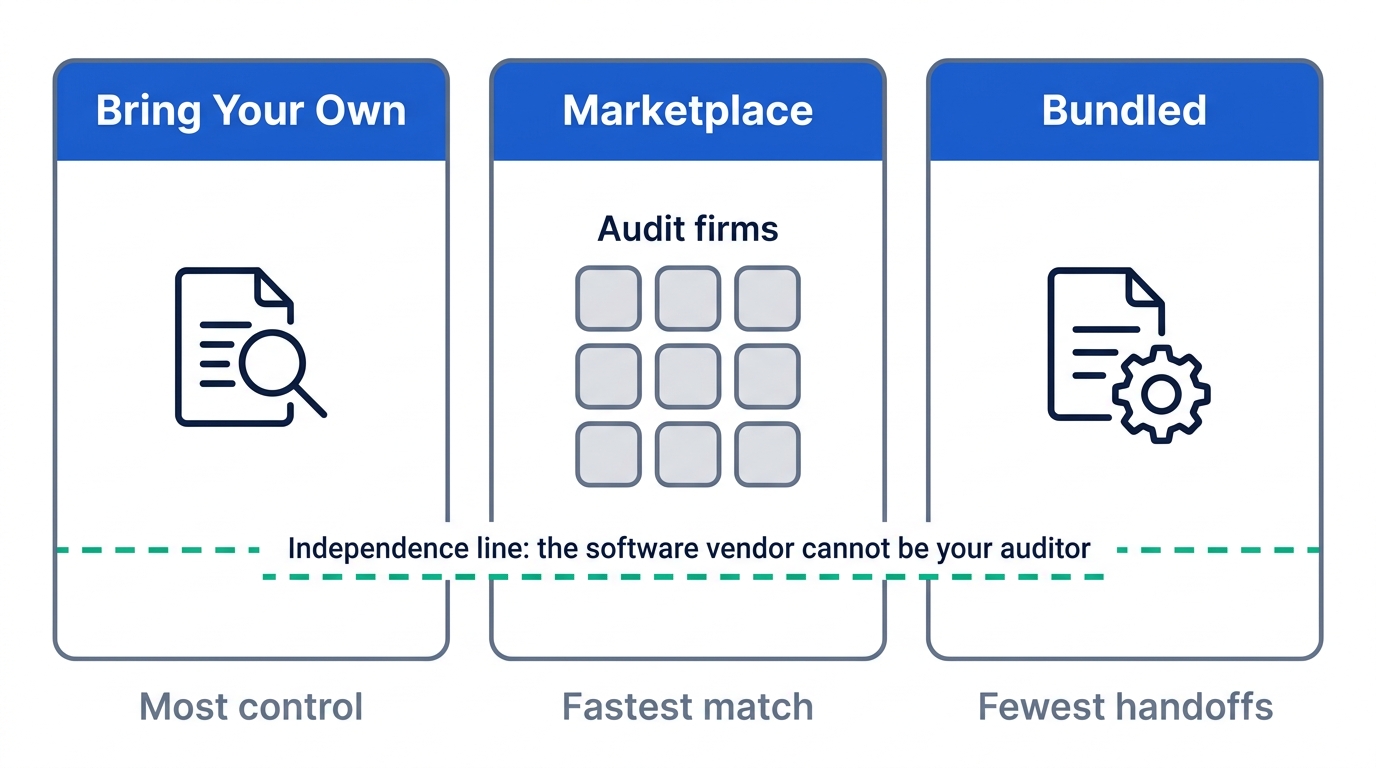
For SOC 2, the AICPA requires the CPA firm performing the examination to be independent of external parties, including the compliance automation vendor. A tool company generally cannot also be the CPA firm issuing your report; that would be auditing its own product, which is precisely the conflict the independence rules exist to prevent. The AICPA's 2022 revisions to the SOC 2 guide leaned hard into independence and non-attest services specifically because of how the tooling market had changed. For ISO 27001 and ISO 42001, the parallel requirement is an accredited certification body.
The three procurement models
- Bring your own auditor. You already have a firm, or your customers or investors expect a specific one. Most control, most coordination work, and by far the fastest way to shortlist — see below.
- Platform marketplace. The vendor maintains a panel of firms with experience reading evidence out of their product. Genuinely useful when you are starting cold, because auditor familiarity with the platform is a real variable in how long fieldwork takes.
- Bundled. Software and audit sold together, often at an attractive combined price. This is a price on the audit, not a shortcut past independence: the attesting firm is still a separate, independent entity. Ask explicitly who signs the report and what their relationship to the vendor is.
Ask them two questions before you talk to any vendor: which platforms does your team read fastest, and which ones generate evidence you routinely have to re-request? Their answer is the most honest shortlist you will get, and it has a direct budget consequence — auditor evidence-review hours are billed to you.
The observation window is a bigger lever than the platform
Buyers routinely evaluate platforms on promised speed to compliance, and then discover the timeline is set by something else entirely. A SOC 2 Type 2 report requires an observation period: three months is the practical minimum most auditors will accept, six months is common and generally recommended for a first Type 2, and twelve months is the standard for renewals and for enterprise buyers who ask. End to end — readiness, observation, fieldwork, reporting — a first Type 2 typically runs six to fifteen months, with fieldwork alone taking four to six weeks after the window closes.
The window is also the single largest lever on audit cost, because a longer window means the auditor samples across more periods. So when a vendor promises compliance in eight weeks, they mean audit readiness, or they mean a Type 1. Both are legitimate; neither is a Type 2 report. Decide your window length first, because it determines your report date far more than your software choice does.
Measure your evidence coverage ratio before you take a demo
This is the decision that separates buyers who are satisfied at month six from buyers who are quietly doing manual uploads at month six. It is also the one almost nobody performs, because vendors offer a much easier substitute: the integration count.
Vanta's pricing page advertises pulling data from 400+ tools. Drata's says it connects to hundreds. Both statements are true and neither is useful, because the number that determines your outcome is not how many integrations exist — it is the intersection of that catalog with the systems you run, weighted by which controls those systems actually evidence. A platform with 400 integrations and no connector for the identity provider you use has a worse coverage ratio for you than one with 150 that does.
Evidence coverage ratio = in-scope controls the platform can evidence automatically from systems you already run ÷ total in-scope controls.
It is computable before you sign, it is comparable across vendors, and it predicts your month-six manual workload better than any feature list.
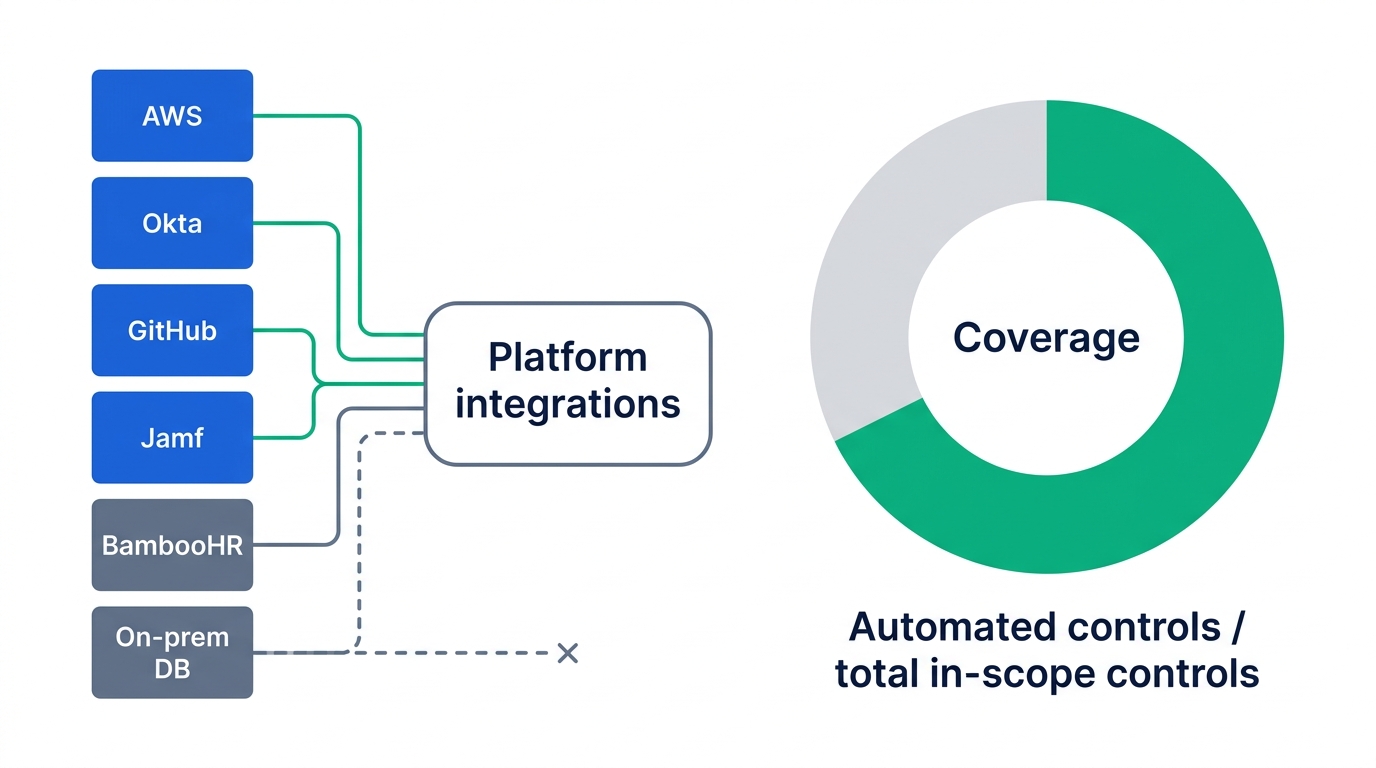
The two-hour procedure
- Export your actual system inventory. Pull the application list from your identity provider or SSO, then add what SSO does not cover: cloud accounts, code hosting, CI, MDM, ticketing, HRIS, the data warehouse, and any self-hosted or on-premise systems in scope. Most companies find between fifteen and forty systems, and most are surprised by a few of them.
- Split the control list. Take the control list for your target framework and mark each control as system-derived (a machine can observe it) or process-based (a human must produce it). The second pile is bigger than the marketing suggests, and it does not shrink no matter which platform you buy.
- Make the vendor map, at control level. Hand each shortlisted vendor your inventory and require a control-by-control answer: which of these systems do you read, and which specific control tests does each satisfy? Not "we integrate with AWS" — which AWS-derived controls, tested how often.
- Compute and compare. One number per vendor, from the same inputs. This is the only genuinely apples-to-apples comparison available in a market with no published prices.
What never automates — on any platform
Before you evaluate the ratio, calibrate the denominator. A meaningful share of any framework's control set is structurally manual, and vendor demos rarely dwell on it.
| Evidence | Automates? | Why |
|---|---|---|
| Infrastructure configuration | Yes | Encryption, logging, backup settings and network rules read directly from cloud provider APIs. |
| Access and provisioning | Yes | Account inventory, MFA status, group membership and deprovisioning timing from the identity provider — provided your IdP is actually the system of record. |
| Endpoint state | Yes | Disk encryption, screen lock and agent presence from MDM. |
| Change management | Mostly | Pull request approvals and deploy records from the code host, if your workflow is disciplined enough to be readable. |
| Security training completion | Mostly | Completion records from the training vendor, where an integration exists. |
| Background checks | No | Auditors want proof the check was completed, not its contents. Handling is deliberately manual so sensitive material can be redacted. |
| Board and management minutes | No | These meetings do not run through software. Even when minutes live in cloud storage, an integration cannot pull what the auditor needs from them. |
| BCDR test results | No | Auditors will not accept a plan that has never been executed. Evidence means scenarios, participants, results and lessons learned — a real exercise, documented. |
| Vendor and third-party reviews | Partly | The platform can hold the inventory and risk ratings and chase the schedule. Somebody still has to read each critical vendor's report and record a judgment. |
| Risk assessment | No | A tool can host the register. It cannot decide your risk appetite or your treatment plan. |
| Penetration test | No | A separate engagement with a separate bill. Frequently bundled or upsold — price it as its own line. |
A coverage ratio in the 60–75% band is a normal, good result for a cloud-native company. The honest industry framing is to automate the repetitive majority and reserve expert time for the rest. If a vendor's own mapping claims something like 95%, ask which controls they are counting — usually the number includes internal readiness checks that no auditor tests, or evidence an auditor will re-request in a different form.
Where the gap gets expensive: everything self-hosted
The ratio degrades fastest for companies running material infrastructure outside the standard SaaS catalog — an on-premise database, a self-managed Kubernetes cluster, an internal admin tool that is the actual system of record for customer data access. No vendor has a connector for your internal tool. So you are choosing between manual evidence upload every collection cycle, forever, or building a connector against the platform's custom-evidence API.
If that describes you, the deciding feature is not the logo grid at all. It is the quality of the platform's custom evidence model: does it accept programmatic submissions with proper timestamps and provenance, or only file uploads through a web form? That is a build-versus-buy integration decision with the same economics as any other, and the pattern is familiar — we walked through the full cost model in native integration vs iPaaS vs custom API. The relevant lesson transfers directly: build cost is a fraction of lifetime cost, and a connector you own is a connector you maintain every time an auditor asks a new question.
A worked example
A 60-person B2B SaaS company scopes SOC 2 Type 2 across the Security and Availability criteria and lands on 94 in-scope controls after mapping. Splitting the list gives 61 system-derived and 33 process-based. Of the 61, two vendors return different answers on the same inventory: one maps 52, the other 44, and the difference is concentrated in a self-hosted logging stack and a niche HRIS that only one of them reads.
Coverage ratios: 55% and 47% of total in-scope controls. Expressed as work, the gap is eight controls collected by hand every cycle. At roughly two hours per control per year of collection, chasing and re-collection, that is a recurring 16-hour annual tax — before counting the auditor hours spent asking for evidence that arrived in the wrong shape. It will not always outweigh a price difference. But it is a number, which is more than the logo grid gave you.
Price the year, not the license
The most common budgeting error in this category is treating the platform subscription as the cost of compliance. For a first SOC 2 Type 2 at small scale, it is usually the second or third largest line.
Year-one cost stack: first SOC 2 Type 2, roughly 50–150 employees
Reported ranges from published cost analyses and vendor-adjacent sources, August 2026. Bars show the reported range, not a single price. Read as orders of magnitude.
Two consequences follow directly from that shape.
First, engineering hours dominate at small scale. If your team's fully loaded cost is $120 an hour, a platform that saves 40 hours of collection and remediation work is worth $4,800 a year — which is larger than most of the price differences you are agonizing over. This is exactly why the coverage ratio deserves more weight than price.
Second, quotes are only comparable against a written scope. Because nothing is published, the only way to get numbers that mean the same thing is to send every vendor an identical scope document and require a quote against it. At minimum, specify: headcount including contractors, frameworks in years one, two and three, which modules are in and which are explicitly out, contract term, number of user seats, and whether the quote includes the audit or a pen test.
Aggressive first-year discounts followed by steep renewals are a well-documented pattern in this category, with customers reporting renewal increases in the 25–100% range. A renewal price cap written into the initial contract costs the vendor nothing at signing and is close to impossible to obtain later, once your evidence, policies and control mappings live inside their product. Ask for it in the first negotiation or accept that you will pay whatever the second one costs.
Compliance automation, or GRC?
These are two product categories that demo similarly and solve different problems. Compliance automation tools get you certified. GRC platforms run your risk and compliance program. Buying the wrong one is the most expensive mistake available in this category, because you discover it eighteen months in.
Compliance automation is framework-centric by design: evidence collection, continuous monitoring, audit readiness against a defined set of frameworks. What most compliance automation tools do not do is maintain a centralized risk register linked to business processes, provide governance workflows for policy approvals and committee oversight and board reporting, handle contract lifecycle management, or track regulatory change across jurisdictions. Those are GRC functions, and their absence is a design decision rather than a gap.
Signals you have outgrown compliance automation
- Risk ownership can no longer be held in one person's head, and you need a register with categories, owners and treatment plans rather than a list.
- You have an internal audit function, or a board committee that asks for reporting on a schedule.
- Policy approval needs a real workflow with reviewers, versioning and attestation — not a document with a signature page.
- Third-party risk is a program with tiering and continuous monitoring, not an annual spreadsheet.
- You operate across multiple legal entities or jurisdictions and need to track regulatory change as an ongoing process.
| Segment | Typical buyer | What it is built to do |
|---|---|---|
| Compliance automation | Mid-market security teams pursuing SOC 2 or ISO 27001 | Get to a report or a certificate, then keep evidence fresh between cycles. |
| Mid-market GRC | Companies with an internal audit or risk function | Run the program. Strengths differ noticeably: cross-framework mapping, workflow configurability and third-party risk, or audit orchestration and SOX. |
| Enterprise GRC | Multi-entity, global, or public companies | SOX, ESG, regulatory change management and board-level reporting across entities. |
If you sit near the boundary, resolve the audit deadline first and the governance problem second — on separate purchase cycles. Trying to solve both in one quarter usually produces a platform that is too heavy for the deadline you actually have.
The module that quietly justifies the spend
For sales-led B2B companies, the trust center and security questionnaire automation module is often where the platform earns its keep — not in the audit. Vendors report questionnaire response time savings in the 75–91% range, and the newer AI-assisted implementations claim high answer accuracy against SOC 2 and ISO 27001 content. Treat those as vendor-reported figures, but the underlying dynamic is real: if security review is on your critical path to close, moving questionnaire turnaround from days to hours has a revenue effect that dwarfs the license.
Price it separately anyway. It is almost always a paid module rather than an included feature, and competent standalone tools exist. Do not let a compelling trust center demo carry a weak coverage ratio into your decision.
What it costs to be wrong
Every buyer in this category assumes they can switch. Technically they can. What surprises them is where the friction actually lives.
The contract is not the real lock-in — portability is. Switching platforms looks like a vendor swap and behaves like a re-implementation: policies come across as documents, and then almost nothing else does. Control mappings differ between platforms and have to be redone. Every integration must be re-authorized. Evidence-freshness clocks reset from zero. And historical evidence stays where you collected it, which matters the moment an auditor asks about a period that predates the migration. A focused migration typically takes two to four weeks of real work. We documented the mechanics end to end in our Vanta to Drata migration guide, and the timing lesson generalizes to any pair of platforms.
Never migrate during an in-progress Type 2 observation window. Breaking the window mid-flight can cost you the report period. Plan any switch for the gap between audit cycles.
Four clauses to settle before signing
- Export scope and format, in writing. Not "you can export your data" — which objects, in which format, and does it include historical evidence with its original timestamps.
- Read access after termination. How long before the account goes read-only, and how long after that before it goes dark. Get the full export before either happens.
- Auto-renewal notice period. Diarize it the day you sign. Missing a 60-day notice window is how a switching decision gets made for you.
- Renewal price cap. Covered above, and worth repeating: this is the highest-leverage sentence in the contract.
Putting it together: a weighted scorecard
Score each shortlisted platform 1–5 on each dimension, multiply by the weight, and total. The weights below reflect the order of the decisions above — adjust them to your situation, but adjust them deliberately and before you see the quotes.
| Dimension | Weight | How to score it |
|---|---|---|
| Evidence coverage ratio | 30 | The measured number from decision three, on your own inventory. Not the vendor's integration count. |
| Framework roadmap fit | 20 | Does it cover frameworks two and three, at a price quoted now? Score low if your roadmap has one framework — and reallocate this weight to cost. |
| Auditor fit | 15 | Your auditor's opinion, or the depth and quality of the marketplace panel if you don't have one. |
| Total year-one cost | 15 | Quotes against one written scope, plus audit, plus your loaded engineering hours. |
| Program fit | 10 | Automation versus GRC. Score honestly against where you will be in 18 months, not today. |
| Exit cost | 10 | Export scope, contract terms, renewal cap. A vendor that answers these crisply is telling you something. |
One tie-breaker worth stating explicitly: if two platforms finish within about 10% of each other, take the one your auditor reads faster. That difference shows up in billed fieldwork hours in year one and every year after.
Three companies, three different answers
The framework is only useful if it produces different outputs for different inputs. It does.
28-person seed-stage SaaS, first SOC 2 Type 2
Fully cloud-native stack, no auditor relationship, no second framework on any credible horizon. Enterprise deals are stalling on the security review.
Coverage ratio comes back high — nearly everything in scope is derived from the cloud provider, the identity provider and the MDM. Framework roadmap value is approximately zero, so decision one collapses: cross-mapping should carry no weight, and the 20 points move to cost.
180-person Series C, US and EU customers
Holds SOC 2, needs ISO 27001 for European enterprise deals, has GDPR obligations and NIS2 exposure through customers in scope. Two self-hosted systems sit inside the control boundary.
This is the case where cross-mapping genuinely pays: ISO 27001:2022 covers roughly 70% of NIS2 Article 21, so the ISO investment does double duty — with the caveat that national transpositions add requirements the standard does not reach. Coverage ratio is the deciding number, and the self-hosted systems make the custom-evidence API a first-class evaluation criterion rather than a footnote.
600-person defense supplier, CUI in scope
Contracts renew after 10 November 2026, when CMMC Phase 2 begins adding Level 2 requirements to new and renewing contracts. Risk register lives in spreadsheets. An internal audit function exists.
Decision one dominates everything: the date is contractual, and assessor availability is the binding constraint. The shortlist is the handful of platforms with credible CMMC and CUI scoping support, and coverage ratio is scored only within that set. This company is also plainly at the GRC threshold — internal audit, a real register, board reporting.
The demo script
Once you reach a shortlist, these six questions produce more signal than an hour of feature walkthrough. The failure modes are as informative as the answers.
Bad answer: "We have 400+ integrations." A vendor that cannot map your inventory at control level during a sales cycle will not do it during implementation either.
Bad answer: "We can discuss that at renewal." That is the answer that becomes a 60% increase in eighteen months.
Bad answer: "That doesn't happen." It happens to every platform. A specific, unflattering story is the strongest positive signal available in this conversation.
Bad answer: Any reference the vendor insists on choosing. Auditors are unusually candid about which tools create work for them.
Bad answer: "Renewals are handled by a different team." That is an accurate description of the problem, not a response to it.
Bad answer: "You can download your policies." Policies are the one thing that always travels. Ask specifically about historical evidence and control mappings.
Frequently Asked Questions
What are the 7 pillars of compliance?
There is no standard that defines "seven pillars," but there is a real and citable seven-element framework behind the phrase. The US Department of Health and Human Services Office of Inspector General first set out seven elements of an effective compliance program in its 1998 Compliance Program Guidance for Hospitals, and reaffirmed them in its 2023 General Compliance Program Guidance. They were derived from the US Federal Sentencing Guidelines, Chapter 8, Part B.
The seven are: written policies and procedures; a designated compliance officer and committee; effective training and education; effective lines of communication; internal monitoring and auditing; enforcement through well-publicized disciplinary standards; and prompt response with corrective action when problems are detected.
The buying implication is worth noting: compliance automation platforms are strong on elements one and five, partial on three, and largely absent on two, four, six and seven — which are governance functions. If your obligations are framed in these terms, you are closer to a GRC purchase than a compliance automation purchase.
What are the major compliance frameworks?
For B2B technology companies, the ones that actually appear in contracts and regulations are: SOC 2 (US market expectation, an attestation from a CPA firm rather than a certification); ISO/IEC 27001 (international certification, the most efficient base layer if you sell into Europe); ISO/IEC 42001 (AI management systems); HIPAA (US healthcare); PCI DSS (card data); GDPR (EU personal data); NIS2 (EU network and information security, binding since October 2024); DORA (EU financial entities, applicable since January 2025); and CMMC and FedRAMP for US federal and defense work.
Which of these you need is set by your customers and your jurisdictions, not by your preference. That is why the framework roadmap is decision one rather than decision four.
What are the 5 key areas of compliance?
Like the "seven pillars," this is a consulting framing rather than a defined standard, and different sources list different fives. The practically useful grouping for a technology company is: governance and accountability (who owns compliance and who they report to); risk assessment and treatment; controls implementation and operation; monitoring, evidence and internal audit; and reporting, response and remediation.
Mapping a platform against these five is a fast way to run decision five. Compliance automation tools concentrate almost entirely on the third and fourth. If your gaps are in the first, second or fifth, more evidence automation will not close them.
Can you give me an example of a compliance framework?
ISO/IEC 27001 is the clearest example of a framework in the full sense. It specifies requirements for an information security management system — the governance process around security — and its Annex A lists reference controls covering areas such as access control, cryptography, supplier relationships and incident management. You define a scope, run a risk assessment, select and justify controls in a Statement of Applicability, operate the system, and are then audited by an accredited certification body in a two-stage process, with surveillance audits in following years.
The contrast with SOC 2 is instructive: SOC 2 is not a certification and has no fixed control list. You define controls against the Trust Services Criteria, and a CPA firm issues an opinion on whether they were suitably designed and, for a Type 2, operating effectively over a period. This structural difference is exactly why the two have different timelines, different costs and different sequencing logic.
Do I need a compliance automation platform at all for a single SOC 2?
Not necessarily, and this is the question the market is least motivated to answer honestly. A small, fully cloud-native company pursuing one SOC 2 Type 2 with a competent auditor and a disciplined engineer can get there with cloud-native config tooling, a document repository and a spreadsheet. Companies do it every year.
What you buy with a platform is continuous monitoring between cycles, faster evidence assembly at fieldwork, a trust center if security review is on your sales critical path, and a structure that survives the person who built it leaving. Those are real, and for most companies they are worth the money — but they are benefits, not necessities. Run decision four with an honest zero-platform baseline and see what the delta actually buys you.
The calculus shifts decisively the moment a second framework enters the roadmap, or the moment your team spends more hours on evidence than the license costs.
Methodology
Based on our research, not on a vendor engagement. This article is a decision framework rather than a product ranking, and deliberately avoids naming a winner — the central argument is that no ranking can be correct without your scope.
Pricing statements were verified in August 2026 by reading vendor pricing pages directly; the finding that no major platform publishes a rate is a primary observation, not a secondary claim. Regulatory dates — the CMMC 48 CFR rule and Phase 2 timing, the EU AI Act Digital Omnibus deferrals, NIS2 transposition status, DORA applicability, and ISO/IEC 42001 and 42006 publication and accreditation status — were checked against regulatory, standards-body and specialist legal sources current to August 2026. Cost ranges, contract and renewal patterns, questionnaire time savings and migration effort figures are drawn from third-party analyses and vendor-reported data, and are labeled as reported ranges throughout because no comparable published rates exist in this market. The evidence coverage ratio, the weighted scorecard and the demo script are our own constructions, offered as procedure rather than as findings.
Two areas readers frequently ask about are adjacent to this framework but out of its scope, and we plan to cover them separately: a practical guide to ISO 42001 certification cost and accredited certification bodies, and a comparison of standalone security questionnaire automation tools for teams that want the trust center without the platform.
Sources and further reading
- Vanta — Pricing (tiers listed, no published rate; verified August 2026)
- Drata — Pricing (no tiers or rates published; verified August 2026)
- United States Sentencing Commission — Guidelines §8B2.1, Effective Compliance and Ethics Program
- ISO — ISO/IEC 42001 explained
- PKF O'Connor Davies — CMMC Rule 48 CFR 7021 takes effect November 10, 2025
- Gibson Dunn — EU AI Act Omnibus agreement: postponed high-risk deadlines and other key changes
- Linford & Co. — SOC 2 automation tools: an auditor's breakdown of AICPA FAQs
- OneTrust — What can and can't be automated for SOC 2
- Bass, Berry & Sims — HHS releases General Compliance Program Guidance

Technology consultant with 10+ years in the Japanese tech industry. Specializing in SaaS evaluation, workflow automation, and B2B tool integration.