Somewhere in your first enterprise sales cycle, a prospect's security team sends over a questionnaire, or just asks a single question in a Slack thread: "Do you have a SOC 2 report?" If you're a first-time B2B SaaS founder, that question can stop a deal in its tracks — not because you did anything wrong, but because nobody explained what SOC 2 actually is before you needed to know.
This guide is the explainer we wish existed the first time a customer asked us that question. No jargon left undefined, no assumption that you already know what a "Trust Services Criteria" is. By the end, you'll know exactly what SOC 2 covers, what it costs and takes to get one in 2026, and what to do first.
SOC 2 is not a certification you pass — it's an independent auditor's report (an "attestation") on how well your company's security controls actually work. No law requires it, but most mid-market and enterprise B2B buyers in the US will ask for one before they'll sign a contract, so for a SaaS company it functions as a de facto sales requirement.
There are two versions: Type 1 checks that your controls are designed correctly on a single date (faster, cheaper, a good first step); Type 2 checks that those controls actually worked over a 3–12 month window (what most enterprise buyers eventually want to see). Budget roughly $15,000–$40,000 and 3–6 months for a first Type 1, and $30,000–$80,000 all-in for a first Type 2, once you include the audit fee, a compliance platform, and a penetration test.
What SOC 2 Actually Is (and Isn't)
SOC stands for System and Organization Controls. The framework is maintained by the AICPA (the American Institute of Certified Public Accountants) — the same body that oversees US audit standards for financial statements. SOC 2 applies that same audit discipline to something different: how a technology company protects the data it stores and processes on behalf of its customers.
The single most common misunderstanding, even among people who've been through the process once, is calling it a "SOC 2 certification." There is no such thing. SOC 2 is an attestation, not a certification. A certification means an accredited body checks you against a fixed standard and issues a pass/fail credential (think ISO 27001). An attestation means a licensed CPA firm examines your specific controls and issues a written opinion on how well they meet the criteria. You don't "pass" SOC 2 — you receive a report, and the auditor's opinion inside that report can range from a clean "unqualified" opinion down to a "qualified" one that flags exceptions.
That distinction matters in practice: when a prospect's procurement team asks for "your SOC 2 certificate," what they actually want is a copy of your SOC 2 report (usually under NDA, since it contains sensitive detail about your internal controls).
SOC 2 vs. SOC 1: Don't Confuse Them
You may also come across SOC 1. The two exist for different purposes, so it's worth being able to tell a prospect which one you have:
- SOC 1 covers controls relevant to a customer's financial reporting — it matters if your product touches things like payroll processing, billing calculations, or general-ledger data that a client's auditor would need to rely on.
- SOC 2 covers controls over data security and operations more broadly — access control, encryption, monitoring, incident response, and related practices. This is the one almost every B2B SaaS company gets asked for, regardless of what the product does.
Unless you're building fintech or accounting infrastructure that feeds directly into a customer's audited financials, SOC 2 is the one you need.
Why B2B SaaS Founders Can't Just Ignore It
No US federal law requires SOC 2. You won't get fined by a regulator for not having one. But for a B2B SaaS company selling to mid-market or enterprise customers in North America, the market has effectively made it mandatory anyway. Enterprise procurement and security teams run new vendors through a security review before signing, and "Are you SOC 2 compliant?" is one of the first filter questions on almost every vendor security questionnaire.
Practically, this shows up in three ways for a founder:
- It gates deals, not just slows them. Some enterprise buyers won't even open a security questionnaire dialogue until you can show a report — SOC 2 becomes a qualifying criterion before your champion can move the deal forward internally.
- It removes repetitive due-diligence work. Without a report, each new enterprise prospect's security team will want to interview your engineers, review your policies individually, and sometimes request an on-site or virtual audit of their own. A SOC 2 report lets you hand over one document instead.
- It's increasingly expected earlier in the funnel. A few years ago, SOC 2 was something you got after landing your first enterprise logo. In 2026, well-funded competitors already have Type 2 reports by seed or Series A, which resets buyer expectations for everyone selling into the same market.
The Five Trust Services Criteria
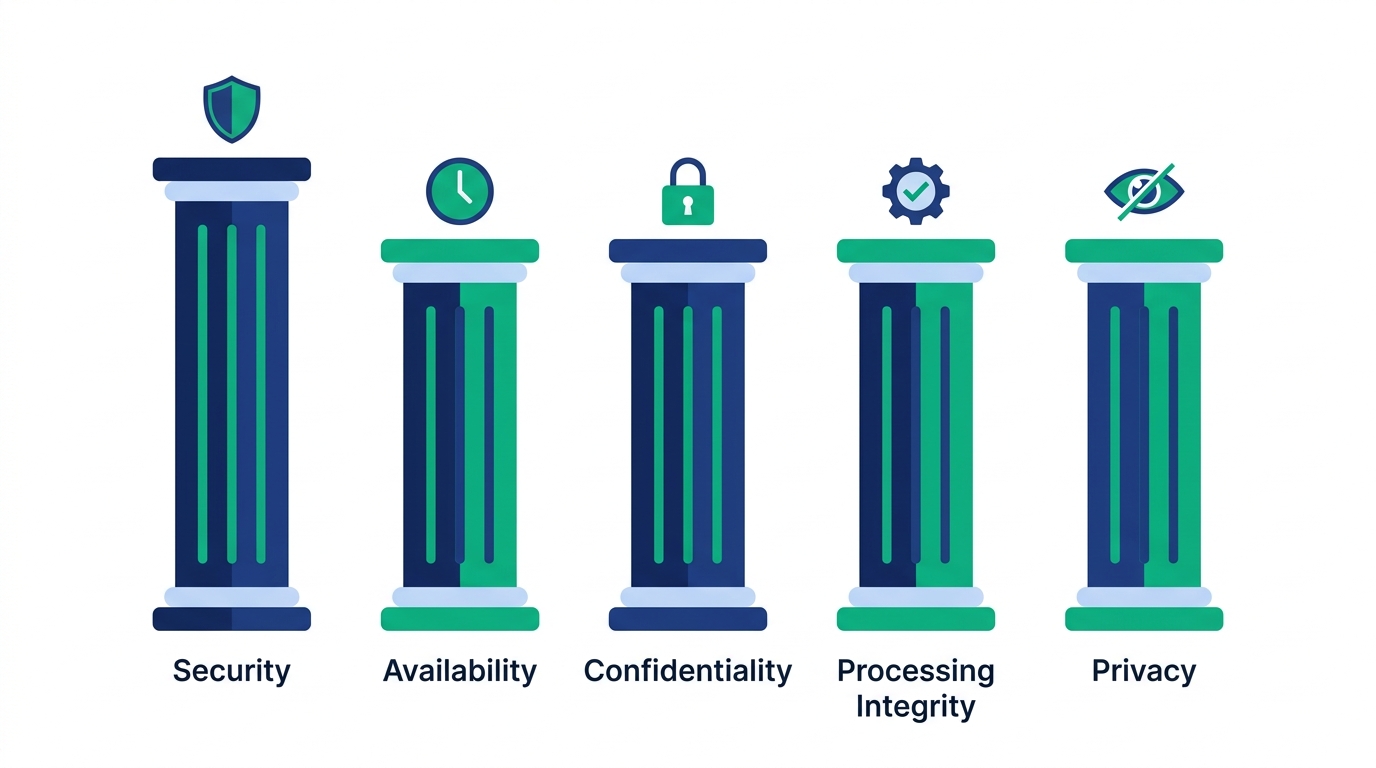
Everything a SOC 2 auditor evaluates maps back to five categories defined by the AICPA, known as the Trust Services Criteria (TSC). The current structure was set out in the AICPA's 2017 revision (effective for audits performed on or after December 15, 2018), with updated guidance on points of focus published in 2022.
Security is the only mandatory criterion — every SOC 2 report includes it. The other four are optional and scoped in based on what your product does and what your customers actually ask about.
| Criterion | Required? | What it covers | When to include it |
|---|---|---|---|
| Security | Always | Protection against unauthorized access, disclosure, and system damage — access control, encryption, monitoring, incident response. | Every report. |
| Availability | Optional | Whether the system is accessible and operational as agreed — uptime monitoring, backups, disaster recovery, incident/outage handling. | You sell an SLA-backed or uptime-critical product. |
| Confidentiality | Optional | Protection of confidential business data (not necessarily personal data) — data classification, retention, secure disposal, NDAs. | Customers share proprietary business data or documents. |
| Processing Integrity | Optional | Whether system processing is complete, accurate, timely, and authorized. | You process transactions, calculations, or workflows customers rely on being correct. |
| Privacy | Optional | How personal information is collected, used, retained, disclosed, and disposed of. | You collect meaningful personal data (beyond basic account/contact info). |
Most first-time B2B SaaS SOC 2 reports scope in Security plus Availability, since enterprise buyers ask about uptime almost as often as they ask about security. Adding criteria increases audit scope, evidence collection, and cost, so it's worth scoping based on what your actual customers ask for in security questionnaires — not adding all five just to look thorough.
SOC 2 Type 1 vs. Type 2: Which Do You Need First?
This is the question that trips up almost every first-time founder. Both report types evaluate the same Trust Services Criteria — the difference is the time dimension.
| Type 1 | Type 2 | |
|---|---|---|
| What it tests | Whether controls are designed correctly, as of one specific date | Whether controls are designed correctly and operated effectively over a period of time |
| Observation window | None — a single point-in-time snapshot | 3–12 months (most first-timers choose the minimum 3-month window) |
| Typical total timeline | 3–6 months (readiness + fieldwork) | 6–15 months, since the observation period is added on top |
| Typical first-year cost | $15,000–$40,000 all-in | $30,000–$80,000 all-in |
| How enterprise buyers view it | A credible starting signal, but many will still ask when Type 2 is coming | The report most mid-market/enterprise security teams actually want to see |
A common, sensible path for an early-stage B2B SaaS company: start with Type 1 to prove your controls are properly designed and get a report in hand faster, then roll straight into the observation window for your first Type 2 report. Some companies skip Type 1 entirely and go straight for Type 2 if they can tolerate the longer runway — this avoids paying for two separate audits, since Type 1 doesn't count toward Type 2's observation period unless your auditor structures it that way. Talk to your auditor about which sequencing fits your sales timeline before committing.
How Much Does SOC 2 Cost, and How Long Does It Take? (2026 Figures)
Pricing varies by auditor, scope, and how much you outsource versus do in-house. As of September 2026, based on current published breakdowns from SOC 2 audit firms and compliance platforms, here's roughly what a lean B2B SaaS startup should budget:
| Cost item | Typical range |
|---|---|
| CPA audit fee — Type 1 | $10,000–$20,000 |
| CPA audit fee — Type 2 | $10,000–$30,000 |
| Readiness assessment / gap analysis | $3,000–$25,000 |
| Compliance automation platform (annual license) | $5,000–$30,000/year |
| Penetration test (often required for the Security criterion) | $5,000–$25,000 |
| Security tooling upgrades (MDM, SSO, logging, etc.) | $5,000–$50,000+, highly variable |
Add it up and most sources converge on the same range: roughly $25,000–$80,000 in total first-year spend, depending on whether you're going for Type 1 or Type 2 and how much manual work a compliance platform automates away for you. The most commonly missed line items are the penetration test and the readiness assessment — vendor quotes for "the audit" often quietly exclude both, so ask what's included before you sign an engagement letter.
On timeline: Type 1 realistically takes 3–6 months door to door once you include 2–3 months of readiness work. Type 2 adds the observation period — most first-time founders choose the minimum 3-month window specifically to get to a usable report faster, then extend to a full 12-month cycle for their second report.
The SOC 2 Process, Step by Step
-
Define your scope
Decide which systems, services, and Trust Services Criteria the audit will cover. Most first-time SaaS founders scope in the production application, the infrastructure it runs on, and the internal systems that touch customer data — not the entire company.
-
Choose Type 1 or Type 2
Base this on your sales timeline and what your biggest active prospects are actually asking for, not on what looks more impressive.
-
Run a readiness assessment (gap analysis)
Compare your current policies, access controls, and technical safeguards against the Trust Services Criteria you've scoped in. This can be done in-house, with a consultant, or as a bundled feature of a compliance automation platform — the goal is to find gaps while they're still cheap to fix, before an auditor finds them for you.
-
Remediate the gaps
Write or update the policies you're missing (access control, incident response, vendor management, and so on), turn on the technical controls you don't yet have (SSO/MFA enforcement, centralized logging, encryption at rest and in transit), and start collecting evidence that these controls are actually being followed.
-
Select your auditor
The final report must be issued by a licensed CPA firm — this is not optional and cannot be done in-house. Interview more than one firm; audit style, responsiveness, and familiarity with your compliance platform all vary and directly affect how painful the fieldwork is.
-
(Type 2 only) Live through the observation window
For 3–12 months, your controls need to actually operate as documented — this is where continuous evidence collection matters most, since the auditor will sample activity from across the entire period, not just the end of it.
-
Fieldwork and report issuance
The auditor tests your controls, requests evidence, and interviews your team, then issues the report with their opinion. A clean "unqualified" opinion means no material exceptions were found.
-
Maintain it — SOC 2 doesn't stay valid forever
A SOC 2 report is generally treated as current for about 12 months by most enterprise buyers. Getting one is the start of an ongoing program, not a one-time project — expect to go through fieldwork again annually to keep your report current.
Do You Need a Compliance Automation Platform?
Tools like Vanta, Drata, Secureframe, and Sprinto connect to your cloud infrastructure, HR system, and identity provider to continuously collect the evidence an auditor needs, instead of your team manually screenshotting settings every quarter. As of September 2026, annual licenses for these platforms commonly run in the roughly $5,000–$30,000 range depending on company size and scope, on top of the CPA audit fee itself — they don't replace the auditor, they make the auditor's job (and yours) faster.
For a very early-stage team with a small, simple stack, a manual, spreadsheet-driven readiness process is still possible, just slower. Once you have more than a handful of engineers or more than one cloud environment, the time these platforms save on evidence collection tends to pay for itself well before your first renewal. We've written a full framework for evaluating these tools — including when a compliance platform is worth it versus when compliance-as-a-service (an outsourced provider or fractional/virtual CISO who runs the whole program for you) makes more sense for a pre-Series-A team — in our guide to choosing a compliance automation platform.
Common Mistakes First-Time Founders Make
Treating it as a one-time certification instead of an ongoing program. Because there's no "pass," maintaining SOC 2 compliance means the controls you stood up for the audit need to keep running afterward — access reviews, log monitoring, vendor reviews — not just during the observation window.
Starting too late. Between readiness work and the observation period, a first Type 2 report can realistically take 6+ months from a standing start. If a $200K enterprise deal is already asking for one, you're already behind — start the moment SOC 2 shows up as a recurring line item in deal conversations, not after it's blocked a signature.
Over-scoping the audit. Including systems, criteria, or business units that no customer has actually asked about adds cost and audit time without adding sales value. Scope to what your active and target enterprise prospects request.
Skipping the readiness assessment to save money. Going straight to a formal audit without a gap analysis first is the single most common way first-time SOC 2 projects blow their budget and timeline — auditors will find the gaps either way; a readiness assessment just lets you find them while they're cheap to fix.
SOC 2 vs. Other Frameworks
SOC 2 isn't the only framework you'll hear about, and founders selling into different verticals or regions often end up juggling more than one:
- ISO 27001 is an internationally recognized information security management system standard and, unlike SOC 2, is a true certification issued by an accredited certification body — it's asked for more often by European and enterprise-international buyers. We're publishing a dedicated ISO 27001 vs. SOC 2 comparison covering which one to pursue first if your buyers span both markets.
- HIPAA applies specifically if your product touches protected health information for US healthcare customers, and it isn't a report you can substitute SOC 2 for — some healthcare buyers will ask for both. If that's your market, see our HIPAA compliance software comparison.
If your buyers are overwhelmingly US-based B2B SaaS companies, SOC 2 is almost always the right one to start with. It's also worth knowing that many compliance automation platforms let you map controls across multiple frameworks at once, so pursuing a second one later is meaningfully cheaper than starting from zero — another reason the platform choice in the section above matters even if you only need SOC 2 today.
FAQ
What does SOC 2 stand for?
SOC stands for System and Organization Controls. SOC 2 is one of several report types the AICPA defines (alongside SOC 1, for controls relevant to financial reporting, and SOC 3, a public-facing summary version of a SOC 2 report).
Is SOC 2 legally required?
No. There's no US federal or state law that mandates SOC 2. It's a market requirement, not a legal one — most mid-market and enterprise B2B buyers treat it as a baseline expectation during vendor security review, so in practice it functions like a sales prerequisite rather than a compliance obligation.
What's the difference between SOC 1 and SOC 2?
SOC 1 covers internal controls relevant to a customer's financial reporting (billing accuracy, payroll processing, and similar). SOC 2 covers controls over data security and operations — access control, availability, confidentiality, processing integrity, and privacy. Most B2B SaaS companies only need SOC 2 unless their product feeds directly into a customer's audited financial statements.
How long is a SOC 2 report valid?
There's no official fixed expiration date printed on the report, but enterprise buyers generally expect a report covering the most recent 12 months. Most companies go through the audit annually to keep their report current for ongoing sales cycles.
Can a startup get SOC 2 compliant without a compliance automation platform?
Yes — a platform isn't required by the AICPA framework, and some very early-stage teams run readiness manually with spreadsheets and shared drives. In practice, once you have more than a handful of engineers or more than one production environment, the evidence-collection time these platforms save usually outweighs the license cost well before your first annual renewal.
References & Further Reading
- AICPA & CIMA — 2017 Trust Services Criteria (with Revised Points of Focus – 2022)
- Vanta — Guide to SOC 2 Trust Services Criteria
- Drata — SOC 2 Type 1 vs. Type 2: Timeline, Cost, and Key Differences
- ISMS.online — Why SOC 2 Is Not a Certification
- ComplyJet — SOC 2 for Startups: Costs, Timing & Fastest Path (2026)
- Secureframe — SOC 1 vs SOC 2 vs SOC 3: What's the Difference?

Technology consultant with 10+ years in the Japanese tech industry. Specializing in SaaS evaluation, workflow automation, and B2B tool integration.