The short version
France is one of the few countries where the EOR model itself is legally constrained. Pure "labor lending" is prohibited, so a compliant arrangement runs through a provider's own French entity (a standard CDI employer) rather than a borrowed partner. That makes the entity model the single most important thing to check — more than headline price.
- Best overall for France: Remote — owned French entity, flat $599/employee/month, no deposit. The safest default.
- Best for scaling teams & broad coverage: Deel — owned French entity, deepest platform, but charges a security deposit and FX fees.
- Best value for small headcount: Multiplier — lowest platform fee (~$400), good for 1–5 hires where budget leads.
Whichever you pick, budget for roughly 40–45% employer social contributions on top of gross salary, plus mandatory mutuelle and 50% transit reimbursement. For an EU national already living in France, expect about one to two weeks from signed offer to compliant payroll. The step-by-step hiring playbook is further down this page.
If you've read other "best EOR in France" lists, you've seen the same ranked grid of logos with a price column and a generic feature checklist. Most of them skip the one fact that actually changes your risk in France: an Employer of Record cannot legally operate here the way it does in the US or UK.
French law broadly prohibits the lending of staff for profit (prêt de main-d'œuvre à but lucratif), with criminal penalties — up to two years' imprisonment and fines of up to €30,000 for company officers, and up to €150,000 for the entity. The only compliant routes are a properly licensed temporary-work agency, the regulated portage salarial model, or — the one almost every global EOR actually uses — employing the worker directly through the provider's own French company on a standard contract.
So in France, "which EOR is best" really means "whose French entity do you want to stand behind your hire, and how cleanly do they run URSSAF, mutuelle, and your convention collective." This guide does two jobs. First, it compares six providers on exactly that, with 2026 pricing checked against each vendor's published rates. Second, it walks through the full hiring sequence — the decisions to make before you start, the contract, the pre-hire declarations, the first payroll, and the realistic timeline — so you can go from shortlist to a compliant French employee without surprises. It pairs well with our deep dives on the best EOR for hiring in Germany and the best EOR for hiring in the Netherlands if you're staffing across the EU.
What hiring through an EOR actually means in France
An Employer of Record is a company that already has a legal presence and payroll infrastructure in France. When you hire through one, the EOR signs a compliant French employment contract with your chosen candidate and becomes their legal employer: it runs payroll, remits social contributions to URSSAF, files the mandatory electronic returns, and administers benefits. You keep everything that matters operationally — who you hire, what they work on, how they're managed, and what you pay them.
The appeal is speed and risk transfer. Setting up your own French subsidiary (an SAS or SARL, registering with the commercial court registry, opening a French bank account, setting up payroll) typically takes three to six months and creates ongoing accounting and corporate obligations. An EOR compresses that to one to two weeks and hands employment compliance to a specialist. For one to a handful of hires, that trade is almost always worth it. (For where the math flips, see our breakdown of EOR vs. setting up a foreign entity.)
Why France is different from every other EOR market
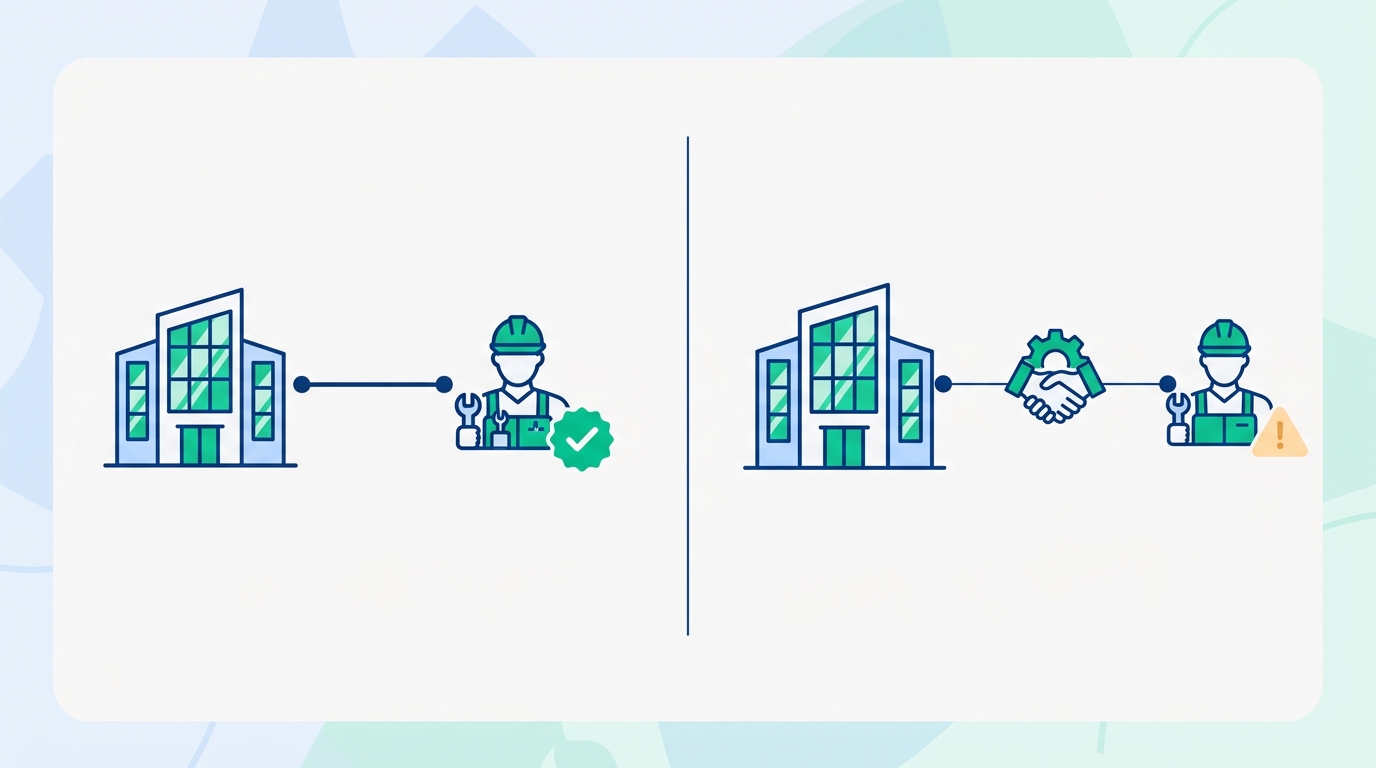
In most countries, the practical difference between an "owned entity" provider and an "aggregator" (one that resells a local partner's entity) is a matter of quality and support. In France, it edges closer to a matter of legality and liability. Because the compliant structure is direct employment by a French company, the entity that issues the bulletin de paie is the one carrying the labor-law obligations — and the one a French conseil de prud'hommes (labor tribunal) will look to in a dispute.
When a provider uses a third-party partner entity for France, you add a layer between you and that liability, and you inherit whatever that partner's compliance posture happens to be. For a single contractor-style hire it may be fine. For a growing team of permanent cadres, the difference compounds.
Before you shortlist: three decisions that shape everything
Most France hiring mistakes are made before the first form is filled in. Settle these three questions before you request a single quote.
1. EOR vs. your own entity vs. portage salarial
Each vehicle solves a different problem. The table below is the quick way to confirm an EOR is actually the right one for your hire.
| Vehicle | Best for | Speed to hire | Who carries employer compliance |
|---|---|---|---|
| EOR (owned French entity) | 1–20 standard employees, no local entity, need to move fast | 1–2 weeks | The EOR |
| Portage salarial | A single autonomous consultant on a defined mission (≤36 months) | Days | The portage company |
| Your own French entity | Large, permanent presence (20+ heads, office, multi-year horizon) | 3–6 months | You |
2. CDI or CDD — permanent or fixed-term
France treats the open-ended contract (CDI) as the default and the fixed-term contract (CDD) as the exception, permitted only for specific, justifiable reasons such as a defined project, a seasonal peak, or replacing an absent employee. A CDD can't be used simply to "try someone out" — that's what the trial period is for — and it generally cannot be ended early by either side before its term. If in doubt, a CDI with a properly set période d'essai is the safe, standard choice, and it's what every provider below supports.
3. Budget for the real cost, not the salary
This is the number that surprises people most, and it matters far more than which provider you pick. Get it wrong and every offer you extend will be off by roughly a third — which is why the cost section comes before the provider reviews.
The 6 best EOR providers for France in 2026, at a glance
| Provider | France entity model | EOR fee (per employee/mo) | Deposit | Best for |
|---|---|---|---|---|
| Remote | Owned | $599 flat | None | Safest default for France |
| Deel | Owned | From $599 (Std); $899 Enterprise | Yes | Scaling teams, widest coverage |
| Rippling | Partner* | ~$499 + platform fees | Varies | Existing Rippling IT/HR customers |
| Multiplier | Owned | ~$400 | Varies | Lowest cost, 1–5 hires |
| Velocity Global (Pebl) | Owned | ~$799–$1,200 | Varies | High-touch, complex cases |
| Papaya Global | Owned | $20,000+/yr platform | Varies | 100+ employee payroll programs |
*Rippling owns entities in several primary markets and uses partners elsewhere; for France specifically, multiple 2026 analyses report a partner-entity arrangement. Confirm the current model directly with Rippling for your contract.
Complex markets like France sometimes carry a country-specific surcharge or a larger deposit on top of the list price, and rates are often negotiable once you reach 10–20+ employees. Always ask for a France-specific quote that itemizes the deposit, any surcharge, FX handling, and termination support before you compare providers on price.
How much hiring in France actually costs
The EOR fee is the smallest, most visible number — and the one buyers fixate on. The line item that determines your real budget is France's employer social burden. On top of an employee's gross salary, employers in France pay roughly 40–45% in employer social contributions (URSSAF), covering health, pension, unemployment, family benefits, and accident insurance.
The main components of the employer's share are:
- Health insurance — around 13% of gross at the full rate, uncapped.
- Old-age pension — about 8.55% up to the monthly social security ceiling (plafond de la sécurité sociale, set at €4,005/month for 2026, or €48,060/year), plus a smaller uncapped portion.
- Family allowance — 5.25% at the full rate.
- Unemployment insurance — roughly 4%, on earnings up to four times the ceiling.
- AGIRC-ARRCO supplementary pension.
- Work-accident insurance (AT/MP) — a rate URSSAF sets individually by sector and claims history.
A worked example for a €60,000 gross salary hire, using a mid-market EOR at $599/month:
- Gross annual salary: €60,000
- Employer social contributions (~43%): ~€25,800
- EOR platform fee: ~€6,600/year (≈$599 × 12)
- Approx. total annual cost: ~€92,400
The same logic scales up: a €100,000 gross salary commonly lands around €143,000–€147,000 in total employer cost before the EOR fee. France is one of the most expensive markets in the world to employ someone, and it's the statutory burden, not the EOR margin, that drives it.
Two practical takeaways. First, a $100–$200/month difference in platform fee is noise next to the employer burden — don't optimize the wrong number. Second, watch the costs that don't appear on the rate card: FX conversion (Deel typically applies a 3–5% spread on cross-border payouts), security deposits (one to two months of fully-loaded cost held upfront), and off-cycle or termination handling, which in France can be material because of statutory notice and severance. Your EOR will bill all of this through its monthly invoice, but model the loaded cost yourself before you agree a salary, so the offer is affordable at the total number rather than the headline one. For how per-employee flat fees compare with percentage-of-payroll pricing across markets, see our guide to EOR pricing models.
The 6 providers reviewed
1. Remote — best overall for France
Remote owns its French entity outright and applies a single flat $599/employee/month rate worldwide, with no security deposit. For France that combination is hard to beat: you get a direct CDI employer that manages URSSAF registration, the mutuelle enrollment, and convention collective alignment, with predictable pricing and no upfront cash drag. It's the provider we'd reach for first when France is a serious, lasting part of the plan rather than a one-off.
Pros
- Owned French entity; direct CDI employment
- Flat $599 everywhere — easy to forecast
- No deposit; better cash flow than deposit-takers
- Strong, France-localized benefits administration
Cons
- Fewer "everything-app" IT/device features than Rippling
- Add-on integrations less broad than Deel's marketplace
- Flat rate is less competitive at very low headcount vs Multiplier
2. Deel — best for scaling teams and broad coverage
Deel pairs an owned French entity with the deepest platform in the category: the widest country coverage, the largest integration marketplace, and strong contractor-to-employee conversion tooling if some of your French talent starts as freelancers. The trade-offs are financial rather than compliance-related — Deel requires a security deposit and typically applies a 3–5% FX spread on cross-border payments. If you're standing up a multi-country team and France is one node of several, Deel's breadth usually justifies it. For a France-only hire focused on cost predictability, Remote edges ahead. (See our full Deel vs Papaya Global comparison for the enterprise-payroll angle.)
Pros
- Owned French entity; CDI and CDD supported
- Broadest country coverage for multi-EU teams
- Largest integration and HR-app ecosystem
- Excellent contractor-to-employee conversion flow
Cons
- Security deposit ties up cash upfront
- 3–5% FX fees on cross-border payouts
- Enterprise tier ($899) needed for some advanced features
3. Rippling — best if you already run Rippling
Rippling's strength is the unified system: HR, IT, device management, and payroll under one roof. If your company already lives in Rippling, adding a French hire keeps everything in one console. The caveat for France is the entity model — Rippling owns entities in several primary markets but, per multiple 2026 analyses, uses a partner entity for France. For a straightforward single CDI that may be perfectly workable; for a growing team navigating complex conventions collectives, an owned-entity provider is the safer structural choice. Note the platform also layers per-employee and base fees on top of the EOR rate.
Pros
- Best-in-class unified HR + IT + payroll
- Smooth device and app provisioning for new hires
- Competitive headline EOR rate
Cons
- Partner (not owned) entity reported for France
- Stacked platform fees reduce the headline savings
- Less France-specific depth than Remote or Deel
4. Multiplier — best value for small headcount
Multiplier runs an owned-entity model with one of the lowest platform fees in the market — around $400/employee/month. For one to five France hires where budget is the deciding factor, that gap is real money (over a small team it can save tens of thousands a year in platform fees versus premium-priced rivals). You give up some of the polish and ecosystem breadth of Remote and Deel, but the core compliance machinery — URSSAF, mutuelle, payroll filings — is covered.
Pros
- Lowest platform fee among owned-entity providers
- Owned entity; standard CDI employment
- Fast, no-frills onboarding for small teams
Cons
- Thinner integration ecosystem
- Less hand-holding on complex collective agreements
- Brand recognition lower with French candidates
5. Velocity Global (Pebl) — best for high-touch, complex cases
Velocity Global, rebranded Pebl, sits at the premium end with a high-touch, advisory-led service. The owned-entity coverage is solid and the support is genuinely consultative, which earns its keep when you have unusual French situations — equity components, executive packages, or sensitive terminations. For a standard CDI engineer or marketer, the price premium over Remote is hard to justify, and the platform-fee delta over a 10–20 person team is substantial.
Pros
- Owned entity with consultative, white-glove support
- Strong on complex comp and edge-case compliance
Cons
- Among the most expensive options for France
- Overkill for straightforward CDI hires
- Post-rebrand product changes worth diligencing
6. Papaya Global — best for large, payroll-led programs
Papaya Global is a global payroll platform first and an EOR second. Its strength is consolidating and reporting on large, multi-country payroll at scale, with the analytics and treasury controls big finance teams want. The economics only make sense at meaningful headcount — annual platform fees in the five figures make it impractical for a handful of France hires. If you're running payroll for 100+ people across many countries and want France folded into one system, it belongs on your shortlist; otherwise it's the wrong tool.
Pros
- Enterprise-grade global payroll consolidation
- Deep reporting, analytics, and treasury controls
- Owned entity for France
Cons
- High annual platform minimum
- Not cost-viable for small France headcount
- EOR is secondary to its payroll focus
How to hire in France through an EOR: the step-by-step playbook
Once you've picked a provider, here's the full sequence from "we want to hire in France" to "our employee is on compliant payroll." With an experienced owned-entity EOR, most of steps 3–6 run in parallel inside the first two weeks.
Step 1 — Confirm an EOR is the right vehicle
Using the vehicle table above, confirm that you want standard employment (not portage salarial), that you're not ready to open an entity, and that the role is genuinely employment rather than a legitimately independent contractor. Treating a full-time, directed worker as a freelancer is a serious misclassification risk in France — the EOR route exists precisely to avoid it.
Step 2 — Choose and vet the provider
Prioritize a direct, owned entity in France, transparent handling of deposits, and clear per-employee pricing — the comparison table and reviews above cover each of these. Ask every finalist for a France-specific quote and a sample French contract before you sign. If you want a structured way to run that evaluation, our 7-question framework for choosing an EOR provider works well as a scoring sheet.
Step 3 — Build the offer around the true cost
With your loaded-cost model in hand, agree the gross salary and the package. Several benefits aren't optional in France: mutuelle health cover (at least 50% employer-funded), 50% reimbursement of the commuting pass, and paid leave that starts at five weeks per year, often supplemented by RTT days for employees whose working time exceeds the 35-hour framework. Your EOR will confirm what the applicable collective agreement adds on top.
Step 4 — Get the employment contract right
The EOR drafts a French-law contract covering role, working time, salary, and termination terms. Three things to check yourself:
- Convention collective: your employee's sector almost certainly falls under an industry-wide collective agreement that can raise minimum pay, add leave, or set specific rules. The EOR must apply the right one.
- Période d'essai (trial period): for a CDI, the initial maximum is 2 months for employés/ouvriers, 3 months for agents de maîtrise/technicians, and 4 months for cadres, renewable once — to 4, 6, and 8 months in total — only if the collective agreement and the contract allow it.
- Notice periods: once past the trial, ending a CDI is a formal, regulated process; notice commonly runs up to around three months for senior staff, and severance rules apply. There is no at-will employment in France.
Step 5 — Complete the pre-hire compliance
Before the start date, the EOR files the DPAE with URSSAF, enrolls the employee in the mutuelle, and schedules the occupational-health appointment (visite d'information et de prévention). GDPR privacy notices are issued for signature. Your job is to supply accurate candidate details and the agreed terms promptly so nothing slips past day one.
Step 6 — Onboard and run the first payroll
The employee enters bank details, emergency contacts, and benefit selections; the EOR issues the compliant payslip, withholds income tax at source, and files the monthly DSN. From there it's a normal payroll cycle — the EOR remits contributions to URSSAF, produces payslips, and tracks leave accrual. You approve time off and expenses and manage performance.
Step 7 — Operate the relationship and watch PE risk
Day-to-day, treat the person like any other team member. Two ongoing watch-items: keep the line clean between the legal employer (the EOR) and day-to-day direction (you), and stay aware of permanent establishment (PE) risk as your French presence grows. Our guide to EOR compliance mistakes that trigger permanent establishment risk covers the warning signs in detail.
What the one-to-two-week timeline really looks like
For an EU/EEA national already resident in France, a realistic sequence with an owned-entity provider is:
- Days 1–3: provider selected, France quote accepted, contract drafted.
- End of week one: contract signed and DPAE filed with URSSAF.
- Week two: mutuelle enrollment, occupational-health appointment scheduled, onboarding completed.
- Next payroll cycle: first compliant payslip and DSN filing.
Compare that with three to six months to stand up your own entity and payroll. For non-EU hires, the immigration process (see Step 5) extends the front end substantially.
France compliance: what a good EOR handles for you
Whichever provider you pick, the value is in correctly executing a specific, non-negotiable sequence of French obligations. Use this as your due-diligence checklist when you evaluate a provider's France service.
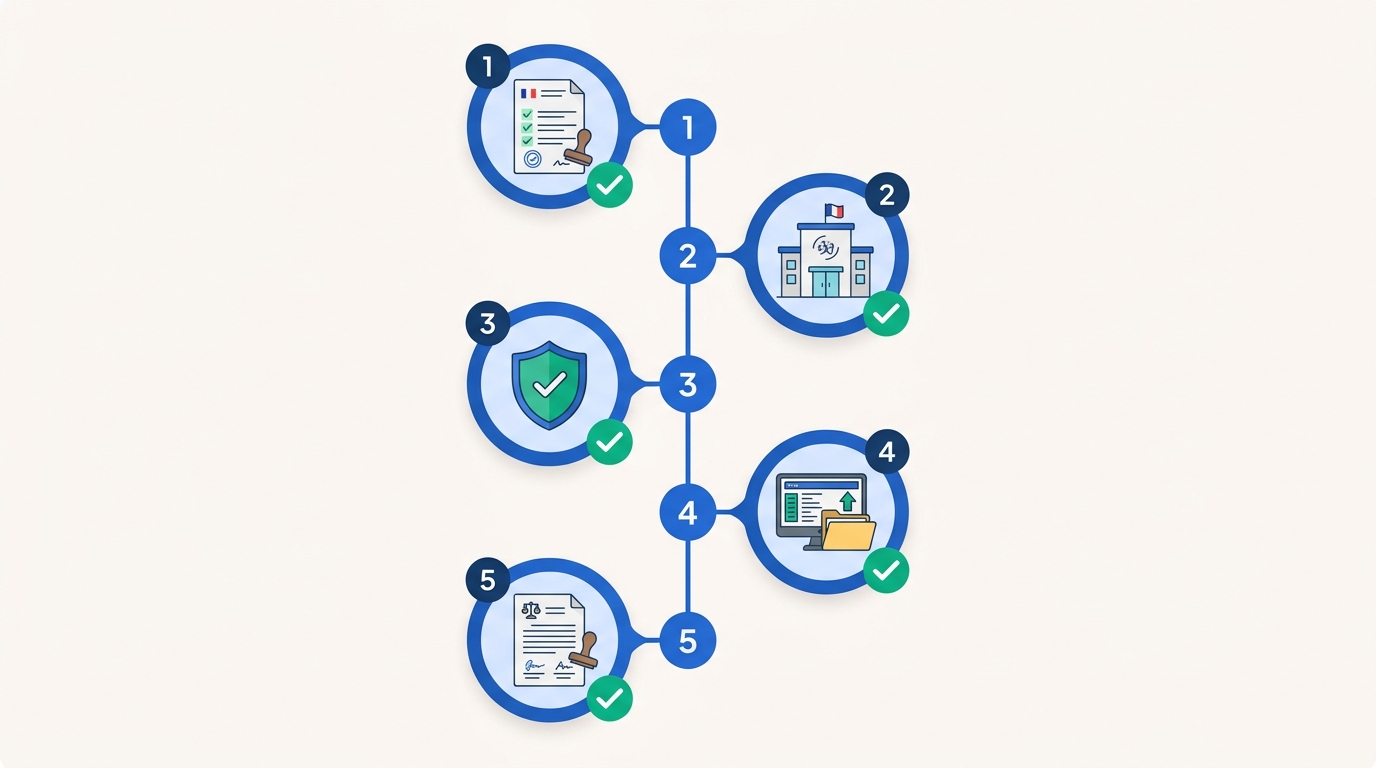
- DPAE (pre-hire declaration): the Déclaration Préalable à l'Embauche must be filed with URSSAF before the employee's first day. Missing it is a classic compliance failure.
- URSSAF registration & contributions: monthly calculation and payment of employer and employee social contributions, the backbone of French payroll.
- Mutuelle (complementary health): employers must offer it and cover at least 50% of the premium, per the ANI agreement.
- Occupational health: the visite d'information et de prévention with the occupational-health service must be organized for each new hire.
- Monthly DSN filing: the Déclaration Sociale Nominative consolidates social reporting to the authorities every month.
- Income tax at source: prélèvement à la source — the employer withholds income tax directly from each pay run.
- Convention collective alignment: France has roughly 700 industry agreements that can override the Labor Code on minimum pay, classifications, 13th-month bonuses, and extra leave. The right one must be applied to each hire.
- Compliant CDI & trial period: a permanent contract with a correctly set période d'essai — broadly 2 months for non-executive staff, 3 for technicians/supervisors, and up to 4 for cadres, each renewable once where the agreement permits.
Common mistakes to avoid
- Quoting salary before loading the cost. Promising €80k gross without modeling the ~40–45% employer charge, mutuelle, and transit reimbursement is the most common budgeting error.
- Choosing on platform fee alone. In France the entity model and the employer burden matter far more than a $100–$200/month fee gap.
- Using a CDD as a probation. Fixed-term contracts need a legitimate legal reason and are hard to exit early. Use a CDI with a proper trial period instead.
- Ignoring the convention collective. Sector agreements can override your defaults on pay, leave, and notice. Confirm which one applies.
- Treating France like your home market on termination. There's no at-will employment; plan notice and severance from day one.
- Confusing portage salarial with an EOR. They solve different problems — pick deliberately.
When an EOR is not the right answer for France
The EOR model has limits. If you're planning a large, permanent French operation — say, 20+ employees, an office, and a multi-year horizon — per-employee fees add up, and your own entity becomes more economical while giving you direct control. If you're engaging a genuinely independent consultant on a defined mission, portage salarial or a compliant contractor arrangement may fit better. And if the person is truly a freelancer serving several clients, forcing them into salaried employment isn't necessary. The EOR sweet spot is a handful of standard employees you want on compliant payroll, fast, without a local entity.
Hiring elsewhere in Europe too? The mechanics are similar across the EU, but the numbers and rules differ market by market — see our companion guides for hiring in Spain, Germany, and the Netherlands. If you're an early-stage team deciding how to run payroll as you scale, see our take on Rippling vs. Gusto for startups.
How we chose
We evaluated providers on five criteria, weighted for the French market specifically: (1) entity model — owned vs partner, weighted heavily given France's labor-lending restrictions; (2) true total cost — platform fee plus deposits, FX, and termination handling, not the headline rate alone; (3) France compliance depth — URSSAF, mutuelle, DSN, and convention collective handling; (4) pricing transparency and cash-flow impact; and (5) fit by team size. Provider pricing reflects each vendor's published 2026 rates as of June 2026; French employment rules (trial and notice periods, CDI vs. CDD, URSSAF contributions, and the DPAE/DSN requirements) were cross-referenced against official French public-service and social-security sources, and the 2026 social security ceiling (€4,005/month) was confirmed against the December 2025 ministerial order. Confirm current figures and your specific France terms directly with each provider before signing. Our assessment is based on documented research, not first-hand use of every platform.
Frequently asked questions
Is using an EOR in France legal?
Yes — when structured correctly. France prohibits for-profit labor lending, so a compliant EOR employs the worker directly through its own French entity on a standard contract, or uses the regulated portage salarial model where appropriate. Avoid arrangements that resemble simply "renting" staff, which can carry criminal penalties for the parties involved.
How much does an EOR cost in France?
Platform fees typically run from roughly $400 to $1,200 per employee per month, with most mid-market providers around $599. But the larger cost is France's ~40–45% employer social contributions on top of gross salary — a €100,000 salary commonly reaches about €143,000–€147,000 in total employer cost before the EOR fee. Add mutuelle, 50% transit reimbursement, and any meal vouchers, and budget the full loaded cost, not the platform fee in isolation.
Owned entity or partner entity — does it really matter in France?
More than in most countries. Because the compliant structure is direct employment by a French company, the entity issuing the contract carries the labor-law liability. An owned entity keeps that relationship clean and direct; a partner entity adds a layer and imports that partner's compliance posture. For permanent or growing teams, prefer owned.
What's the difference between EOR and portage salarial?
An EOR (via an owned entity) gives you standard employees on CDI/CDD contracts — the right fit for permanent roles and scalable to a team. Portage salarial is an umbrella model for autonomous independent professionals on defined missions, with a ~36-month cap and a salary floor. Using portage for someone working like a full-time employee risks legal requalification.
How fast can I onboard someone in France through an EOR?
For an EU national already living in France, typically one to two weeks with an owned-entity provider — drafting the contract, filing the DPAE, enrolling the mutuelle, scheduling the occupational-health visit, and setting up payroll. That's far faster than the three to six months it takes to incorporate your own French entity. Non-EU hires take longer because of work-authorization and OFII timelines; start those at least eight weeks ahead.
Can I terminate an EOR-employed worker in France easily?
No — France has no at-will employment. During the période d'essai (2–4 months for a CDI depending on category, renewable once if the collective agreement allows), termination is more flexible. After that, ending a CDI is a formal process with notice — commonly up to around three months for senior roles — and potential severance. Negotiated exits (rupture conventionnelle) also carry the higher 40% employer contribution from 2026. Your EOR manages the procedure, but plan for it from the outset.
Could using an EOR create a permanent establishment in France?
It can, independent of the EOR model. If your France-based employee signs contracts on your behalf, generates taxable revenue, or makes management decisions for your company from France, tax authorities may argue you have a permanent establishment. Keep roles operational rather than revenue-binding, and take tax advice for senior hires.

Technology consultant with 10+ years in the Japanese tech industry. Specializing in SaaS evaluation, workflow automation, and B2B tool integration.