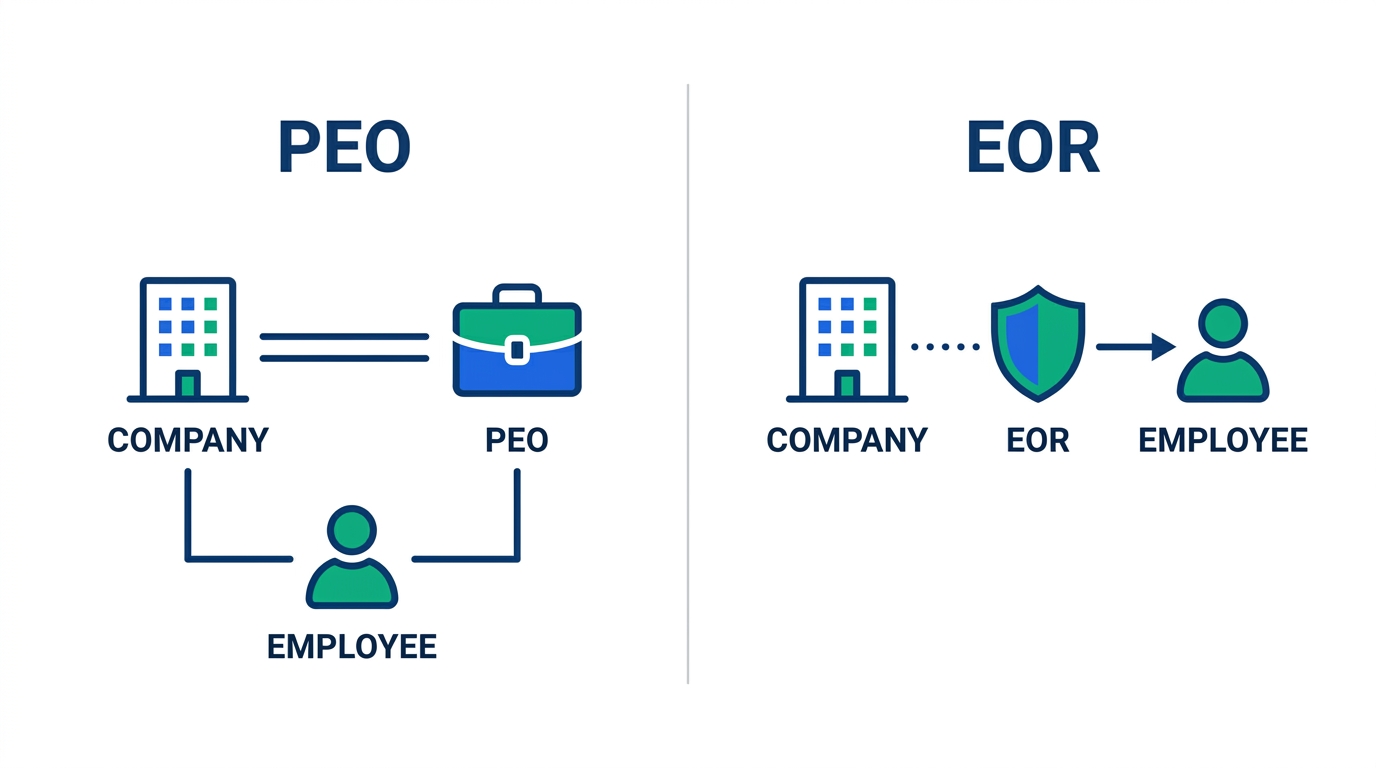
An EOR and a PEO solve two different problems, not the same problem at two price points. A PEO co-employs workers you could already employ directly — it's an HR outsourcing layer for a company that already has a legal entity, and it's mostly a US-domestic tool. An EOR is the sole legal employer of your workers — it exists specifically so you can hire in a country where you have no entity at all. If you're scaling US headcount and want payroll, benefits, and compliance off your plate, look at a PEO. If you're hiring your first person in France, Vietnam, or Kenya and don't have (or don't want) a local entity, a PEO can't help you — you need an EOR. Most of the confusion between the two comes from marketing copy that uses them interchangeably; the underlying legal relationship is not interchangeable at all.
| Dimension | PEO | EOR |
|---|---|---|
| Legal employer | Co-employer — shares the role with you | Sole legal employer of record |
| Entity required | Yes, you must already hold one | No — the EOR's own entity is used |
| Geography | Mostly single-country, largely a US market | Any country the provider operates in, often 100+ |
| Typical cost | ~2–12% of payroll, or $40–$200/employee/month | ~$300–$800+/employee/month |
| Time to first hire | Immediate, bounded by your own entity/registration | Days — no entity setup needed |
| Liability | Shared/joint — you retain meaningful exposure | Provider assumes statutory employer liability |
| Best for | Scaling domestic headcount without an internal HR team | Hiring where you have no legal entity |
What Is a PEO, Exactly?
A Professional Employer Organization enters into a co-employment agreement with your business. Your company keeps the legal employment relationship — you already have an entity, you already have an EIN, and you're already the employer of record on paper in the jurisdictions where you operate. The PEO effectively becomes a second, parallel employer for tax, payroll, and benefits purposes. In practice that means the PEO runs payroll, files employment taxes under its own umbrella, administers benefits (usually at group rates it negotiates across all its client companies), and handles a lot of the compliance paperwork you'd otherwise need an internal HR/payroll team for.
What a PEO does not do is remove the need for you to have a legal presence. If you don't have an entity in a state or country, a PEO can't put you there — it operates on top of an employment relationship that already legally exists. That's the single most important thing to understand before comparing pricing: PEOs are an outsourcing decision, not an expansion decision.
What Is an EOR, Exactly?
An Employer of Record does the opposite. The EOR is the sole, legal employer of the worker — it signs the employment contract, runs payroll through its own entity in that country, withholds and remits statutory taxes, provides the legally mandated benefits, and carries the compliance obligations that come with being the employer under local law. Your company directs the person's day-to-day work, but you never become their legal employer.
This is what makes an EOR useful for companies with no local entity: because the EOR already holds one (or a network of local partner entities) in the country you want to hire in, you can extend an offer and have someone legally employed within days instead of the two-to-four months it typically takes to register a foreign subsidiary, open a local bank account, and register for payroll taxes. The EOR's business model is built entirely around already having done that setup once and reselling access to it across many clients.
The Real Difference: Legal Employer vs. Co-Employer
Every practical difference between the two — cost, speed, geography, paperwork — traces back to this one legal distinction. A PEO is a co-employer: liability for wage-and-hour compliance, discrimination claims, and workplace safety is shared between you and the PEO, and that share is determined by which party actually exercised control over the specific decision being challenged, not by a flat 50/50 split written into the contract. An EOR is the sole employer: it assumes full statutory employer liability, and your company is contractually shielded from most direct employment claims because you were never the legal employer in the first place.
This matters more than most comparison articles let on, because "shared liability" is not the same thing as "outsourced liability." Federal courts, the EEOC, the Department of Labor, and the NLRB all apply joint-employer doctrines that can pull both a client company and its PEO into the same lawsuit — co-employment reduces administrative burden, but it does not erase legal exposure. Co-employment findings frequently surface in class or collective actions, and once class-action mechanics (attorney fees, cumulative damages across a worker class) are factored in, settlement multipliers in joint-employer cases can run 3 to 10 times the direct wage exposure of the underlying claim. If your company is risk-averse about employment litigation — or is hiring into a jurisdiction with aggressive labor enforcement — that exposure gap is worth putting in front of legal/finance before signing, not after.
Cost Breakdown: What You'll Actually Pay
As of August 2026, PEO pricing generally falls into two models: a flat per-employee-per-month (PEPM) fee, typically $40–$200, or a percentage of payroll, typically 2–12%. Industry body NAPEO puts the average PEO cost at roughly $1,395 per employee per year, with most businesses landing in the $500–$1,900 range depending on benefits richness and company size. Because PEO pricing is built around administering a workforce you already legally employ, it's fundamentally an HR-and-payroll-outsourcing line item, not an expansion cost.
EOR pricing runs meaningfully higher — published fees commonly land in the $300–$800+ per employee per month range, with several well-known providers clustering closer to $459–$599/month on standard plans. Annualized, that puts all-in EOR cost at roughly $3,600–$8,400 per employee per year, on top of the employee's own salary and benefits. That gap isn't padding — it's the cost of the EOR carrying full statutory employer liability and maintaining a compliant entity (or partner network) in a country where you have none. If you want the country-by-country math on when that annual fee is cheaper than standing up your own foreign subsidiary, we've broken that down separately in our EOR vs. setting up a foreign entity cost comparison.
Speed to Hire & Entity Requirements
This is where the two models diverge most sharply in practice. With a PEO, hiring speed is really a function of your own onboarding process — the PEO doesn't add much delay because you're already legally set up to employ in that state or country. The bottleneck, if there is one, is entity registration in a new US state, which most companies handle well before engaging a PEO.
With an EOR, the entity question is the whole point. Registering a foreign subsidiary typically involves 2–4 months of legal, banking, and tax-registration work before you can legally put a single person on payroll. An EOR removes that timeline entirely: because the provider's entity already exists and is already compliant, you can usually get an employment agreement signed and someone legally onboarded within days once background and right-to-work checks clear. That speed is the primary reason EORs are used for market testing — hiring one or two people in a country to validate demand before committing capital to a full subsidiary.
Compliance and Litigation Exposure: Who's Actually on the Hook
Beyond day-to-day payroll accuracy, the two models allocate ongoing regulatory risk very differently. A PEO keeps you as a co-employer, which means when local labor law changes — a new minimum-wage tier, a paid-leave mandate, a reclassification rule — your company still carries meaningful exposure if the PEO's guidance turns out to be wrong or your own managers make a decision that conflicts with it. One of the most common misreadings of a PEO relationship is treating "co-employment" as if it were "outsourced liability." It isn't. It's shared responsibility, and it only functions well when the services agreement is explicit about who owns which risk.
An EOR, by contrast, is structured so the provider carries the statutory employer obligations — tax withholding accuracy, mandatory benefits, termination procedure, and most wrongful-termination or misclassification exposure sit with the EOR because it is, legally, the employer. That's a meaningful risk transfer, but it isn't unconditional: you still own decisions that only a "real" manager can make (performance management direction, what work gets assigned, whether a role still exists), and a poorly chosen EOR with weak local compliance practices can still expose you to reputational and operational risk even if the legal liability sits with them on paper.
The Three Types of PEO (and Why It Matters for Your Decision)
"PEO" isn't a single, standardized offering — providers in this market typically fall into three buckets, and the label a vendor uses changes what you're actually buying:
- Standard / co-employment PEO — the model described throughout this article: full co-employment, shared employer-of-record status for tax and benefits purposes, and comprehensive HR services bundled in.
- CPEO (Certified PEO) — a standard PEO that has gone through IRS certification, which adds specific federal tax-liability protections for the client company around FICA and FUTA payments. If a vendor emphasizes "IRS-certified," this is what they mean, and it's worth confirming for larger payrolls.
- ASO (Administrative Services Organization) — administrative HR outsourcing without co-employment. You remain the sole employer of record, and the ASO just processes payroll and administers programs on your behalf. It's a lighter-touch, usually cheaper alternative when you don't want to share employer status at all.
Some large providers offer more than one of these under the same roof — Paychex, for example, sells both a PEO product (co-employment, marketed as Paychex HR Pro / Paychex Oasis) and a separate ASO product (Paychex HR Solutions) with no co-employment involved. When you're evaluating a "PEO," confirm which of the three you're actually being quoted, since it changes both the price and the liability picture materially.
Decision Framework: Which Does Your B2B Team Actually Need?
In our research, most teams that frame this as "EOR vs. PEO" are really asking one of four distinct questions. Match your situation below rather than picking a model in the abstract.
You're scaling headcount in the US (or one country you already operate in) and don't want to build an internal payroll/benefits team. This is the PEO's home turf. You already have the entity; you just want the administrative load and benefits-buying power off your plate. Compare providers by pricing transparency, benefits network, and how "software-first" vs. "service-led" the support model is — Justworks and Rippling lean toward workflow automation, while TriNet and Insperity lean toward hands-on compliance advisory for more regulated industries.
You want to hire your first employee in a country where you have no legal entity. This is the EOR's entire reason to exist. A PEO cannot solve this — it has nothing to attach to without an entity. Go straight to EOR pricing and coverage-country lists. If the country is one we've already profiled, start with our EOR guide for hiring in Poland or our EOR guide for hiring in Portugal for the specific reclassification-risk and pricing detail that varies by jurisdiction.
You're testing a new international market and aren't sure you'll keep the headcount. An EOR is almost always the right call here too, specifically because it avoids the sunk cost of entity registration. If the market doesn't work out, offboarding through an EOR is a contract termination; unwinding a foreign subsidiary is a formal, sometimes multi-month legal process.
You already have entities in every country you're hiring in, but your HR team is stretched thin across all of them. This is a less common case, but it's a PEO-style outsourcing decision repeated per country rather than a single EOR relationship — some larger EOR/global payroll platforms also offer this as an add-on. If your near-term roadmap is really "which provider do we standardize on across our existing entities," that's a provider-selection question rather than a model question; our Deel vs. Rippling comparison for global engineering teams and Deel vs. Remote pricing comparison cover that layer in more depth.
Pros and Cons at a Glance
PEO
Pros
- Lower cost per employee than an EOR
- Access to group-rate benefits normally reserved for larger employers
- Offloads payroll, tax filing, and much of HR admin
- No change to your legal employer status
Cons
- You must already hold a legal entity — can't be used for market entry
- Liability is shared, not transferred — meaningful exposure remains
- Mostly a US/single-country tool; limited global coverage
- Switching PEOs mid-year can complicate tax filings
EOR
Pros
- No local entity required — hire in days, not months
- Provider assumes statutory employer liability
- Handles local statutory benefits and termination procedure correctly
- Low-commitment way to test a new market
Cons
- Meaningfully more expensive per employee than a PEO
- You don't control the employment contract terms directly — the EOR does
- Not ideal as a permanent, large-scale structure for a country you're committing to long-term
- Provider quality varies a lot by country — verify local compliance track record

Where to Go From Here
If this article confirmed you need an EOR, the next decision is which provider and which country — pricing, contract terms, and statutory benefit obligations all vary meaningfully by jurisdiction. Start with the country-specific breakdowns for hiring in Poland and hiring in Portugal, or if you're still deciding between building your own entity and using an EOR at all, our EOR vs. foreign entity cost comparison walks through the break-even math country by country. If you've already ruled out entity setup and just need to pick a provider, Deel vs. Rippling for global engineering teams and Deel vs. Remote pricing compare two of the more commonly shortlisted platforms head to head.
If instead you're scaling a single-country team and just need payroll and benefits off your plate, the provider-level comparison is a separate research track we haven't published yet — for now, use the PEO cost ranges above as your budgeting baseline and weight software-first vs. service-led support against how much hands-on HR guidance your team actually needs.

Frequently Asked Questions
What are the three types of PEO?
Standard (co-employment) PEOs, CPEOs (IRS-certified PEOs with added federal tax-liability protection), and ASOs (administrative services organizations that outsource HR admin without co-employment). Some providers, like Paychex, sell more than one of these as separate products, so it's worth confirming which one a quote actually covers.
Is Paychex considered a PEO?
Yes, but not only that. Paychex offers a true co-employment PEO product (marketed as Paychex HR Pro and Paychex Oasis) as well as a separate ASO product, Paychex HR Solutions, which does not involve co-employment. Paychex reports serving more than one million worksite employees across these offerings combined.
What does PEO stand for in staffing?
Professional Employer Organization. It's distinct from a staffing agency: a staffing agency typically recruits and employs temporary or contract workers it places with clients, while a PEO co-employs a client's own permanent employees for payroll, benefits, and compliance purposes. The employees are yours; the PEO just shares the employer-of-record function.
Can you switch from a PEO to an EOR, or use both at once?
Yes to both. It's common for a company to use a PEO domestically for its US team while using an EOR for new international hires — they're not mutually exclusive, since they typically apply to different countries. Switching a domestic team from PEO to direct employment (or vice versa) is more involved, since it usually means re-registering payroll tax accounts under your own entity mid-year.
Do I need an EOR for a single remote hire, or can I just use a contractor?
That depends on the role and the country's worker-classification rules, not on headcount. If the person works set hours, uses your equipment, and takes direction like an employee, most jurisdictions will treat them as one regardless of the "contractor" label, and misclassification penalties can be significant. An EOR is the safer default for anyone who functions like a full-time employee, even if you're only hiring one person in that country.
Methodology
This article is based on our research into publicly published PEO and EOR pricing pages, cost-comparison guides, NAPEO industry benchmarks, and legal/compliance commentary on co-employment and joint-employer liability, current as of August 2026. Pricing ranges reflect published rates from comparison sources rather than direct quotes we obtained ourselves; always confirm current pricing directly with a provider before budgeting, since PEO and EOR fees are frequently negotiated per contract size and benefits package.
References & Sources
- Borderless — EOR vs PEO: Key Differences and How to Choose the Right Model in 2026 Annual EOR cost range ($3,600–$8,400/employee) and employment-structure comparison.
- EOR HQ — PEO Cost & Fees 2026: $40–$160 PEPM vs % of Payroll PEO pricing structure and NAPEO average cost benchmark.
- Zamp HR — How PEOs Prevent Co-Employment Risks Co-employment liability allocation and joint-employer doctrine background.
- Paychex — PEO vs. ASO vs. HRO: How Do They Differ? Paychex's own PEO and ASO product structure.
- Rippling — The 11 Best PEO Companies for HR Software in 2026 2026 PEO provider landscape and pricing range ($40–$150 PEPM or 2–12% of payroll).
- Sequoia — Choosing the Right PEO: 3 Models for Small but Growing Companies Standard PEO / CPEO / ASO classification.

Technology consultant with 10+ years in the Japanese tech industry. Specializing in SaaS evaluation, workflow automation, and B2B tool integration.