EOR vs. Setting Up a Foreign Entity (2026): The Break-Even Math, Country by Country
By Ken Hayashi ·
For most companies hiring in a new country, an EOR is cheaper until roughly 5 to 15 employees in that specific country — and the single biggest variable is not the country, it's which EOR contract you signed.
Run the same country through a $199/month provider instead of a $599/month provider and the break-even headcount roughly triples. In Germany, break-even lands at about 9 employees against a $599 list-price EOR, but around 27 employees against a $199 provider. Most published guides quote "15 to 30 employees" as though it were a property of the jurisdiction. It isn't. It's mostly a property of your procurement.
Two rules that survive every scenario we modeled: never open an entity to hire your first employee in a market, and never keep more than ~15 people in one country on a list-price EOR without at least renegotiating.
Section 01The mistake almost every comparison makes
Search this topic and you will find a dozen guides that compare "the cost of an EOR" against "the cost of an entity" by stacking up salary, employer taxes, benefits, and platform fees into two big numbers.
That comparison is wrong, and it is wrong in a way that systematically favors whichever option the publisher sells.
Here is the problem. If you hire a €80,000 engineer in Germany, you pay that €80,000 whether you use an EOR or your own GmbH. You also pay German employer social contributions — roughly 20.65% in 2026, split across pension (9.3%), health (~7.3%), unemployment (1.3%), and long-term care (1.5%) — under either model. France's employer burden of roughly 45% and Spain's 30.65% likewise apply to both.
Salary and statutory employer burden are identical on both sides of the equation. They cancel out. Including them in a comparison does nothing except inflate both numbers and make a 4% difference look like a rounding error.
The real decision is between two administrative cost structures: a per-employee recurring fee (EOR) versus a largely fixed annual cost of owning a legal entity (setup, compliance, filings, and your own team's time). Everything else is noise.
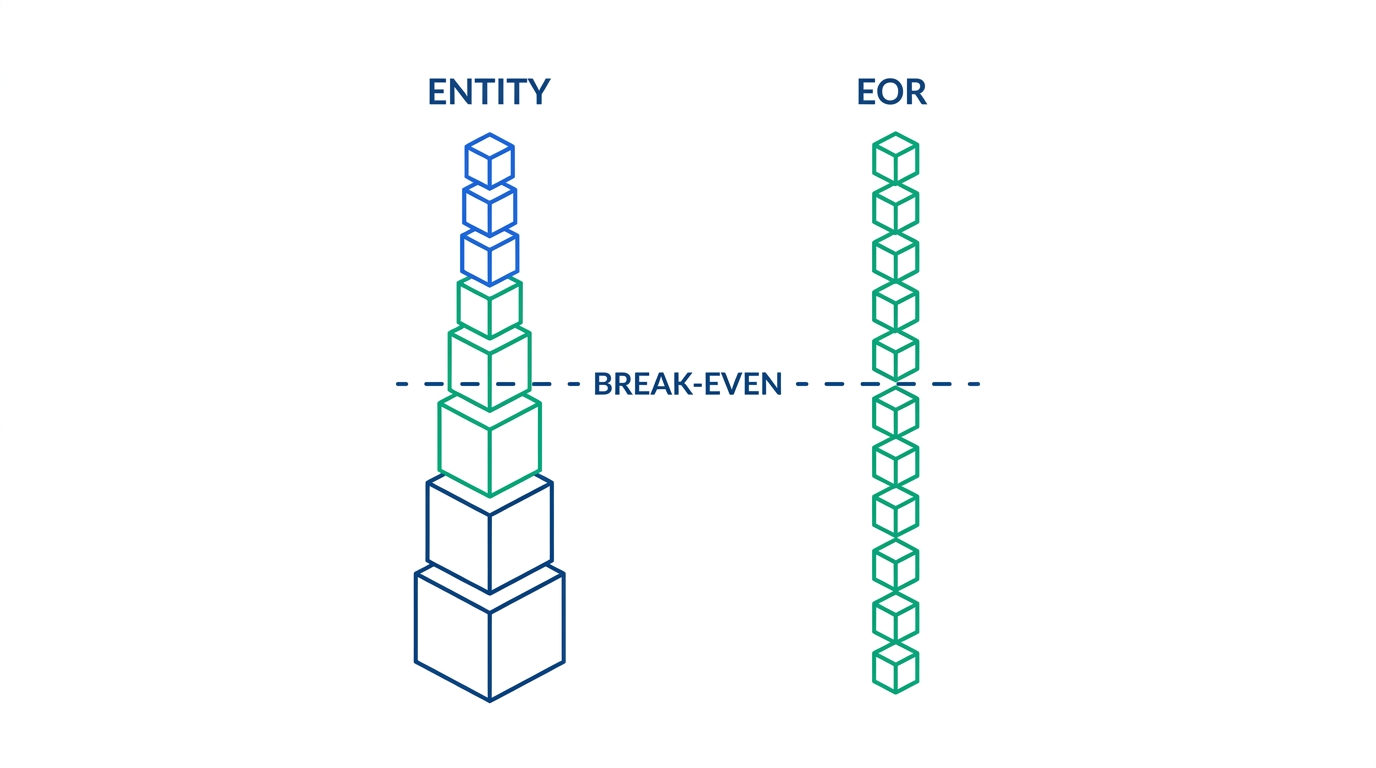
Once you strip out the cancelling terms, the shape of the problem becomes obvious. EOR cost is a straight line through the origin: it scales linearly with headcount and never flattens. Entity cost is a big step up front followed by a nearly flat line: it barely cares whether you employ 3 people or 30. Two lines with different shapes cross exactly once. That crossing point is the entire decision.
Section 02The formula
Here is the model in full. It has four inputs, and you can fill all four in about ten minutes with a quote from one EOR and one corporate services firm.
EOR cost = Headcount × PEPM × 12 × N
Break-even = Entity cost ÷ (PEPM × 12 × N)
// PEPM = per employee per month EOR fee
// Salary and employer taxes are excluded — they are
// identical under both models and cancel out.
We use a three-year horizon throughout this article. Three years is long enough for a $70,000 setup cost to amortize into something meaningful, and short enough that you are not pretending to forecast headcount in a market you entered last quarter. If your planning horizon is genuinely five years and your headcount forecast is genuinely reliable, substitute N=5 and the entity looks better. Be honest about whether it is.
Section 03What a foreign entity actually costs
Entity costs vary more by jurisdiction than anything else in this analysis. Published 2026 ranges from corporate services providers put initial setup between $20,000 and $150,000 depending on country, with ongoing compliance at $15,000 to $30,000 per country per year in most markets and $30,000 to $80,000 in the heavier Western European jurisdictions.
| Country | Setup (one-time) | Annual compliance | Typical timeline |
|---|---|---|---|
| Singapore | $20k – $35k | $15k – $22k | 1 – 3 days |
| United Kingdom | $25k – $50k | $16k – $24k | 1 – 2 weeks |
| Netherlands | $25k – $50k | $18k – $26k | 3 days – 4 weeks |
| India | $30k – $60k | $18k – $28k | 4 – 8 weeks |
| United States | $30k – $80k | $18k – $28k | 1 – 3 weeks |
| Germany | $50k – $90k | $20k – $32k | 2 – 8 weeks |
| Mexico | $50k – $100k | $20k – $30k | 6 – 12 weeks |
| France | $60k – $120k | $24k – $38k | 2 – 4 weeks |
| Brazil | $80k – $150k | $28k – $45k | 3 – 6 months |
Two things in that table deserve more attention than they usually get.
Setup cost is not the incorporation fee
Government registration fees are trivial — often between $29 and a few hundred dollars. The $50,000 in Germany is legal drafting, notarization, tax registration, a local registered address, banking setup, payroll system configuration, benefits brokerage, and the advisory hours to coordinate all of it. Founders routinely benchmark against the registration fee, then discover the real number is two orders of magnitude higher.
Minimum share capital is trapped cash
A German GmbH requires €25,000 in share capital with at least €12,500 paid in before registration. That is not a fee — you still own the money — but it is capital locked in a foreign bank account that your treasury cannot deploy elsewhere, and repatriating it later means unwinding the entity. A Dutch BV, by contrast, requires as little as €0.01. If you are capital-constrained, this difference matters more than a few thousand dollars of advisory fees, and almost no comparison guide mentions it.
Brazil at 3–6 months means a candidate you want to hire in September starts in March. Either you lose them, or you bridge with an EOR anyway — which is why "entity from day one" is rarely a real option even for companies that have decided on an entity.
Section 04What an EOR actually costs
EOR pricing has stratified into three fairly clean tiers in 2026. The spread between them is wide enough that your provider choice moves the break-even point further than your country choice does.
| Provider | List PEPM | Tier |
|---|---|---|
| Remofirst | $199 | Budget |
| Skuad | $199 | Budget |
| Gloroots | $199 | Budget |
| Rivermate | €299 | Budget |
| Multiplier | $400 | Mid |
| WorkMotion | $549 | Mid |
| Deel | $599 | Premium |
| Remote | $599 – $699 | Premium |
| Atlas HXM | $599 | Premium |
| Oyster | $499 – $699 | Premium |
Pricing shown is list price as published in 2026; several providers discount on annual commitment. We compare Deel and Remote line by line in our Deel vs. Remote pricing comparison for 2026, and the broader platform landscape in our roundup of the best payroll software for international teams.
The headline price is 5–15% short
Every EOR contract carries fees that do not appear on the pricing page. Budget roughly 5% to 15% on top of the headline PEPM annually:
- Security deposit — typically 1–2 months of total cost (salary + burden + fee), refundable but a real working-capital hit
- Onboarding fee — $0–$500 per new employee
- FX markup — 1–3% on currency conversion, easy to miss and charged on the full salary, not just the fee
- Termination handling — $250–$1,000 per exit
- Off-cycle payroll runs — $50–$250 each
- Benefits broker markup — 5–15% of premium
- Visa and immigration support — $1,500–$5,000 per case
The FX markup is the one that catches finance teams. A 2% markup on a €80,000 salary is €1,600 a year — comparable to three months of a budget-tier EOR fee, charged silently.
Volume discounts are real and materially change the math
List price is a starting position. Companies placing 20 or more employees commonly negotiate to roughly $400–$500 PEPM, and 50+ on multi-year terms have reported effective rates near $315–$400. This matters because it is precisely the headcount range where entity setup starts to look attractive — meaning the EOR gets cheaper exactly when you were about to leave. Any break-even calculation using list price at 30 employees is comparing against a price you would never actually pay.
Deel
$599 PEPM list, 150+ countries, and the deepest in-house entity network of the premium providers — which matters if you expect to convert to your own entity later and want the same vendor to run both. Volume pricing is negotiable from ~20 seats.
Section 05Break-even headcount, country by country
This is the table the other guides do not publish. Each cell is the number of employees in that single country at which a three-year entity cost equals three years of EOR fees.
Inputs use the midpoint of the setup and compliance ranges above, plus internal overhead (explained in the next section). Read across a row to see how much your provider tier moves the answer.
| Country | 3-yr entity cost | vs $199 EOR | vs $449 EOR | vs $599 EOR |
|---|---|---|---|---|
| Singapore | $117,500 | 16 | 7 | 5 |
| United Kingdom | $133,500 | 19 | 8 | 6 |
| India | $153,000 | 21 | 9 | 7 |
| United States | $163,000 | 23 | 10 | 8 |
| Mexico | $195,000 | 27 | 12 | 9 |
| Germany | $196,000 | 27 | 12 | 9 |
| France | $234,000 | 33 | 14 | 11 |
| Brazil | $280,000 | 39 | 17 | 13 |
Across every country, moving from a premium EOR to a budget EOR pushes break-even out by roughly 3x. The gap between the cheapest country (Singapore) and the most expensive (Brazil) at a fixed price tier is only about 2.5x. Your vendor choice moves this decision more than your geography does — and unlike geography, vendor choice is something you control.
If you are hiring in a market covered by our country guides, the provider landscape differs meaningfully by jurisdiction — see our comparisons for EOR providers in Germany, France, the Netherlands, Spain, and Portugal. Not every provider operates its own entity in every country; some subcontract to local partners, which affects both price and liability.
Section 06The three costs nobody models
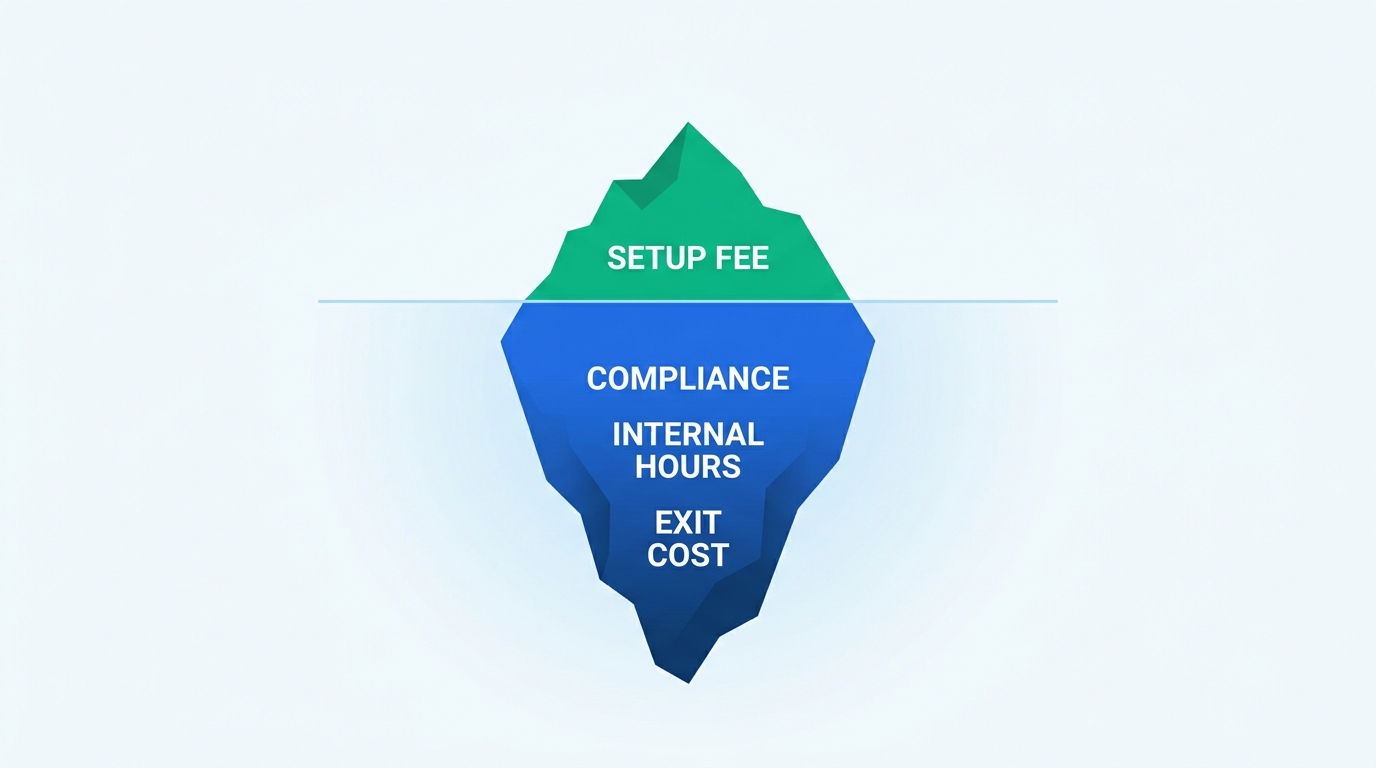
1. Your own team's hours
An entity does not run itself. Someone at your company reviews local filings, approves statutory accounts, coordinates with the local accountant, signs off on payroll, and answers questions from the corporate registry. Published estimates put this at 8–15 hours per month of finance or legal time. At a loaded cost of $80–$150/hour for senior finance staff, that is $7,600–$27,000 per year, per country.
This cost is invisible because it never appears on an invoice. It shows up as your controller having less time. Our model includes it at $12,000–$20,000 per country per year depending on jurisdiction complexity — and excluding it is the single most common way entity costs get understated.
2. Exit cost
Opening an entity is a decision you can reverse only slowly and expensively. Wind-down is not the mirror image of setup; it is typically worse.
- Poland: a straightforward liquidation realistically takes 7–9 months — driven by a mandatory three-month creditor claim window and a six-month wait before assets can be distributed. Complex cases run 12–18 months.
- UAE: roughly 2–3 months and AED 10,000–25,000, with a mandatory 45-day creditor period.
- Germany: one mid-size tech company reported total dissolution costs exceeding €85,000 over 14 months for a GmbH wind-down.
- Brazil and India: commonly cited at two years or more.
Throughout that period you are still paying for compliance, filings, and a local accountant on an entity that produces nothing.
3. The option value of being wrong
This is the one that never appears in any comparison, and it is the one a CFO should care about most.
Suppose your Germany break-even is 9 employees and you expect to reach 12. Opening the entity looks correct. But you are not certain about that forecast — call it 70% confident. If the market underperforms and you wind down at 18 months, you eat the setup cost plus a wind-down that could exceed €85,000.
Fold that in and the decision changes:
// Germany, 30% chance of exit within 3 years:
$196,000 + (0.30 × $90,000) = $223,000
// Break-even moves from 9 employees to ~10–11.
The practical implication: uncertainty is worth roughly two employees of headroom. If your forecast sits within two or three people of the break-even line, the EOR is the correct choice even when the point estimate says otherwise — because you are buying the right to change your mind for approximately the cost of one extra seat.
Section 07Worked example: Germany over three years
Concrete numbers, using the model above. Entity cost is $196,000 over three years ($70,000 setup + 3 × $26,000 compliance + 3 × $16,000 internal hours). Salary and the 20.65% employer burden are excluded from both columns because they are identical.
| Headcount | EOR @ list $599 | EOR @ negotiated | Own entity | Cheaper |
|---|---|---|---|---|
| 1 | $21,564 | $21,564 | $196,000 | EOR |
| 3 | $64,692 | $64,692 | $196,000 | EOR |
| 5 | $107,820 | $107,820 | $196,000 | EOR |
| 9 | $194,076 | $194,076 | $196,000 | Break-even |
| 12 | $258,768 | $226,800 | $196,000 | Entity |
| 20 | $431,280 | $324,000 | $196,000 | Entity |
| 50 | $1,078,200 | $675,000 | $196,000 | Entity |
Note the row at 12 employees. At list price the EOR costs $258,768, but a company placing 12 seats would realistically negotiate toward ~$525 PEPM, bringing it to $226,800. The entity still wins — but by $31,000 over three years, not $63,000. Factoring in realistic negotiated pricing moves Germany's true break-even from 9 employees to about 11.
Remote
$599–$699 PEPM with owned entities across its core markets. Worth shortlisting if your three-year plan crosses the break-even line, since staying with one vendor through an EOR-to-entity transition avoids a second migration.
Section 08Decision rules
Use an EOR when
- You are hiring your first 1–5 people in a country — this is unambiguous at every price tier and in every jurisdiction
- Your headcount forecast sits within ~2 employees of the break-even line
- You are testing market demand and might exit within 24 months
- You need someone to start in weeks, not months
- You are hiring across many countries thinly — 3 people each in 6 countries is 6 entities and 6 sets of internal overhead
- You lack in-house international payroll and employment law capability
Open an entity when
- You are confidently above break-even for that country and expect to stay there 3+ years
- The market is proven — you have revenue there, not just a hiring plan
- You need to sign local contracts, hold a local license, or invoice locally
- You require direct IP assignment under local law without an intermediary employer
- Equity grants to local staff are central to your compensation model
- You need operational control an EOR cannot give: bespoke benefits, non-standard contract terms, works council arrangements
Notice that the right-hand column contains several reasons that have nothing to do with cost. This is important: above a certain size, the entity decision usually stops being financial. Companies that need to invoice locally or grant local equity open an entity at 4 employees and accept the cost. Companies that need neither can stay on an EOR well past break-even if they value the flexibility. The math tells you the price of your preference; it does not make the decision for you.
Section 09The hybrid path is the actual default
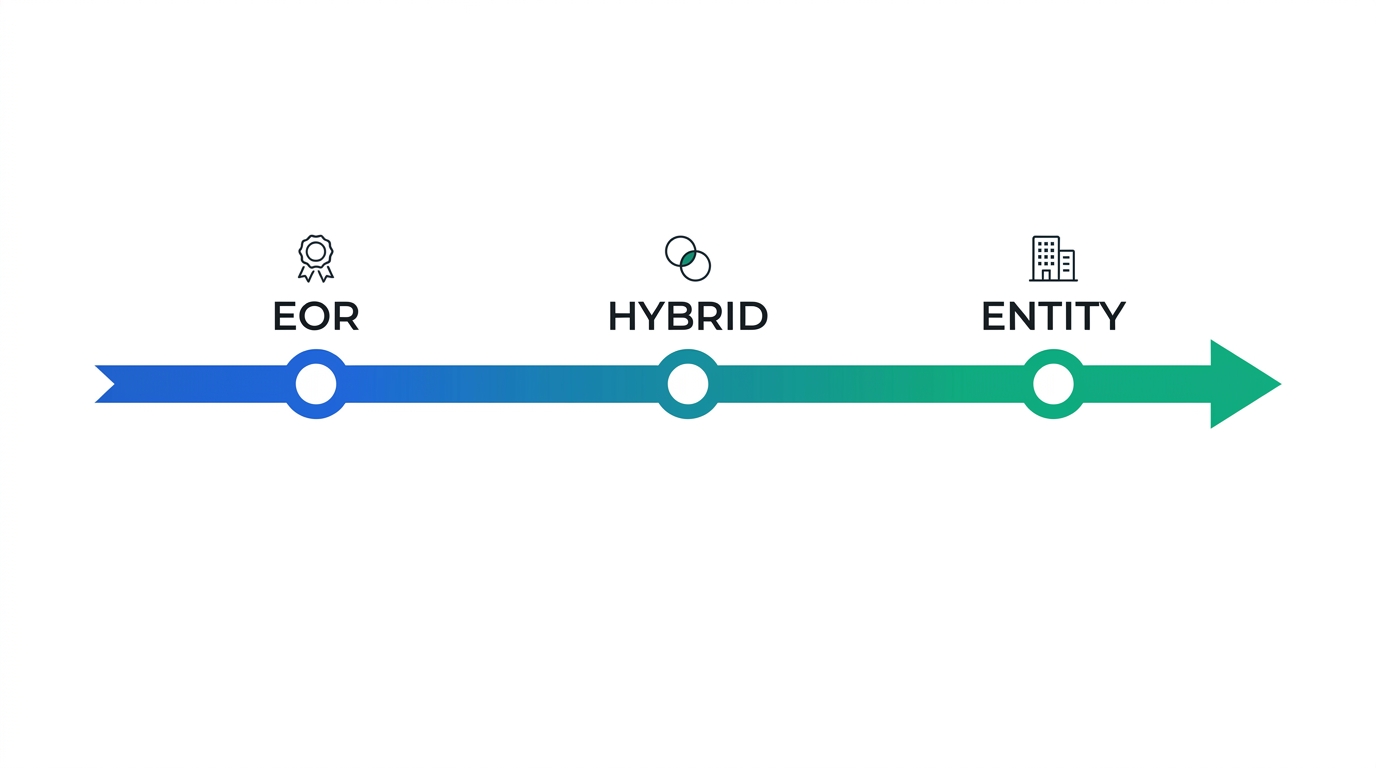
Framing this as a binary choice is the last mistake worth avoiding. In practice most companies that end up with a German entity got there like this:
- Months 0–12 — EOR. Hire the first 3–8 people. Zero setup cost, hires start in days, and if the market disappoints you leave by giving notice rather than by running a 14-month liquidation.
- Months 9–15 — Incorporate in parallel. Once headcount is clearly trending past break-even, start the entity. Germany takes 2–8 weeks; Brazil takes 3–6 months. Begin before you need it, not after.
- Months 12–18 — Transfer. Move employees from the EOR to the new entity. This is a real employment-law event in most jurisdictions: new contracts, continuity of service, preserved seniority, sometimes works council consultation. Budget legal review and expect to run both models in parallel for at least one payroll cycle.
- Ongoing — Keep the EOR for the long tail. Most companies keep an EOR relationship for the countries where they have 1–3 people. You are not choosing a company-wide model; you are choosing per country.
Transferring staff from an EOR to your own entity is the least-documented step in this whole process and the one most likely to generate an unbudgeted legal bill. Ask any prospective EOR two questions during procurement: what does transferring an employee to our own entity involve, and what does it cost. The answers vary widely, and they are much harder to negotiate once you are already a customer.
If you are working through the practical mechanics of a first EOR hire, our step-by-step walkthroughs for hiring an employee in France via an EOR and hiring in the Netherlands via an EOR cover the documentation and onboarding sequence in detail.
Compare budget-tier EOR providers
If you are hiring 1–3 people each across several countries, a $199 PEPM provider pushes break-even out to 20–35 employees per country and makes the entity question irrelevant for years. Verify entity ownership per country before signing — budget providers more often subcontract to local partners.
Section 10Frequently asked questions
At what headcount does an entity become cheaper than an EOR?
Between about 5 and 39 employees in a single country, depending on the jurisdiction and your EOR rate. Against a premium $599/month EOR, break-even lands at roughly 5–13 employees; against a $199/month provider, it moves to roughly 16–39. Widely quoted figures of "15 to 30 employees" assume a mid-tier EOR rate and rarely state that assumption.
Break-even is also per country, not company-wide. Thirty employees spread across six countries does not justify an entity anywhere.
Should salary and employer taxes be included in the comparison?
No. You pay the same salary and the same statutory employer contributions under both models — Germany's ~20.65%, France's ~45%, Spain's 30.65% apply whether the legal employer is an EOR or your own subsidiary. Including them inflates both sides equally and obscures the administrative difference that actually drives the decision.
The one caveat: some EORs charge a percentage-based fee (typically 8–15% of gross salary) rather than a flat rate. In that case salary does affect the EOR side, and high-salary roles push break-even down sharply. For senior engineering hires, flat-fee pricing is almost always cheaper.
What does it cost to close a foreign entity?
More than most companies budget, and it takes far longer than setup. A straightforward Polish liquidation takes 7–9 months because of a mandatory three-month creditor claim window and a six-month wait before distributing assets; complex cases run 12–18 months. One reported German GmbH wind-down cost over €85,000 across 14 months. UAE liquidation runs roughly AED 10,000–25,000 over 2–3 months.
Because exit is slow and expensive, entity setup should be treated as a semi-permanent commitment, and the probability of exit should be priced into the decision up front.
Can I negotiate EOR pricing?
Yes, and you should — it is the highest-leverage action available in this entire decision. Companies placing 20+ employees commonly negotiate premium providers from $599 down to $400–$500 PEPM, and 50+ seats on multi-year terms have reached roughly $315–$400.
Also negotiate the non-obvious terms: FX markup, security deposit size, termination fees, and the cost of transferring employees to your own entity later. These add 5–15% annually and receive far less scrutiny than the headline rate.
Do I still need an entity if I only hire contractors?
Usually not, but contractor status is the most aggressively audited area in global hiring. If a contractor works full-time hours, uses your equipment, follows your schedule, and has no other clients, most jurisdictions will treat them as an employee regardless of the contract — with back taxes, social contributions, and penalties owed by you.
An EOR exists precisely to solve this: it converts a misclassification risk into a per-month fee. If your "contractors" look like employees, the comparison is not EOR vs. contractor — it is EOR vs. an eventual reclassification assessment.
Methodology
Break-even figures are calculated over a three-year horizon using the midpoint of published 2026 setup and annual compliance ranges from corporate services and EOR providers, plus an internal-overhead allowance of $12,000–$20,000 per country per year derived from the widely cited 8–15 finance/legal hours per month at a $80–$150 loaded hourly rate. Salary and statutory employer contributions are excluded from both sides because they are identical under either model. EOR pricing reflects publicly listed 2026 rates; negotiated-rate columns apply reported volume discount tiers ($525 PEPM at 10–19 seats, $450 at 20–49, $375 at 50+). Entity costs are modeled as headcount-independent, which slightly favors the entity at high headcount since payroll administration does scale modestly. Figures are planning estimates, not quotes — actual costs vary by industry, city, capital structure, and advisor. Verify against live quotes before committing. Based on our research; StackScout does not provide legal or tax advice.
Sources & further reading
- Deel — "EOR vs. Entity Costs: What's More Affordable?" (EOR annual service fee and UK entity setup ranges), accessed August 2026.
- RemotePeople — "EOR Cost 2026: 31-Provider Pricing Comparison & Hidden Fees" (provider list pricing, hidden fee categories, entity setup costs by country), accessed August 2026.
- Safeguard Global — "Build vs. Buy: The Real Cost of Setting Up Foreign Entities", accessed August 2026.
- Knit People — "EOR vs. Setting Up a Foreign Entity: The Cost Math Most Expansion Guides Get Wrong" (internal overhead hours, German GmbH dissolution case), accessed August 2026.
- GoGlobal — "Setting Up a GmbH in Germany: Timeline, Costs and Step-by-Step Process" (share capital and formation timeline), accessed August 2026.
- Sarego Finance — "Liquidation of a Polish Sp. z o.o. in 2026: Step-by-Step Guide" (creditor claim periods and liquidation timelines), accessed August 2026.
- Europe HR Solutions — "Social Security Tax Rate in Europe: 2026 Guide" (employer contribution rates), accessed August 2026.
- PwC Worldwide Tax Summaries — Spain, Other Taxes (employer social security contribution rate), accessed August 2026.

Technology consultant with 10+ years in the Japanese tech industry. Specializing in SaaS evaluation, workflow automation, and B2B tool integration.