Best EOR for Hiring in Canada (2026): 8 Providers Compared on Price, Speed, and Provincial Compliance
Deel and Remote are the safest defaults for a first Canadian hire — Deel lists Canada at a flat $599/employee/month, Remote matches that price on annual billing (it's $699/month if you pay monthly), both onboard in days, and both have handled enough Canadian payroll runs to have the provincial edge cases (Quebec's QPP, statutory holiday variance, francization thresholds) already built into their platform. If your Canadian hires are the first of a broader US-Canada build-out and you already run HR/IT/payroll through one system, Rippling is worth the custom quote for its native North American payroll rails. If budget is the constraint and you're hiring one or two people to test a market, RemoFirst, Boundless, or Skuad all publish $199/employee/month rates. The variable that actually changes the answer isn't the vendor — it's whether every hire lands in one province or is spread across Ontario, Quebec, and British Columbia, because Quebec alone runs a different pension plan, a different parental insurance scheme, and a French-language law that most EOR comparison content treats as a footnote.
Every "best EOR in Canada" list published this year runs the same nine or ten vendors through the same three columns — price, onboarding speed, countries covered — and calls it done. That's a reasonable start if you're hiring one contractor in Toronto. It falls apart the moment a VP Engineering says "let's also open a Montreal office" or an HR director is asked to staff a support team split between Vancouver and Ottawa. Canada isn't a single labor market with one set of rules; it's ten provinces and three territories, and the compliance gap between them is bigger than the gap between most EU countries. This guide compares the eight providers most commonly shortlisted for Canadian hiring, then spends the second half on the part that decides whether the vendor you pick actually protects you: what changes when your Canadian headcount stops being one province.
Quick Comparison: 8 EOR Providers for Canada
| Provider | EOR Fee | Pricing Model | Standout Strength for Canada |
|---|---|---|---|
| Deel | $599/mo | Flat, per country | Fastest onboarding (2–4 business days); strongest if Canada is one of several markets |
| Remote | $599/mo (annual) · $699/mo (monthly) | Flat, per country | Owns its legal entities directly rather than routing through local partners |
| Rippling | ~$499–599/mo | Custom quote | Native US-Canada payroll inside one HR/IT/payroll platform |
| RemoFirst | $199/mo | Flat, global rate | Lowest published price; good for a first hire while you validate the market |
| Boundless | $199/mo | Flat, global rate | Canada-first content and support; sells itself specifically on this market |
| Oyster | $699/mo (monthly) · $499/mo (annual) + FX | Flat, global rate | Public pricing calculator, built-in benefits marketplace |
| G-P | ~$700–1,000+/mo | Custom quote | Enterprise-grade in-country legal backing; strongest for regulated industries |
| Skuad | $199/mo | Flat, global rate | Budget alternative with coverage across 110+ countries |
Pricing as publicly listed or quoted as of September 2026. Rippling and G-P do not publish flat Canada rates; figures are third-party reported ranges, not vendor-confirmed prices — get a quote before budgeting. Volume discounts of roughly $350–$500/employee/month have been reported once headcount passes 20–50 across most vendors.
Two of these numbers deserve a flag before you go further. Deel and Remote land at the exact same $599 headline price, which means the real decision between them is operational, not financial — see our full Deel vs Remote pricing comparison for how the total cost of ownership diverges once benefits administration and FX markups are included. And if Rippling is on your shortlist because you're also evaluating it for US payroll, the Canada decision is really a platform decision — we cover that trade-off in Deel vs Rippling for global engineering teams.
Why Canada Isn't One Labor Market
Federal rules (CPP, EI, the Canada Labour Code for federally regulated industries) apply everywhere. Almost everything else — notice periods, vacation accrual, statutory holidays, language requirements, and pension contributions — is set provincially. An EOR's job is to absorb that variance so you never have to read an Employment Standards Act. But the three provinces that account for the large majority of tech and B2B hiring — Ontario, Quebec, and British Columbia — differ from each other more than most comparison articles let on.
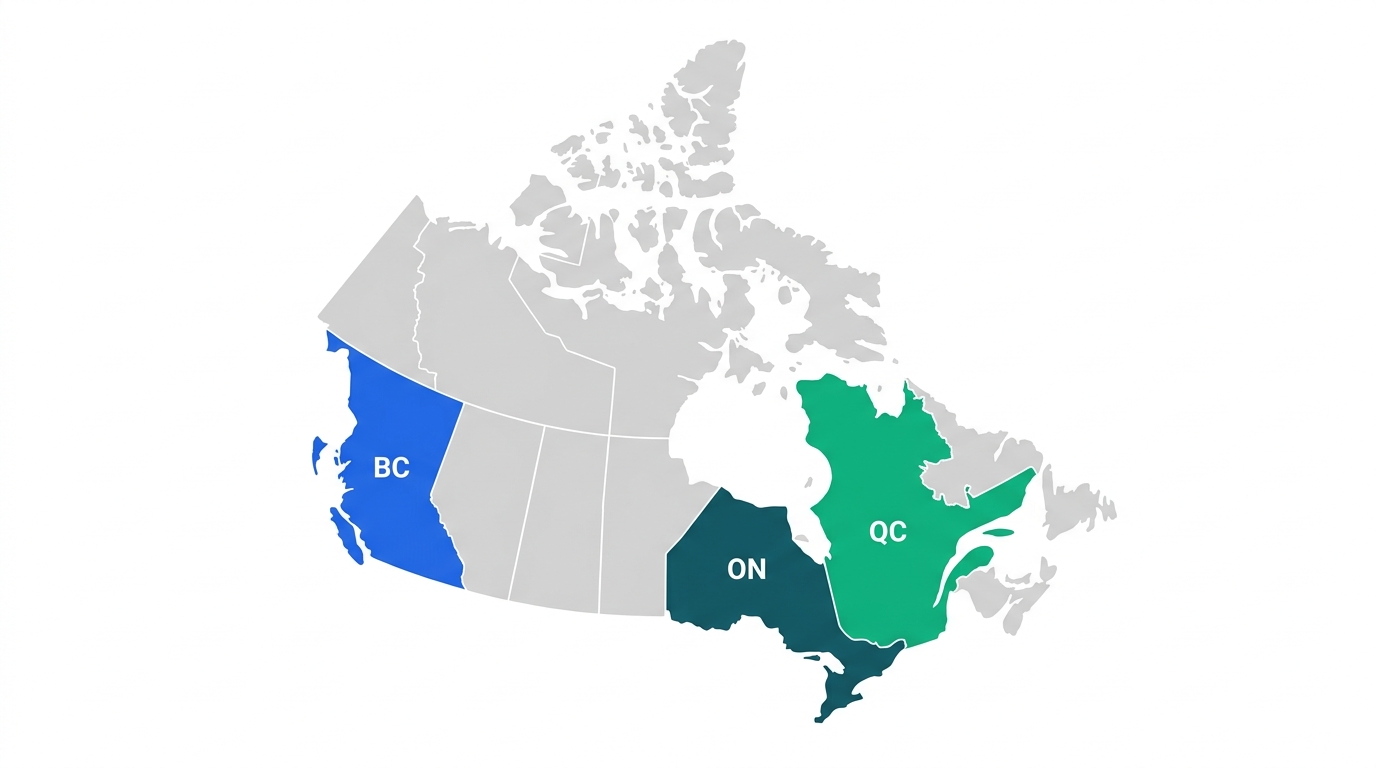
| Factor | Ontario | Quebec | British Columbia |
|---|---|---|---|
| Legal system | Common law | Civil law (Civil Code of Québec) | Common law |
| Statutory notice | 1–8 weeks by tenure (ESA floor) | 1–8 weeks by tenure, plus Civil Code "reasonable notice" | 1–8 weeks by tenure (ESA floor) |
| Vacation minimum | 2 wks (4%) yr 1 → 3 wks (6%) after 5 yrs | 1 wk (4%) yr 1 → 2 wks after 1 yr → 3 wks after 3 yrs | 2 wks (4%) after 1 yr → 3 wks (6%) after 5 yrs |
| Statutory holidays | 9 days | 8 days (no Remembrance Day) | 11 days (most of the three) |
| Employment documents | English (no restriction) | French mandatory by law (Bill 96) | English (no restriction) |
| Pension / income protection | CPP + federal EI | QPP + QPIP (both separate from the federal programs) | CPP + federal EI |
Two of these rows are the ones that catch US-based decision-makers off guard.
Quebec's language law isn't a formality. Bill 96 requires employment contracts, internal communications, and job postings for Quebec-based staff to be available in French by default; if a role genuinely requires English or another language, the employer has to be able to justify why. Since June 2025, the francization-registration threshold dropped from 50 employees to 25 — so a Quebec team that used to fly under the radar at 30–40 heads is now in scope. If you're planning to grow past a handful of Montreal hires, confirm with your EOR in writing that they handle French-language contract generation and OQLF francization filings, not just payroll remittance. Not every provider does this well by default.
Statutory minimums are a floor, not the actual severance risk. Every comparison table — including the one above — quotes ESA/CNESST statutory notice because that's the legal minimum. In practice, Ontario and BC common law (and Quebec's Civil Code Article 2091) allow terminated employees to claim "reasonable notice," which courts routinely set well beyond the statutory floor — sometimes multiple months for a longer-tenured, senior hire. An EOR's contract templates and termination process should already account for this gap; if a sales rep asks you to confirm the "notice period" and quotes only the ESA minimum, that's worth a follow-up question before you sign.
Ontario's Employment Standards Act requires employers to pay a minimum of three hours' wages if an employee is called in and then sent home early — the so-called "three-hour rule." It rarely affects salaried remote software or operations roles, but it matters if any Canadian hire is shift-based, hourly, or client-facing on a schedule. Confirm your EOR's payroll engine actually enforces this automatically rather than relying on manual review.
The 8 Providers, Reviewed
Deel
Deel is the default answer to "best EOR" almost everywhere, and for Canada specifically that reputation holds up: publicly reported onboarding times of two to four business days are faster than most of this list, and the platform's scale means Canadian payroll edge cases (multi-province remittance, T4 generation, ROE filing on termination) are well-trodden ground rather than a first-time build. It's the strongest pick if Canada is one stop in a broader global hiring plan, since you get one contract template and one invoice across every country.
Pros
- Fastest reported onboarding of the major providers
- Deep bench of in-house legal/compliance staff for edge cases
- One platform if you're also hiring outside Canada
Cons
- $599/mo is mid-to-high versus RemoFirst/Boundless/Skuad
- Support can feel less personal at scale than smaller providers
- Add-ons (benefits, equipment) increase the effective monthly cost
Remote
Remote's headline $599 rate applies to annual billing; paying month-to-month bumps the per-employee fee to $699 — worth factoring in before comparing it head-to-head with Deel's flat $599. Its differentiator is otherwise structural: it owns its legal entities in the countries it operates in rather than subcontracting to local partner firms, which some HR and legal teams treat as a lower counterparty-risk setup — there's no third party between you and the entity of record. For Canada, that translates into a more consistent experience if you're also running EOR hires in other Remote-owned markets and want one accountable party end to end, rather than a patchwork of local partners with varying service quality.
Pros
- Owned entities — no reliance on third-party local partners
- Consistent process if you're scaling across several Remote-covered countries
- Well-regarded benefits administration
Cons
- Matches Deel's $599 price only on annual billing ($699 monthly), with typically slower onboarding
- Owned-entity model means slower expansion into newer/smaller markets
- Less aggressive volume-discount messaging than Deel
Rippling
Rippling doesn't sell EOR as a standalone product the way the rest of this list does — it's one module inside a unified system that also runs US payroll, device management, IT provisioning, and benefits. For a US company adding its first Canadian employees while keeping everyone else on Rippling's US payroll, that's a genuine advantage: one login, one org chart, one approval workflow, rather than stitching a separate EOR vendor's portal into your existing HR stack. It's a weaker fit if you don't already run — or don't plan to run — the rest of your HR/IT on Rippling, since you'd be adopting a full platform to solve a single-country hiring problem. See Deel vs Rippling for global engineering teams for a deeper look at when the platform trade-off is worth it.
Pros
- Native North American payroll — strong US-Canada corridor
- Unifies EOR with IT, device management, and US payroll
- Approval workflows and permissions carry across the whole org, not just HR
Cons
- No public pricing — every quote requires a sales call
- Overkill if Canada is your only non-US hiring need
- Less global country breadth than Deel or Remote
RemoFirst
RemoFirst's flat $199 rate applies globally, including Canada, and undercuts Deel and Remote by $400/month per head — real money once you're past two or three hires. It's a reasonable choice for an early-stage team validating whether a Canadian hire even makes sense before committing to a pricier platform, but the trade-off at this price point is typically a smaller in-house legal/compliance bench for the harder provincial questions (Quebec francization, multi-province payroll splits) than the top-tier providers carry.
Pros
- Lowest headline price of the well-known providers
- Same $199 rate across all 185+ countries — simple to budget
- Good fit for a single test hire before scaling
Cons
- Smaller compliance/legal bench than Deel, Remote, or G-P
- Less proven track record at higher Canadian headcounts
- Fewer benefits-marketplace options reported than Oyster or Deel
Boundless
Boundless publishes some of the most detailed Canada-specific compliance content of any EOR in this space, and its own comparison guide (a competing article to this one, worth reading with that in mind) goes deep on the province-by-province detail most vendors skip. At $199/month it's priced with the budget tier, but it markets itself specifically around getting Canadian nuance right rather than treating Canada as one line item in a 100-country price list.
Pros
- Genuinely deep Canada-specific compliance content and positioning
- $199/mo — same tier as RemoFirst and Skuad
- Useful if Canada is your primary or only international market
Cons
- Narrower global footprint than Deel, Remote, or G-P
- Less independently verified track record than the larger names
- Weaker fit if you'll need EOR coverage outside North America soon
Oyster
Oyster's officially listed rate is $699/employee/month, dropping to $499 on annual billing — either way it's the highest flat monthly price on this list before the discount, but it comes with a public pricing calculator and a benefits marketplace that's generally well reviewed. The FX line matters more than it sounds — if you're paying a Canadian hire in CAD from a USD account, currency conversion spreads add a real, recurring cost on top of the base fee that some competitors bundle in and Oyster reportedly does not.
Pros
- Transparent, public pricing calculator (no sales call required to estimate cost)
- Strong benefits marketplace
- Clean, well-reviewed employee-facing portal
Cons
- Highest flat rate of the eight providers compared here
- FX costs reported as separate from the base fee — confirm before budgeting
- Smaller enterprise/legal bench than G-P for complex cases
G-P (Globalization Partners)
G-P is one of the original EOR companies and still carries the deepest in-country legal bench of any provider on this list, which is the reason it shows up on enterprise and regulated-industry shortlists specifically. It's also the priciest name here by most third-party reports, and at least one independently reported quote included a one-time setup fee on top of the monthly rate — ask for the full quote breakdown, not just the per-employee figure, before comparing it to the rest of this list. For a straightforward Canadian software-engineering hire, that depth is arguably more than you need at the price point implied by its reported quotes. It earns its place when the hire is senior, the role touches regulated activity, or legal/compliance wants a provider with an established enterprise contract and SLA rather than a self-serve platform.
Pros
- Deepest in-country legal/compliance bench of this group
- Strong track record with regulated industries and enterprise buyers
- Handles both full-time EOR and contractor management
Cons
- No public pricing; reported quotes are the highest on this list
- Enterprise sales process is slower than self-serve competitors
- Likely overpriced for a single early-career or mid-level Canadian hire
Skuad
Skuad sits in the same budget tier as RemoFirst and Boundless, with coverage across 110+ countries — narrower than Deel or Remote's footprint but broad enough for most B2B teams expanding into a handful of markets. It's a reasonable shortlist candidate any time price is the deciding factor and Canada isn't your only or primary international hiring target.
Pros
- $199/mo flat rate, same tier as RemoFirst and Boundless
- Covers 110+ countries — reasonable breadth for the price
- Positioned well for small teams making their first few international hires
Cons
- Narrower country coverage than Deel, Remote, or G-P
- Less enterprise/regulated-industry track record than G-P
- Independent, third-party reviews are sparser than the category leaders
What the EOR Fee Doesn't Cover: The Real Cost of a Canadian Hire
The $199–$899 monthly figures above are the EOR's service fee. Underneath every Canadian hire, whichever provider you use, sits a set of mandatory statutory contributions that the EOR remits on your behalf — and those contributions are not the same in every province, even though the fee on your invoice is. For 2026:
- CPP (federal, all provinces except Quebec): employer matches the employee contribution, up to a maximum of $4,230.45 per employee for the base plan, plus a CPP2 enhancement adding up to $416.00 more on higher earners.
- EI (federal, all provinces except Quebec): the employer rate is 1.4× the employee rate; with the 2026 employee rate at 1.63% on insurable earnings up to $68,900, the employer's maximum works out to roughly $1,572 per employee.
- QPP (Quebec only, replaces CPP): employer contributes 6.3% combined base-and-additional rate on earnings between $3,500 and $74,600, plus 4% on the band between $74,600 and $85,000 — a materially different structure and rate than CPP.
- QPIP (Quebec only, replaces federal EI's parental-leave function): a separate employer premium, set at 0.636% for 2026.
- Provincial workers' compensation premiums: vary by province and by industry risk classification. Office-based tech and professional-services roles sit in low-risk bands in every province, but the rate — and which provincial board you're remitting to — changes the moment an employee's home province changes.
The practical implication: two employees earning the same CAD salary, hired through the same EOR at the same monthly fee, can generate different total employer costs depending on whether one is based in Ontario and the other in Quebec. A good EOR handles this transparently and shows it in your invoice breakdown; a good HR or finance stakeholder should ask to see that breakdown before assuming "the fee is the fee" applies uniformly across provinces.
Misclassification Risk: Why "Just Use a Contractor" Backfires in Canada
The cheapest way to "hire" in Canada is to skip the EOR entirely and pay someone as an independent contractor. For a genuinely independent, project-based relationship that can be the right call. For anyone working set hours, using company equipment, reporting to a manager, and doing the same work as your regular employees, it's a misclassification risk — and Canadian enforcement has gotten more aggressive, not less. The Canada Revenue Agency has continued inspection blitzes in tech and other white-collar sectors, and since March 2025 the federal Labour Program has had a formal information-sharing arrangement with the CRA, meaning a labor-standards complaint can now trigger a tax-side misclassification review. Penalties on a successful reclassification claim include back CPP/EI contributions (both the employer's and the worker's share), unpaid vacation pay and statutory benefits calculated retroactively, provincial fines that can reach CAD 50,000 in Ontario for serious cases, and interest on everything. An EOR doesn't just handle payroll paperwork — it's the mechanism that removes this risk category entirely, because the worker is legally employed by the EOR's Canadian entity, not classified by you at all.
How to Choose: A Decision Framework for Multi-Province Hiring
Rather than picking a provider off the comparison table alone, work through these in order:
- Will this stay a one-province hire, or is it the first of several? If you already know Ontario, Quebec, and BC are all on the roadmap, ask every shortlisted vendor directly how they handle Quebec's French-language contract requirements and the QPP/QPIP contribution structure — not every provider treats this as a solved problem, and it's the single most common gap between "handles Canada" and "handles Canada well."
- Do you already run US or global payroll on a platform that also offers EOR? If yes (most commonly Rippling), get a quote before assuming a standalone provider is simpler — consolidating onto one system often outweighs a lower headline EOR fee once you count the integration and reporting overhead of running two platforms.
- Is the role senior, regulated, or does termination risk matter more than usual? Lean toward the providers with the deepest legal bench (Deel, Remote, G-P) rather than the budget tier — the "reasonable notice" exposure described above scales with seniority and tenure, and that's exactly where a thin compliance team costs you the most if it gets Canadian termination law wrong.
- Is this a single test hire to validate a market? The $199/month tier (RemoFirst, Boundless, Skuad) is a legitimate way to keep costs down while you find out whether the Canadian expansion is worth scaling — just plan to re-evaluate the vendor once headcount and provincial spread both grow.
EOR vs. PEO vs. Your Own Entity
An EOR becomes the legal employer of record in Canada on your behalf — no local entity required, hires can start in days, and you exit just as fast if the market doesn't work out. A PEO is a co-employment arrangement that assumes you already have a Canadian entity; it's rarely the right starting point for a company with zero Canadian presence, but it can be cheaper per head once you're established. See EOR vs. PEO: what's the difference and which does your B2B team need for the full breakdown of when each applies.

Setting up your own Canadian entity only starts to beat an EOR's ongoing fee once headcount and time horizon are both large enough — most breakeven models land somewhere in the 10–15+ employee range held for multiple years, though the exact number depends heavily on which province (entity setup and ongoing corporate compliance costs more in Quebec than in Ontario or BC) and how much internal payroll/legal overhead you're willing to carry. We walk through the country-by-country and province-aware version of that math in EOR vs. setting up a foreign entity: the break-even math, country by country. If your Canadian plans are part of a wider international expansion rather than a Canada-only bet, our Best EOR for Hiring in the UK comparison uses the same evaluation framework and is worth reading alongside this one before you commit to a single global vendor.
Frequently Asked Questions
Is Canada actively recruiting foreign workers or foreign employers in 2026?
Canada's federal and provincial immigration streams continue to prioritize tech, healthcare, and skilled-trades occupations, which keeps the talent pool for those roles competitive rather than easy to hire into at low cost. For an employer, the more relevant question usually isn't immigration policy — it's whether you need a work permit sponsor at all. An EOR only solves the employment and payroll side; if you're hiring a candidate who needs a Canadian work permit rather than an existing citizen or permanent resident, confirm separately whether your chosen EOR supports sponsorship, since not all of them do.
What is the best payroll software in Canada in 2026?
This depends on whether you have a Canadian entity or not. If you do, dedicated Canadian payroll platforms (outside the scope of this guide) can run CPP/EI/QPP remittance directly. If you don't have an entity, an EOR effectively is your payroll software — the eight providers compared above all include payroll processing, tax remittance, and year-end T4 slip generation as part of the base EOR fee, so a separate payroll tool isn't necessary until you eventually convert to your own entity.
What is the three-hour rule in Canada?
It's an Ontario Employment Standards Act rule (not federal, and not identical in every province): if an employee is scheduled and reports to work, the employer must pay for a minimum of three hours at the employee's regular rate, even if they're sent home early — with limited exceptions for circumstances genuinely beyond the employer's control. It rarely applies to salaried remote roles but matters for any hourly, shift-based, or client-facing Ontario employee. Confirm your EOR's payroll engine applies this automatically.
Which jobs are in demand in Canada in 2026, and does that affect EOR pricing?
Demand remains concentrated in software engineering, data/AI roles, healthcare, and skilled trades — high-demand categories generally mean a tighter, more competitive salary market rather than a change in EOR fees. EOR pricing is a flat per-employee platform fee unrelated to the role's market demand; what changes with a hot role is the base salary you'll need to offer to compete, which in turn affects your CPP/EI (or QPP/QPIP) contribution ceiling since those are calculated as a percentage of insurable/pensionable earnings up to an annual maximum.
Do I need a different EOR for each Canadian province?
No — every provider in this comparison operates a Canada-wide entity and can legally employ staff in any province. What changes province to province isn't which entity employs the person, it's the compliance detail behind the scenes: contribution scheme (CPP/EI vs. QPP/QPIP), language requirements for employment documents, statutory holiday calendar, and vacation accrual rules. One EOR contract can cover a multi-province Canadian team; the diligence question is whether that provider's platform actually applies the correct province-specific rules automatically, rather than whether you need multiple vendors.
How does the cost of an EOR compare to setting up your own Canadian entity?
The two costs aren't the same shape, which is why comparing them isn't just "$599/month vs. a bigger number." Incorporating in Canada is a one-time government filing cost — $200 online federally, plus a provincial registration fee that runs roughly $265–$450 depending on the province (Ontario is $300; British Columbia is $350 plus a $30 name-approval fee) — but legal, registered-agent, and payroll-setup work on top of that routinely pushes all-in setup well past $1,000–$2,000 in practice, and there's a small recurring cost afterward (the federal annual return alone is $12/year, with separate provincial filing fees). An EOR has none of that upfront cost but bills $199–$899 per employee every month, indefinitely. As covered in the section above, most breakeven models put the crossover somewhere in the 10–15+ employee range held for multiple years — see our EOR vs. entity break-even math, country by country for the full calculation rather than a one-size-fits-all number.
Methodology
Pricing, onboarding-speed, and country-coverage figures in the comparison table and provider reviews were gathered from each vendor's publicly listed rates where available, cross-checked against independent buyer's-guide and pricing-analysis publications current as of September 2026, and flagged as vendor-reported estimates where no public rate card exists (Rippling, G-P). Canadian incorporation figures (federal and provincial filing fees, annual return costs) were checked against current government filing schedules. Provincial employment-law detail (notice periods, vacation minimums, statutory holidays, Bill 96 francization thresholds, and 2026 CPP/EI/QPP/QPIP contribution rates) was sourced from Canadian government and payroll-compliance publications. This is not legal advice; confirm current rates and requirements with your EOR provider and, for anything termination- or classification-related, qualified Canadian employment counsel before acting.
Sources & References
- Boundless HQ — Best Employer of Record in Canada (2026)
- Revenu Québec — Employers: Principal Changes for 2026
- Government of Canada — 2026 QPIP Rates and Multiples
- Government of Ontario — ESA Policy and Interpretation Manual, Three-Hour Rule
- Blakes — Quebec's French Language Charter: A Year After Bill 96
- Agendrix — Statutory Holidays in Canada in 2026
- Corporations Canada — Services, Fees and Processing Times

Technology consultant with 10+ years in the Japanese tech industry. Specializing in SaaS evaluation, workflow automation, and B2B tool integration.