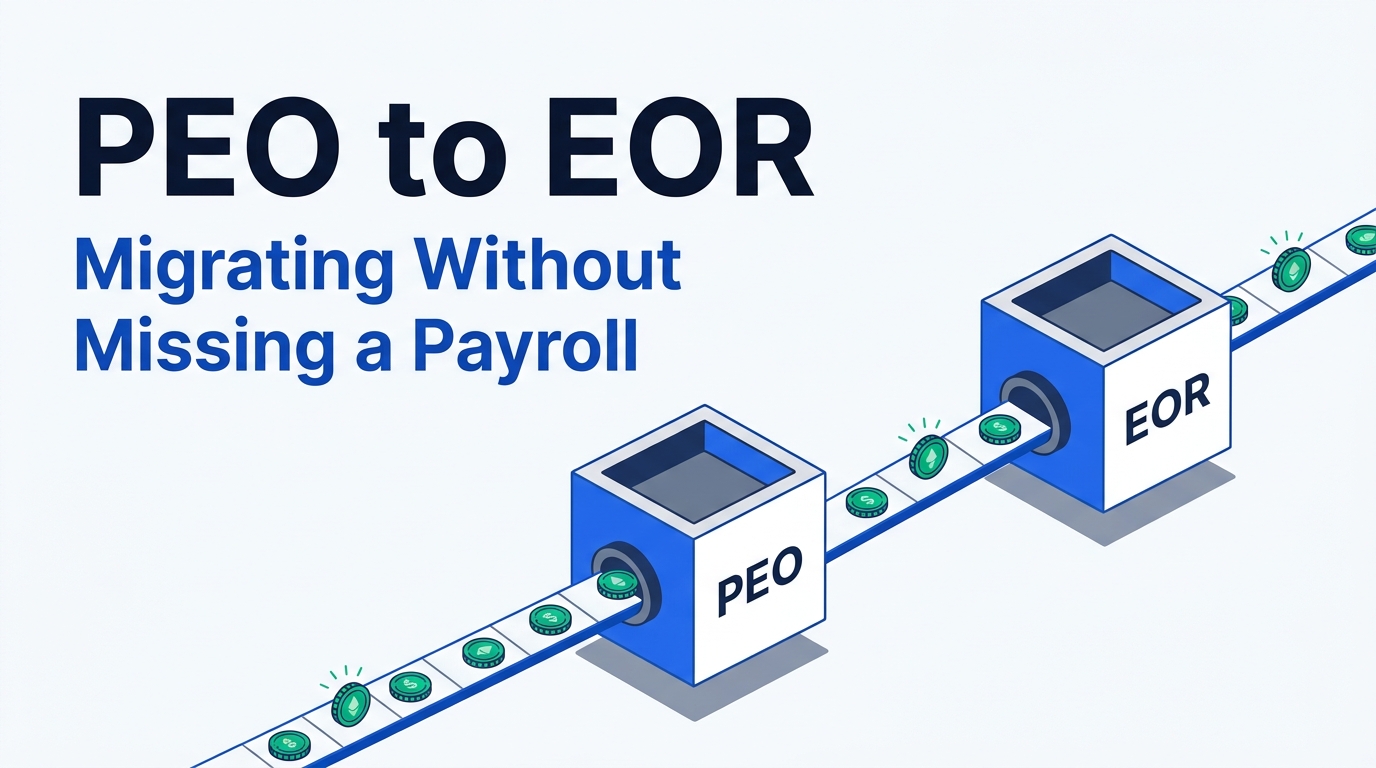
How to Switch From a PEO to an EOR Without Disrupting Payroll: A 2026 Migration Guide
The data transfer is the easy part. What breaks payroll is the calendar — the cutover date, the wage-base reset, the benefits day-boundary, and the month you have to fund two payrolls at once.
The short version
If you have already decided that an EOR is the right model, the migration itself is a scheduling problem with a tax problem hiding inside it.
Three decisions determine whether anyone misses a paycheck. First, work out which of three structurally different migrations you are actually running — they share a name and almost nothing else. Second, pick a cutover date: January 1 is materially cleaner than any other day of the year, and a quarter boundary is a distant second. Third, budget for the cutover month, when you settle your final PEO invoice in arrears and pre-fund your first EOR payroll in advance, in the same 30 days.
Plan 90 days for a US-only move and 120–150 days if you are handing employees from your own foreign entity to an EOR, where local employment law — not tax — sets the pace. Run at least two full parallel payroll cycles before you switch off the old system, and reconcile year-to-date balances separately from current-period figures. Current-period parity with wrong year-to-date numbers still produces a wrong W-2 in January.
Three different migrations wear the same name
"Switching from a PEO to an EOR" describes at least three transactions that fail in completely different ways. Before you build a plan, establish which one you are running, because the answer decides whether your critical path runs through a tax adviser, an employment lawyer, or a data engineer.
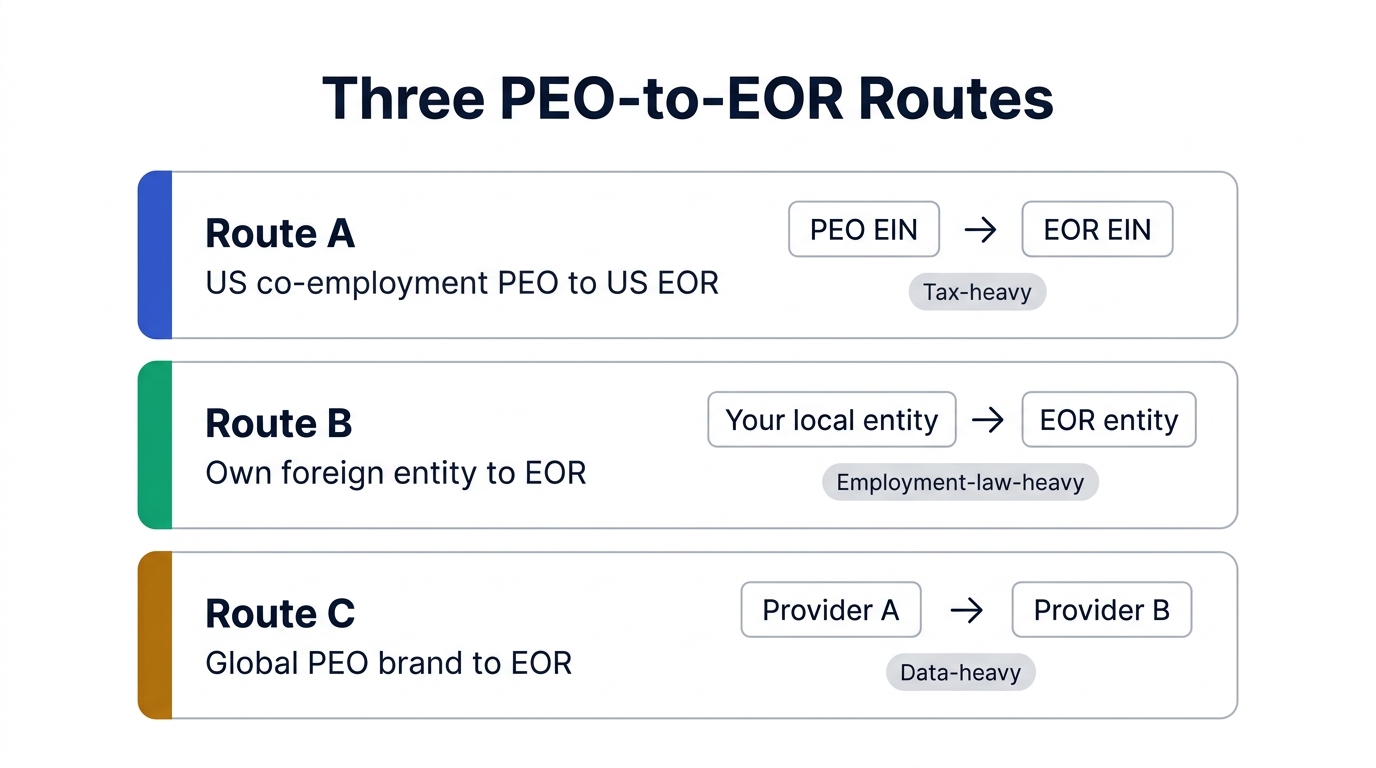
US co-employment PEO → US employer of record
Your people stay in the same jobs, but the federal employer identification number that pays them changes. Nothing about the commercial relationship ends; for employment tax purposes, quite a lot does.
Your own foreign entity → EOR
You have a real legal entity in-country, and you are handing its employees to someone else's legal entity. This is a genuine change of legal employer in a jurisdiction that almost certainly regulates one.
"Global PEO" → EOR (provider switch)
You bought something marketed as a global PEO, you never had an entity in that country, and the provider was therefore functioning as an EOR all along. Legally this is usually an EOR-to-EOR transfer.
The naming confusion in Route C is worth resolving before anything else. A professional employer organization co-employs staff alongside an employer that already exists in that country; an employer of record is the employer. So if you have no legal entity in the country in question, whatever you bought was almost certainly an EOR regardless of what the invoice says. Open the contract and check whether a local entity of yours appears as a party. If it does not, you are on Route C, and much of the tax anxiety below does not apply to you. Our breakdown of the actual structural difference between an EOR and a PEO covers where the line falls.
Six things that actually break payroll
In order of how expensive they are to discover late.
1. The wage-base reset (Route A)
US payroll taxes with an annual ceiling are tracked per employer, not per person. When wages start being paid by a different EIN partway through a calendar year, the accumulated year-to-date total generally restarts at zero unless successor-employer treatment applies under IRC §3121(a)(1) for Social Security and §3306(b)(1) for FUTA. Those provisions turn on the acquisition of substantially all of a trade or business — and an ordinary service agreement is not an asset acquisition.
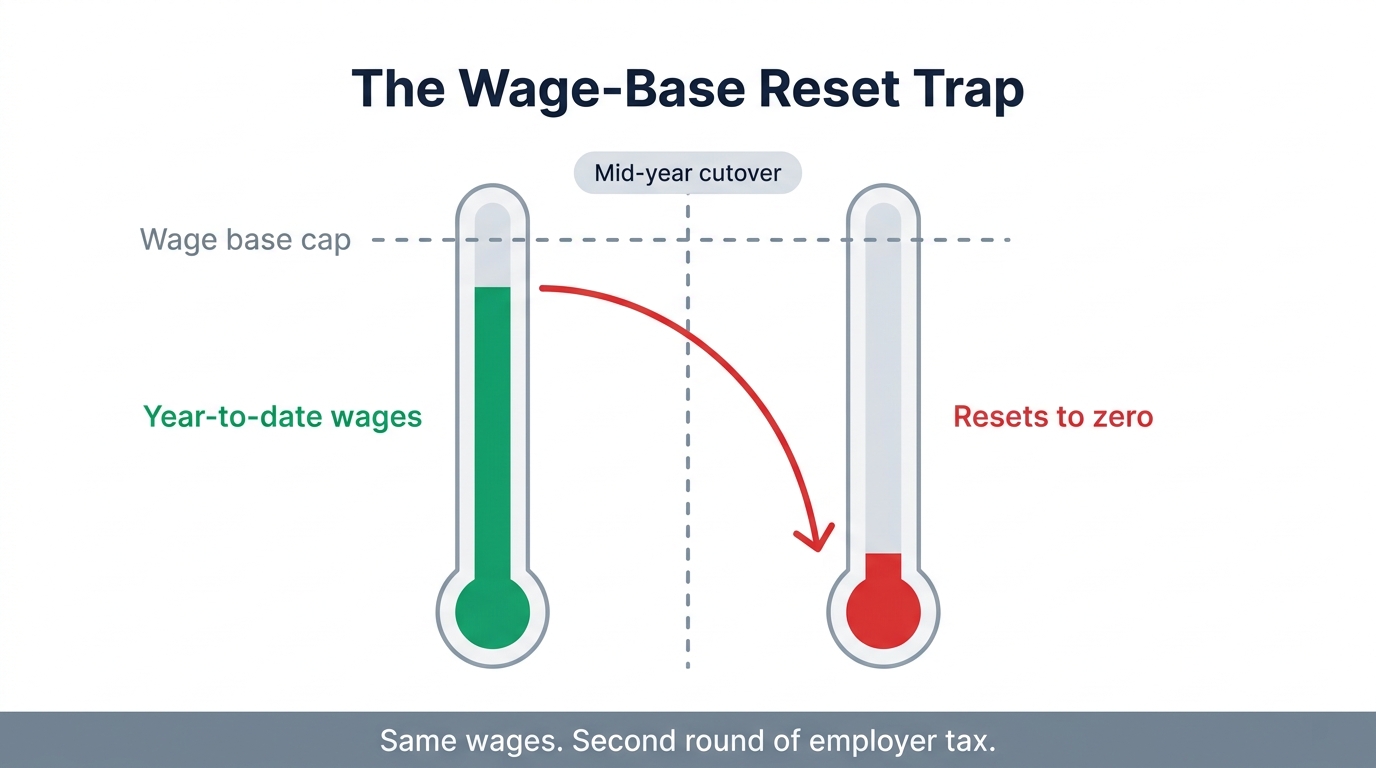
That last point is where most write-ups on this topic overstate the damage. A restart does not double your payroll tax bill. It only costs anything for employees whose annual pay crosses the ceiling, because splitting a below-ceiling salary across two employers produces exactly the same tax as leaving it with one.
For 2026 the Social Security taxable wage base is $184,500, up from $176,100 in 2025, and the employer rate is 6.2% — a maximum of $11,439 per side. Here is what a clean July 1 cutover costs in additional employer Social Security tax per employee, assuming pay is spread evenly across the year:
| Annual salary | Employer SS tax, no reset | Employer SS tax, with reset | Extra cost |
|---|---|---|---|
| $150,000 | $9,300 | $9,300 | $0 |
| $184,500 | $11,439 | $11,439 | $0 |
| $220,000 | $11,439 | $13,640 | $2,201 |
| $250,000 | $11,439 | $15,500 | $4,061 |
| $300,000 | $11,439 | $18,600 | $7,161 |
| $369,000+ | $11,439 | $22,878 | $11,439 |
Calculated at the 2026 wage base of $184,500 and the 6.2% employer rate, for a cutover exactly halfway through the year. The extra cost tops out at $11,439 per employee once salary reaches roughly $369,000, because both halves independently hit the ceiling.
The employee side of the same tax is identical in amount, but recoverable: an individual with excess Social Security withheld by two or more employers can claim it as a credit on their Form 1040 (Schedule 3). Your company cannot. So a mid-year reset is an employer-only cost, and it lands on exactly the population — senior staff — whose January W-2 questions generate the most noise.
FUTA restarts too, but the numbers are small: 0.6% of the first $7,000 is $42 per employee, unless you are in a credit-reduction state. For tax year 2025, reported on the Form 940 that was due February 2, 2026, California carried a 1.2% credit reduction and the US Virgin Islands 4.5%; Connecticut and New York repaid their federal advances before the November 10, 2025 deadline and avoided one. A California restart therefore costs up to $126 per employee rather than $42. The 2026 list is not settled until November 2026, so treat any figure you see for the current year as provisional.
If your current PEO is IRS-certified (a CPEO), the reset problem may not exist. Under 26 CFR §31.3511-1(d)(1), a CPEO and its customer are treated as successor and predecessor employer when a CPEO contract begins, and as predecessor and successor when it ends. The annual wage base is not applied separately across that boundary, which is precisely why certification exists.
Verify certification yourself on the IRS CPEO public listing, which is refreshed quarterly by the 15th of the first month of each quarter. Do not take a sales team's word for it, and note that "accredited" (an industry body) and "certified" (the IRS) are different claims.
CPEO successor relief runs between the CPEO and its customer — that is, to your EIN. In a PEO-to-EOR move, your wages are not going to your EIN. They are going to a third party's. The chain is CPEO → you → EOR, and the second leg needs its own basis for successor treatment.
If the incoming EOR is itself a CPEO, entering that contract makes it your successor and the chain plausibly holds. If it is not, the relief may simply stop at your EIN and the reset happens one step later. Put this question to your own tax adviser in writing, with both contracts in front of them, before you sign anything. It is the single highest-value hour of professional advice in the whole project, and it is not a question a vendor implementation manager is qualified to close out.
2. Two W-2s, and the January that follows
When the paying entity changes mid-year, the default is that each entity reports what it paid. Rev. Proc. 2004-53 sets out two options. Under the standard procedure, the predecessor reports its own wages and the successor reports its own, so each affected employee receives two Forms W-2. Under the alternate procedure, the successor files a single W-2 covering the entire year, the predecessor is relieved of reporting for those employees, and all Forms W-4 transfer across.
The alternate procedure is the one everyone wants and the one that is often unavailable, because the revenue procedure applies to acquisitions of substantially all the property used in a trade or business — which a PEO exit typically is not. Plan for two W-2s, confirm which procedure applies in writing, and tell employees in November rather than letting them discover it in January. In our experience reviewing migration post-mortems, unexplained duplicate W-2s are the single largest driver of HR ticket volume after a mid-year cutover, and they are entirely preventable with one email.
One more filing to chase: if you are leaving a CPEO, it must notify the IRS that the service contract has ended by filing Form 8973 within 30 days of termination. Ask for a copy for your file. It is the cleanest evidence you have that the handover was reported.
3. State unemployment: your experience rate does not travel
State unemployment insurance rates are experience-rated, and a good rate earned over years of low claims is a real asset. Federal law requires unemployment experience to transfer when there is substantially common ownership, management, or control between the two employers — a nationwide minimum standard added by the SUTA Dumping Prevention Act of 2004 (P.L. 108-295) and implemented through the Department of Labor's UIPL 30-04.
An unrelated EOR is, by definition, not under common control with you. So your experience rate does not follow your employees; theirs applies. That can go either way, and it is a cost line, not a rounding error — ask any shortlisted EOR for its current SUI rate in every state where you employ people, and model the delta. If you are simultaneously keeping some employees in-house, be aware you may be assigned a new-employer rate on your own account for the population you retain.
4. The benefits cliff is a day-boundary problem
PEO health coverage sits on the PEO's master plan. It ends when your service agreement ends. EOR coverage starts on the EOR's start date. If those two dates are not the same calendar day — not the same week, the same day — you have created a coverage gap and, with it, a qualifying event.
The exposure is asymmetric and worth knowing precisely. Under IRC §4980B, COBRA failures carry an excise tax of $100 per day per qualified beneficiary, or $200 per day per family, and separate ERISA notice penalties of up to $110 per day per participant can apply on top. Establish in writing, before the exit date is fixed, who administers COBRA for the population leaving the PEO plan. It is a contract question with a default answer you will not like.
If your 401(k) sits inside the PEO's multiple employer plan, exiting means choosing between a spin-off (assets move to your own single-employer plan; no distributions occur) and a termination (participants take distributions). Termination triggers the successor plan rule: a terminated 401(k) cannot distribute elective deferrals if the employer maintains or establishes another 401(k) during the period beginning at termination and ending 12 months after the last asset is distributed.
This matters specifically here because the EOR you are moving to will very likely offer a 401(k) — but it will be the EOR's plan, sponsored by the EOR, which changes the analysis in ways that depend on your facts. Many MEP documents also fully vest participants if a transfer is not initiated within a set window, commonly 120 days. Get ERISA counsel on this one. It is the only item on this list that can still bite you a year after cutover.
5. The double-funding month
PEOs generally invoice you with or shortly after each payroll. EORs generally require money up front, and the difference is a working-capital event that lands squarely in your cutover month.
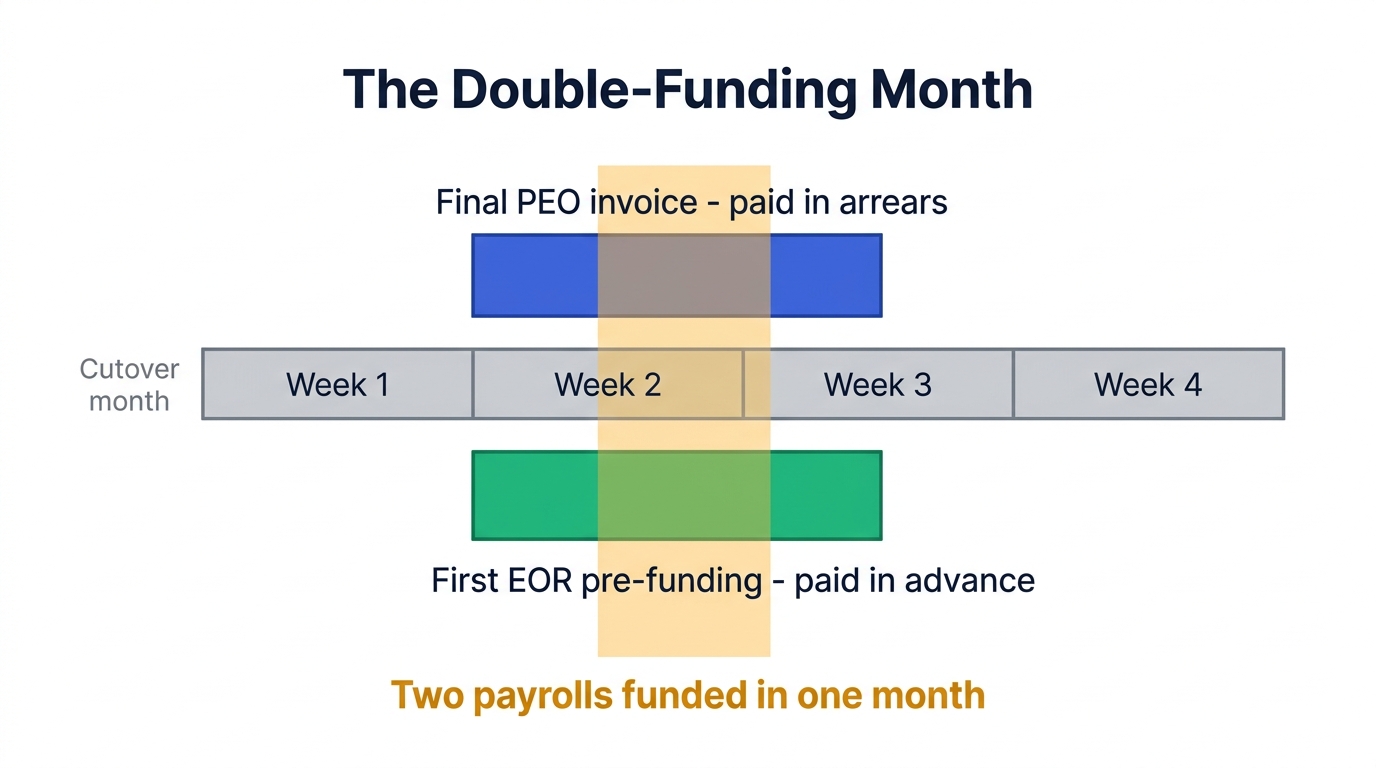
The mechanics are published. Remote issues an EOR payroll pre-funding invoice on the first working day of the month, based on estimated payroll for that month. Deel, with early invoicing enabled, issues both the current month's EOR invoice and next month's pre-funding statement on the 23rd, with payment due five days later. Either way, the cash leaves before the payslips do.
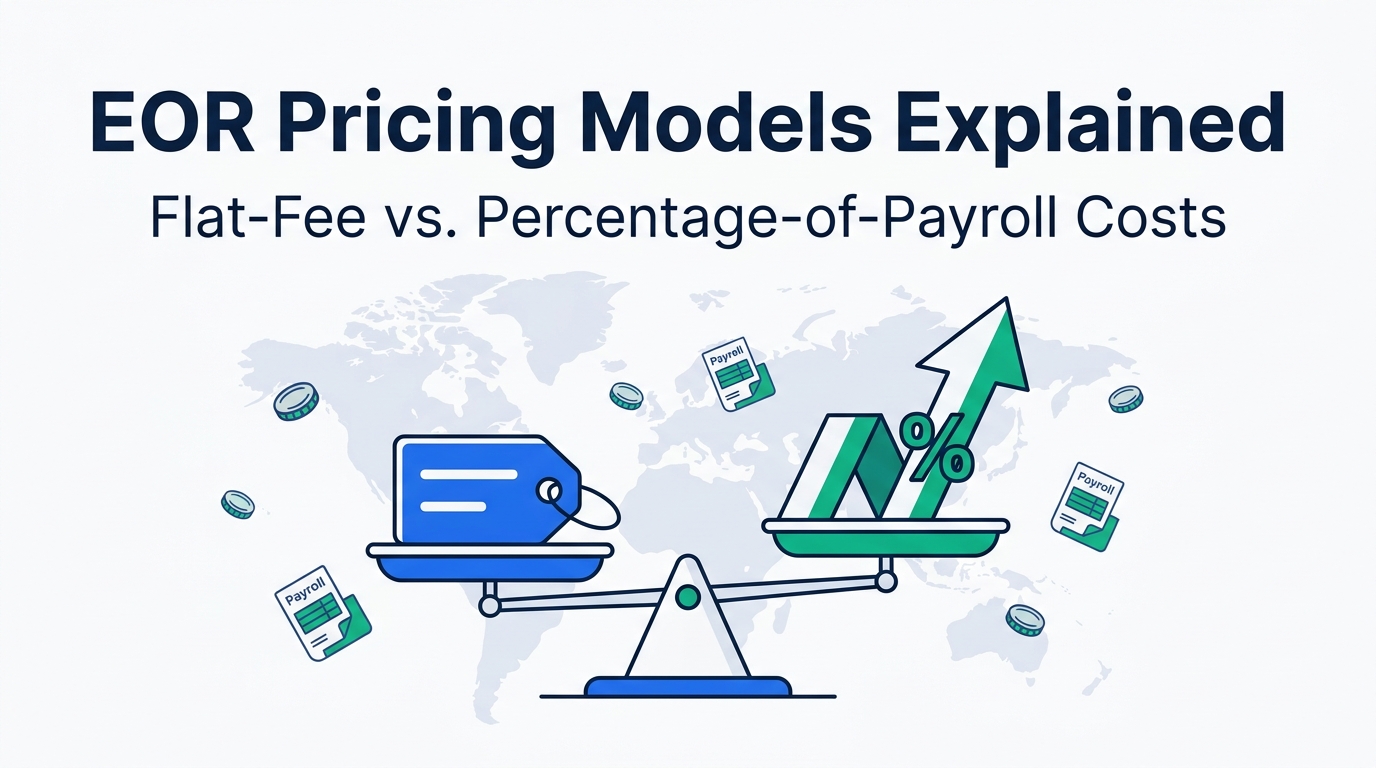
Practical guidance: budget roughly 1.5 to 2 times one month of fully loaded payroll as a one-time bump in the cutover month, and get finance to approve it as a line item rather than discovering it as a payment run. Also resist the temptation to set the first pre-funding transfer as a fixed standing order — pre-funding is an estimate, and FX movement, expense claims, bonuses, and thirteenth-month accruals all produce true-ups. If you have not yet modeled ongoing cost, our breakdown of flat-fee versus percentage-of-payroll EOR pricing covers the recurring side.
6. Continuity of service is not automatic (Route B)
Where the legal employer genuinely changes, whether the employee's service counts as continuous is a jurisdiction-by-jurisdiction question with real money attached — severance is usually a function of tenure. Many countries will recognize continuity where the working relationship is materially unchanged and the parties document it properly, commonly through a tripartite agreement signed by the outgoing employer, the EOR, and the employee. Many will not do it by default.
Six things need to be explicitly carried across in the new contract rather than assumed:
- Original start date, not the EOR contract date — this is the number that drives everything else.
- Accrued but untaken leave, and whether it transfers as a balance or must be paid out by the outgoing entity.
- Seniority for severance and any length-of-service benefits.
- Probation — a fresh employment contract can restart it unless expressly waived, which is a nasty surprise for a five-year employee.
- Notice entitlement, which in many jurisdictions scales with tenure.
- Thirteenth or fourteenth month accruals, common across Latin America and parts of Europe, and typically part-accrued at the transfer date.
Two sequencing points for Route B. First, if the outgoing entity owes a statutory final settlement on the last day of employment, that lump sum lands in the same month as your first EOR pre-funding — stack it into the cash plan alongside the double-funding effect above. Second, if the reason for the move is to wind the entity down, the entity has to survive long enough to file its final payroll returns and close its tax year. Do not start dissolution until the last filing is accepted. And confirm that the arrangement you are moving to has not simply relocated your exposure: the EOR compliance mistakes that trigger permanent establishment risk are worth reading before you assume the entity was the only thing creating it.
Choosing the cutover date
This is the highest-leverage decision in the project and, in most organizations, the one made most casually. Ranked:
| Window | Tax | Benefits | Operational load | Verdict |
|---|---|---|---|---|
| January 1 | Clean | Clean | Heaviest | Wage bases restart anyway, benefit plan years usually align, one W-2 per employee. The catch is that January is the busiest month for every payroll implementation team on earth. Book it in Q3 of the prior year or you will not get the slot. |
| Quarter boundary | Bounded | Depends | Moderate | April 1, July 1, October 1. Form 941 quarters close cleanly on each side, so reconciliation is bounded to a single filing period. You still get two W-2s and a possible wage-base restart, but you can find errors inside one quarter instead of across a smeared boundary. |
| Mid-quarter | Messy | Depends | Moderate | Reserve for a hard external deadline: entity dissolution, notice already served, an M&A close. You will reconcile a partial quarter split across two filers, and any discrepancy is harder to isolate. |
| December | Messy | Messy | Worst | Every mid-year problem, plus year-end close and W-2 production, in the same two weeks, with holiday coverage gaps on both provider teams. Move to January 1 or wait for the next quarter. |
PEO agreements commonly require 30 to 60 days' written notice and frequently align termination to a month-end or quarter-end regardless of when you serve notice. Many auto-renew. Work backward from the notice deadline, not forward from when you would like to start — missing an evergreen renewal window by a week can cost you a full additional term, which turns a date choice into a year-long problem.
The 90-day runbook
Sized for Route A. Add 30–60 days at the front for Route B, because local counsel and statutory notice periods set the pace and neither compresses. T is the cutover date — the first pay date processed by the EOR.
-
T−90 to T−75
Decide, price, and get the tax answer in writing
- Confirm which route you are on by reading the current contract for a local entity of yours as a party.
- Check the incoming and outgoing providers against the IRS CPEO public listing.
- Put the successor-employer question to your tax adviser in writing. Everything downstream depends on the answer.
- Collect SUI rates by state from the incoming EOR; model against your current rates.
- Model the double-funding month with finance and get it approved as a line item.
-
T−75 to T−60
Serve notice and lock the exit date
- Serve written notice to the PEO in the form the contract requires, to the address the contract requires.
- Get the exit date confirmed in writing, and confirm it is the day before the EOR start date — no gap, no overlap.
- Agree in writing who administers COBRA for the exiting population and who produces the final W-2s.
- Start the 401(k) decision with ERISA counsel. This has the longest tail on the list.
-
T−60 to T−45
Extract and clean the data
- Pull the full census, YTD wage and tax registers by employee and jurisdiction, deduction and benefit elections, garnishment orders, PTO balances, and Forms W-4 and I-9.
- Reconcile the YTD register against filed Forms 941 for every closed quarter. Discrepancies found here are cheap; found in January they are not.
- Clean addresses and work locations first — stale work-state data is the most common cause of wrong tax withholding after a cutover.
- Confirm I-9 handling for the new legal employer with counsel; a change of employer does not always ride on the existing form.
-
T−45 to T−30
Build and configure
- Load the census, earning and deduction codes, and YTD balances into the EOR system.
- Map every earning code one-to-one and document any that do not map. Unmapped codes surface as silent zeroes.
- Register in any state or country where the EOR is not already active, and confirm registration numbers exist before the parallel run.
- Configure GL mapping and cost-center allocation now, not after go-live, or finance inherits the problem.
-
T−30 to T−15
Parallel run #1
- Process a full cycle in both systems against identical inputs. Compare line by line.
- Log every variance with a named root cause and an owner. "Probably rounding" is not a root cause.
- Fix configuration, then re-run the affected population.
-
T−15 to T−7
Parallel run #2 and benefits enrollment
- Second full cycle, deliberately including edge cases: a leaver, a mid-cycle raise, a garnishment, a benefits change, an expense reimbursement.
- Run open enrollment on the EOR's plans with a hard deadline before cutover, and chase non-responders individually.
- Confirm the first EOR pre-funding amount and the exact date the money must land.
- Named sign-off from someone on your side. Not the vendor's implementation manager.
-
T−7 to T
Freeze and cut
- Freeze master-data changes in the old system. All changes route to the EOR from here.
- Final PEO payroll processes; capture the final invoice and the final register.
- Pre-fund the EOR. Confirm receipt — do not assume a wire arrived.
- First EOR payroll previews against the frozen register before approval. Approve nothing you have not compared.
-
T+1 to T+30
Reconcile and close out
- True up the final PEO invoice; expect a reconciliation credit or debit, and chase it.
- Obtain the Form 8973 copy, confirm final Forms 941 and 940 are filed, and close state accounts you no longer need.
- Confirm 401(k) asset transfer or termination filings actually completed.
- Get the W-2 responsibility split in writing while the vendor still has an incentive to respond.
- Reconcile the first benefits invoice against your enrollment file, employee by employee.
The parallel run, done properly
Most failed cutovers had a parallel run. It was just a bad one. Two full cycles is the working minimum, three if you are on monthly payroll or running multiple countries, because cumulative thresholds and recurring deductions only misbehave over time. A single cycle proves almost nothing.
Compare at the line level, not the total. Totals hide offsetting errors, and offsetting errors are exactly the kind that reappear when the population changes next quarter:
| Compare | Tolerance | What a variance usually means |
|---|---|---|
| Gross pay | Zero | Wrong rate, wrong hours import, or an unmapped earning code |
| Each earning code | Zero | Code mapped to the wrong tax treatment — often taxable vs. non-taxable |
| Pre-tax deductions | Zero | Benefit election not carried across, or wrong plan-year rate |
| Employer contributions | Zero | Match formula or eligibility rules configured from a template, not your plan |
| Tax by jurisdiction | Sub-dollar, explained | Work-state or local jurisdiction wrong, or a missing registration |
| Net pay | Zero | Anything above, compounded — this is the number the employee sees |
| YTD balances | Zero | Import failure. Current-period parity with wrong YTDs still yields a wrong W-2 |
Pick ordinary cycles for the comparison baseline — a period distorted by a company-wide bonus or a mass hire tells you very little about steady-state behavior. But make sure at least one cycle contains real edge cases, because the edge cases are where configuration defaults show up. If your parallel run only ever processes salaried full-timers with no changes, you have tested the easiest 80% and shipped the other 20% to production.
Communications that prevent tickets
Three messages, and a named human rather than a shared inbox. Employees do not care about your EIN; they care whether their money arrives on the usual day and whether their doctor is still covered.
T−30: the announcement
What is changing and what is not. Lead with the invariants: same pay, same pay date, same manager, same job. Then the mechanics — new payslip portal, new benefits enrollment with a deadline, new support contact. State the legal employer change plainly rather than burying it; people find out from their payslip anyway, and finding out that way is worse.
T−7: action required
A short list of what each person must do, with a deadline and a link. Bank details confirmation, tax withholding form, benefits election, portal activation. Chase non-responders by name. Anyone who has not completed this by cutover becomes a manual exception on the busiest day of the project.
T+1: reading your first payslip
Send this on the first pay date, not before. Explain the layout differences, why year-to-date figures may look different, and — critically — that they will receive two Forms W-2 for this year if that is the case. One paragraph in September prevents a queue in January. Include what to do if anything looks wrong and how fast you will respond.
Ten questions to put to your EOR in writing
Before signing, not during implementation. Written answers, from someone with authority to give them.
- Are you an IRS-certified PEO, and if so, under which legal entity name on the IRS public listing?
- How will year-to-date wage and tax balances be carried across, and what is your position on successor-employer treatment for our specific fact pattern?
- Which W-2 procedure applies — standard or alternate — and who files for the pre-cutover period?
- What is your current state unemployment insurance rate in each state where we employ people?
- Exactly what date does benefits coverage begin, and does it require an enrollment action from each employee?
- What is the pre-funding schedule, how is the amount calculated, and how are true-ups settled?
- How many parallel cycles are included in implementation, and what is the escalation path if a variance is unresolved at the planned go-live date?
- For each country: is continuity of service preserved, and how is it documented?
- Which of our countries do you serve through your own entity versus a local partner, and who is the legal employer on the contract?
- If we later move employees onto our own entity, what does your offboarding process and notice period look like?
Question nine deserves emphasis. An EOR operating through an in-country partner is not necessarily worse, but it adds a party to every escalation and changes who holds the employment liability. It belongs on the same list as the other selection criteria in our seven-question EOR decision framework, and question ten is worth answering before you need it — moving employees off an EOR onto your own entity is a project of its own, and the terms are much easier to negotiate while you are still the prospect.
What this guide deliberately leaves out
Two adjacent decisions are out of scope here because they precede the migration rather than form part of it. If you have not yet settled whether an EOR is the right structure at all, start with the structural comparison rather than the runbook — the EOR versus PEO decision turns on whether you want to hold the employment relationship, not on migration mechanics. And if you are choosing between platforms with strong HR-suite ambitions, the trade-off between a unified system and a best-of-breed stack is covered in our comparison of Deel and Rippling for global engineering teams.
Frequently asked questions
Is it hard to switch payroll companies?
The data migration is routine; providers do it constantly. What makes it hard is everything with a date attached — the wage-base boundary, the benefits termination day, the notice period in your existing contract, and the funding overlap. Teams that treat it as a data project and start 30 days out are the ones that miss a payroll. Teams that treat it as a scheduling project and start 90 days out generally do not.
How long does it take to switch payroll providers?
Plan 90 days for a US-only PEO-to-EOR move: roughly two weeks to decide and get the tax position confirmed, two weeks for notice and exit terms, four weeks for data extraction and configuration, and four weeks for two parallel payroll cycles. Add 30 to 60 days if you are transferring employees out of your own foreign entity, where local counsel and statutory notice periods set the pace. A January 1 cutover needs to be booked in Q3 of the prior year, because implementation capacity at every provider is scarcest in December and January.
Can you switch payroll providers mid-year?
Yes, and it is common. The cost is that year-to-date wage bases may restart under the new employer's EIN, employees may receive two Forms W-2, and reconciliation spans two filers. Choose a quarter boundary if you have any flexibility, so Form 941 quarters close cleanly on both sides. The wage-base restart only produces real extra cost for employees whose annual pay crosses the Social Security ceiling — $184,500 in 2026 — so run that calculation on your actual census before assuming the number is large.
What is a PEO, and why would a company switch to an EOR?
A PEO co-employs your staff alongside your own legal entity, sharing employer responsibilities: you keep the employment relationship, the PEO handles payroll, benefits, and employment tax administration. An EOR becomes the sole legal employer, which means you do not need a legal entity in that country at all. Companies switch when they want to stop maintaining an entity, when they want a single provider across many countries rather than one PEO per jurisdiction, or when they want employment liability held by the provider rather than shared.
Will our employees really get two W-2s?
For a mid-year cutover, usually yes. Under the standard procedure in Rev. Proc. 2004-53, each employer reports the wages it paid, so an employee who was paid by two entities during the year receives two forms. A single combined W-2 is possible under the alternate procedure, but that requires the transaction to fall within the revenue procedure's scope and both parties to agree — and an ordinary PEO exit often does not qualify. Confirm which applies in writing during implementation, and tell employees well before January.
How we researched this
This guide is built from primary sources rather than vendor marketing: the Internal Revenue Code and Treasury regulations governing CPEOs and successor employers, IRS revenue procedures on wage reporting during employer changes, Department of Labor guidance on unemployment experience transfers, and the published pre-funding and invoicing documentation of major EOR providers. Where a figure applies to a specific tax year, we have said which year and when it was set — FUTA credit reduction rates in particular are not finalized for a given year until the following November.
Where a question depends on facts we cannot see, we have said so rather than guessed. In particular, whether successor-employer treatment survives a transfer from a certified PEO to a third-party EOR depends on both contracts and is a question for your own tax adviser. We do not name specific providers as certified or uncertified; check the IRS public listing yourself, because certification status changes.
References and sources
- Internal Revenue Service — Rev. Proc. 2004-53 (standard and alternate procedures for Forms W-2, W-3, 941 and W-4 in certain acquisitions)
- Electronic Code of Federal Regulations — 26 CFR §31.3511-1, Certified professional employer organization (successor and predecessor treatment at contract start and termination)
- Internal Revenue Service — CPEO public listings (quarterly list of certified, suspended, and revoked CPEOs)
- Internal Revenue Service — Instructions for Form 8973, CPEO/Customer Reporting Agreement (30-day notification on contract start and termination)
- Social Security Administration — Contribution and benefit base ($184,500 for 2026; $176,100 for 2025)
- Federal Register — Notice of FUTA Credit Reductions Applicable for 2025 (California 1.2%; US Virgin Islands 4.5%)
- US Department of Labor, Employment and Training Administration — UIPL 30-04, SUTA Dumping Prevention Act amendments and mandatory experience-transfer standards
- Remote — EOR payroll pre-funding invoice documentation
- Deel — About EOR early invoicing

Technology consultant with 10+ years in the Japanese tech industry. Specializing in SaaS evaluation, workflow automation, and B2B tool integration.