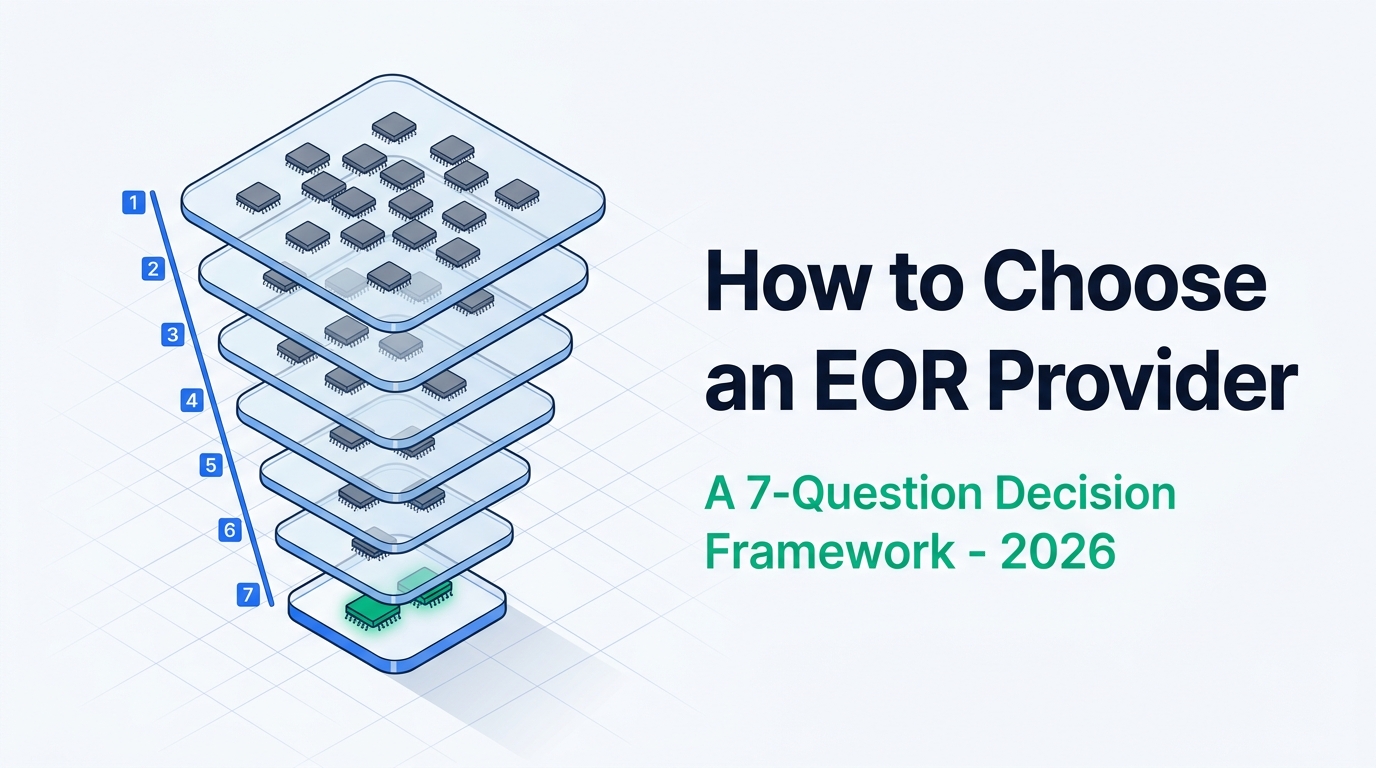
How to Choose an EOR Provider: A 7-Question Decision Framework for 2026
Almost every "how to choose an EOR" guide on the first page of Google is a 12-, 15-, or 20-point evaluation checklist. Checklists are useful once you have a provider in front of you. They are close to useless when you have forty of them and no idea which ones to call.
This framework is ordered differently. The first three questions are about you, not the vendor — how many people, for how long, and whether you are opening a local entity. Answered honestly, those three eliminate most of the market and occasionally eliminate the entire category. Only then do the four provider-facing questions matter: does the provider own the entity in your specific countries and hold the license the law requires, what is the fully loaded cost, who owns the IP your team creates, and what does it cost to leave.
Work through it in order and you should end with a shortlist of two or three, not a spreadsheet of forty.
Why one more checklist will not help you
We read the pages currently ranking for this query. They are, with few exceptions, flat lists of criteria: entity ownership, pricing, FX markup, deposits, contract flexibility, onboarding speed, compliance depth, termination handling, payroll accuracy, benefits, visas, platform, support, data security, references. Every item is legitimate. The 15-point checklist from Employsome, for example, gives you a question, a good answer, and a red flag for each criterion — genuinely useful material.
The problem is structural. A flat list implies every criterion carries equal weight and applies to every buyer. It does not. If you are hiring one engineer in Germany for a nine-month project, "benefits broker markup" is noise and the 18-month statutory assignment cap is the entire decision. If you are hiring twenty people in Poland and plan a subsidiary next year, the monthly fee barely matters and the exit clause is everything.
Worse, a flat list is unordered, so it cannot eliminate anything. You end up scoring forty vendors against fifteen criteria — six hundred cells of research, most of it wasted, because the answer to question two would have cut the field to six.
So the framework below is a funnel, not a list. Each question is placed where it removes the most candidates for the least effort.
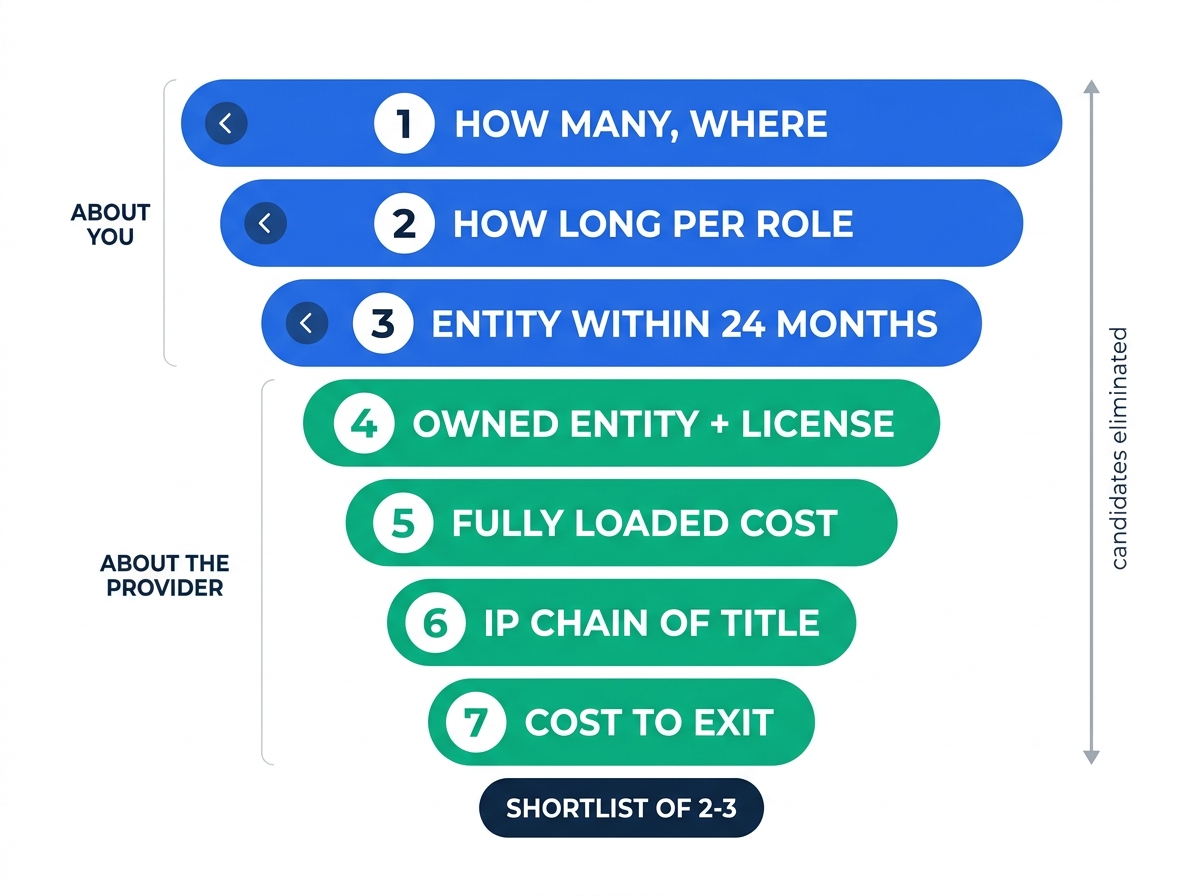
| # | Question | What it decides |
|---|---|---|
| 1 | How many people, in which countries, over what horizon? | Whether an EOR is the right instrument at all — and your pricing leverage |
| 2 | How long will each role exist in each country? | Whether a statutory duration cap forces an exit date into your plan |
| 3 | Will you open a local entity within 24 months? | Whether you are buying a destination or a bridge — changes every other weighting |
| 4 | In my countries, do you own the entity and hold the license? | Who actually carries liability, and whether the arrangement is lawful |
| 5 | What is the fully loaded monthly cost, itemized? | The real budget, typically well above the headline fee |
| 6 | Who owns the IP my team creates, and show me the chain? | Whether you actually own what you are paying to have built |
| 7 | What does it cost to terminate one employee — and to terminate you? | Your cost of being wrong about questions 1–6 |
How many people, in which countries, over what horizon?
Before you shortlist anyone: is an EOR even the right instrument here?
An Employer of Record converts a fixed cost (a legal entity, a local payroll bureau, an accountant, a registered address) into a variable per-head cost. That trade is excellent at low headcount and progressively worse as you scale. There is a crossover point, and knowing roughly where yours sits is the first filter.
The commonly cited crossover in a single country is 15–25 employees, though it arrives earlier in administratively simple markets like the UK or Singapore and much later in France or Brazil. Some analyses put it far lower for specific corridors — for a European company placing staff in the US without a dedicated HR function, the case for an entity can start to strengthen at around six employees, because US entity maintenance is cheap by international standards at roughly $3,250–$7,350 per year in franchise tax, registered agent fees, filings, and basic payroll administration.
The number that matters is not total headcount but headcount per country. Five people spread across five countries is a textbook EOR case. Fifteen people in one country is an entity conversation. We work through the full model, including the fixed-cost side, in our country-by-country break-even analysis of EOR versus setting up a foreign entity.
Two other things fall out of this question. First, volume is leverage: most providers open discounts at 5–10 employees, and buyers at 20+ heads report negotiating major platforms down from list into the $400–$450 range. If you are buying at scale, do not accept the published rate. Second, if your people are in a single country and you mainly want benefits administration and HR support rather than a foreign legal employer, you may want a PEO instead — a different instrument with a different liability structure, which we separate out in EOR vs PEO: which one your team actually needs.
If any single country is heading past ~15 heads within 18 months, model the entity before you sign a multi-year EOR agreement. If headcount is thin and spread wide, EOR is almost certainly correct — continue to question 2.
How long will each role exist in each country?
"How long can I keep someone on your EOR in Germany?" — ask this before pricing.
This is the question the ranking checklists most consistently underweight, and it is the one that can invalidate an otherwise perfect selection.
In several jurisdictions the EOR model is legally a form of labor leasing or temporary agency work, and it comes with a statutory maximum duration. It is not a provider policy you can negotiate around. Switching providers does not reset the clock in the countries that count assignment time against the client rather than the vendor.
| Country | Limit | Legal basis and mechanics |
|---|---|---|
| Germany | 18 months | Arbeitnehmerüberlassungsgesetz (AÜG). Maximum 18 consecutive months with the same client, then a mandatory ~3-month break before reassignment. |
| Poland | 18 months | Temporary staffing rules. 18 months to the same client within any 36-month window; changing provider does not reset it. |
| France | 36 months | EOR is permitted essentially only inside the portage salarial framework, which carries eligibility conditions including minimum daily rates, and caps engagements at 36 months. |
| Croatia | 36 months | Temporary agency licensing; reassignment requires a ~2-month break or a materially different role. |
| Norway | ~3 years | Project-based logic — defensible where the work is genuinely time-bound with defined scope. |
| UK, Ireland, Canada, Finland, Belgium, New Zealand | No statutory cap | Indefinite EOR arrangements permitted, subject to ordinary local employment law. |
The practical consequence: in a capped country, an EOR is a bridge with a known expiry date, not a permanent operating model. If you are hiring a permanent senior engineer in Germany, you are committing today to either incorporating within 18 months or losing that person. That belongs in the plan at signing, not in a panicked email in month sixteen.
This also reframes provider selection. In a capped market, the criterion is not "cheapest per month" but "will help me convert the employment relationship cleanly when the cap arrives." For the two capped markets where we have published country-level analysis, see our provider comparisons for hiring in Poland; for the uncapped end of the spectrum, the UK and Canada behave very differently and let you treat EOR as a long-term arrangement.
"For each country on my list, what is the maximum period you can employ someone on my behalf, what is the legal basis, and what happens on the day that period ends?" A provider that answers with a number and a statute is credible. A provider that says "there is no limit, we handle it" either does not operate in that country directly or has not read the local rules.
Will you open a local entity within 24 months?
Are you buying a destination or a bridge? The answer inverts your weightings.
Questions 1 and 2 usually make this one answer itself. Formalize it anyway, because it changes what "best" means.
If EOR is your destination — small distributed team, uncapped countries, no incorporation planned — then optimize for the things you will live with for years: employee experience, benefits quality, payroll accuracy, support responsiveness, platform integrations with your HRIS. The monthly fee compounds, so negotiate it hard.
If EOR is a bridge — capped country, or headcount approaching the crossover — then optimize for exit. Contract flexibility, notice period, deposit refund terms, and the provider's willingness to support a transfer of employment to your new entity outrank the monthly fee entirely. A provider $80/month cheaper that locks you into a 24-month term with a 90-day exit notice is the more expensive option for a bridge.
This is also where you decide whether to concentrate or spread your vendors. Consolidating into one provider maximizes discount leverage and gives you one platform. Splitting — one provider in your complex markets, another in your simple ones — costs you leverage but avoids the failure mode where a provider with strong coverage in Western Europe quietly subcontracts your one hire in Vietnam to a partner you never evaluated. Which brings us to the provider-facing half of the framework.
In my countries, do you own the entity — and hold the license?
Not "how many countries do you cover." Country by country, on paper.
Coverage numbers in EOR marketing are close to meaningless because they blend two very different delivery models. In the owned-entity (direct) model, the provider's own local subsidiary is the legal employer. In the partner (indirect) model, the provider subcontracts to a local firm that becomes the legal employer, and you gain a subprocessor you did not vet.
Both models are legitimate. Owned entities generally give tighter compliance control and faster issue resolution because there is no intermediary; a well-run partner network can offer deeper in-country expertise than a thinly staffed owned entity and reaches markets nobody incorporates in. The claim that direct-only is always better is marketing, not analysis.
What is not negotiable is disclosure. A provider advertising 180 countries may own entities in 30 of them. The only useful question is which model applies in your countries.
| Provider | Stated coverage | Model |
|---|---|---|
| Deel | 150+ countries | Large owned-entity footprint (100+) plus partners beyond it |
| Remote | 100+ countries | Owned entities in 80+, partner network beyond |
| Oyster | ~180 countries | Explicitly hybrid — owned in high-volume markets, vetted partners elsewhere |
| Multiplier | 150+ countries | Mixed owned and partner |
Then the second half of this question, which almost no buyer asks: does the employing entity hold the license the local law requires? The EOR arrangement is regulated infrastructure in several markets:
- Germany — the employing entity must hold a valid AÜG labor-leasing license from the Federal Employment Agency. Operating without one exposes both parties to fines and, critically, to reclassification of the employee directly onto you. We break the licensing checks down further in our guide to choosing an EOR for hiring in Germany.
- Netherlands — Waadi registration applies, and under Article 8a a payroll employee is entitled to the same employment conditions as your directly hired staff, pension included where you offer one. That is a cost input, not a footnote.
- France — outside portage salarial, the arrangement is generally not permitted at all — including the minimum daily rate that governs eligibility, covered in our breakdown of EOR options for hiring in France.
The compliance-depth test that separates real operators from resellers is to ask about something recent and specific. The Dutch Wet DBA enforcement moratorium ended on 1 January 2025, and from 1 January 2026 serious-fault penalties returned, with the tax authority able to bill the client and backdate to the start of 2025. Separately, EU member states face a 2 December 2026 deadline to transpose the Platform Work Directive, which introduces a rebuttable presumption of employment and reverses the burden of proof. A provider whose compliance team volunteers these unprompted is watching the regulatory calendar. One that needs you to explain them is not.
Good answer
A written country-by-country schedule naming the employing entity, its model, its license number where applicable, and how partners are audited — delivered before contract, not after.
Red flag
"We cover 150+ countries" with no per-country detail, reluctance to name the employing entity in writing, or a coverage map that turns out to include markets served on request via an unnamed third party.
An EOR reduces permanent establishment risk but does not eliminate it. If people in that country sign contracts on your behalf, if leadership routinely makes business decisions from there, or if the footprint grows large enough to draw scrutiny, you can still trigger PE and the tax obligations that follow. Ask the provider what activities they consider PE-triggering; the ones with real tax counsel have a documented answer.
What is the fully loaded monthly cost, itemized?
"Send me a full invoice simulation for a €90,000 engineer in Germany, month one and month two."
The headline fee is the smallest number in the transaction. Published list rates as of August 2026, taken from vendors' own pricing pages where available:
| Provider | List rate | Source basis |
|---|---|---|
| Skuad | $199 | Third-party aggregator |
| Multiplier | $400 | Third-party aggregator |
| Deel | $599 | Vendor pricing page |
| Atlas HXM | $599 | Third-party aggregator |
| Remote | $699 | Vendor pricing page |
| Oyster | $699 | Third-party aggregator |
| Papaya Global | ~$650–770 | Quote-based; third-party estimate |
| Velocity Global (Pebl) | $599 (promo ~$399) | Third-party aggregator |
| Globalization Partners | Quote (~$800+) | Quote-based; third-party estimate |
Treat that table as a starting point, not a fact. Aggregator sites go stale fast: several currently list Remote at $599, while Remote's own pricing page showed $699 per employee per month when we checked in August 2026. Always confirm against the vendor and against a written quote. For a deeper teardown of two of these, see our Deel vs Remote total cost of ownership comparison.
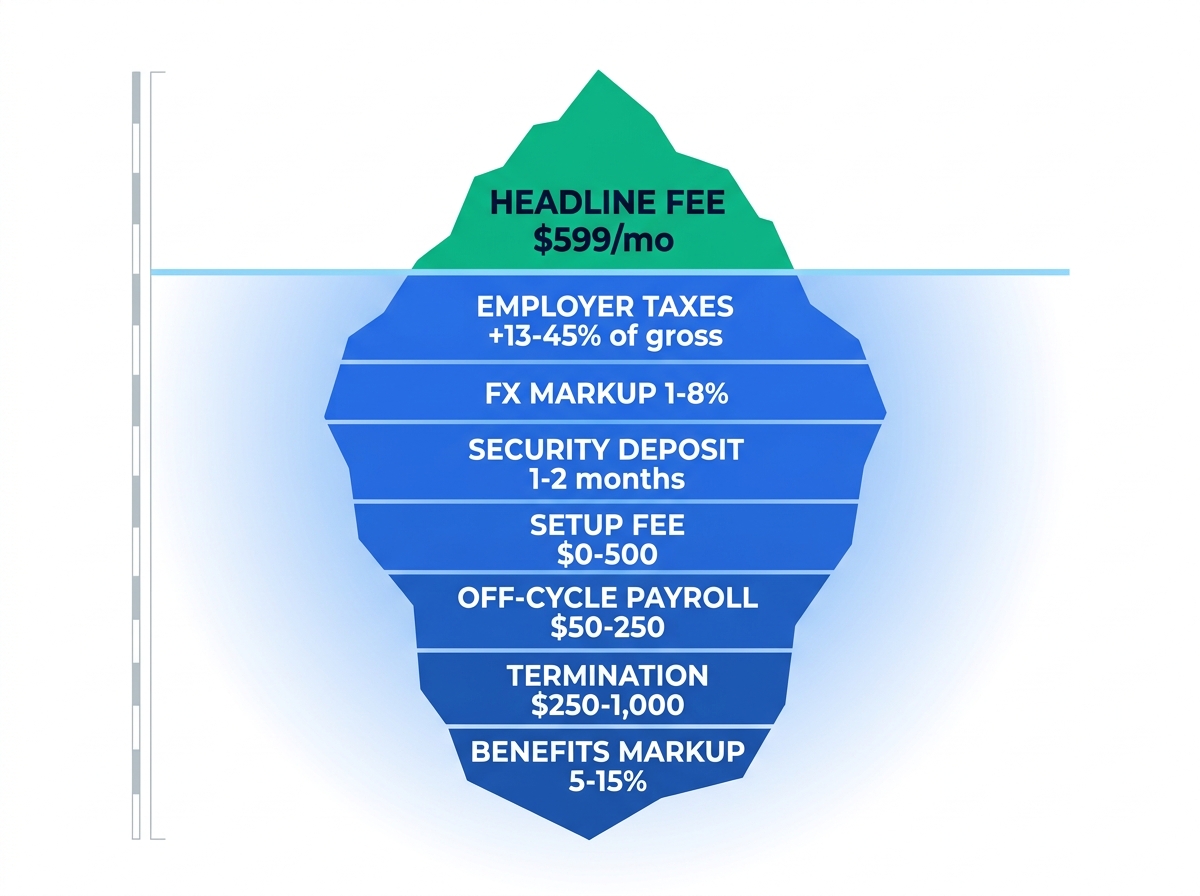
The line items that actually move the budget
Employer social contributions. These are statutory and pass straight through, but they are the largest variable and they are not in the headline. Employer-side contributions run roughly 42–45% of gross in France, around 40% in Germany, roughly 22% in Poland, and about 15% in the UK. On a €90,000 salary, the France-versus-UK spread is over €25,000 a year — forty times more consequential than a $100/month difference in management fee.
FX markup. Typically 0.5–3% over mid-market, occasionally up to 8%, and frequently undisclosed. On $1M of annual cross-border payroll that is $5,000–$30,000 a year of pure margin. Ask for the markup in basis points over mid-market and get it into the contract.
Security deposit. Usually 1–3 months of total cost, refundable. On a twenty-person team it can immobilize six figures of working capital. Ask three things: how it is calculated, what triggers its return, and how many days after offboarding it is actually returned.
Everything else. Setup $0–500 per employee (higher in France, Germany, Brazil), off-cycle payroll runs $50–250 each, termination handling $250–1,000, equipment shipping at 10–20% of equipment value, benefits broker markup 5–15% of premium. Collectively these typically add 5–15% on top of program cost.
Good answer
A line-item invoice simulation for a named salary in a named country, showing month one (with setup and deposit) separately from month two, with the FX methodology stated numerically.
Red flag
A single blended number, "FX at market rates" with no margin disclosed, or a deposit whose refund trigger is described only as "on settlement of all obligations."
Who owns the IP my team creates — and can you show me the chain?
"Walk me from the employee's contract to my balance sheet. Which documents assign the IP?"
This is the highest-severity item in the framework and the one most absent from competing checklists. It matters most for exactly the buyers most likely to use an EOR: software companies hiring engineers abroad.
The mechanism is simple and unforgiving. The EOR is the legal employer, not you. In many jurisdictions, IP created by an employee in the course of employment vests by default in the employer — which here means the EOR or its local partner entity. Without an explicit, unbroken back-to-back assignment running employee → employing entity → you, the code and designs you are paying for may not be yours.
The failure mode is quiet. Nothing breaks during the engagement. It surfaces in diligence during a funding round or acquisition, when counsel asks you to evidence title to the codebase and you cannot, or in a partner-model arrangement where the assignment stops at a local subcontractor you never contracted with.
Ask for the chain as documents, not reassurance:
- The IP assignment clause in the local employment contract the employee signs — and confirmation it is enforceable under that country's law (some jurisdictions restrict blanket future-invention assignments or require separate consideration).
- The assignment from the employing entity to the provider's parent, if a local subsidiary or partner is the employer.
- The assignment from the provider to you in the master services agreement.
- Confirmation that the chain survives termination and does not depend on the MSA staying live.
If any link is missing, that is a contract negotiation before signature, not a problem to fix later. It is materially harder to obtain an assignment from a former employee in another country after the relationship ends. For engineering-heavy hiring specifically, the platform's handling of this varies more than the pricing does — a theme in our Deel vs Rippling analysis for global engineering teams.
What does it cost to terminate one employee — and to terminate you?
"Show me a written termination cost breakdown for this role in this country, today."
Termination is where EOR relationships fail, because it is the one moment where the provider's interests and yours diverge. You want speed; the provider carries the legal liability and will insist on doing it properly. That is the system working — but only if you priced it.
There are two exits to test, and buyers routinely test only the first.
Exit one: ending an employment
Demand a written breakdown before you sign, for a representative role in each country: notice period pay, statutory severance, accrued unused leave payout, any local-specific obligation (works council consultation, mandatory settlement agreements, court approval in some jurisdictions), and the provider's own termination handling fee of roughly $250–1,000. A provider that walks you through this unprompted has done it many times. One that treats it as hypothetical has not.
Exit two: ending the relationship
The one people forget. Test it directly:
- Notice to terminate the MSA — 30, 60, or 90 days, and does an auto-renewal clause reset the term?
- Transfer of employment — when your entity opens or you switch providers, will they cooperate in transferring the employee, and does the contract oblige them to? Preserving continuity of service matters, because in many countries seniority drives severance entitlement.
- Deposit return — the trigger and the actual timeline in days.
- Data portability — can you export payroll history, contracts, and employee records in a usable format, and for how long do they retain them?
If question 3 told you this is a bridge, exit two is your single most important criterion. Weight it accordingly.
The framework applied: seven hires across three countries
A 60-person US SaaS company opening a European engineering hub
The plan: four engineers in Germany, two in France, one DevOps hire in Poland. All permanent roles. No European entity today.
Q1 — scale. Seven heads across three countries, maximum four in any one. Comfortably below any entity crossover. EOR is correct, and seven heads is enough to ask for volume pricing but not enough to command it. Category confirmed.
Q2 — duration. This is where the plan changes. The roles are permanent, but Germany caps assignment at 18 months and Poland at 18 months in any 36. France allows 36 under portage salarial, with a minimum daily rate to clear. So four of seven hires have a hard expiry in a year and a half, and one more at three years. The company is not buying an operating model; it is buying eighteen months.
Q3 — entity. Given Q2, incorporation is no longer optional — it is scheduled. A German GmbH inside 18 months, with the German hires transferring into it, and the Polish and French staff following or being re-papered. Weighting flips hard toward exit terms.
Q4 — entity and license. Only providers with an owned German entity holding a current AÜG license make the shortlist; a partner-model arrangement in Germany adds a subprocessor to the highest-risk market in the set. France must be explicitly portage salarial, with the minimum daily rate confirmed against the offered salaries before offers go out. Field cut to three.
Q5 — cost. Management fees across the finalists span roughly $200/employee/month — about $17,000/year across seven heads. Employer contributions span 40% (Germany), 45% (France), and 22% (Poland) of gross, which on this team is a low-six-figure annual difference driven entirely by where they hired, not whom they hired from. Worth knowing; not the deciding factor between finalists.
Q6 — IP. Non-negotiable for a software company. One finalist cannot produce an assignment chain from its Polish partner entity through to the parent. Eliminated.
Q7 — exit. Two finalists remain. One is $60/month cheaper with a 24-month term and 90-day notice. The other is month-to-month, has a documented entity-transition process, and returns the deposit within 30 days of offboarding. Given Q3, the second wins on the criterion that actually applies.
Outcome: the cheaper provider lost on a question that has nothing to do with price — and the company entered the contract already knowing its incorporation deadline. That is the difference between a framework and a checklist.
The scorecard, in the order you should use it
Copy this into your evaluation doc. Answer 1–3 internally before contacting a single vendor; take 4–7 into every demo and require written answers.
- Headcount per country over 18 months. Any country trending past ~15? Model the entity first. Output: EOR confirmed, or entity evaluation triggered.
- Statutory duration cap per country. Get the number and the statute for each market. Output: an exit date, or confirmation there is none.
- Entity within 24 months: yes or no. Output: weight toward employee experience (destination) or exit terms (bridge).
- Per-country employing entity, model, and license number in writing. Output: eliminates anyone who will not disclose.
- Full invoice simulation, month one and month two, FX in basis points. Output: real annual budget, not the headline fee.
- Documented IP chain: employee → employing entity → you, surviving termination. Output: eliminates anyone with a broken link.
- Written termination cost breakdown + MSA notice, transfer, deposit, and data terms. Output: your cost of being wrong.
Five ways buyers get this wrong
- Optimizing the management fee. It is typically 10–20% of what you actually pay. Employer contributions and country choice dominate. A $100/month saving is noise next to a 20-point difference in social charges.
- Reading coverage counts as capability. "180 countries" tells you nothing about the three you need. Only the per-country entity and license disclosure does.
- Discovering duration caps in month sixteen. Germany and Poland cap at 18 months. If nobody asked question 2 at signing, you learn this with six weeks of runway and no entity.
- Assuming IP flows to you automatically. It does not. The EOR is the legal employer. Without a back-to-back chain, your acquirer's counsel will find the gap before you do.
- Treating an EOR as a misclassification fix. Moving genuinely-contractor relationships onto an EOR does not retroactively cure prior misclassification, and with Dutch penalties backdating to 2025 and the Platform Work Directive landing by December 2026, the exposure you already carry stays with you.
Frequently asked questions
How long does EOR onboarding actually take?
Can I switch EOR providers without the employee losing seniority?
Is a cheaper provider at $199/month a false economy?
Does using an EOR eliminate permanent establishment risk?
Should we use one provider globally or several?
At what point should we stop using an EOR and incorporate?
Methodology
This framework was built by reading the pages currently ranking for this query, identifying what a flat checklist structurally cannot do, and reordering the criteria by elimination power. Pricing was taken from vendors' own pricing pages where published (Deel and Remote, both checked August 2026) and from third-party aggregators where pricing is quote-based, labeled as such in the table above — we found live vendor pages already diverging from widely republished aggregator figures, which is why every number here should be re-verified against a written quote before it enters a budget. Statutory duration limits, licensing requirements, and employer contribution rates are drawn from published legal and payroll sources cited below; employment law changes, and none of this is legal advice. Confirm current requirements with qualified local counsel for each jurisdiction before signing. Based on our research, not on a paid engagement with any provider named here.
Sources and further reading
- How long can you use an EOR? Country-by-country limits explainedBoundless — statutory assignment caps for Germany, France, Poland, Croatia, Norway
- Deel pricingDeel — published EOR list rate, checked August 2026
- Remote pricingRemote — published EOR list rate, checked August 2026
- EOR cost 2026: 31-provider pricing comparison and hidden feesRemotePeople — setup, deposit, FX, off-cycle, termination and benefits-markup ranges
- Employer of Record: a German and Dutch perspectivePallas Employment Lawyers — AÜG licensing and Waadi Article 8a equal-treatment
- EOR in France: the do's and don'tsNorton Rose Fulbright, Global Workplace Insider — portage salarial as the permitted route
- It's official: the EU Platform Work Directive is hereOgletree Deakins — 2 December 2026 transposition deadline and presumption of employment
- France: other taxes — social contributionsPwC Worldwide Tax Summaries — employer contribution rates
- How to choose an EOR: 15-point evaluation checklistEmploysome — the checklist format this framework reorders

Technology consultant with 10+ years in the Japanese tech industry. Specializing in SaaS evaluation, workflow automation, and B2B tool integration.