Best Subscription Billing Software for SaaS (2026): 8 Platforms Compared on Fees, Usage Billing, and ASC 606
There isn't one best billing platform. The answer depends on two things: how you sell (self-serve, sales-led contracts, or pure usage) and who closes the books (a founder in QuickBooks, or a controller who has to defend ASC 606 schedules to an auditor). Based on our research, Stripe Billing + Stripe Revenue Recognition is the cheapest complete stack below roughly $150K in monthly billings if you already process on Stripe. Chargebee is the most flexible general-purpose engine for hybrid seat-plus-usage pricing across 40+ payment gateways. Maxio is the finance-first pick: its $599/month Grow plan bundles billing with GAAP revenue recognition up to $100K in monthly billings. Zuora is still the enterprise default. Paddle is the pick if you'd rather hand global sales tax to a merchant of record than run it yourself.
01 — QUICK ANSWERTop 3 picks
Chargebee: the best all-round engine for hybrid SaaS pricing
Flow plan at 0.80% of invoicing volume (or $99 + 0.65% past a $66K/month breakeven), 100M usage events/month included, 40+ gateways. RevRec is a separate, quote-only product.
Stripe Billing + Revenue Recognition: the lowest cost if you're already on Stripe
0.7% pay-as-you-go for Billing, plus Revenue Recognition from $25/month. No annual contract required to start. Metronome, now a Stripe product, covers heavy usage-based pricing.
Maxio: the best fit when finance owns billing
Grow is $599/month for up to $100K in monthly billings and includes revenue recognition, deferred revenue waterfalls, and A/R. Scale adds performance obligations, SSPs, and carve-outs.
02 — THE FRAMEYou're buying two systems, not one
Most "best billing software" lists rank tools on one axis. That's why so many SaaS finance teams end up re-platforming 18 months later. A subscription billing platform decides what to charge and when: plans, seats, usage meters, proration, invoices, dunning. A revenue recognition engine decides when that money counts as revenue under ASC 606 (US GAAP) or IFRS 15. It turns invoices into deferred revenue schedules and journal entries for your general ledger.
The two can live in one product (Maxio, Zuora) or two (Chargebee Billing + Chargebee RevRec, Stripe Billing + Stripe Revenue Recognition, Recurly + Recurly RevRec). Plenty of seed-stage companies get by with billing alone plus a spreadsheet for deferred revenue. That works until the first audit or diligence request. The layered view below is how we scored every tool in this guide.
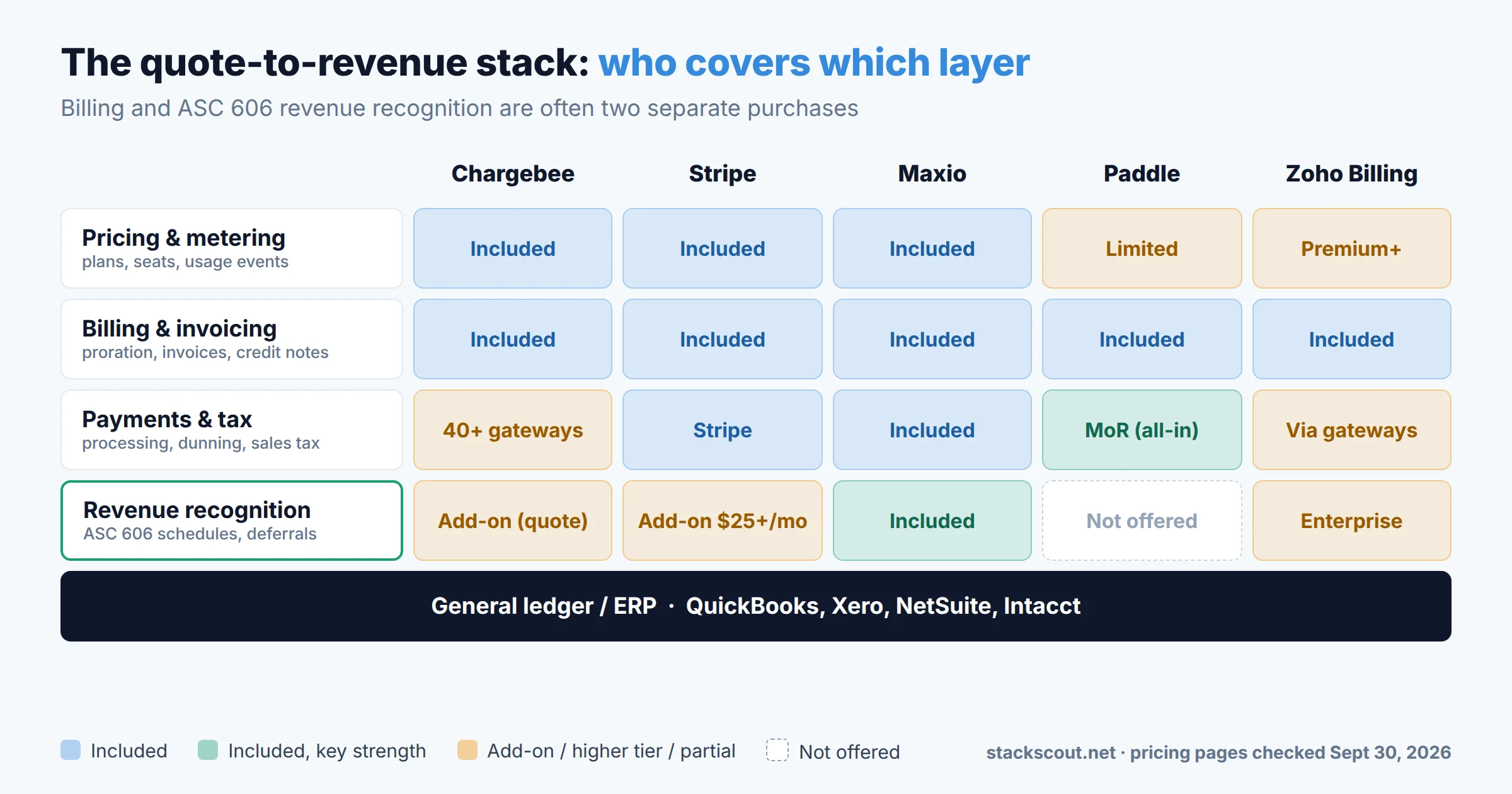
If your controller already handles recognition in an ERP like NetSuite, weight the billing layer heavily and check GL sync. If you're a founder-led finance team on QuickBooks or Xero, look for a platform that produces the deferred revenue schedule for you. (For the ledger itself, see our guide on how to choose accounting software for startups vs. agencies.)
03 — SIDE BY SIDEComparison table
We checked all prices on the vendors' official pricing pages on September 30, 2026. "Quote" means the vendor publishes no list price.
| Platform | Entry pricing | Usage-based billing | ASC 606 revenue recognition | Best for |
|---|---|---|---|---|
| Chargebee | Flow: 0.80% of invoicing volume, or $99 + 0.65% | Yes, 100M events/mo on Flow | Separate product (quote) | Hybrid seat + usage, multi-gateway |
| Stripe Billing | 0.7% PAYG; plans from $620/mo | Yes (Metronome for advanced) | Stripe Revenue Recognition from $25/mo | Teams already processing on Stripe |
| Maxio | Grow: $599/mo up to $100K monthly billings | Yes | Included (advanced on Scale) | Finance-led B2B SaaS |
| Recurly | Quote (subscriptions) | Yes | RevRec add-on, $850/mo billed annually | High-volume subscriber businesses |
| Zuora | Quote | Yes | Zuora Revenue (separate module) | Enterprise, multi-entity |
| Paddle | 5% + 50¢ per transaction (all-in MoR) | Limited | Not a rev-rec tool | Global self-serve, tax offload |
| Zoho Billing | Standard $39/mo, Premium $79/mo (annual) | Premium and up | Enterprise edition only | Early-stage, under $1M/yr billed |
| Metronome / Orb / Lago | Quote (Lago also open source) | Core strength | Varies; usually paired with a rev-rec tool | AI and API products billed on consumption |
Billing platform fees are charged on top of payment processing (for example, Stripe's standard 2.9% + 30¢ US card rate), except for Paddle, whose 5% + 50¢ bundles processing, tax, and fraud protection.
04 — THE MATHWhat you'll actually pay at $50K, $150K, and $400K a month
Percentage-of-volume pricing looks cheap on a pricing page and then grows with every renewal you invoice. Below, we modeled the monthly platform fee (processing excluded) at three billing volumes. We used each vendor's cheapest published option at that volume, and added revenue recognition wherever it's sold separately and publicly priced.
| Monthly billings | $50K | $150K | $400K |
|---|---|---|---|
| Stripe Billing | $350 | $955 | $2,505 |
| + Stripe Revenue Recognition | $125 | $290 | $750 |
| = Stripe stack total | $475 | $1,245 | $3,255 |
| Chargebee Flow (billing only) | $400 | $1,074 | $2,699 |
| Maxio (billing + rev rec) | $599 | Quote (Scale) | Quote (Scale) |
| Zoho Billing Premium (no ASC 606) | $79 | Over plan limit | Over plan limit |
How we calculated it: Stripe Billing at 0.7% PAYG, or the $620 annual plan (covers $100K) + 0.67% on additional volume, whichever is lower. Stripe Revenue Recognition at $25/month (first $10K) + 0.25%, or the $190 annual plan + 0.2%, whichever is lower. Chargebee Flow at min(0.80% × volume, $99 + 0.65% × volume). Zoho's Standard/Premium plans cap annual billed revenue at $1M. Chargebee RevRec and Recurly are quote-only, so they're excluded from the totals.
Three things jump out:
- Under about $100K a month, the Stripe stack and Maxio Grow are within roughly $125 of each other, and Maxio's number already includes deferred revenue reporting, A/R, and a revenue waterfall. If you'd have to buy Chargebee RevRec on top of Chargebee Flow, Maxio is likely the cheaper complete stack at that stage.
- Chargebee Flow costs slightly more than Stripe Billing at every volume we modeled ($400 vs. $350 at $50K; $2,699 vs. $2,505 at $400K). The gap is roughly $50–$200 a month. What you get for it is gateway independence, meaning you aren't locked into Stripe's processing rates. Once a quoted RevRec contract enters the picture, the total is a negotiation, not a formula.
- Zoho Billing is roughly a fifth of the cost at $50K a month, but you're buying billing only. Revenue recognition configurations sit in the custom-priced Enterprise edition.
Watch the contract, not just the rate. Stripe's volume plans are 1-year contracts billed monthly. Maxio's default agreements are paid annually, with premium options for monthly or quarterly payment. Recurly's RevRec add-on is billed annually. The only true month-to-month options in this table are Stripe's pay-as-you-go rates, Chargebee Flow, and Stripe Revenue Recognition's $25 monthly tier.
05 — ASC 606What revenue recognition software actually automates (and what it doesn't)
ASC 606 gives every contract the same five-step model: identify the contract, identify the performance obligations, determine the transaction price, allocate that price to each obligation, and recognize revenue as each obligation is satisfied. For a plain annual subscription, that's easy. A $12,000 annual plan paid upfront becomes $1,000 of revenue a month, and the rest sits in deferred revenue. It gets hard in three places SaaS companies hit quickly:
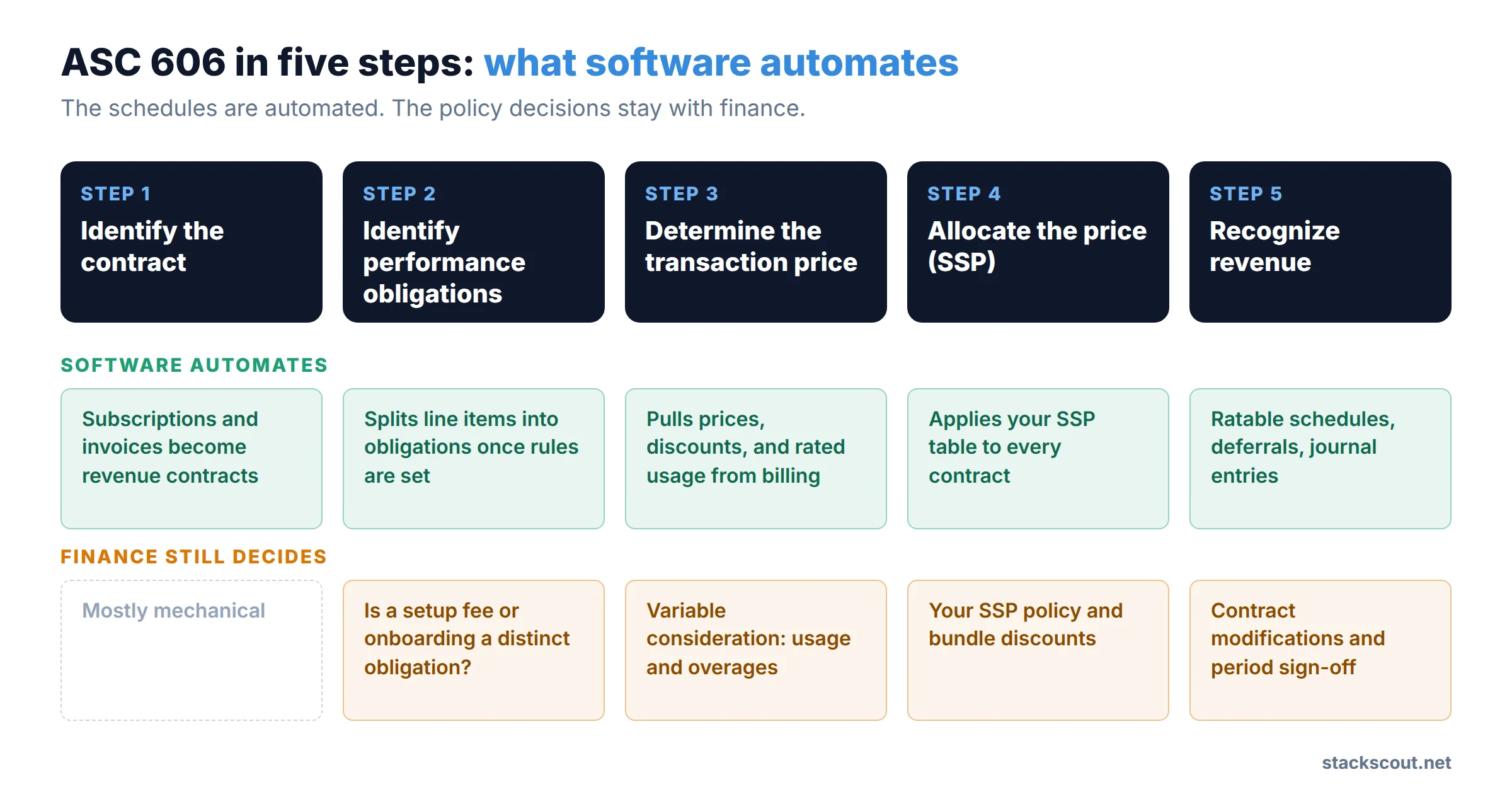
- Bundles with implementation or services. Onboarding fees, training, or professional services are often separate performance obligations. The contract price has to be allocated by standalone selling price (SSP). Maxio lists performance obligations, SSPs, and carve-outs among its revenue features; Chargebee RevRec Enterprise lists contract-based recognition and advanced revenue rules. Tools without these force you to do the allocation in a spreadsheet and book a manual journal entry.
- Usage and overages. Usage fees are variable consideration. Revenue follows consumption, which means the rev-rec engine needs the rated usage from your billing engine, not just the invoice total. Chargebee reserves usage-based recognition for its RevRec Enterprise tier. That's a detail worth confirming in any demo if your pricing has a usage component.
- Mid-term changes. Upgrades, downgrades, credit notes, and early renewals are contract modifications. Stripe Revenue Recognition auto-adjusts revenue for credit notes and lets you reopen accounting periods for historical adjustments. Ask every vendor to show you a mid-cycle downgrade followed by a refund, then check the journal entries it produces.
What no tool does for you: decide your SSP policy, decide whether a setup fee is a distinct obligation, or sign off on the numbers. The software's job is to apply your policy consistently and produce an audit trail. For a sense of how auditors approach system evidence more broadly, our beginner's guide to SOC 2 for B2B SaaS founders covers the control mindset. Your billing platform will be in scope for SOC 2 as well.
06 — THE REVIEWSIndividual reviews
1. Chargebee
- Flow: 0.80% or $99 + 0.65%
- 100M usage events/mo
- 40+ gateways
- RevRec: quote
Chargebee has rebuilt its pricing around a single self-serve plan, Flow. As of September 30, 2026, Flow costs $0 + 0.80% of monthly invoicing volume. Once you pass a $66K/month breakeven, switching to $99 + 0.65% is cheaper. Flow includes usage-based billing with up to 100 million usage events a month and real-time usage limits and alerts. It also includes integrations with Xero, QuickBooks, and Anrok for sales tax. Enterprise (custom pricing) adds multi-entity management, parent-child account hierarchies, contract terms, NetSuite and Intacct integrations, and up to 500M usage events a month as a paid add-on.
Revenue recognition is a separate product line. RevRec Performance covers point-in-time and ratable recognition, multi-currency, GAAP reports, and journal entry mapping. RevRec Enterprise adds multi-entity support, advanced revenue rules, and usage-based and contract-based recognition. Both are quote-only. Chargebee also bundles CPQ Lite (first 50 quotes free) and a free Growth Starter tier for retention experiments.
The strongest argument for Chargebee is gateway independence. It connects to 40+ payment gateways, so you aren't tied to one processor's rates as you expand internationally. If you're selling agent- or credit-based pricing, Chargebee now markets usage ingestion through an MCP server as well. We covered how agent platforms meter their own bills in our AI agent automation platforms comparison.
Pros
- Transparent, month-to-month entry pricing
- Handles seats, tiers, and usage in one plan
- Gateway-agnostic (40+ gateways)
- QuickBooks/Xero sync on the entry plan
Cons
- ASC 606 RevRec is a separate, quoted contract
- Usage-based recognition only on RevRec Enterprise
- NetSuite/Intacct sync requires Enterprise
- Percentage fee grows with every invoice
2. Stripe Billing + Stripe Revenue Recognition
- Billing: 0.7% PAYG
- Plans $620–$5,750/mo
- RevRec from $25/mo
- Metronome for usage
Stripe Billing's pay-as-you-go rate is 0.7% of billing volume, covering Billing transactions processed on and off Stripe but excluding one-off invoices. If your volume is predictable, the 1-year plans lower the effective rate: $620/month covers up to $100K in monthly volume, $1,500 up to $250K, $2,950 up to $500K, and $5,750 up to $1M, with 0.67% on volume above each tier. Smart Retries and automatic reminder emails are included. The hosted customer portal is too, with a custom domain for $10/month.
Stripe Revenue Recognition is priced separately by payment volume. It's $25/month on a monthly subscription (up to $10K in volume, 0.25% above that), then annual plans at $190, $450, $860, and $1,650 per month for up to $100K, $250K, $500K, and $1M, with 0.2% on additional volume. It includes pro-rata or point-in-time treatment, reopening closed periods, credit note adjustments, 4-4-5 calendars, chart-of-accounts mapping, and waterfall reports. A 30-day free trial is available.
For complex usage pricing, Stripe completed its acquisition of Metronome in January 2026. Metronome is now the engine behind Stripe's advanced usage-based billing and is still sold standalone through metronome.com. It's contact-sales only.
Pros
- Lowest published cost for a full billing + rev-rec stack at low volume
- No annual commitment on PAYG
- One vendor for payments, billing, and rev rec
- Deep developer tooling
Cons
- Rev rec automates Stripe transactions; outside data needs imports
- You're coupled to Stripe as your processor
- Sales-led contract features (ramps, multi-entity) are thinner than Zuora's or Maxio's
- Heavy usage pricing moves you into a separate Metronome sales process
3. Maxio
- Grow: $599/mo ≤ $100K billings
- Scale: quote
- Rev rec included
- Annual by default
Maxio is the product of the Chargify and SaaSOptics merger. It has the most finance-oriented feature set in the mid-market. The Grow plan is $599/month for businesses billing up to $100K a month. It includes automated invoicing, subscription management, payment processing, usage-based billing, A/R management, and standard revenue recognition with scheduled, recognized, and deferred revenue. Scale (over $100K in monthly billings, quote only) upgrades financial reports, A/R, and revenue recognition to "advanced" tiers. It also adds advanced revenue management, expense amortization, metering and rating, and multi-entity support.
The reporting is the reason controllers choose Maxio. It includes contract-level deferred revenue waterfalls, deferred revenue and A/R roll-forwards, deferred revenue by transaction, and unbilled A/R. Revenue features include performance obligations, SSPs, carve-outs, and multiple revenue books. These are the reports an auditor asks for, and they'd otherwise be built by hand.
Pros
- Billing + GAAP rev rec in one published price
- Audit-grade waterfalls and roll-forwards
- SSP and performance-obligation support
- Milestone billing for services-heavy contracts
Cons
- Annual agreements by default; monthly costs extra
- Scale pricing is quote-only
- Less oriented to self-serve PLG checkout than Chargebee or Stripe
- More finance setup before go-live
4. Recurly
- Subscriptions: quote
- RevRec: $850/mo (annual)
- Engagement: $1,600/mo
Recurly's pricing page no longer lists subscription plan prices. As of September 30, 2026, it offers a demo and a commercial structure "around your volume." The two add-ons it does price publicly are automated revenue recognition at $850/month (billed annually, scaled to billing volume) and an engagement product at $1,600/month (billed annually) for AI churn-propensity prompts. Recurly says it processes $12B in annual payment volume.
Recurly's reputation rests on subscriber retention: dunning, failed-payment recovery, and lifecycle offers. That matters most for businesses with many small subscriptions, like prosumer SaaS, media, and consumer apps. For a B2B SaaS company with 200 annual contracts, the retention tooling is less decisive than contract handling and rev rec.
Pros
- Strong churn and payment-recovery tooling
- Published RevRec add-on price
- Proven at high subscriber counts
Cons
- No public subscription pricing
- Add-ons are annual contracts
- Tilted toward high-volume B2C over contract-heavy B2B
5. Zuora
- Quote only
- Billing, Revenue, Collect modules
- Private since 2025
Zuora went private in 2025 after agreeing to a $1.7B all-cash acquisition by Silver Lake and GIC. It remains the reference platform for large, multi-product, multi-entity subscription operations. Zuora Billing, Zuora Revenue, and Zuora Collect are priced separately, and none are published. Procurement marketplace Vendr reports a median buyer price of about $170,000 a year across 149 purchases. That's a third-party figure, not a list price, but it tells you where Zuora starts to make sense.
Choose Zuora when you have multiple legal entities, complex ramp deals and amendments, and a revenue team that needs Zuora Revenue's depth, usually alongside an ERP. Choose something lighter if your finance team is three people.
Pros
- Deepest contract amendment and multi-entity handling
- Dedicated revenue module for complex ASC 606
- Deep ERP integrations
Cons
- Enterprise price point and implementation effort
- No public pricing
- Overkill below mid-market scale
6. Paddle
- 5% + 50¢ per transaction
- Merchant of Record
- Invoicing: custom pricing
Paddle is a different model. As a merchant of record, Paddle is the legal seller to your customer. It handles global sales tax registration, filing, and remittance, plus chargebacks and fraud, and pays out to you. The all-in rate is 5% + 50¢ per transaction with no monthly fees. Paddle contrasts this with roughly 7%+ when you add up a payment processor, billing, tax, and fraud tooling separately.
Two caveats matter for B2B buyers. First, Paddle's pricing page says that if you require invoicing, or sell products under $10, pricing is custom. Sales-led B2B contracts paid by invoice fall outside the headline rate. Second, Paddle is a billing and payments layer, not an ASC 606 engine. You'll still need to recognize revenue in your own books. Paddle fits best for self-serve SaaS selling internationally to many small customers.
Pros
- Global tax compliance handled for you
- One all-in rate, no monthly fees
- Fraud and chargeback protection included
Cons
- 5% + 50¢ is expensive on large contracts
- Invoiced B2B deals need custom pricing
- No revenue recognition
7. Zoho Billing
- Standard $39/mo · Premium $79/mo (annual)
- ≤ $1M billed/yr
- 14-day trial
Zoho Billing is the budget option. Standard is $39/month billed annually ($50 monthly), and Premium is $79/month billed annually ($100 monthly). Premium adds usage-based billing. Both plans allow up to 100,000 invoices a year and annual billed revenue up to $1M, with 3 users on Standard and up to 10 on Premium. Revenue recognition configurations and advanced usage controls are in the custom-priced Enterprise edition.
For a seed-stage SaaS company billing well under $1M a year, Zoho Billing plus disciplined spreadsheet deferrals is a defensible choice. Plan the migration before you hit the revenue ceiling, not after.
Pros
- Flat fee, not a percentage of revenue
- Usage billing from $79/mo
- Fits the Zoho Books/CRM ecosystem
Cons
- $1M/yr billed-revenue cap on self-serve plans
- Rev rec only on Enterprise
- User limits (3 / 10)
8. Usage-first engines: Metronome, Orb, Lago
- All quote-based
- Lago: open-source core
- Built for metering
If your product is priced on tokens, API calls, compute, or credits, a usage-first engine may matter more than anything else on this list. Metronome (now a Stripe product) is sold through sales. Orb offers Core, Advanced, and Enterprise tiers, all via sales, and lists Vercel, Replit, and Supabase among its customers. Lago offers an open-source core you can self-host, plus a paid cloud product. These engines excel at ingesting and rating events. Most B2B teams still pair them with a separate revenue recognition tool or ERP for ASC 606.
A good rule: if more than half of revenue comes from metered usage, evaluate a usage-first engine alongside Chargebee and Stripe. If usage is a small overage on top of seats, Chargebee Flow's or Stripe Billing's built-in usage support is usually enough.
Pros
- Built for high-volume event rating
- Handles credits, commits, and prepaid drawdown
- Lago can be self-hosted
Cons
- No published prices (except self-hosted Lago)
- Typically need a separate rev-rec layer
- More engineering involvement
07 — THE FITWho should choose which
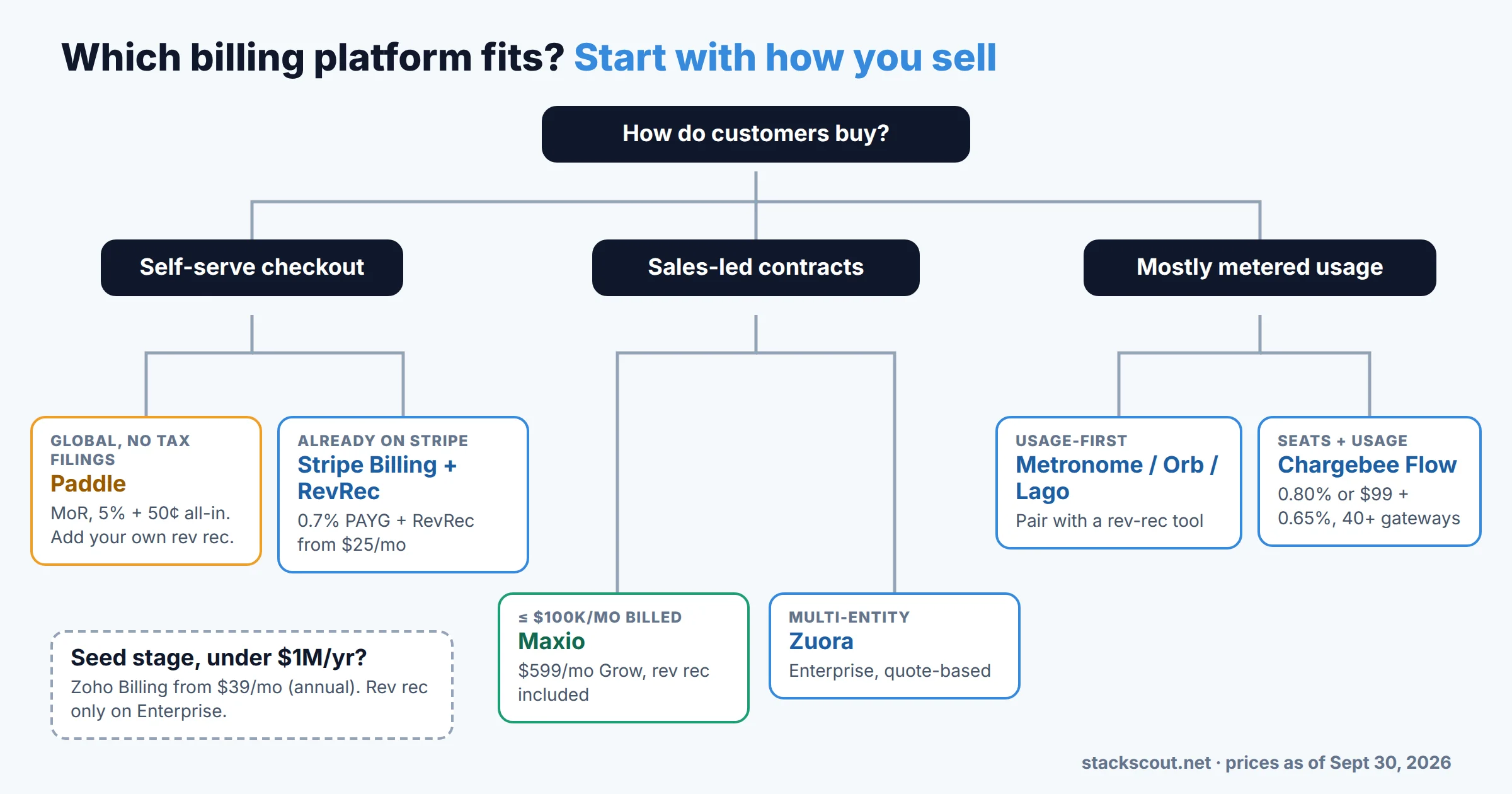
Whatever you pick, the integration to your ledger is where most billing projects break: customer records duplicate, credit notes don't sync, or revenue lands in the wrong account. Our QuickBooks vs. Xero comparison for growing B2B teams covers the ledger side. If you're wiring billing events into a CRM or ERP, see our breakdown of iPaaS platforms for B2B SaaS teams. If you're weighing a Chargebee-to-Stripe move specifically, we're preparing a Chargebee vs. Stripe Billing migration guide.
08 — METHODOLOGYHow we chose
We started from the platforms that recur across current buyer guides and review sites for SaaS subscription billing. We kept the ones that publish enough product documentation to evaluate. We scored each on four criteria: (1) published price transparency and total cost at $50K, $150K, and $400K in monthly billings; (2) pricing-model coverage: seats, tiers, usage, credits, and contract terms; (3) ASC 606 depth: ratable and point-in-time recognition, SSP allocation, usage-based recognition, and audit reports; and (4) ledger and gateway integrations. All prices come from each vendor's official pricing page, checked on September 30, 2026. The only exception is Zuora, where we cite a third-party procurement figure and label it as such. We didn't run live billing through these systems. Our findings are based on our research into vendor documentation and pricing pages, and we have no affiliate relationship with any vendor listed.
09 — FAQFrequently asked questions
Is Stripe Billing ASC 606 compliant?
Chargebee vs. Recurly vs. Maxio: which is best for B2B SaaS?
Do I need separate revenue recognition software if I use QuickBooks or Xero?
What does subscription billing software cost for a SaaS startup?
Is Paddle a good choice for B2B SaaS?
Sources
- Chargebee, Plans and Pricing: chargebee.com/pricing (checked Sept 30, 2026)
- Stripe, Billing pricing: stripe.com/billing/pricing
- Stripe, Revenue Recognition pricing: stripe.com/revenue-recognition/pricing
- Stripe, "Metronome + Stripe: Building the future of billing": stripe.com/blog
- Maxio, Pricing: maxio.com/pricing
- Recurly, Pricing and Plans: recurly.com/pricing
- Paddle, Pricing: paddle.com/pricing
- Zoho Billing, Pricing plans (US): zoho.com/us/billing/pricing
- TechCrunch, "Subscription management firm Zuora agrees to be acquired for $1.7B": techcrunch.com
- Vendr, Zuora pricing data: vendr.com/marketplace/zuora
- Orb, Pricing: withorb.com/pricing · Lago, Pricing: getlago.com/pricing

Technology consultant with 10+ years in the Japanese tech industry. Specializing in SaaS evaluation, workflow automation, and B2B tool integration.