How a Remote-First Startup Onboarded 12 Employees Across 5 Countries With an EOR: A Case Study
TL;DR
A 42-person remote-first SaaS company needed 12 hires live within one quarter across Germany, Brazil, the Philippines, India, and Portugal — with no legal entity in any of them. Setting up five entities would have run an estimated $75,000–$200,000 combined and taken anywhere from a few months to over a year before the first paycheck could go out. Routing all 12 hires through a single Employer of Record instead got the first employee working in 4 business days, and the slowest jurisdiction in the group (Germany) live in 19.
The step sequence, the three compliance snags that showed up country by country, and the full cost comparison are below.
The Setup: 12 Hires, 5 Countries, One Hiring Quarter
The company had just closed a funding round and needed to open go-to-market and delivery capacity in EMEA, LatAm, and APAC inside a single quarter. The roster looked like this:
The company was remote-first from day one, but every hire until this point had been on its home-country payroll. It had no legal entity in Germany, Brazil, the Philippines, India, or Portugal, and no in-house international HR function. Two constraints shaped everything that followed. First, every one of the 12 roles was ongoing, integrated, and directed day-to-day by the company — the kind of work that international misclassification rules treat as employment, not contracting, regardless of what the paperwork calls it. Bringing anyone on as a contractor to save time was off the table from the start (more on why that line almost got crossed anyway in the pitfalls section below). Second, finance wanted one predictable line item covering all 12 hires, not five separate local payroll relationships to reconcile every month.
Why an EOR, Not Five Local Entities — or a PEO
An Employer of Record becomes the legal employer of a worker in a country where the hiring company has no entity, handling the local contract, payroll, tax withholding, and statutory benefits while the company keeps day-to-day management of the work itself. Setting up a foreign subsidiary instead typically runs $15,000–$40,000 in initial legal and registration costs per country, with ongoing local accounting and compliance overhead that can reach well into six figures a year depending on the country and industry, and the process itself commonly takes anywhere from a few months to well over a year before the entity is fully operational. Multiply that by five countries and the entity route wasn't a live option for a one-quarter hiring sprint — the company estimated $75,000–$200,000 in combined setup cost alone, before a single salary was paid.
A Professional Employer Organization (PEO) was briefly on the table too, but a PEO co-employs workers under an entity the client company already has — it doesn't supply the entity itself, which is exactly what this hiring plan was missing in all five countries. That distinction, and when a PEO relationship makes more sense than an EOR one, is covered in full in our EOR vs. PEO breakdown. (Teams that already run domestic payroll through a PEO and are making their first international hire face a related but different transition question — see our guide on switching from a PEO to an EOR without disrupting payroll.) With no existing entity or PEO relationship anywhere in the five countries, an EOR was the only path that matched the one-quarter timeline.
The Onboarding Workflow, Step by Step
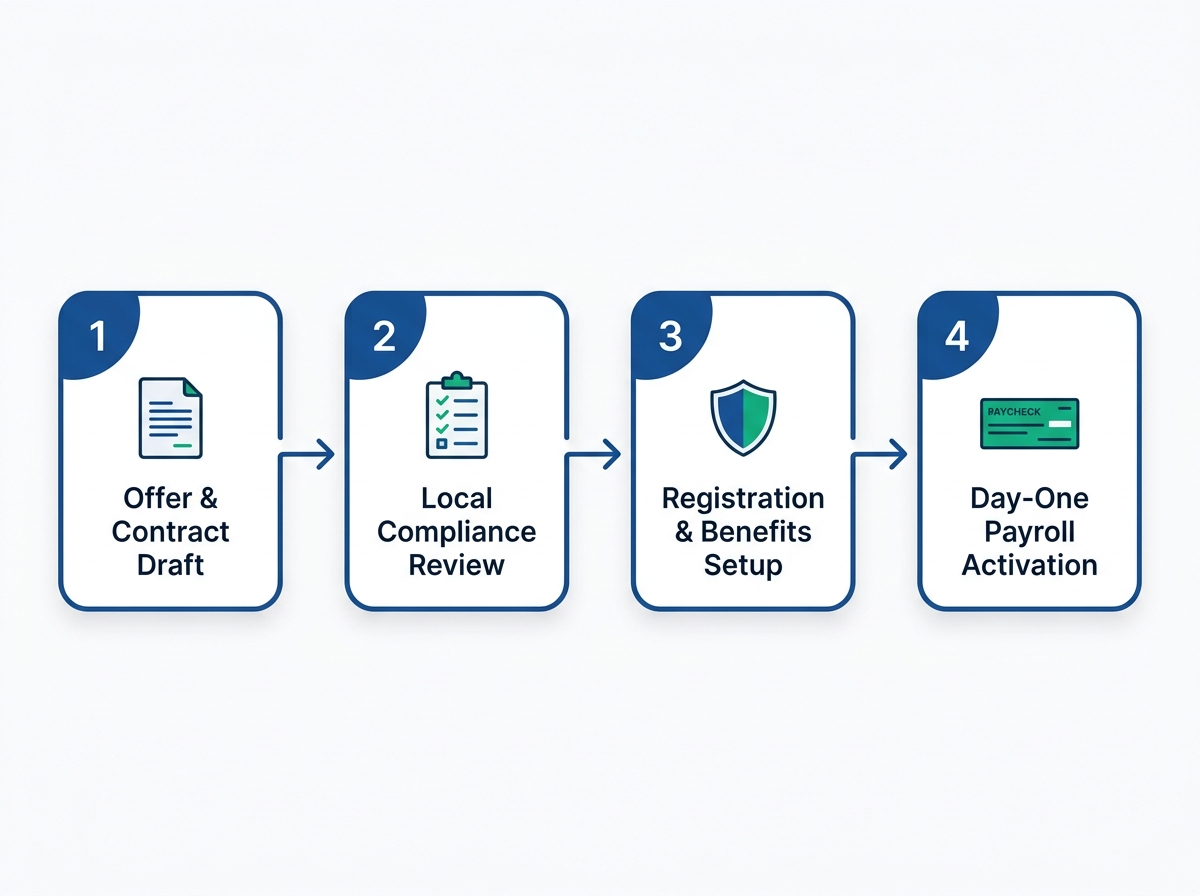
Every country ran through the same four-stage process — offer and contract draft, local compliance review, registration and benefits setup, day-one payroll activation — but the stages took very different amounts of time depending on the country's own rules. Published EOR onboarding benchmarks put typical go-live at roughly 2–3 business days, with most providers quoting a 1–7 day range across their full country coverage. The single biggest schedule lever wasn't picking a faster provider; it was parallel-tracking all five countries from day one instead of onboarding them in sequence, which is what kept the entire 12-person roster inside one quarter.
Here's how the five countries actually lined up, fastest to slowest:
Fastest of the five. Statutory registrations (SSS, PhilHealth, Pag-IBIG) are routine and well-templated for an EOR that already operates locally.
Contract and Provident Fund enrollment moved quickly; the only delay was confirming the correct notice-period clause, since India's notice periods are contractual rather than fixed by statute.
CLT contract registration and FGTS account setup added a few days versus the Asia-Pacific hires, plus time to confirm the 13th-salary accrual schedule with finance up front.
Probation-length classification (90 vs. 180 vs. 240 days, tied to seniority) had to be settled before the contract could be finalized, which pushed this past the Brazil and APAC hires.
Slowest by a wide margin. German law requires the written employment contract under the Nachweisgesetz, employee selection of a statutory health-insurance fund before payroll can run, and — later, at offboarding — a termination notice on paper with a wet-ink signature, since email isn't legally sufficient. None of that is negotiable regardless of which EOR is used.
Keeping 12 parallel onboarding threads visible across five time zones, without anything quietly stalling in someone's inbox, took more than a shared spreadsheet. The company leaned on a lightweight workflow automation layer on top of the EOR's own portal to track each hire's stage and flag anything sitting idle for more than a day — the same category of tooling covered in our roundup of workflow automation tools for HR onboarding.
Country-by-Country Compliance Snapshot

Five countries, five completely different rulebooks. None of the five hires could safely inherit the company's home-country assumptions about probation, notice, or benefits — each one had to be researched on its own terms.
| Country | Probation period | Notice (post-probation) | Mandatory pay / benefits | Employer statutory add-on |
|---|---|---|---|---|
| 🇩🇪 Germany | Up to 6 months (statutory cap, BGB §622(3)) | 4 weeks to the 15th or end of month, rising to 4 months at 10+ years' tenure | Statutory health, pension, and unemployment insurance from day one | ~21% of gross salary |
| 🇧🇷 Brazil | Typically up to 90 days (contrato de experiência) | 30 days + 3 days per year worked, capped at 90 days | 13th salary (2 installments) + 1/3 vacation bonus + FGTS from month one | ~29–31% (INSS + FGTS + RAT) |
| 🇵🇭 Philippines | Up to 6 months (statutory maximum) | Typically 30 days | Pro-rated 13th month pay from month one; SSS/PhilHealth/Pag-IBIG from day one | ~14.5% combined (SSS/PhilHealth/Pag-IBIG) |
| 🇮🇳 India | No statutory cap — commonly 3–6 months by contract | Commonly 1–3 months, set by contract, not statute | Provident Fund from day one; gratuity after 1 year for fixed-term staff under the 2020 Social Security Code | ~12% Provident Fund (wage-capped) + gratuity accrual |
| 🇵🇹 Portugal | 90 days standard; 180 for specialists; 240 for senior management | 7–15 days during probation, longer after, scaled to tenure | 13th and 14th mandatory salaries; minimum 22 days annual leave after year one | ~23.75% total employer social security (TSU) |
Three of the five held surprises worth walking through in more detail.
🇧🇷 Brazil: the 13th salary isn't a bonus, it's payroll
Finance initially modeled Brazil's mandatory 13th salary as an annual bonus line item. It's actually a legal entitlement paid in two installments — an advance between June and December, and the balance by December 20 — with FGTS calculated and deposited on the 13th-salary amount in the same month it's paid. Get the accrual timing wrong and the December installment lands as an unbudgeted spike rather than the smooth monthly accrual it should have been from month one. Anyone building a hiring plan specifically for Brazil should budget this in from the first payroll run — we cover the full mechanics in our upcoming guide to choosing an EOR for hiring in Brazil.
🇵🇭 Philippines: benefits start on day one, not after regularization
HR assumed — reasonably, based on how probation works in some other markets — that SSS, PhilHealth, and Pag-IBIG enrollment could wait until the two Philippines hires converted from probationary to regular status. Philippine labor law requires all three from the employee's first month, regardless of probationary status, and pro-rated 13th month pay starts accruing from month one as well. The EOR caught this before go-live, but it meant a same-week budget correction that a slightly earlier compliance check would have avoided. More on Philippines-specific EOR selection is coming in our dedicated guide to hiring in the Philippines.
🇮🇳 India: gratuity eligibility just changed under the new Social Security Code
Under India's old rule, gratuity only applied after five years of continuous service — well outside the planning horizon for two new engineering hires. Under Section 53 of the Code on Social Security, 2020, which took its EPF Scheme provisions live in mid-2026, fixed-term employees now qualify for gratuity on a pro rata basis after just one year. That's a rule most companies hiring in India before 2026 never had to plan around, and it changes the total cost of employment for anyone on a fixed-term contract there. We're building a full EOR provider comparison for hiring in India that walks through the updated Code on Social Security requirements in detail.
Three Things That Went Wrong (And How the EOR Caught Them)

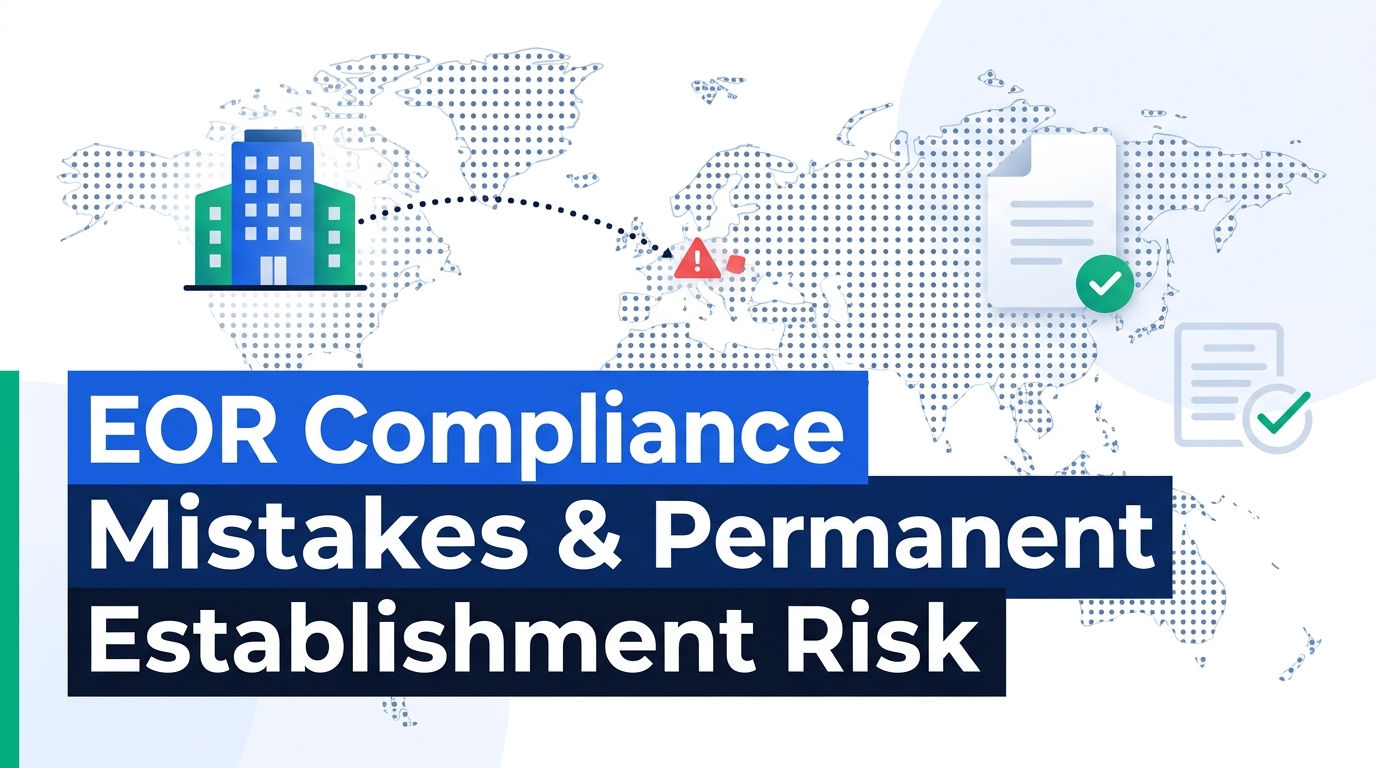
The almost-contractor mistake in Brazil. The original plan had one Brazil hire start as an independent contractor for the first month "while paperwork finalized," with conversion to full employment once the CLT contract cleared. The role was full-time, ongoing, and directed day-to-day by the company's own managers — precisely the fact pattern that misclassification rules and permanent establishment exposure key on, contractor label or not.
The fix: the EOR flagged it before the start date, and the hire began under full CLT employment from day one instead — no contractor bridge period. Misclassification and permanent establishment risk are covered in depth in our guide to EOR compliance mistakes that trigger permanent establishment risk.
Benefits budgeted for the wrong start date in the Philippines. As covered above, HR had modeled SSS/PhilHealth/Pag-IBIG and 13th month pay as starting after the probationary period ended, not from the first month of employment.
The fix: a same-week correction to the payroll budget once the EOR's compliance review surfaced the day-one requirement, made before the first payroll run rather than after.
Five payroll calendars, one finance team. Each country's payroll cutoff and pay date follows its own local convention — Brazil's 13th-salary advance window running June through December doesn't line up with a standard monthly cycle, and Germany's contract and notice paperwork run on different clocks entirely from either. Trusting five local calendars independently created a reconciliation mismatch in the first month.
The fix: building one unified pay-calendar view across all five countries before the second payroll cycle, rather than trying to reconcile five separate ones after the fact.
What It Actually Cost: EOR Fees vs. Five Local Entities
| Cost factor | 5 local entities | 1 EOR, 12 employees |
|---|---|---|
| Upfront setup | ~$75,000–$200,000 combined (roughly $15K–$40K per entity) | $0 — no incorporation required |
| Ongoing overhead | Local accounting, legal, and compliance per entity, potentially reaching well into six figures annually per country | A single per-employee fee — flat-rate or percentage-of-payroll, depending on the provider's model |
| Time to first paycheck | A few months to well over a year, depending on jurisdiction | 4–19 business days, depending on jurisdiction |
| Statutory employer costs | Identical either way — set by each country's own law | Identical either way — set by each country's own law |
| Who's the legal employer | The company itself, via its own local entity | The EOR, on the company's behalf |
Statutory employer costs — the Germany, Brazil, Philippines, India, and Portugal figures in the table above — are a government-set cost that applies no matter who the legal employer is; an EOR doesn't reduce them, it just remits them on the company's behalf. What an EOR fee replaces is the entity's overhead, not the statutory burden. On top of the EOR's own charge, providers typically price either a flat fee per employee per month or a percentage of gross salary, commonly in the 10–20% range — the two models produce very different totals depending on each hire's salary, which we break down fully in EOR pricing models explained.
One honest caveat: this math flips with scale. Once headcount in a single country climbs into the 10–15+ range and stays there, the fixed cost of an entity — spread across that many salaries — can undercut an ongoing per-employee EOR fee. The company that ran this hiring sprint already knows it'll revisit incorporating in Germany specifically once that office passes roughly 15 people; for this quarter's 12-hire, five-country sprint, though, the EOR route was the only one that fit the timeline at all.
The Decision Framework We'd Reuse
- Match the structure to the country, not the company. EOR, PEO, and entity aren't interchangeable defaults — decide per country based on expected headcount and timeline, not on whatever structure worked in the last country hired into. Our EOR vs. PEO comparison is the starting filter for that decision.
- Vet the provider against a fixed checklist, not price alone. Coverage in all five target countries, local compliance depth, and support responsiveness matter more than the headline rate. Our seven-question EOR provider framework is what we'd run through before signing.
- Parallel-track compliance review across every country from day one. Sequencing countries one after another is what turns a one-quarter hiring plan into a two-quarter one.
- Build one unified pay calendar before the first payroll run, not after the first reconciliation mismatch surfaces it.
- Treat probation, notice, and benefits rules as research, not assumptions. Every country in this case study had at least one rule that didn't match what the home-country team expected by default.
Frequently Asked Questions
How long does it actually take to onboard an employee through an EOR?
Published benchmarks put typical EOR onboarding at 2–3 business days, with most providers quoting a 1–7 day range across their country coverage. In this case study, the range across five countries ran from 4 business days (Philippines) to 19 (Germany) — the slower end driven entirely by that country's own legal requirements, like Germany's paper-based, wet-ink-signature contract and termination rules, not by the provider.
Do employees hired through an EOR get the same benefits as direct hires?
Yes — an EOR-employed worker is entitled to every statutory benefit the local law requires (social insurance, mandatory bonuses, leave, gratuity, and so on), on the same terms as a direct hire under a local entity. The EOR is the legal employer of record, so it carries the same statutory obligations any employer in that country would.
When does it make more sense to set up a local entity instead of using an EOR?
Once headcount in a single country grows large enough — commonly cited around 10–15+ employees sustained over time — the fixed cost of incorporating and running a local entity can undercut an ongoing per-employee EOR fee. Below that threshold, or for a fast, multi-country hiring sprint like the one in this case study, an EOR is almost always faster and cheaper on a total-cost basis.
Can one EOR provider cover all five of these countries, or do you need country specialists?
Many EOR platforms do cover all five markets directly or through owned local entities, which is what made a single-provider relationship workable for this hiring sprint. Coverage depth varies by provider, though — some rely on third-party local partners in less common markets, which can add a step to compliance review. Confirming direct-entity coverage in each target country is one of the seven questions in our EOR provider decision framework.
What's the biggest compliance mistake companies make when hiring across multiple countries at once?
Misclassifying an employee as a contractor to buy time, and assuming home-country benefit and probation rules carry over to a new jurisdiction. Both mistakes nearly happened in this case study — the almost-contractor start in Brazil and the mis-timed benefits budget in the Philippines — and both are exactly the pattern covered in our guide to EOR compliance mistakes that trigger permanent establishment risk.
Sources
- teamed., Germany Probation Period 2026: Statutory 6-Month Cap — checked September 2026.
- se-legal.de, Notice Periods in Germany: Employee Rights & Legal Options (2026) — checked September 2026.
- teamed., Brazil Termination & Severance 2026: FGTS, Notice — checked September 2026.
- Republic of the Philippines Official Gazette / FOI, Mandatory Benefits for Probationary Employees (DOLE) — checked September 2026.
- India Briefing, Employee Provident Fund 2026: Compliance Rules for Employers in India — checked September 2026.
- Boundless, Employer of Record in Portugal (2026) — checked September 2026.
- Remote, Permanent Establishment Risk for a Remote Workforce — checked September 2026.
- Lano, Cost & Time Required to Set Up a Foreign Legal Entity — checked September 2026.
- RemotePeople, EOR Cost 2026: 31-Provider Pricing Comparison & Hidden Fees — checked September 2026.

Technology consultant with 10+ years in the Japanese tech industry. Specializing in SaaS evaluation, workflow automation, and B2B tool integration.