Best PEO for Startups (2026): 7 Providers Compared on Minimums, Pricing, CPEO Status, and Exit Terms
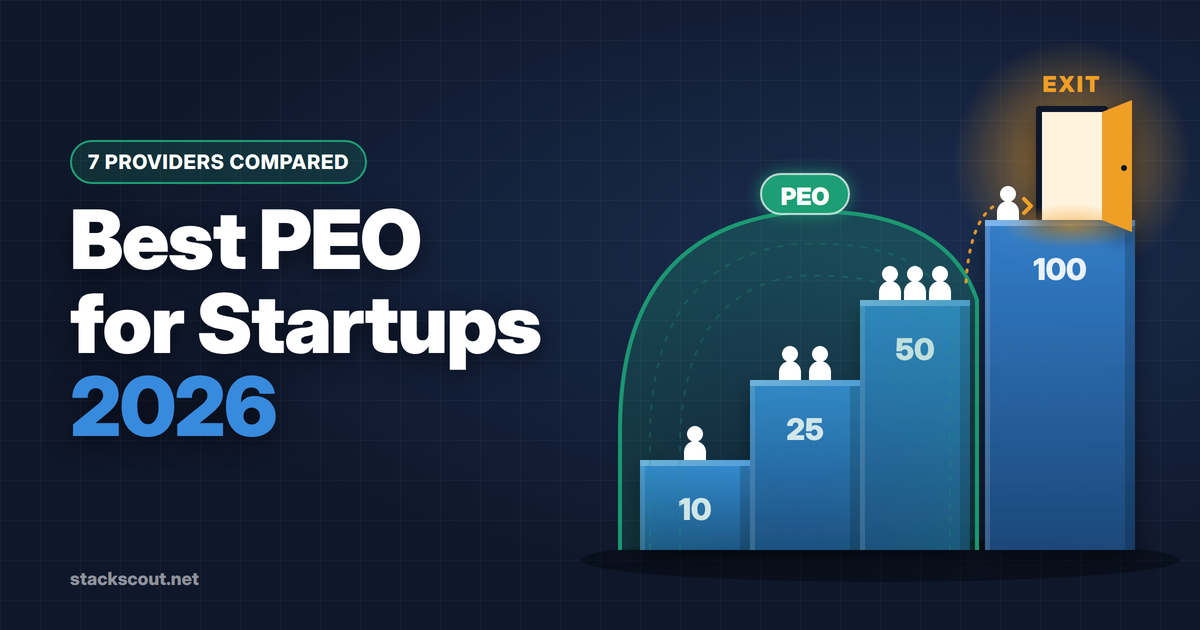
Most "best PEO" lists are written for small businesses in general. A venture-backed startup has a different problem. You need to offer health insurance that can compete with Big Tech when you're hiring employee number four, and you'll probably want to leave that same PEO a few years later when you have a people team and a CFO checking every invoice.
So this guide compares US PEOs on the things that matter most to a startup: how few employees you can sign up with, whether the price is published, whether the PEO is IRS-certified (CPEO), what the contract lets you do, and what leaving will cost. Every price and minimum below was checked on the vendor's own site, IRS records, or SEC filings in October 2026. Where a vendor doesn't publish a number, we say so instead of repeating figures from review sites.
TL;DR: the short answer
For most seed-stage startups with 2–25 US employees, Justworks is the easiest PEO to evaluate and join. It publishes its prices ($79 per employee per month for PEO Basic, $124 for PEO Plus, as of October 2026). It only needs two W-2 employees. And it's an IRS-certified PEO, which protects you from paying payroll tax twice if you leave mid-year. If you already know you'll grow out of a PEO, Rippling PEO is the only one that lets you switch the PEO off and keep the same HR and payroll system. If your investor has a partner deal, get a TriNet or Sequoia One quote before you sign anything. TriNet advertises up to 60% off admin fees through some VC portfolio programs.
What a PEO does for a startup (in one minute)
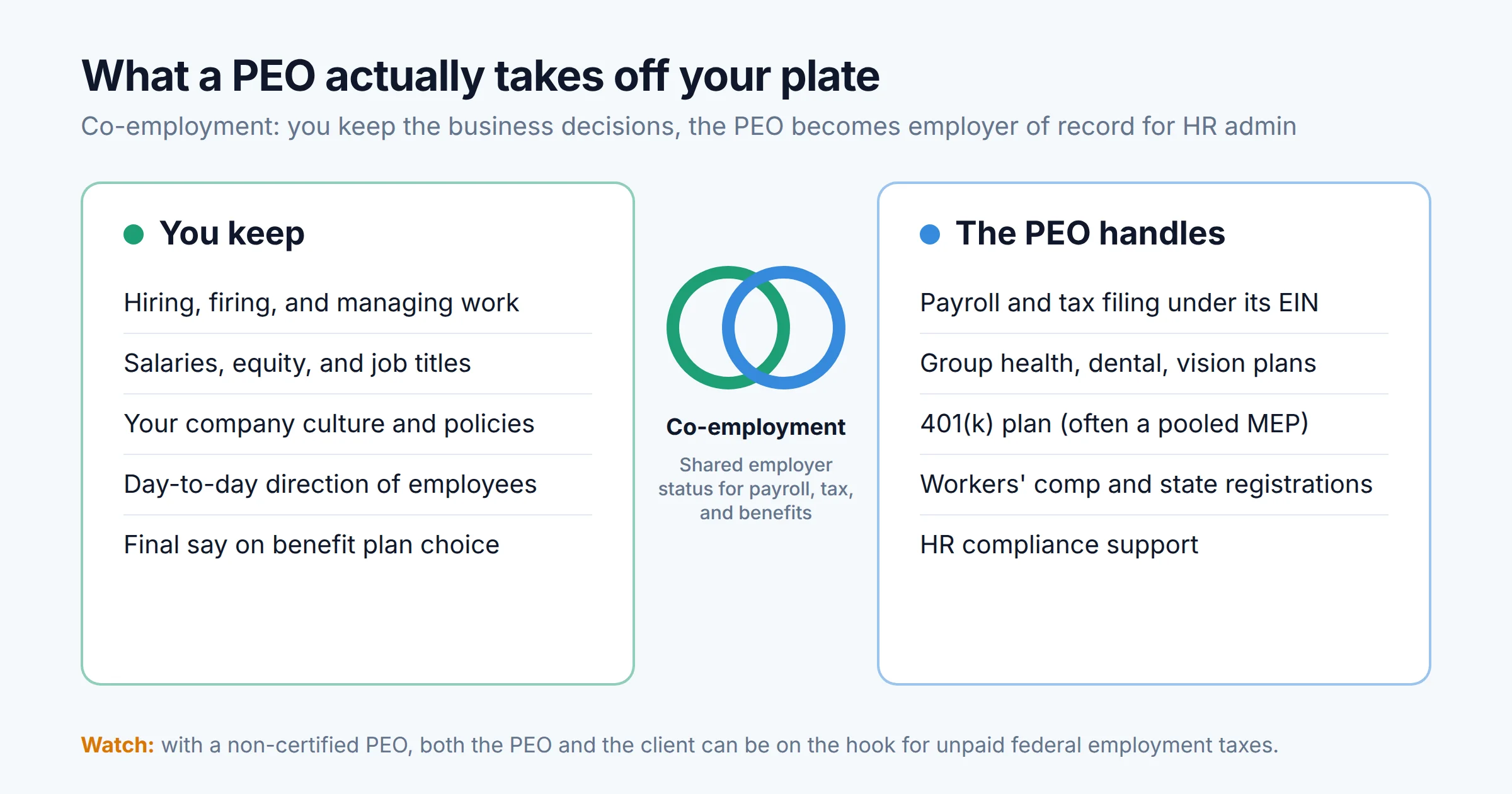
A professional employer organization (PEO) co-employs your US staff. It runs payroll and files employment taxes under its own tax ID, puts your team on its large pooled health plan, and handles workers' comp, state registrations, and HR compliance. You still decide who to hire, what to pay them, and how much equity to grant. For a 6-person startup, the main draw is benefits: on the PEO's master plan, your team gets the kind of coverage a small group usually can't get on its own.
The industry is big. NAPEO, the PEO trade association, reports that 502 PEOs served 5.4 million worksite employees at 233,000 client businesses at the end of 2025. NAPEO's ROI study estimates a 27.2% annual return from using a PEO ($1,775 in savings against $1,395 in PEO cost per employee). Keep in mind that the study is based on 2018 survey data, and the $1,395 is PEO gross profit per employee, not the total invoice you'll pay. If a PEO doesn't fit what you need, read our EOR vs PEO explainer. If you're hiring outside the US without an entity, you need an EOR, not a PEO.
Quick comparison table
All data was checked in October 2026. "Quote" means the vendor publishes no price. CPEO status comes from the IRS active CPEO list (report dated August 7, 2026).
| PEO | Published price | Fee model | Stated minimum | CPEO | Contract / exit | Best for |
|---|---|---|---|---|---|---|
| Justworks | $79 Basic / $124 Plus per employee per month, no base fee | Flat per employee | 2 W-2 employees | Yes | No published term; close the account through support | Seed, 2–25 people |
| Rippling PEO | Quote | Flat per employee ("one flat employee rate") | Not published | No | Can switch the PEO off and stay on Rippling's HR platform | Teams planning to leave the PEO later |
| TriNet | Quote | Per employee per month, plus benefits | PEO serves 5–500 employees | Yes (subsidiary) | Annual contract that auto-renews; usually 30 days' notice | VC-backed tech companies with a partner offer |
| Sequoia One | Quote | Not published | Not published | Yes | Not published | VC-backed tech startups |
| Deel PEO | $125 per US PEO employee per month | Flat per employee | Not published; US entity required | No | Month-to-month list price; the current promo requires a 2-year term | US team plus international hires |
| ADP TotalSource | Quote | Quoted by headcount, risk, and location | Not published | Yes | Not published | Startups expecting to scale large |
| Insperity | Quote | Percentage of payroll | Targets 10–5,000 employees | Yes | Pricing usually fixed for one year; 30 days' written notice | Founders who want high-touch HR service |
One pattern stands out: only Justworks and Deel publish a PEO price. Everyone else asks for a census (your employee list with ages, ZIP codes, and salaries) and builds a quote. That isn't necessarily bad, since benefits costs really do depend on who's on your team. But it does mean you can't compare these vendors without collecting at least three quotes.
The 7 PEOs, reviewed for startups
1. Justworks Best overall for seed stage
Justworks is the only major PEO where you can work out your bill before talking to sales. As of October 2026, its pricing page lists PEO Basic at $79 and PEO Plus at $124 per employee per month, with no base fee and no implementation fee. The difference between the plans matters. Basic includes the 401(k) and an ICHRA option but not group medical, dental, or vision. Plus adds the group health plans along with perks like One Medical and Talkspace. Most startups that choose a PEO for benefits will end up on Plus. Insurance premiums are billed on top of the admin fee.
To join, you need at least two W-2 employees, and one of them can be an unpaid owner. Benefits eligibility requires 30 or more hours a week. Part-time staff are billed at $79 and can't get benefits on either plan. Justworks offers waiting periods of 0, 30, or 60 days, which you can only change at onboarding or renewal.
Check two things before you sign. First, carrier access depends on your state. Justworks says it works with Aetna, Kaiser, and UnitedHealthcare "depending on where the company is sitused," and companies with 50 or fewer employees headquartered in Maryland or Maine can't get medical through Justworks. Second, the earlier volume-discount note no longer appears on the pricing page, so don't count on an automatic discount at scale. Ask for one.
Pros
- Full prices published; no setup fee
- Lowest stated minimum (2 employees)
- IRS-certified (four entities on the IRS list)
- Billed monthly with no published contract term; you can switch between Basic, Plus, and Payroll
Cons
- Group health requires the $124 Plus plan
- Medical restricted for small Maryland and Maine companies
- No published volume discount
- Less customization than an enterprise PEO
2. Rippling PEO Best if you'll outgrow the PEO
Rippling's selling point for startups is about the end of the PEO relationship, not the start. Rippling says it is "the only provider to let you move off PEO without replacing your underlying system." When you turn the PEO off, your HR, payroll, and employee data stay in the same account, your integrations stay connected, and your employees keep the same login. Leaving any other PEO means a full data migration to a new HRIS and payroll provider. Our PEO-to-EOR migration guide shows how much work that involves.
Rippling doesn't publish a PEO price. Its page says only "one flat employee rate, no hidden fees." Figures on third-party sites aren't confirmed, so we don't repeat them. Our Rippling pricing breakdown covers the platform modules you'll pay for alongside the PEO. On renewals, Rippling claims increases of 7.5% or less "for the vast majority of customers for four consecutive years." That's a company claim, but it's more specific than what most competitors say.
Rippling PEO is not on the IRS CPEO list, and Rippling openly argues certification "is not needed." Weigh that claim against the wage-base issue explained below.
Pros
- Leave the PEO without a system migration
- Same platform covers IT, devices, and spend
- Specific renewal-increase claim (≤7.5% for most customers)
Cons
- No published price or minimum
- Not IRS-certified
- Carriers and 401(k) provider not named on official pages
- Platform modules add to the total cost
3. TriNet Best for VC-backed tech teams
TriNet has served venture-backed tech companies for decades, and it shows in its VC partner pages. Sequoia, Pear, Norwest, Lead, and others have portfolio offers. The Sequoia page promises "up to 60%* off monthly admin fees" for new clients who meet headcount thresholds. If your fund has one of these deals, it's the biggest discount we found anywhere in this market. TriNet bills a per-employee-per-month admin fee, with benefits, workers' comp, and taxes billed separately. Its PEO serves companies with 5 to 500 employees.
Contract terms are friendly to founders. According to TriNet's 2025 annual report, PEO contracts auto-renew annually, but "in most cases" clients can cancel with 30 days' notice. The risk is benefits pricing. TriNet's own 10-K attributes falling worksite-employee counts in technology and other verticals partly to "necessary repricing of our health benefits services." Its average worksite employees dropped 11% year over year in Q2 2026. Ask for the renewal history behind any quote. If you used TriNet Zenefits, note that the old HRIS has been moved to an ASO product now sold as "HR Plus."
Pros
- VC partner discounts of up to 60% on admin fees
- Benefit bundles built for tech companies
- 30-day cancellation in most cases
- ESAC-accredited, with a CPEO subsidiary
Cons
- No published price
- 5-employee floor for the PEO
- Recent health-plan repricing
- Only one subsidiary holds CPEO status, so confirm which entity you contract with
4. Sequoia One Best niche pick for VC-backed tech
Sequoia One (not related to Sequoia Capital) describes its PEO as "an outsourcing solution for VC-backed tech startups." It's smaller than the big four, which can mean more attention from your account team. It's an IRS-certified PEO ("Sequoia One PEO, LLC," effective January 2018) and says it's covered by ESAC's financial assurance program. It publishes no pricing or minimum, so treat it as a quote you collect to put pressure on the other vendors, especially when your board wants a third bid.
Pros
- Built for venture-backed tech companies
- CPEO status
- A useful third quote against TriNet and Justworks
Cons
- No pricing, minimum, or contract terms published
- Smaller platform than Rippling or ADP
5. Deel PEO Best for US team plus global hires
Deel lists its US PEO at $125 per employee per month across all 50 states, with benefits premiums billed separately. It's the obvious choice if you already use Deel for international contractors or EOR hires and want one platform. See our best EOR for startups comparison for that side. National medical plans come from Aetna and Kaiser, and Deel says it's the only PEO offering Aetna International plans for employees who travel or relocate.
Read the contract terms carefully. Deel's pricing FAQ says it offers "flexible month-to-month pricing" and "you can cancel at any time." But the current "3 months free" PEO promotion applies to order forms signed between July 15 and December 31, 2026 with a minimum two-year term. The credit is applied at the end of the term, and terminating early means paying list price for the whole order form. For a startup that might raise, pivot, or get acquired within 24 months, the month-to-month list price is often worth more than the free months.
Pros
- Published price
- One platform for US PEO, EOR, and contractors
- Aetna International option
Cons
- Not IRS-certified
- Promo requires a 2-year lock-in
- Requires a US legal entity
- No published minimum
6. ADP TotalSource Best for scaling large
ADP TotalSource calls itself "the largest PEO certified by the Internal Revenue Service." It has more than 19,000 clients and 770,000 worksite employees, according to ADP's fiscal 2026 10-K. ADP says pricing "is quoted rather than listed" and depends on headcount, demographics, workers' comp risk, and where employees work. It has been ESAC-accredited since 1995. For a startup, the appeal is that it can grow with you: multi-state compliance and a large carrier network are routine for ADP. The trade-off is that it isn't built for startups, and you won't get a VC program or published startup pricing.
Pros
- Largest CPEO, with ESAC accreditation
- Strong multi-state compliance
- Workers' comp included in the service fee, per ADP
Cons
- Quote-only, with no startup program
- Enterprise-style sales process
- Minimum not published
7. Insperity Best for high-touch service
Insperity is known for hands-on HR service. Its main PEO product is now called HR360 (formerly Workforce Optimization). The pricing model is the issue for startups. According to Insperity's 10-K, the service fee is "a percentage of the payroll cost" of your employees. That structure costs more as salaries rise, and engineering salaries are high. Insperity's 10-K says it targets businesses with about 10 to 5,000 employees, so a 4-person seed team is below its focus. For most HR360 clients, pricing is set for one year and either side can terminate with 30 days' written notice.
Pros
- Hands-on HR and compliance service
- CPEO and ESAC accredited
- 30-day termination for most HR360 clients
Cons
- Percentage-of-payroll fees penalize high salaries
- Targets 10+ employees
- Quote-only
Also considered: Paychex PEO (Paychex HR Pro and Oasis) is a CPEO and serves teams under 10, but it publishes no price or minimum and isn't startup-focused. Gusto PEO launched as a waitlist product limited to Texas, California, and Florida for existing Gusto payroll customers, so it's too limited to rank yet. Gusto's standard plans are not a PEO (more on that below).
What a PEO really costs at 10, 25, 50, and 100 employees
Since only Justworks and Deel publish prices, they're the only ones we can model honestly. The table shows annual admin fees only. Insurance premiums, workers' comp, and payroll taxes come on top with every option. For comparison, the last column shows Gusto Plus, which is payroll and HR software where you stay the employer, priced at $80 a month plus $12 per person as of October 2026.
| Headcount | Justworks Basic ($79) | Justworks Plus ($124) | Deel PEO ($125) | Gusto Plus (not a PEO) |
|---|---|---|---|---|
| 10 | $9,480 | $14,880 | $15,000 | $2,400 |
| 25 | $23,700 | $37,200 | $37,500 | $4,560 |
| 50 | $47,400 | $74,400 | $75,000 | $8,160 |
| 100 | $94,800 | $148,800 | $150,000 | $15,360 |
This comparison isn't apples to apples. The PEO fee buys access to large-group health rates, workers' comp administration, multi-state registrations, and HR support that Gusto doesn't include. But the gap shows why companies leave PEOs. At 10 employees, you pay about $12,500 a year more for the PEO (Justworks Plus vs Gusto Plus), which one good benefits package can justify. At 100 employees the gap is about $133,000 a year, more than the salary of an experienced HR manager. At that size, many companies can also get competitive benefits on the open market through a broker.
Why percentage-of-payroll pricing hurts tech startups
TriNet's and Rippling's own cost guides put typical PEO pricing at 2% to 12% of wages when it's charged as a percentage, and ADP's guide gives an industry range of $40 to $160 per employee per month for flat pricing. Here's a hypothetical example (not a vendor quote): 25 engineers averaging $170,000 means $4.25 million in payroll. A 3% fee on that is $127,500 a year, or about $425 per employee per month, more than three times Justworks Plus. If a quote is a percentage, ask for the equivalent flat per-employee amount and compare that.
Census tip: PEO benefits quotes are built from your employee census. A young, healthy, single-state team usually gets better rates. A team spread across expensive metro areas with several dependents gets worse ones. Send the same census to every vendor so you're comparing like with like.
CPEO status: the detail most "best PEO" lists skip
None of the top-ranking articles we reviewed explain what CPEO status means for a startup's tax bill, and it matters most when you leave a PEO.
Under 26 U.S.C. §3511, an IRS-certified PEO (CPEO) is solely liable for federal employment taxes on the wages it pays. When your contract with a CPEO ends, your company "shall be treated as a successor employer" for Social Security (FICA) and federal unemployment (FUTA) tax purposes. In practice, the wages already paid that year carry over, and the annual wage caps don't restart.
With a non-certified PEO, a mid-year switch can restart those wage bases, so you pay the employer share again on wages that already hit the cap. The 2026 Social Security wage base is $184,500.
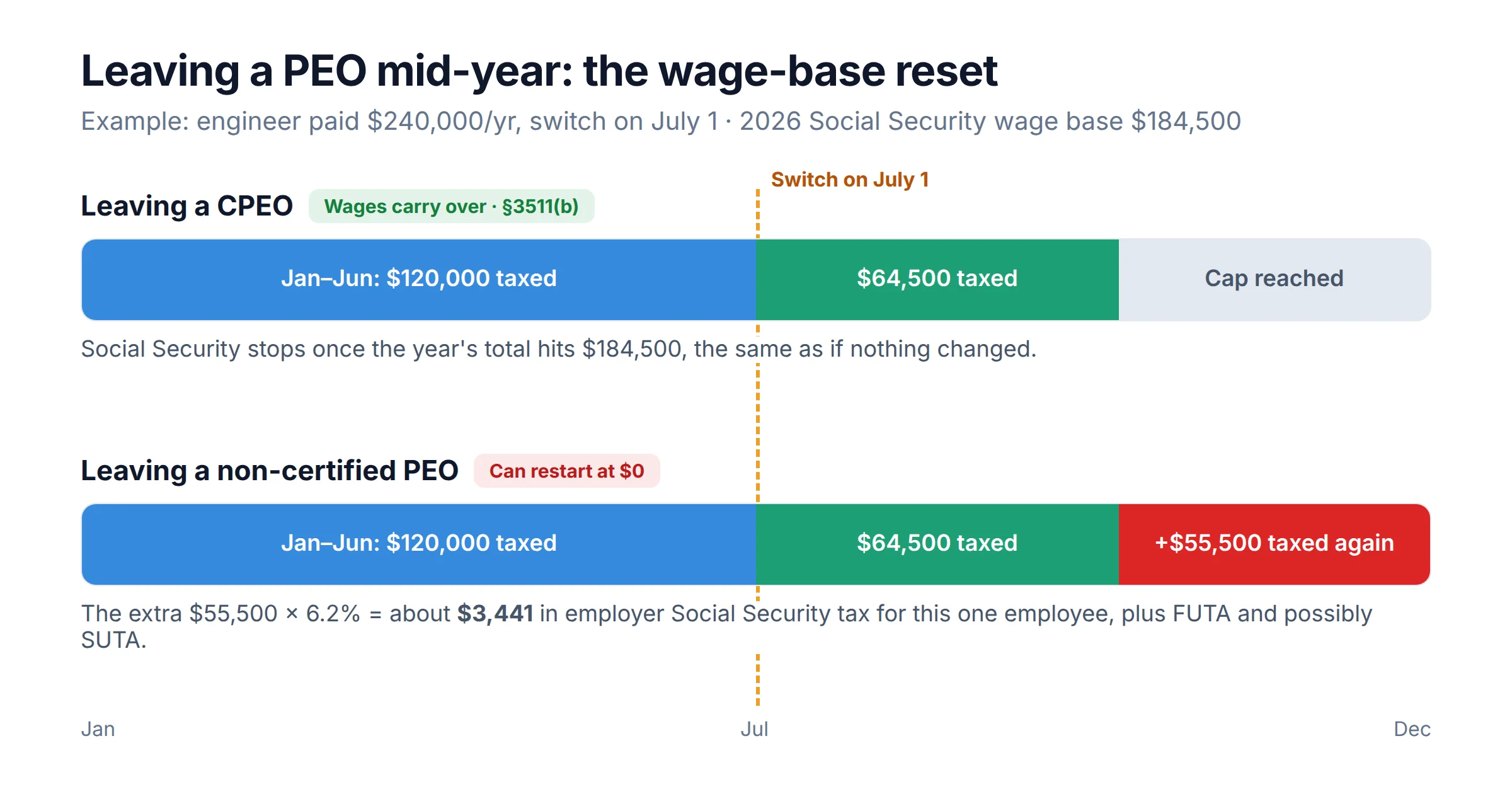
Multiply that roughly $3,441 by every employee earning more than $184,500, and a badly timed exit from a non-certified PEO can cost a well-paid engineering team tens of thousands of dollars. FUTA restarts too, though it's only $42 per employee at the standard 0.6% net rate on the first $7,000. State unemployment tax depends on the state: some states have PEOs report at the PEO level and others at the client level. The employee share of over-withheld Social Security can generally be recovered on personal returns, but the employer share can't.
The practical rule, which compliance vendor Middesk also recommends: time any PEO exit for your renewal date or January 1. Do that and CPEO status matters much less. If you might need to leave mid-year, for example because an acquirer requires it, a CPEO is valuable insurance.
When to leave your PEO
Startups join PEOs early and, according to startup insurance broker Founder Shield, "frequently stay with PEOs for far too long." HR software advisor OutSail says PEOs are "typically designed for companies with 5-50 employees" and that beyond 50 or 75 employees companies "can typically get similar benefit offerings on the open market." A benefits consultant writing for Technical.ly put the general threshold at 100 full-time employees and described a client that saved 29% after leaving. Combining those views with the cost table above:
A PEO's main value is benefits you couldn't buy alone. Choose one with a low minimum and published pricing, and avoid multi-year lock-ins because your plans will change.
Admin fees grow but are still less than an HR hire. Multi-state remote hiring is where a PEO's state registrations save the most time.
Get an open-market benefits quote from a broker before each PEO renewal. If you've hired an HR lead, you may be paying twice for the same work.
Six-figure admin fees, a CFO reviewing every invoice, and a need for custom policies usually mean it's time to move to your own payroll, HRIS, and broker. Time the move for January 1 or your renewal date.
Signs it's time to leave sooner: your renewal increase is well above what an open-market broker quotes; the PEO's standard handbook, leave policy, or onboarding conflicts with what you want; you've hired a full-time people lead; or a fundraise or acquisition requires you to run payroll under your own entity. When you leave, you'll pick payroll software. Our Rippling vs Gusto for startups comparison covers the two most common landing spots.
Who should choose which
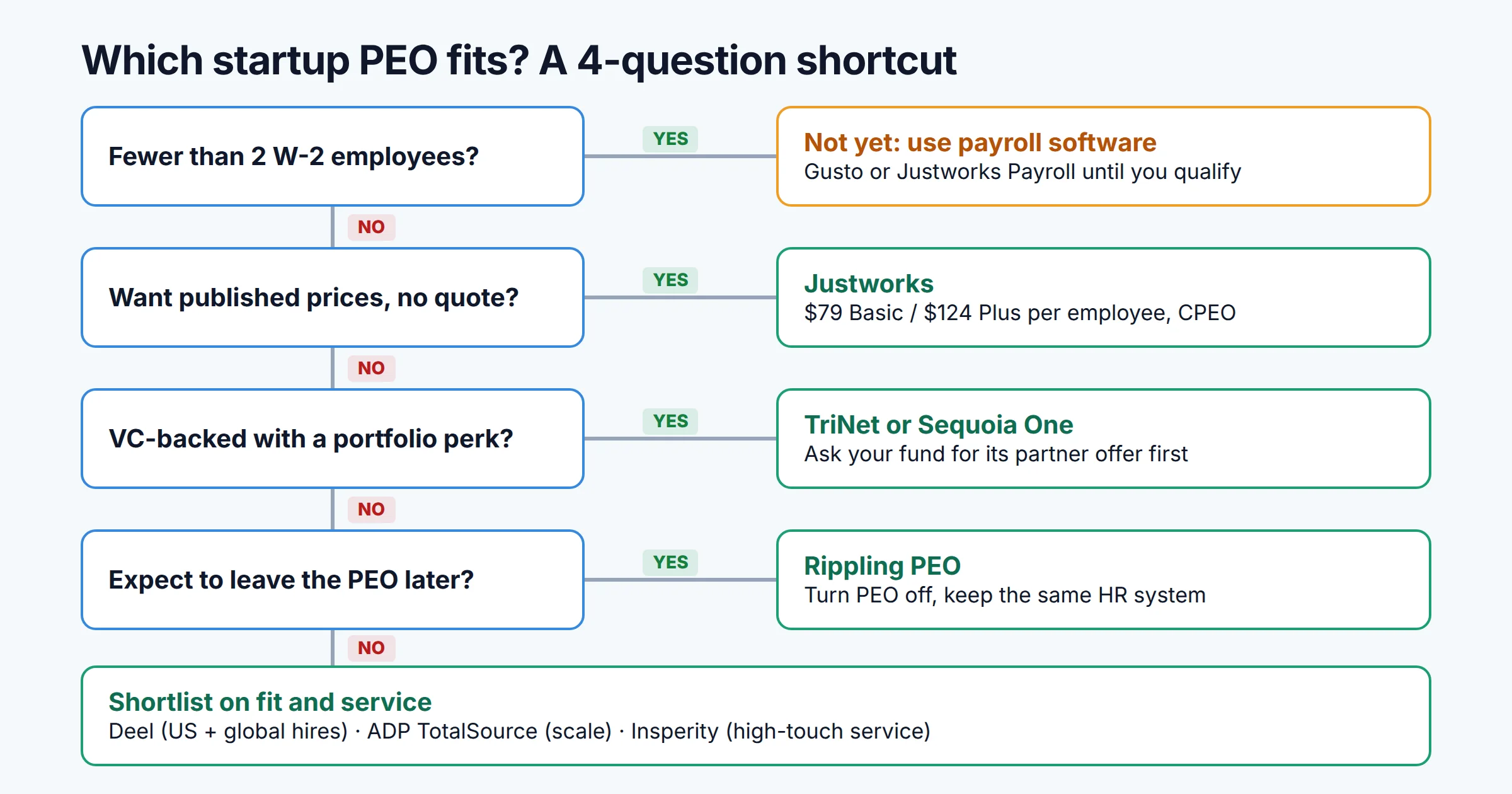
- Two to five people, first benefits plan: Justworks. It has the lowest minimum, and you'll know the price before the sales call.
- Seed or Series A with a fund partnership: TriNet or Sequoia One. Ask your investor's platform team which PEO offers the portfolio deal.
- Expecting rapid growth and an eventual exit: Rippling PEO, because leaving won't require replacing your HR system.
- US team plus overseas hires: Deel PEO, at the month-to-month list price unless you're sure about the next 24 months.
- Heading toward hundreds of employees across many states: ADP TotalSource.
- Non-technical founders who want hands-on HR: Insperity, once you're near 10 employees and if salaries are moderate.
- Don't need pooled benefits: skip the PEO. Payroll software with a benefits broker (Gusto's brokerage has no admin fee beyond premiums) costs a fraction of the price.
FAQ
What is the minimum number of employees to use a PEO?
What is the cheapest PEO for a startup?
Is Gusto a PEO?
Does it matter whether a PEO is IRS-certified (CPEO)?
Can a PEO cover remote employees in multiple states?
Methodology
We shortlisted PEOs that rank for startup searches or have dedicated startup or VC programs, then checked each one in October 2026 against primary sources: vendor pricing and product pages, help-center articles, the IRS active CPEO list (report dated August 7, 2026), and the most recent 10-K filings for TriNet, Insperity, ADP, and Paychex. We ranked them on fit for startups with 2–100 US employees: published pricing, stated minimum headcount, CPEO status, contract flexibility, and how easy it is to exit. We excluded prices that appear only on third-party review sites. We did not run payroll on these platforms. The cost table uses list prices only, and actual quotes depend on your census.
Sources
- Justworks, Pricing: justworks.com/pricing
- Justworks Help Center, eligibility and medical carriers: help.justworks.com/…/360004481811, …/360004471672
- IRS, Active CPEOs list (report date 8/7/2026): irs.gov/pub/irs-sbse/active-cpeos.pdf
- 26 U.S.C. §3511, Certified professional employer organizations: law.cornell.edu/uscode/text/26/3511
- SSA, Contribution and benefit base: ssa.gov/oact/cola/cbb.html; IRS Topic 759 (FUTA): irs.gov/taxtopics/tc759
- Rippling PEO: rippling.com/peo-smb; renewal claim: rippling.com/blog/99-retention-rate-rippling-peo
- Deel, Pricing and PEO promotion terms: deel.com/pricing, deel.com/peo
- TriNet, Benefits (PEO 5–500) and Sequoia VC offer: trinet.com/benefits, trinet.com/vc/sequoia; TriNet FY2025 10-K: sec.gov
- Insperity FY2025 10-K: sec.gov
- ADP TotalSource: adp.com; ADP FY2026 10-K: sec.gov
- Sequoia One PEO: sequoia.com/peo
- Gusto, Pricing and Gusto PEO: gusto.com/product/pricing, gusto.com/product/peo
- NAPEO, Industry statistics and ROI white paper: napeo.org, ROI of using a PEO (PDF)
- When to leave a PEO: OutSail, Founder Shield, Technical.ly, Middesk
- PEO cost ranges: TriNet, Rippling, ADP

Technology consultant with 10+ years in the Japanese tech industry. Specializing in SaaS evaluation, workflow automation, and B2B tool integration.