Rippling vs Gusto for Startups (2026): The Real Cost and a Stage-by-Stage Verdict
Both run payroll well. The real decision is whether you're buying payroll — or buying an operating system for your company. Here's what actually changes the answer for a startup.

TL;DR — The 30-second verdict
Pick Gusto if you're a US-based startup under roughly 30 employees who wants payroll, benefits, and basic HR running this week at a predictable, published price. It's cheaper, faster to set up, and rarely the thing you'll regret at this stage.
Pick Rippling if onboarding a hire should also provision their laptop, Google Workspace, Slack, and GitHub automatically — or if you're hiring across states/countries and want HR, IT, and spend on one system you won't outgrow at 80 people.
The honest middle: Gusto is the right first payroll system for the large majority of seed-stage startups. Rippling earns its premium once headcount, IT overhead, or geographic spread make "one platform" genuinely cheaper than the time you're losing stitching tools together.
Why this comparison is different for a startup
Most "Rippling vs Gusto" articles compare them as if you were a generic small business. Startups aren't generic. You hire in bursts after a raise, your headcount can triple in a year, half your team might be remote or international, and your operators are engineers who'd rather automate onboarding than click through it. Those facts change which platform wins — and they change it at different points in your life as a company.
So instead of declaring one winner, this guide does three things competitors mostly skip: it shows the real monthly cost at 5, 15, and 50 employees (not the headline price), it names the billing and setup gotchas that bite startups specifically, and it gives you a stage-by-stage decision you can actually act on. All pricing below was verified against vendor and pricing-tracker sources in June 2026.
Quick comparison at a glance
| Factor | Rippling | Gusto |
|---|---|---|
| What it is | All-in-one HR + IT + Finance platform on one employee record | Payroll-first HR & benefits platform for SMBs |
| Entry pricing | ~$35–40/mo base + ~$8/employee core (Unity), modules added on top | Simple: $49/mo + $6/employee (published) |
| Pricing transparency | Quote-based; module prices not published | Fully published, flat tiers |
| Typical real cost (HR+payroll) | ~$15+/employee/mo once modules are added | ~$6–12/employee/mo depending on tier |
| Time to first payroll | ~2–8 weeks (implementation-style) | Hours to ~2 days (self-serve wizard) |
| IT / device management | Yes — laptops, app provisioning, identity | No |
| International payroll / EOR | 185+ countries | US-only (US contractors abroad only) |
| Multi-state payroll | Yes | Yes (Plus tier and up) |
| Free trial | 14-day trial | Free until your first payroll run |
| Best fit | Tech-forward, scaling, or global teams | US startups under ~30, speed & price first |
A note on Rippling's numbers: because every Rippling contract is custom and module pricing isn't published, the per-employee figures here are realistic estimates from 2026 pricing trackers, not quoted rates. Always get a written quote for your exact module mix before committing.
The part everyone gets wrong: real cost at startup headcount
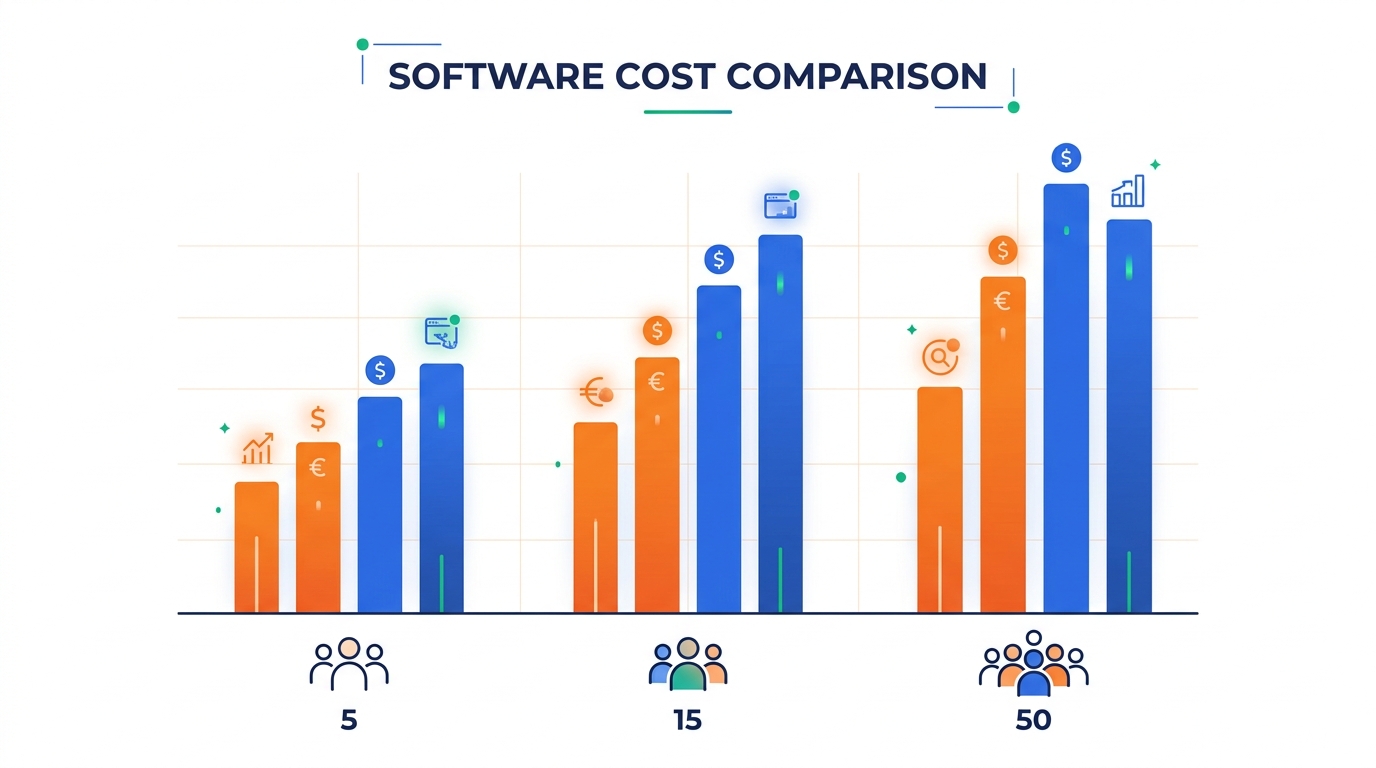
Headline prices lie because they exclude the per-employee multiplier and, for Rippling, the modules you'll actually need. Here's the closer-to-reality monthly math at three startup sizes. Gusto figures use published rates; Rippling figures assume the common "core + US payroll + benefits admin" bundle most startups end up on.
| Team size | Gusto (Simple → Plus) | Rippling (est. HR+payroll+benefits) |
|---|---|---|
| 5 employees | ~$79/mo (Simple: $49 + 5×$6) | ~$110–150/mo (base + ~$20–22/emp) |
| 15 employees | ~$139/mo Simple · ~$260/mo Plus | ~$330–360/mo |
| 50 employees | ~$680/mo Plus ($80 + 50×$12) | ~$1,100–1,250/mo |
Two things jump out. First, at every startup-relevant size, Gusto is materially cheaper — often by 2x or more — because you're not paying for an IT and finance platform you may not use yet. Second, the comparison isn't apples-to-apples: Rippling's higher number includes capabilities Gusto literally cannot do (device management, identity, global payroll). The right question isn't "which is cheaper," it's "am I paying for things I'll use in the next 12 months?"
Where Rippling actually earns its premium: IT automation
This is the single most important differentiator for a tech startup, and it's the reason the price gap can be worth it. In Gusto, onboarding a hire sets up their payroll and benefits. In Rippling, the same action can also ship their laptop pre-configured, create their Google Workspace and Slack accounts, grant GitHub and SaaS access based on role, and enforce device security — then deprovision all of it in one click when someone leaves.
For a 6-person company, you can do that manually in an afternoon and Gusto is the obvious pick. For a 40-person company onboarding three engineers a month, that "afternoon" becomes a recurring tax on your ops person — and the kind of access sprawl that fails your first SOC 2 audit. If you're already thinking about compliance, our breakdown of Secureframe vs Vanta vs Drata pairs naturally with this decision, since identity and device hygiene are exactly what those tools audit.
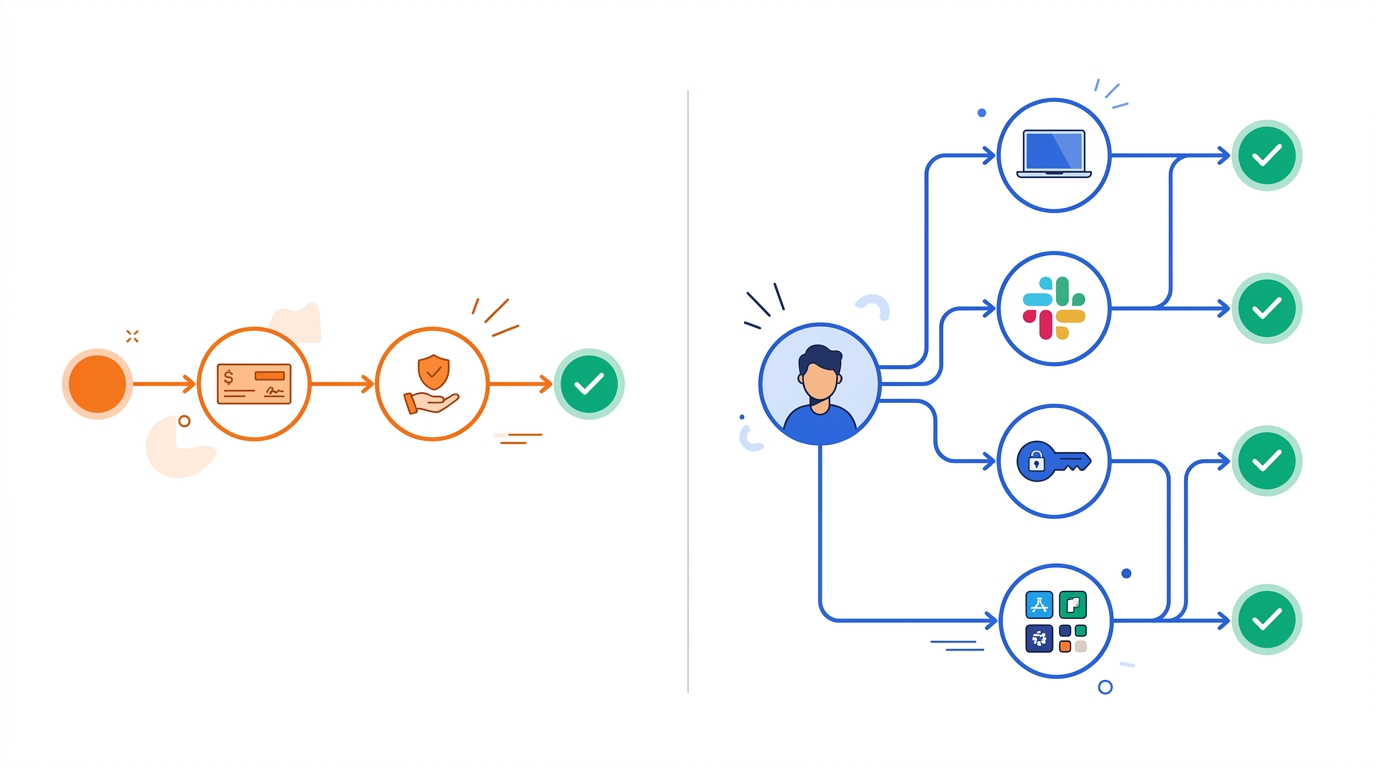
Gusto has been broadening beyond pure payroll — expense management, basic time tracking, and onboarding checklists — but it does not do device management or identity/access provisioning, and it isn't trying to. If unified HR+IT is a core reason you're shopping, that's effectively a single-vendor answer.
Rippling — pros, cons, and who it's for
Pros
- One employee record across HR, payroll, IT, and spend — genuinely fewer tools to stitch
- Best-in-class onboarding/offboarding automation (devices, apps, access)
- Global payroll, contractor payments, and EOR in 185+ countries
- Deep, granular permissions and workflow automation that scale to 100+ people
- Strong fit for SOC 2-bound teams needing access governance
Cons
- Opaque, quote-based pricing; modules add up fast
- Longer, implementation-style setup (weeks, not hours)
- Retrospective full-month billing can cause invoice spikes
- More platform than a sub-20-person US team needs
- Annual contracts and module bundling reduce flexibility
Best for: Tech-forward startups past ~25–30 employees, teams hiring across states or countries, and any company that wants HR and IT operations to live on one system they won't outgrow at Series B.
Scaling or hiring globally?
See if Rippling's unified HR + IT fits your team
Start a free trial and price out only the modules you'll actually use — get a written quote before you commit.
Gusto — pros, cons, and who it's for
Pros
- Transparent, published pricing that's easy to forecast
- Run your first payroll in hours with a self-serve wizard
- Excellent, genuinely friendly small-business UX
- Full-service payroll, tax filing, and benefits in one place
- Affordable Contractor-Only plan for pre-W-2 teams
Cons
- US-only payroll — no native international hiring/EOR
- No IT, device, or identity/access management
- Multi-state payroll requires the pricier Plus tier
- Less suited to complex orgs and heavy workflow automation
- You'll likely migrate off it if you scale past ~100 globally
Best for: US-based startups under ~30 employees who want payroll, benefits, and light HR live this week at a price they can predict — which is the large majority of seed and pre-seed companies.
Just need payroll done right?
Get Gusto running before your next pay run
Published pricing, no implementation project, and full-service tax filing — ideal for a US team under 30.
The decision, by funding stage
This is the framework competitors skip. Match your stage to the recommendation — most startups should switch platforms once, not agonize over it monthly.
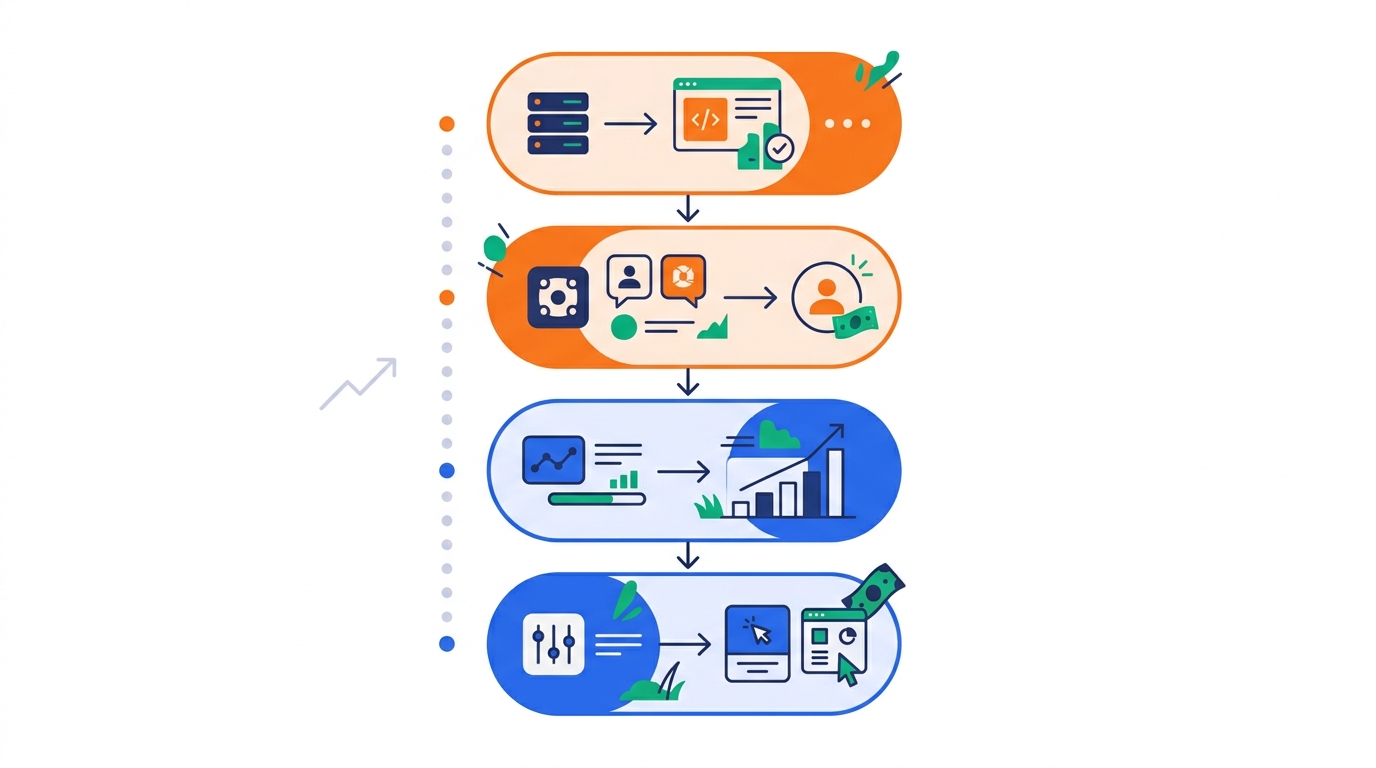
Pre-seed / Bootstrapped Gusto
Under ~10 people, US-only, cash-conscious. You need correct payroll and tax filing, not a platform. Gusto Simple, set up this afternoon. Use the Contractor-Only plan if you don't have W-2 employees yet.
Seed Gusto
10–25 people, maybe a couple of states. Gusto Plus unlocks multi-state payroll and time tracking. The IT automation Rippling offers usually isn't worth its premium or its setup time yet — your ops load is still manageable by hand.
Series A — the inflection point Re-evaluate
25–60 people, hiring fast, onboarding overhead is now real, and SOC 2 is on the roadmap. This is where you seriously price out Rippling. If you're hiring internationally or drowning in device/access management, switch. If you're still US-only with light IT needs, Gusto Premium can carry you further.
Series B and beyond Rippling
60+ people, multiple states or countries, dedicated People/IT functions. The cost of fragmented tools and manual provisioning now exceeds Rippling's premium. Consolidating HR, IT, and spend on one record pays for itself.
How to actually choose (a 4-question test)
Skip the feature spreadsheets. Answer these:
1. Are you hiring anyone outside the US in the next year? Yes → Rippling (Gusto can't do it natively). No → keep going.
2. Does onboarding a hire create real IT work — laptops, app access, security? Yes, and it's painful → Rippling. Not really → keep going.
3. Are you under ~30 employees and want it live this week? Yes → Gusto. No → keep going.
4. Is predictable, board-reportable pricing more valuable than platform depth right now? Yes → Gusto. No → Rippling.
Most seed-stage startups answer their way to Gusto. Most Series A+ tech companies with global or IT-heavy operations answer their way to Rippling. If you land in the middle, default to Gusto — switching later is straightforward, and you'll have real headcount data to quote Rippling against.
Migration reality check
Worried about being "locked in" if you start with Gusto? Don't be. Moving from Gusto to Rippling is a well-trodden path; the main cost is the 2–8 week implementation on Rippling's side, not data portability. Year-end timing matters most: switching payroll providers mid-year means reconciling two sets of tax records, so the cleanest cutover is at the start of a calendar year or quarter. Starting on the cheaper, faster platform and graduating later is a perfectly sound — and common — sequence.
FAQ
Is Rippling good for startups?
Yes, but mostly for scaling or tech-heavy startups. Its strength is unifying HR, IT, and finance, which is overkill (and overpriced) for a sub-20-person US team but increasingly valuable from Series A onward, especially if you hire across states or countries.
Is Gusto good for small business owners and early startups?
Very. Gusto is one of the most highly rated payroll platforms for US small businesses precisely because it's transparent, fast to set up, and easy for non-specialists. For most pre-seed and seed startups, it's the obvious first choice.
How much does Rippling cost for a small business?
Plan on roughly $35–40/month base plus about $15+ per employee once you add the modules a startup typically needs (core, US payroll, benefits admin). Exact pricing is quote-based and not published, so request a written quote for your specific module mix.
How much does Gusto cost?
As of June 2026: Simple is $49/month + $6/employee, Plus is $80/month + $12/employee, and Premium is $180/month + $22/employee. There's also a Contractor-Only plan at $35/month + $6/contractor. All rates are published on Gusto's site.
Should I just use Deel instead?
Deel is worth a look if international contractors or EOR is your primary need rather than US payroll. For a US-first startup, Rippling vs Gusto is the more relevant fight; Deel competes more directly once global hiring is the center of gravity.
Methodology
We evaluated Rippling and Gusto through the lens of a US-based startup scaling from pre-seed to Series B, weighting total cost of ownership at realistic headcounts, time-to-first-payroll, IT/onboarding automation, international capability, and pricing predictability. Pricing was verified against vendor pages and independent pricing trackers in June 2026. Rippling figures are estimates because module-level pricing is not published and every contract is custom; Gusto figures use published rates. We do not claim hands-on deployment of either platform — this analysis is based on documented features, published and tracker-reported pricing, and aggregated user-reported experiences.

Technology consultant with 10+ years in the Japanese tech industry. Specializing in SaaS evaluation, workflow automation, and B2B tool integration.