Best EOR for Startups (2026): 6 Providers Compared on Minimums, Deposits, and Equity
TL;DR
For most seed and Series A companies making their first one to five international hires, the EOR decision comes down to three things that barely appear on pricing pages: whether you are locked in, how much cash the provider holds as a deposit, and whether your new hire can actually receive equity. On those terms, Remote is our top pick for venture-backed startups (no minimums, deposits only in rare cases, and an equity add-on from $39/month for Delaware C-Corps), Deel is the pick if you also pay contractors across many countries, and RemoFirst has the lowest mainstream list price ($199/month, “may vary”) for bootstrapped teams. Oyster is worth a quote if you qualify for its startup discount, which knocks up to $1,200 off each person’s first 12 months.
Most “best EOR” lists are written for HR teams at 200-person companies. A founder hiring a first engineer in Poland or a first account executive in the UK has a different problem: every dollar is runway, nobody on the team is an HR specialist, and the hire probably expects stock options because that is how the rest of the team is paid. This guide compares six providers on exactly those constraints.
If you are still deciding whether to use an EOR at all, start with our EOR vs. foreign entity cost comparison. If you already have a shortlist and want a general scoring method, our 7-question framework for choosing an EOR provider goes deeper on due diligence. This article is narrower: it answers “which EOR fits a small, cash-constrained, equity-granting startup?”
01Quick answer: top 3 picks for startups
No minimums or setup fees, deposits only in “rare, high risk circumstances,” and a built-in equity product for Delaware C-Corps.
Month-to-month, 130+ countries, $49 contractors, and a Carta sync for equity events. Expect a refundable deposit.
No setup, termination, annual contract, or minimums. The price “may vary” by country, and the deposit policy is not published.
02Comparison table: 6 EOR providers for startups
All prices below are the published list price per employee per month, taken from each vendor’s official pricing page on September 29–30, 2026. None of them include the employee’s salary, employer payroll taxes, or mandatory benefits, which in most countries are much larger than the EOR fee itself.
| Provider | EOR list price | Countries (EOR) | Minimum / lock-in | Deposit | Equity support | Startup offer |
|---|---|---|---|---|---|---|
| Remote | $699 | 90+ | None stated | Rare cases only | Equity Essentials from $39/mo (Delaware C-Corps) | None published |
| Deel | $599 | 130+ | Month-to-month | Refundable deposit | SARs, phantom stock, NSO/RSU as benefit in kind; Carta sync | None for EOR |
| Oyster | $699 | 120+ | None stated | Refundable deposit required | Not a headline feature | Up to $1,200 off per person in first 12 months |
| Multiplier | $459 annual / $499 monthly | 150+ | Annual rate needs annual billing | Reported (not on pricing page) | Not a headline feature | Q3 promo ended Sept 30 |
| RemoFirst | From $199 (“may vary”) | 185+ | No annual contracts, no minimums | Not published | Not a headline feature | Price-match offer |
| Native Teams | From $99 | 95+ | Not stated | Not published | Not a headline feature | None published |
“Not a headline feature” means the vendor’s pricing and product pages we reviewed do not describe an equity product. It does not mean they refuse to support grants; ask in the sales call. Sources are listed at the end of this article.
Two providers you might expect are not in this table. G-P (from USD 599, 180+ countries) is strong for enterprise coverage but is not designed around the small-team buyer. Rippling does not publish an EOR price, so we could not compare it on cost. Both are reviewed in our Deel alternatives comparison.
03What actually matters when a startup picks an EOR
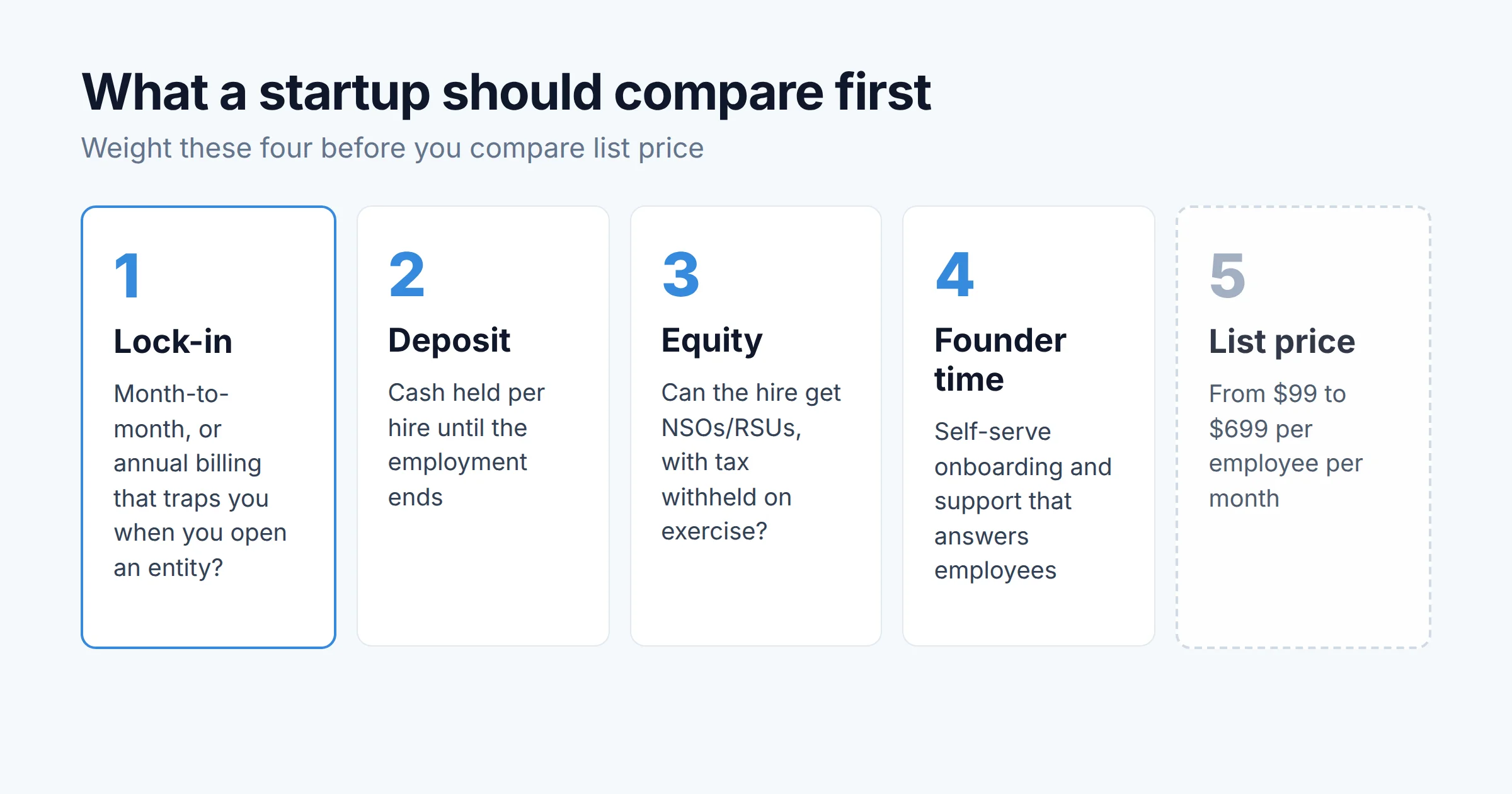
The price per employee gets all the attention, but for a company with 12–24 months of runway, four other factors usually matter more. We weighted them this way when ranking.
1. Lock-in: can you leave when you open your own entity?
Many startups use an EOR as a bridge. Once you have five or more people in one country, a local subsidiary often becomes cheaper (we ran the numbers in our EOR vs. entity cost comparison). If your EOR contract requires an annual commitment, that bridge becomes a toll road. Remote says there are “no minimum requirements or fees,” Deel offers “flexible month-to-month pricing with no long-term commitments,” and RemoFirst advertises “no annual contracts, and no minimums.” Multiplier’s lowest price ($459) is the annual-billing rate. Paying monthly costs $499.
One caveat applies to every provider: the employee’s employment contract still follows local law. Ending the EOR relationship early does not remove the notice period or severance owed to the employee. That is a legal cost, not a vendor fee, and it is the same whichever EOR you choose.
2. Deposits: the hidden cash drain
A refundable security deposit does not show up on the pricing page, but it comes out of your bank account on day one. Deposits are usually sized to cover roughly a month of total payroll cost or the local notice period. For a senior engineer, that can be a five-figure amount per hire, held until the employment ends. Deel’s help center says deposits are refunded within 60 days after the termination is complete and invoices are paid. Oyster’s pricing page says it “requires a refundable deposit for EOR Team Members.” Remote says deposits apply only in “rare, high risk circumstances.” RemoFirst and Native Teams do not publish a policy, and third-party reviews of RemoFirst disagree about it, so get the number in writing before you sign.
If you hire three people and each requires a deposit of one month’s fully loaded payroll, you have tied up about 8% of their annual cost (1 of 12 months) before anyone ships code. For a seed-stage company, that can be the difference between a 14-month and a 13-month runway.
3. Equity: can your hire actually receive stock options?
This is the startup-specific question that generic EOR lists skip. Under U.S. tax law (26 U.S.C. § 422), incentive stock options (ISOs) can only go to employees of the granting corporation or its parent or subsidiary. An EOR employee is legally employed by the EOR’s local entity, not by your company. Deel says so plainly: you “can’t offer Incentive Stock Options (ISOs) to contractors or employees hired through our EOR solution.”
That does not mean EOR hires get no equity. It means you grant non-qualified stock options (NSOs), RSUs, or cash-settled equivalents such as stock appreciation rights (SARs) and phantom stock. The hard part is the payroll side: when the employee exercises, the local tax usually has to run through the EOR’s payroll. Two providers have built this in:
- Remote Equity Essentials starts at $39/month and is available “for direct employees, EoR, and contractors of Delaware C-Corps,” with “built in workflows” for taxable events.
- Deel supports SARs and phantom stock, integrates NSOs/RSUs “as a benefit paid in kind,” and syncs exercise events from Carta so local taxes can be calculated and withheld.
If your offer letters promise options, confirm how the provider will report and withhold on exercise in each country before you sign.
4. Time-to-hire and founder time
A startup’s bottleneck is usually the founder’s calendar, not the fee. Look for self-serve onboarding, a cost calculator you can use before talking to sales, and support that answers employee payroll questions directly so they don’t reach the CEO. The larger platforms (Deel, Remote) have the most self-serve tooling. Oyster sells hourly People Partner time ($300/hour) for teams that want guided help.
04The 6 best EOR providers for startups, reviewed
1. Remote
Best for VC-backed startupsRemote costs the most here, but it is also the provider that removes the most startup-specific friction. Its pricing page states “no platform, onboarding, or setup fees” and “no minimum requirements or fees,” and it holds reserves only in “rare, high risk circumstances.” For a seed company, keeping that deposit cash can outweigh the $100/month gap to Deel.
The biggest differentiator for venture-backed companies is Equity Essentials. From $39/month, it tracks grants (“from stock options to RSUs and beyond”) for EOR employees of Delaware C-Corps, gives employees a portal to see their grants, and handles the payroll workflows for taxable events. Remote Equity Advanced adds cap-table integrations and automated grant documentation for companies that need it.
Note that the $599 annual EOR rate Remote used to show is no longer listed. As of September 2026, the page shows only $699. Remote now lists “90+” countries, fewer than some rivals, so check that your target country is covered.
Pros
- No minimums, setup, or onboarding fees
- Deposits only in rare cases
- Equity product built for Delaware C-Corps
- Cheap contractor tier ($29) for pre-hire trials
Cons
- Highest list price in this comparison
- No published startup discount
- Smaller country list (90+) than Deel or RemoFirst
Choose Remote if you are a Delaware C-Corp promising options to your first international hires and would rather pay a higher fee than lock cash in deposits.
2. Deel
Best for mixed contractor + employee teamsDeel is the default choice for many startups because it covers the whole early hiring path in one account. You can start someone as a contractor ($49/month), move them to contractor of record ($325) if misclassification becomes a concern, and convert them to a full EOR employee ($599) once the role is permanent. The pricing page confirms “flexible month-to-month pricing with no long-term commitments required.”
On equity, Deel publishes a detailed approach: SARs and phantom stock as bonus plans, and NSOs, RSUs, RTUs, and warrants integrated “as a benefit paid in kind,” with legal documents adjusted to reduce co-employment risk. Its Carta integration logs exercise events and calculates local taxes. Deel does not publish a separate price for these equity services.
The trade-off is cash up front. Deel generally takes a refundable deposit, which its help center says is returned within 60 days after the termination is complete and invoices are paid. The only promotion on the pricing page when we checked applied to US PEO customers on two-year agreements, not to EOR.
Pros
- Contractor → EOR conversion in one platform
- Month-to-month, no long-term commitment
- Documented equity options plus Carta sync
- Broad coverage (130+ countries)
Cons
- Refundable deposit ties up cash
- Contractor tier ($49) costs more than Remote/Oyster ($29)
- No startup discount for EOR
Choose Deel if your first hires are a mix of contractors and employees across several countries and you want one tool for all of them. If you are weighing it against Remote on price alone, see our Deel vs. Remote pricing breakdown.
3. Oyster
Best startup discountOyster is the only provider here with a published startup program. Eligible early-stage or bootstrapped companies can “save up to $1,200 on EOR subscription fees” per team member during the first 12 months. If you get the full amount, that is $100 off each month, so Oyster’s effective first-year fee drops from $699 to about $599, the same as Deel. After year one you pay list price, and annual-billing discounts are available.
Oyster also bundles services other providers charge for separately. It says setup, onboarding, HR expert conversations, and terminations are included in the subscription. For founders without an HR hire, the optional People Partner service ($300/hour) is an unusual way to buy expert help by the hour.
The downside for cash-constrained teams: Oyster’s pricing page states that it “requires a refundable deposit for EOR Team Members to initiate the engagement.”
Pros
- Published startup discount (up to $1,200/person, year one)
- Setup, onboarding, and terminations included
- Contractors free for 30 days
Cons
- Refundable deposit required
- List price ($699) returns after 12 months
- Discount eligibility is decided case by case
Choose Oyster if you qualify for the startup program and value included HR guidance over the lowest possible fee.
4. Multiplier
Best mid-price optionMultiplier sits between the premium platforms and the budget providers. Its Core EOR plan is $459 per person per month billed annually, or $499 billed monthly. The Growth tier is $519/$559. You may still see Multiplier listed at “$400” in other roundups; that figure is out of date. The company also ran a “3 months free” promotion that ended September 30, 2026, so don’t count on it.
The annual rate saves $40/month per person, but it works against the “EOR as a bridge” strategy if you expect to move people onto your own entity within a year. Third-party comparisons report that Multiplier takes a refundable deposit tied to the notice-period salary. We could not confirm this on the official pricing page, so ask.
Pros
- About $100–$240/month cheaper than Deel/Remote/Oyster list
- Wide coverage (150+ countries)
- Public per-country cost calculator
Cons
- Lowest rate requires annual billing
- Deposit terms not on pricing page
- No published equity product
Choose Multiplier if you are confident the hire will stay on the EOR for at least a year and want to cut the fee without dropping to a budget provider.
5. RemoFirst
Lowest mainstream list priceRemoFirst is the answer to “cheapest EOR for small teams” if you only look at list price. Its EOR “starts at $199 per person/month,” about one-third of Deel’s list rate, and it states “no setup, onboarding, or termination fees, no annual contracts, and no minimums.” Its FAQ also confirms “no fixed term contracts.” RemoFirst offers to try to match a lower quote elsewhere.
Two things to check. First, the price “may vary based on local country requirements,” so $199 is a floor, not a promise. RemoFirst says it provides a full cost breakdown before you commit. Second, it does not publish a deposit policy, and independent reviews disagree about whether one is charged. Because RemoFirst works through a broad network, also ask whether the entity in your target country is owned or a partner. That matters for data handling and escalation speed (see our owned-entity vs. partner explainer).
Pros
- $199 starting price, 185+ countries
- No setup, termination, or annual contract
- Free basic contractor management
- Price-match offer
Cons
- “May vary” by country
- Deposit policy unpublished
- No published equity tooling
Choose RemoFirst if you are bootstrapped, hiring in countries where the $199 floor holds, and don’t need equity administration from your EOR.
6. Native Teams
Lowest headline priceNative Teams has the lowest starting EOR price we found on an official pricing page: from $99 per employee per month across 95+ countries. It says hiring runs “through Native Teams’ directly owned entities.” It also offers entity management ($149/month plus country-based one-time setup fees), so a startup could in principle move from EOR to its own entity with the same vendor.
“From $99” is a starting point, and third-party roundups describe Native Teams’ pricing as varying with the salary band. Get a written quote for your actual salary and country before comparing it with the flat-rate providers above. Native Teams publishes no deposit or equity policy.
Pros
- Lowest starting price here ($99)
- Claims directly owned entities
- EOR-to-own-entity path with one vendor
Cons
- Headline price is a floor; quote required
- Smaller coverage (95+ countries)
- No published deposit or equity terms
Choose Native Teams if you are hiring one or two people on modest salaries in a covered country and fee minimization is the top priority.
05What 3 hires actually cost in year one
The monthly fee difference looks small until you multiply it out. Below is the EOR fee only (list price × 12 months × 3 employees). Salary, employer taxes, and benefits are the same whichever provider you choose, so they cancel out when you compare. For the RemoFirst and Native Teams rows we used the published floor, so their real cost will be the same or higher.
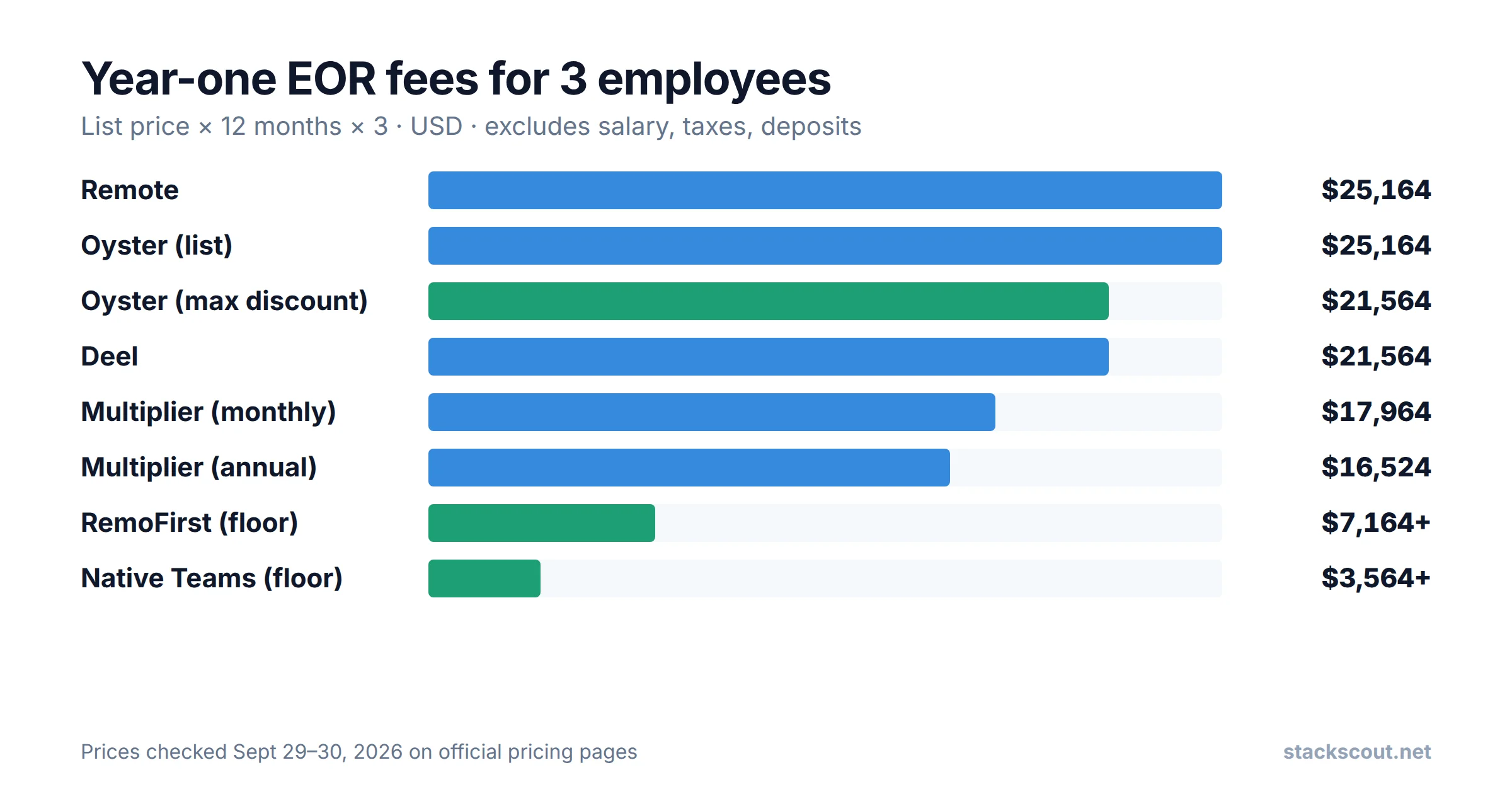
Year-one EOR fees for 3 employees (list price)
USD, excluding salary, employer contributions, and deposits
The spread between the most and least expensive mainstream option is about $18,000 a year for three people, roughly a quarter of a junior hire’s salary in many markets. That is real money at seed stage. But notice what the chart leaves out:
- Deposits. A provider that charges $200/month less but holds a month of payroll as a deposit may leave you with less cash in the first year.
- Country variance. The $199 and $99 floors apply to some countries, not all. Remote, Deel, and Oyster publish flat rates.
- Currency and markups. Invoice currency and FX spreads are covered in our EOR pricing models explainer, which compares flat-fee and percentage-of-payroll pricing across eight countries.
06Who should choose which
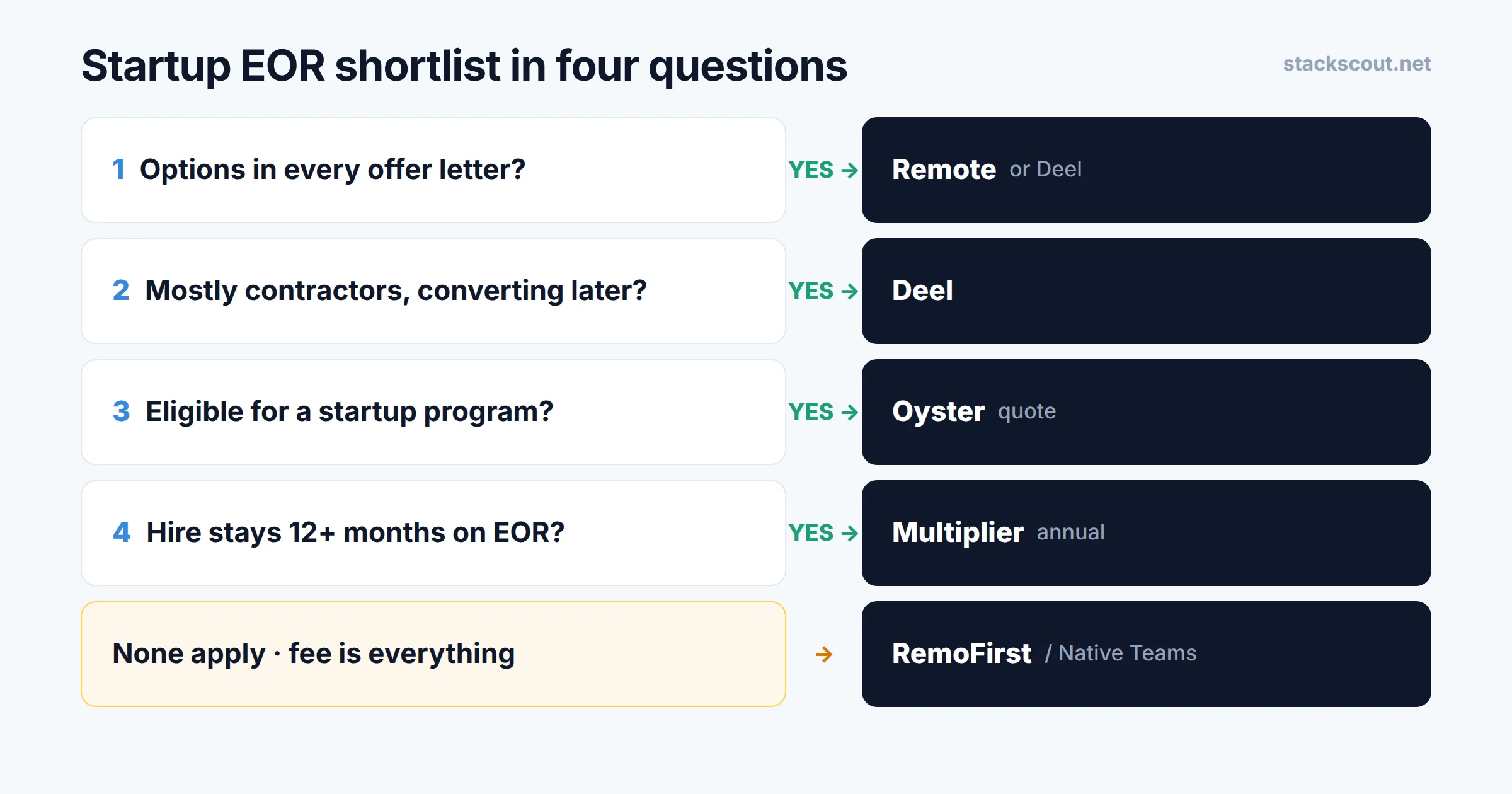
For country-specific rules such as statutory benefits, termination notice, and licensing, see our deep dives on hiring in the UK, Poland, Mexico, and Australia. The best provider overall is not always the best provider in your hire’s country.
Six questions to ask on every EOR sales call
- What is the all-in monthly fee for this specific country and salary, in writing?
- Is there a security deposit? How is it calculated, and how many days after termination is it refunded?
- Is there any minimum term or early-exit fee for ending the service (separate from employee notice)?
- How will you report and withhold tax on stock option exercises for this employee’s country?
- Do you own the entity in this country, or use a partner?
- If we open our own entity, what does the transfer process look like, and what does it cost?
For a real example of these questions in practice, see our case study of a remote-first startup that onboarded 12 employees across 5 countries through an EOR.
07Frequently asked questions
What is the cheapest EOR for a small startup team?
Can EOR employees receive stock options from my startup?
Do EOR providers require a minimum number of employees or a long contract?
When should a startup switch from an EOR to its own entity?
What is the best HR and payroll software for startups hiring abroad?
08How we chose
Based on our research, we built a shortlist of EOR providers that publish pricing and are commonly shortlisted by early-stage companies. We then verified each provider’s EOR price, country count, contract terms, deposit language, contractor pricing, and startup offers on its official pricing, product, or FAQ pages on September 29–30, 2026. Where a vendor page was silent (for example, on deposits), we say so rather than filling the gap with third-party claims, and we flag third-party reports where we mention them. We ranked providers for the startup use case using, in order: lock-in terms, deposit exposure, equity support, founder time, and list price. We did not test the platforms with live hires, and none of the providers paid for placement. EOR prices change often, so confirm the current rate before you sign.

Technology consultant with 10+ years in the Japanese tech industry. Specializing in SaaS evaluation, workflow automation, and B2B tool integration.