⚡ The short version
An Employer of Record (EOR) lets you legally put a French employee on payroll in one to two weeks without opening a French entity — the EOR becomes the employer on paper, you direct the day-to-day work. The hard part in France isn't the software; it's the compliance and the cost.
Budget for the employer social charges of roughly 40–45% on top of gross salary, plus mandatory mutuelle health cover and 50% transit reimbursement. Get the contract type (CDI vs CDD), the période d'essai, and the applicable convention collective right before anyone signs. This guide walks the whole sequence, step by step.
Hiring your first person in France is where a lot of otherwise-careful companies get tripped up. The talent is there, the timezone is friendly to the rest of Europe, and remote work has made a Paris- or Lyon-based hire feel as easy as one in your own city. Then you meet French labour law — protective, codified, and unforgiving of shortcuts — and the "just send an offer letter" instinct falls apart.
This is a how-to guide, not a provider ranking. If you already know you want an EOR and just need to pick one, jump to our full comparison of the best EOR providers for France. If you're still working out how the whole thing actually works — the contract, the declarations, the true monthly cost, the timeline — start here.
What "hiring through an EOR" actually means in France
An Employer of Record is a company that already has a legal presence and payroll infrastructure in France. When you hire through one, the EOR signs a compliant French employment contract with your chosen candidate and becomes their legal employer of record: it runs payroll, remits social contributions to URSSAF, files the mandatory electronic returns, and administers benefits. You keep everything that matters operationally — who you hire, what they work on, how they're managed, and what you pay them.
The appeal is speed and risk transfer. Setting up your own French subsidiary (an SAS or SARL, registering with the greffe, opening a French bank account, appointing payroll) typically takes three to six months and creates ongoing accounting and corporate obligations. An EOR compresses that to one to two weeks and pushes employment-compliance liability onto a specialist. For one to a handful of hires, that trade is almost always worth it.
Before you start: three decisions that shape everything
Most France hiring mistakes are made before the first form is filled in. Settle these three questions up front.
1. EOR vs. your own entity vs. portage salarial
France has a homegrown employment model — portage salarial — that outsiders often confuse with an EOR. They are not the same. Portage salarial is a regulated, tripartite arrangement (codified in the Code du travail) designed for autonomous independent professionals who find their own assignments; a portage company employs the consultant and handles their compliance. It's capped at 36 months and carries a minimum salary threshold (around €3,000–€3,200 gross per month in 2026, plus a mandatory financial reserve). An EOR, by contrast, supports standard, ongoing employment relationships and scales to a team.
| Vehicle | Best for | Speed to hire | Owns compliance risk |
|---|---|---|---|
| EOR | 1–20 standard employees, no local entity, want to move fast | 1–2 weeks | EOR |
| Portage salarial | A single autonomous consultant on a defined mission (≤36 mo) | Days | Portage co. |
| Your own entity | Large, permanent French presence (20+ heads, office, long horizon) | 3–6 months | You |
2. CDI or CDD — permanent or fixed-term
France recognises the open-ended contract (CDI) as the default and the fixed-term contract (CDD) as the exception, permitted only for specific, justifiable reasons (a defined project, a seasonal peak, replacing an absent employee). A CDD can't simply be used to "try someone out" — that's what the trial period is for — and it generally cannot be terminated early by either side before its term. If in doubt, a CDI with a proper période d'essai is the safe, standard choice.
3. Budget for the real cost, not the salary
This is the number that surprises people. See the next section — get it wrong and every offer you extend will be off by a third.
The true cost of a French hire (before you promise anything)
On top of gross salary, employers in France pay social contributions of roughly 40–45% of gross, collected by URSSAF. As a rule of thumb quoted across the industry, a €100,000 gross salary lands somewhere around €143,000–€147,000 in total employer cost — before the EOR's own fee. France is one of the most expensive markets in the world to employ someone, and it's the statutory burden, not the EOR margin, that drives it.
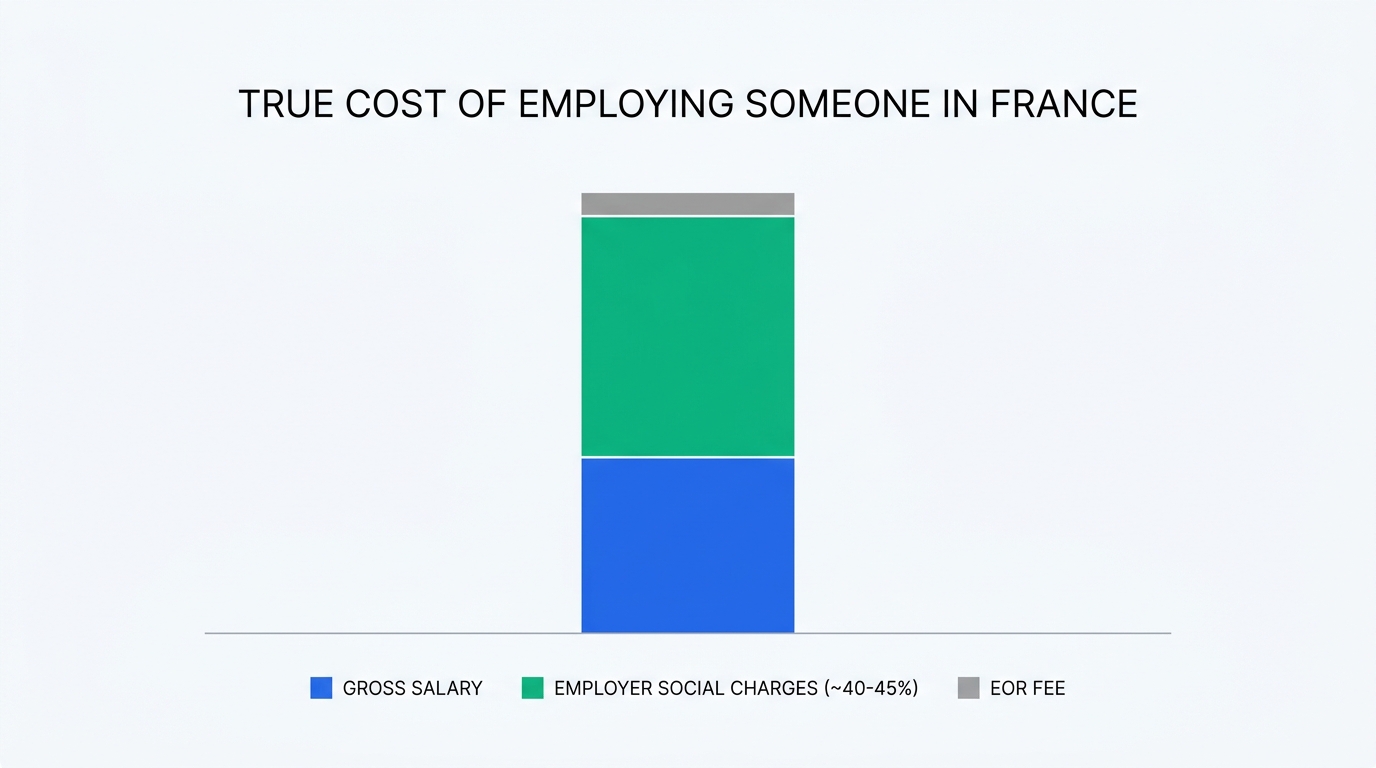
The main components of the employer's share include health insurance (around 13% of gross, uncapped), old-age pension (about 8.55% up to the monthly social security ceiling — €4,005 in 2026 — plus an uncapped portion), the family allowance contribution (5.25%), unemployment insurance (~4% up to four times the ceiling), the AGIRC-ARRCO supplementary pension, and a work-accident (AT/MP) rate that URSSAF sets individually by sector and claims history.
An EOR builds all of this into your monthly invoice, which is exactly why the model is valuable in France — but you should model the loaded cost yourself before you agree a salary, so the offer is affordable at the total number, not the headline one.
The step-by-step playbook
Here's the full sequence, from "we want to hire in France" to "our employee is on compliant payroll." With an experienced EOR, most of steps 3–6 happen in parallel inside the first two weeks.
Confirm an EOR is the right vehicle
Decide, using the table above, that you want standard employment (not portage salarial), that you're not ready to open an entity, and that the role is genuinely employment rather than a legitimately independent contractor. Misclassifying a full-time, directed worker as a freelancer is a serious risk in France — the EOR route exists precisely to avoid it.
Choose and vet your EOR provider
Look for a provider with a direct, owned entity in France (rather than a local partner), transparent handling of France's higher security deposits, and clear per-employee pricing. List prices in 2026 cluster around $599/month per employee for the big global platforms (Remote and Deel), while Multiplier lists closer to $400/month; complex markets like France frequently carry a surcharge, so always confirm the France-specific quote. Pricing checked July 2026 — verify directly, as EOR rates move and are often negotiable at 10–20+ headcount.
For a head-to-head on two of the most common shortlisted providers, see our Deel vs. Papaya Global comparison, and for the full France field, our best EOR for France breakdown.
Comparing EOR providers for France?
Get side-by-side France quotes — including the statutory deposit and any complex-market surcharge — before you commit.
Build the offer around France's true cost
With your loaded-cost model in hand (previous section), agree the gross salary and the package. Note that several benefits aren't optional in France: mutuelle health cover, 50% reimbursement of the commute pass, and paid leave that starts at five weeks per year, often supplemented by RTT days for employees on the 35-hour framework. Your EOR will confirm what the applicable collective agreement requires.
Get the employment contract right
The EOR drafts a French-law contract covering role, working time, salary, and termination terms. Three things to check personally:
- Convention collective: your employee's sector almost certainly falls under a convention collective (industry-wide collective agreement) that can raise minimum pay, add leave, or set specific rules. The EOR must apply the right one.
- Période d'essai (trial period): for a CDI, the initial cap is 2 months for employés/ouvriers, 3 months for agents de maîtrise, and 4 months for cadres (managers/professionals), renewable once — to 4, 6, and 8 months respectively — only if the collective agreement allows.
- Notice periods: once past the trial, ending a CDI is a formal, regulated process; notice commonly runs up to around three months for senior staff, and severance rules apply. There is no "at-will" employment in France.
Complete the pre-hire compliance
Before the start date, France requires a DPAE (déclaration préalable à l'embauche) — a pre-hire declaration filed with URSSAF — plus enrolment in the mutuelle and a scheduled occupational health check (visite d'information et de prévention). GDPR privacy notices are issued for signature. Your EOR handles all of this; your job is to supply accurate candidate details and the agreed terms promptly so nothing slips past the start date.
Onboard and run the first payroll
The employee enters bank details, emergency contacts, and benefit selections; the EOR runs the compliant payslip and files the DSN (déclaration sociale nominative), France's unified monthly social filing. From here it's a normal payroll cycle — the EOR remits contributions to URSSAF, produces payslips, and manages leave accrual. You approve time off and expenses and manage performance.
Manage the ongoing relationship (and watch PE risk)
Day-to-day, treat the person like any team member. Two ongoing watch-items: keep the direction/economic-employer line clean (you manage the work; the EOR is the legal employer), and be aware of permanent establishment (PE) risk — a France-based employee who habitually concludes contracts or drives revenue on your behalf can, over time, create a taxable presence for your company. For a single individual contributor this is usually low-risk; discuss it with your EOR and tax adviser as the team grows.
What the one-to-two-week timeline really looks like
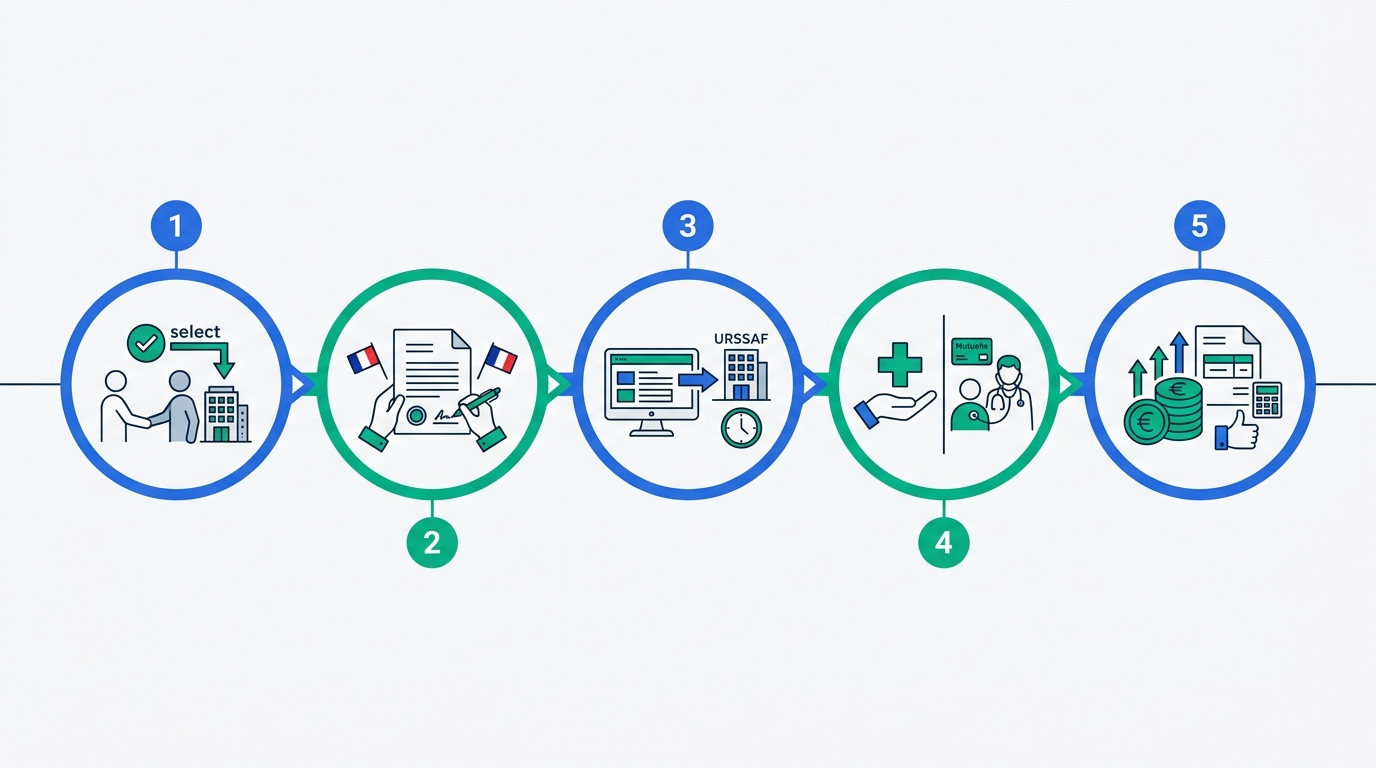
For an EU/EEA national already resident in France, a realistic sequence is: provider selected and contract drafted in days 1–3; contract signed and DPAE filed by end of week one; mutuelle enrolment, occupational-health appointment scheduled, and onboarding completed in week two; first payroll on the next cycle. Compare that to three to six months to stand up your own entity and payroll. For non-EU hires, the immigration timeline (see step 5) extends the front end substantially — plan the visa first and back-solve the start date.
Common mistakes to avoid
- Quoting salary before loading the cost. Promising €80k gross without modelling the ~45% employer charge, mutuelle, and transit reimbursement is the single most common budgeting error.
- Using a CDD as a probation. Fixed-term contracts need a legitimate legal reason and are hard to exit early. Use a CDI with a proper trial period instead.
- Ignoring the convention collective. Sector agreements can override your defaults on pay, leave, and notice. Confirm which one applies.
- Treating France like your home market on termination. There's no at-will employment; plan notice and severance from day one.
- Confusing portage salarial with an EOR. They solve different problems — pick deliberately.
When an EOR is not the right answer for France
The EOR model has limits. If you're planning a large, permanent French operation — say, 20+ employees, an office, and a multi-year horizon — the per-employee fees add up and your own entity becomes more economical and gives you direct control. If you're engaging a genuinely independent consultant on a defined mission, portage salarial or a compliant contractor arrangement may fit better. And if the person is truly a freelancer serving several clients, forcing them into salaried employment isn't necessary. The EOR sweet spot is a handful of standard employees you want on compliant payroll, fast, without a local entity.
Ready to put your French hire on compliant payroll?
Line up a France-specific EOR quote — contract, DPAE, URSSAF, and mutuelle handled — and onboard in one to two weeks.
Get a France EOR quoteHiring elsewhere in Europe too?
The mechanics are similar across the EU, but the numbers and rules differ market by market. If your expansion isn't France-only, our companion guides break down the same decision for hiring in Spain, hiring in Germany, and hiring in the Netherlands. And if you're an early-stage team weighing how to run payroll as you scale, see our take on Rippling vs. Gusto for startups.
Frequently asked questions
Is it legal to hire in France through an EOR?
Yes. Using an EOR to employ staff in France is a legitimate, widely used arrangement. The EOR is the compliant legal employer, handling the French contract, URSSAF contributions, DPAE, and DSN filings, while you direct the work. The main compliance line to respect is the difference between the legal employer (the EOR) and the day-to-day direction (you), plus permanent-establishment considerations as your presence grows.
How long does it take to hire someone in France with an EOR?
Typically one to two weeks for an EU national already in France — drafting the contract, filing the DPAE, enrolling the mutuelle, scheduling the occupational-health visit, and setting up payroll. That compares with roughly three to six months to establish your own French entity. Non-EU hires take longer because of work-authorisation and OFII timelines; start those at least eight weeks ahead.
How much does it really cost to employ someone in France?
Plan for employer social contributions of about 40–45% of gross salary, collected by URSSAF, plus mandatory mutuelle health cover, 50% transit reimbursement, and often meal vouchers. As a benchmark, a €100k gross salary can reach roughly €143k–€147k in total employer cost before the EOR fee. The EOR fee itself commonly lists around $400–$599 per employee per month in 2026, with France-specific surcharges and deposits possible.
What's the difference between an EOR and portage salarial?
Portage salarial is a French-specific, regulated model for autonomous independent professionals on defined missions — capped at 36 months with a minimum salary threshold. An EOR supports standard, ongoing employment (CDI or CDD) and scales to a team. If you're hiring an employee, you want an EOR; if you're engaging one self-directed consultant, portage salarial may fit.
Can I fire an EOR-employed worker in France easily?
No — France has no at-will employment. During the période d'essai (2–4 months for a CDI depending on category, renewable once if the collective agreement allows) termination is more flexible. After that, ending a CDI is a formal process with notice — commonly up to around three months for senior roles — and potential severance. Your EOR manages the procedure, but plan for it from the outset.
How we approached this guide. Based on our research into current French employment rules (trial and notice periods, CDI vs. CDD, URSSAF social contributions, and the DPAE/DSN filing requirements) and 2026 EOR provider list pricing, cross-referenced against official French public-service and social-security sources. Figures such as the monthly social security ceiling (€4,005), the ~40–45% employer charge, and provider list prices were verified in July 2026 and should be reconfirmed against a France-specific quote, as rates and thresholds change.

Technology consultant with 10+ years in the Japanese tech industry. Specializing in SaaS evaluation, workflow automation, and B2B tool integration.