
The short version
An Employer of Record (EOR) lets you put a Dutch employee on compliant payroll in about one to two weeks without opening your own Dutch entity — the EOR becomes the legal employer on paper, you keep directing the work. In the Netherlands, the parts that trip people up aren't the software; they're the chain rule on fixed-term contracts, the 30% ruling application, and the fact that you're on the hook for sick pay for up to two years.
Budget employer social contributions of roughly 18–22% of gross salary (AWf, Aof, Zvw), plus a mandatory 8% holiday allowance and sector pension contributions on top. This guide walks the full sequence — registration, contract, cost, timeline — for anyone who has already decided to hire in the Netherlands and needs to know exactly how it happens.
If you searched for "best EOR for the Netherlands," you've probably already read a ranking. This isn't one. This is for the moment right after you pick a vehicle — or before you can pick one, because you don't yet know what an EOR actually asks of you in the Netherlands: what gets registered where, which contract clause protects you, and what the invoice actually contains once you're past the sales deck.
If you already know you want an EOR and just need to shortlist a provider, our full comparison of the best EOR providers for the Netherlands covers pricing, entity ownership, and the 30% ruling support of six vendors side by side. If you're still working out how the whole process runs — from a candidate's BSN to their first Dutch payslip — keep reading.
In this guide
What "hiring through an EOR" actually means in the Netherlands
An Employer of Record already has a registered Dutch legal entity, a payroll bureau relationship, and the administrative machinery to employ someone under Dutch law. When you hire through one, the EOR signs a compliant Dutch employment contract (arbeidsovereenkomst) with your candidate and becomes their legal employer on paper: it registers the employee with the tax authority and the employee-insurance agency, runs monthly payroll, withholds wage tax, pays the employer's share of social contributions, and administers the mandatory holiday allowance and pension. You keep everything that's actually your job — who you hire, what they work on, how you manage them, and what you pay them.
The trade you're making is speed for a per-employee fee. Standing up your own Dutch entity (a besloten vennootschap, or BV) can be incorporated with a civil-law notary in as little as a week, but getting to compliant, running payroll — employer registration with the Belastingdienst, enrollment in the right sector pension fund, sick-leave insurance, a payroll provider — realistically takes several weeks to a couple of months even after the entity exists. An EOR compresses the whole thing to about one to two weeks and pushes the compliance liability onto a specialist. For one to a handful of hires, that trade is almost always worth it.
Before you start: three decisions that shape everything
Most Netherlands hiring mistakes get made before anyone fills in a form. Settle these three questions first.
1. EOR vs. your own BV vs. payrolling
Three vehicles get confused constantly. An EOR employs the person under its own Dutch entity and owns the compliance risk. A payroll company (a domestic Dutch construct, sometimes called payrolling) is different — it typically requires you to have already sourced the candidate and often assumes some level of local presence or intent to formalize one; it's rarely the right fit for a foreign company hiring its first Dutch employee remotely. Your own BV gives you full control and is the right call once headcount and permanence justify the fixed overhead.
| Vehicle | Best for | Speed to hire | Owns compliance risk |
|---|---|---|---|
| EOR | 1–15 employees, no Dutch entity, want to move fast | 1–2 weeks | EOR |
| Payrolling | Already-sourced candidate, existing local relationship | Days–weeks | Shared |
| Your own BV | 15–25+ employees, permanent Dutch presence, long horizon | Weeks (entity) + weeks (payroll setup) | You |
2. Permanent or fixed-term — and the chain rule
Dutch law recognizes the open-ended contract (onbepaalde tijd) as the standard and the fixed-term contract (bepaalde tijd) as a time-boxed option governed by the chain rule (ketenregeling): you can offer at most three consecutive fixed-term contracts within a 36-month window. Offer a fourth, or cross the 36-month mark, and the contract automatically converts to permanent — no separate action required, no opt-out. A gap of more than six months between contracts resets the chain; anything shorter doesn't. Most EORs interpret this conservatively and will simply refuse to issue a fourth fixed-term contract under any circumstances, so don't plan around testing the edge.
Probation periods (proeftijd) follow their own strict scale: a fixed-term contract of six months or less cannot carry a trial period at all — any clause attempting one is legally void. A fixed-term contract up to two years allows a maximum one-month trial; a permanent contract, or a fixed-term contract longer than two years, allows up to two months. The clause must be identical for both parties and in writing, and a second consecutive contract with the same employer generally can't carry a new trial period unless the role requires materially different skills.
3. Budget for the real cost, not the salary
The employer's share of social contributions, the mandatory holiday allowance, and pension add a meaningful percentage on top of gross salary before your EOR's own fee. See the next section — quoting a candidate a number that only reflects gross salary is the single most common budgeting error in this market.
The true cost of a Dutch hire (before you promise anything)
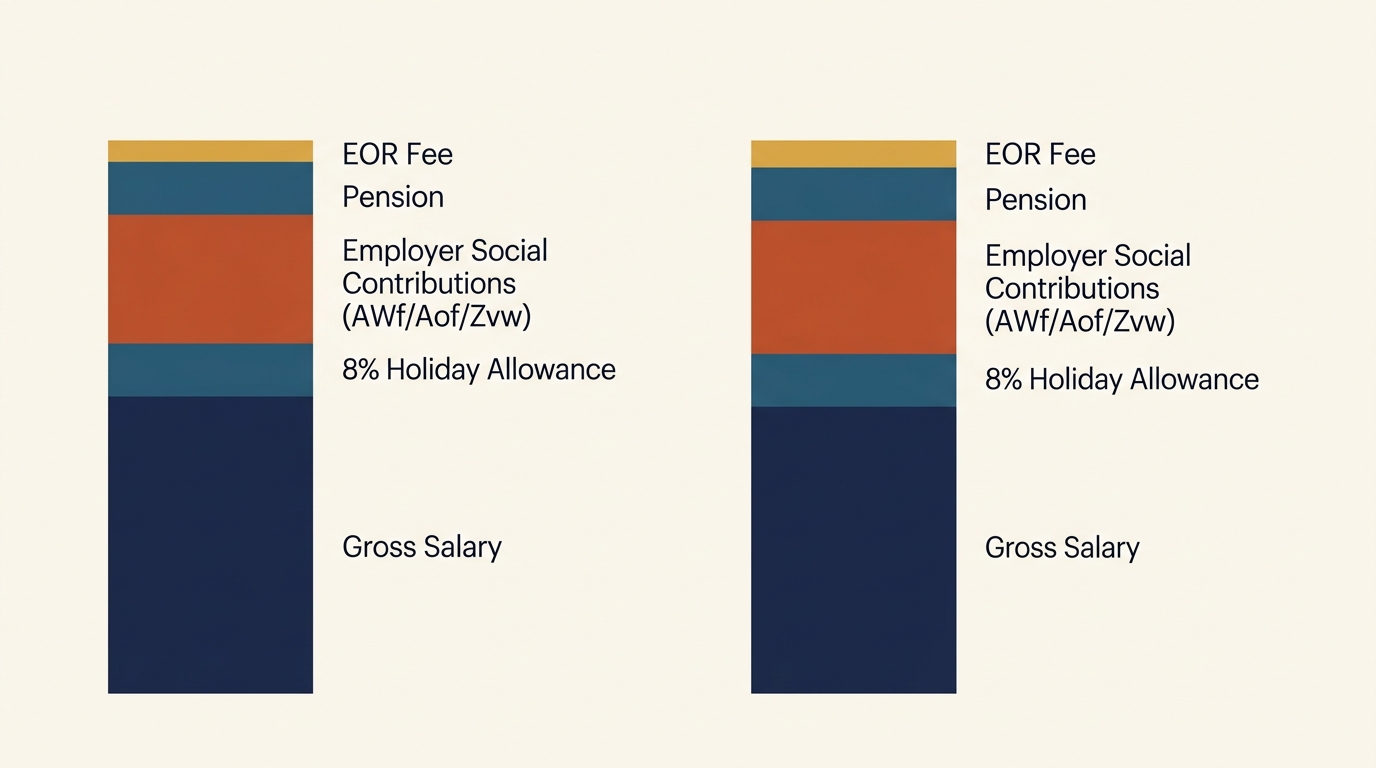
The EOR's platform fee is the visible line item and the one buyers fixate on. It's also the smallest piece. Here's the realistic monthly cost stack for a Dutch employee on a €70,000 gross annual salary, using 2026 contribution rates.
| Cost component | 2026 rate | Note |
|---|---|---|
| Gross salary | — | Base monthly pay before tax |
| Holiday allowance | 8% (statutory minimum) | Usually paid as a lump sum in May |
| AWf (unemployment fund) | 2.74% (permanent) / 7.74% (flexible) | Lower rate rewards permanent contracts |
| Aof (occupational disability fund) | 6.27% (small employer) / 7.63% (medium–large) | Employer-size dependent |
| Zvw (healthcare contribution) | 6.10%, capped at €79,409/yr wage | Employer-paid, income-dependent |
| Sector pension | Varies by CAO, employer typically pays the larger share | Mandatory in ~80% of sectors via bedrijfstakpensioenfonds |
| EOR service fee | ~$199–$699/employee/mo | Varies by provider and entity model |
Add it up and total employer cost typically lands somewhere around 28–35% above gross salary before the EOR's own fee — broadly in line with what our Netherlands EOR comparison found when it modeled a €70k hire. The EOR fee itself is usually 4–7% of the total stack, which is exactly why obsessing over a $100/month difference between two providers is the wrong optimization; the statutory percentages are where the real money is.
Want the real, all-in number before you make an offer?
Get a Netherlands-specific EOR quote that itemizes contributions, holiday allowance, and pension so there's no surprise on invoice three.
Get a Netherlands cost breakdownThe step-by-step playbook
Six recurring Dutch employment-law features show up across the steps below — worth having in view before you start.
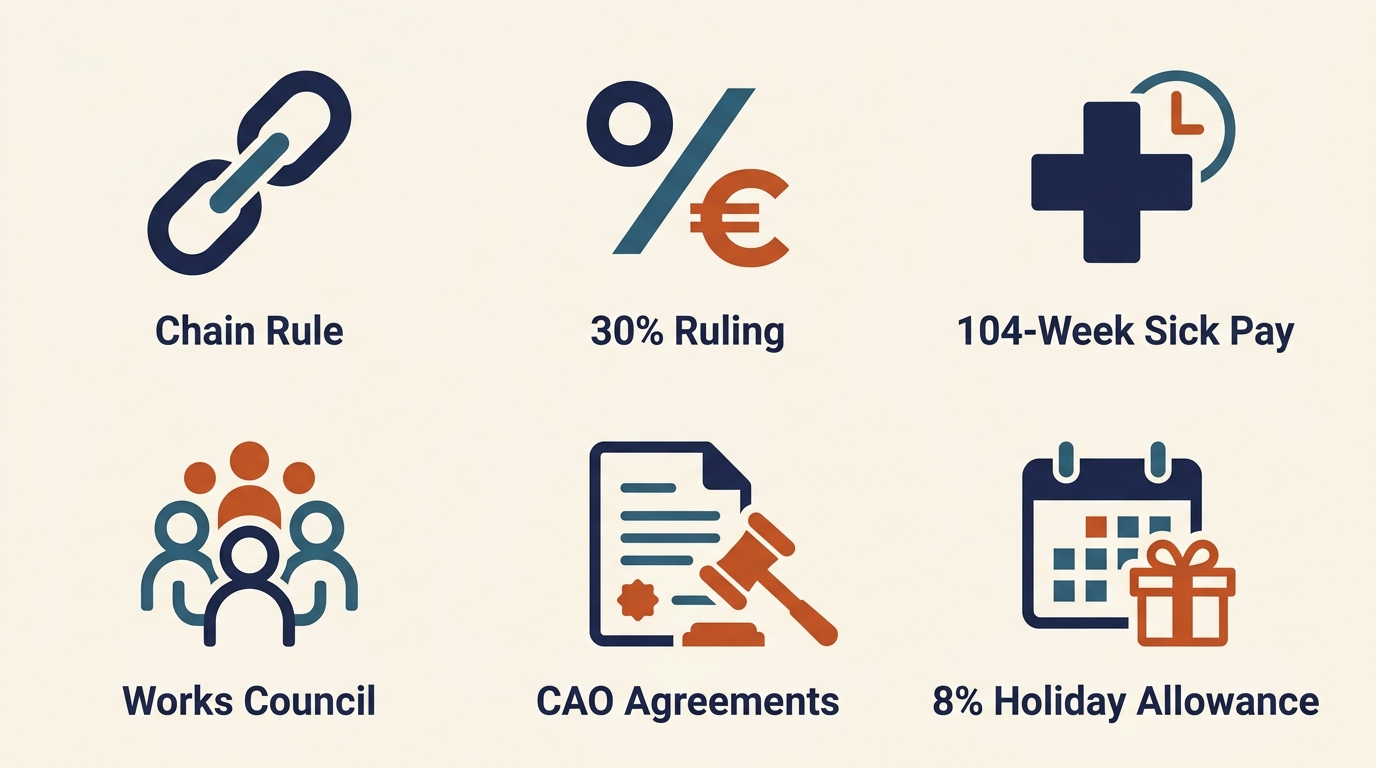
Here's the full sequence, from "we want to hire in the Netherlands" to "our employee is on compliant payroll." With an experienced EOR, steps 4 through 6 typically run in parallel inside the first one to two weeks for an EU/EEA candidate.
Confirm an EOR is the right vehicle
Using the table above, decide you want standard Dutch employment (not payrolling or a contractor relationship), that you're not ready to stand up your own BV, and that the role is genuinely an employment relationship rather than one dressed up as freelance work. Directed, ongoing work that only looks independent on paper is a misclassification risk everywhere in the EU, and the Netherlands is no exception.
Choose and vet your EOR provider
Look for a provider with a directly owned Dutch entity rather than a local partner arrangement, transparent handling of sick-leave insurance, and explicit support for the 30% ruling application if any of your hires might qualify. List prices in 2026 cluster around $599/month per employee for the owned-entity majors, with partner-model budget options starting near $199–$400. Complex cases — works council exposure, unionized CAO sectors, long-tenure senior hires — are where the owned-vs-partner distinction matters most; for a first, straightforward hire it matters less.
Comparing EOR providers for the Netherlands?
See entity ownership, 30% ruling support, and 2026 pricing for six providers side by side.
Build the offer around the real cost
With the cost stack from the section above, agree a gross salary and package that accounts for the 8% holiday allowance, sector pension, and — if the hire is a foreign professional — whether the role clears the 30% ruling salary threshold. For 2026, the ruling requires an annual taxable salary (after the 30% deduction) above €48,013 (or €36,497 for under-30s with a qualifying Dutch or equivalent master's degree). It's worth roughly €15,000–€25,000 a year in take-home value to an eligible hire, so factor it into how competitive your offer feels even though it doesn't change your employer cost.
Get the employment contract right
The EOR drafts a Dutch-law contract covering role, hours, salary, and termination terms. Check three things personally:
- CAO applicability: roughly 80% of Dutch private-sector employees fall under a sector-wide collective labor agreement (CAO) that can set minimum pay scales, extra leave, and notice periods above the statutory floor. Confirm which CAO the EOR is applying and why.
- Contract type and the chain rule: decide upfront whether this is fixed-term or permanent, and if fixed-term, where it sits in the three-contracts/36-month sequence.
- Proeftijd: confirm the trial period matches the scale in the section above — none for contracts of six months or less, one month up to two years, two months for permanent or longer fixed-term deals.
Complete BSN, UWV, and Belastingdienst registration
The employee needs a BSN (burgerservicenummer, the Dutch citizen service number) or an active application for one — EU nationals typically obtain this via municipal registration, non-EU hires through the immigration process below. Once the BSN is available, the EOR registers the employee with the Belastingdienst (tax authority) for wage tax withholding and with the employee-insurance system administered via payroll filings, and captures the employee's loonheffingskorting (payroll tax credit) election. If the 30% ruling applies, this is also the point to file the joint application — the ruling can be backdated to the start date only if filed within four months of employment starting, so don't let this step slip.
Onboard and run the first payroll
The employee submits bank details and benefit elections; the EOR runs the first compliant payslip, withholds wage tax, and remits the employer's AWf, Aof, and Zvw contributions. The 8% holiday allowance accrues monthly even though it's typically paid out as a lump sum in May, so don't be surprised that the first few payslips look lighter than the annualized cost figure you budgeted.
Manage the ongoing relationship
Day to day, manage the person like any other team member — the EOR stays out of your reporting lines. Two things worth tracking as the relationship matures: sick leave (if the employee is signed off long-term, you're financially exposed for up to 104 weeks, and missing a reintegration milestone with the occupational-health provider can extend that liability), and the works council (ondernemingsraad) — most EOR entities employ 50+ people across all their clients and therefore have one; a works council vote on, say, pension terms can technically apply to your hire too, so ask your EOR how they handle that in practice.
What the timeline really looks like
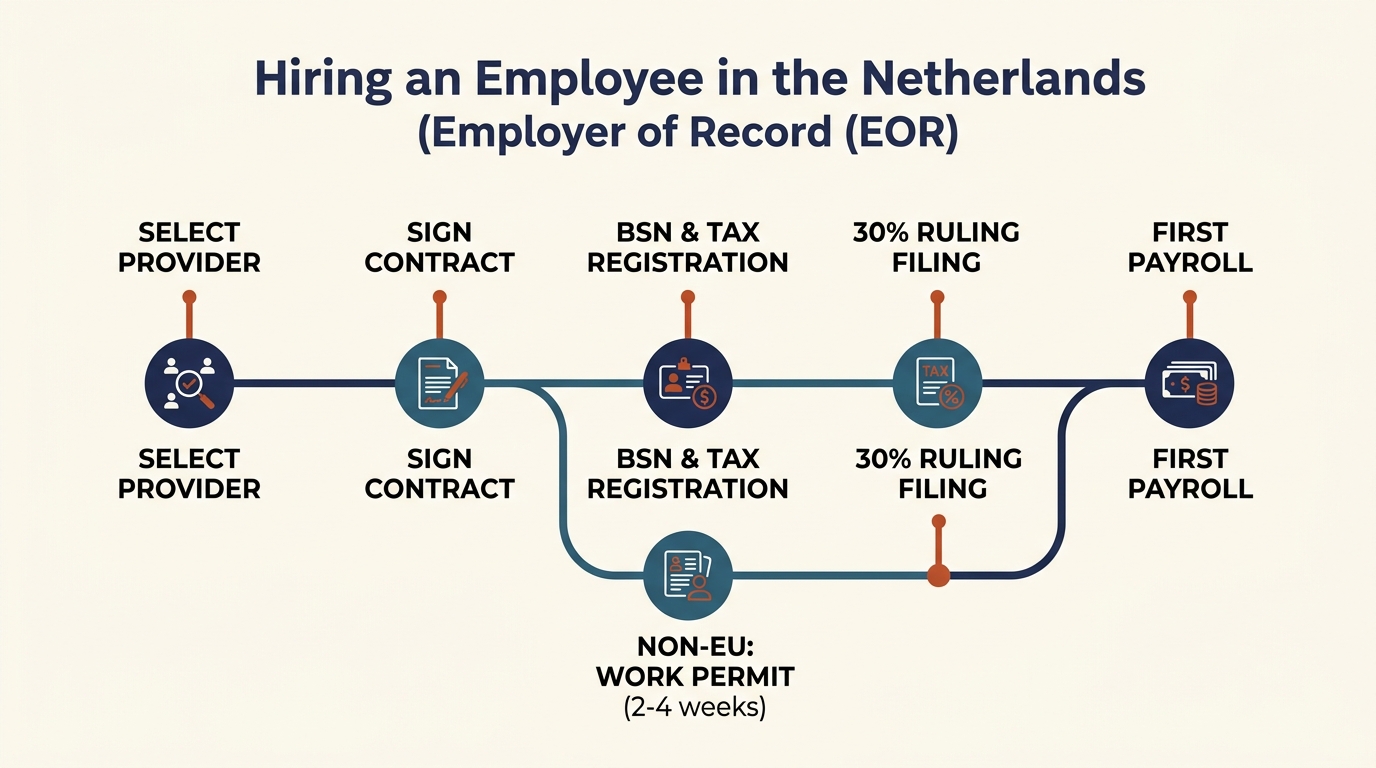
For an EU/EEA national already resident in the Netherlands, a realistic sequence is: provider selected and contract drafted in days 1–3; contract signed and BSN/Belastingdienst registration filed by the end of week one; benefit elections and any 30% ruling paperwork completed in week two; first payroll on the next cycle. That compares with several weeks to a couple of months to stand up your own compliant Dutch payroll from scratch. For non-EU candidates, the highly-skilled-migrant permit becomes the critical path — two to four weeks with a recognized-sponsor EOR, longer otherwise — so start that process the day you make the offer, not after the contract is signed.
Common mistakes to avoid
- Quoting salary before loading the cost. Promising a number that only reflects gross pay, without the 8% holiday allowance, employer contributions, and pension, is the most common budgeting error.
- Missing the 30% ruling's four-month filing window. File late and you lose the retroactive benefit back to the start date — an avoidable, expensive mistake for an eligible hire.
- Testing the chain rule's edges. Assuming you can quietly issue a fourth fixed-term contract, or that a five-month gap doesn't reset the chain. It's an automatic conversion to permanent with no discretion involved.
- Confusing an EOR with payrolling or a staffing agency. The 2026 agency-worker equal-treatment rules target a different legal structure; ask your provider directly which model they use.
- Ignoring the CAO. Assuming statutory minimums apply when a sector collective agreement sets a higher floor on pay, leave, or notice.
When an EOR is not the right answer for the Netherlands
The model has real limits. Once you're running 15–25+ employees in the Netherlands, the accumulated per-employee fees typically exceed the cost of running your own BV with in-house payroll, and you gain direct control over benefits, works council relationships, and termination handling in the process. If the person is a genuinely independent professional serving multiple clients on their own terms, forcing them into salaried employment isn't necessary — a compliant contractor relationship may fit better. The EOR sweet spot stays what it's always been: a handful of standard employees you want on compliant Dutch payroll fast, without opening an entity.
Ready to put your Dutch hire on compliant payroll?
Line up a Netherlands-specific EOR quote — BSN registration, the 30% ruling, and sick-leave insurance included — and onboard in one to two weeks.
Get a Netherlands EOR quoteHiring elsewhere in Europe too?
The mechanics rhyme across the EU, but the numbers and rules differ market by market. If your hiring plan isn't Netherlands-only, our companion guides break down the same decision for hiring in Spain, hiring in France (and the matching France step-by-step playbook), and hiring in Germany. If you're weighing how payroll should work as a team like this scales, see our comparison of Rippling vs. Gusto for startups.
Frequently asked questions
Is it legal to hire in the Netherlands through an EOR?
Yes. Using an EOR to employ staff in the Netherlands is a widely used, legitimate arrangement. The EOR is the compliant legal employer — it handles the Dutch contract, BSN/Belastingdienst registration, wage tax withholding, and social contributions — while you direct the day-to-day work. Keep the line between legal employer (the EOR) and operational direction (you) clean, and it's a well-established, low-risk model.
How long does it take to hire someone in the Netherlands with an EOR?
Typically one to two weeks for an EU/EEA national already resident in the Netherlands — contract drafting, BSN and Belastingdienst registration, and benefit setup. Non-EU candidates need a highly skilled migrant permit first, which takes roughly two to four weeks with an IND-recognized sponsor, or up to 90 days without one. Start the immigration track the moment you extend the offer.
How much does it really cost to employ someone in the Netherlands?
Plan for the 8% statutory holiday allowance, employer social contributions around 18–22% of gross salary (AWf, Aof, and Zvw combined, 2026 rates), and sector pension contributions on top — total employer cost typically lands around 28–35% above gross salary before the EOR's own fee. The EOR fee itself commonly runs $199–$699 per employee per month depending on the provider and entity model.
What is the chain rule and why does it matter?
The ketenregeling caps fixed-term contracts at three consecutive agreements within a 36-month window. Offer a fourth, or exceed 36 months, and the contract automatically becomes permanent — there's no opt-out. A gap of more than six months between contracts resets the count; a shorter gap doesn't. Plan your contract sequence with this ceiling in mind from the first offer.
Can an EOR handle the 30% ruling application?
Most owned-entity providers do, as part of standard onboarding. The 2026 thresholds require an annual taxable salary (after the 30% deduction) above €48,013, or €36,497 for under-30s with a qualifying master's degree, with the tax-free portion capped at €78,600/year. File within four months of the start date to get it backdated — miss that window and you lose the retroactive benefit permanently.
What happens if my Dutch employee gets sick long-term?
Dutch employers must continue paying at least 70% of salary for up to 104 weeks (two years) of illness, and many CAOs top that up to 100% in the first year. A capable EOR carries sick-leave insurance (verzuimverzekering) and coordinates the occupational-health reintegration process on your behalf — confirm this is included before you sign, since it's one of the reasons Dutch EOR fees run higher than some neighboring markets.
How we approached this guide. Based on current Dutch employment-law sources (the chain rule and proeftijd rules from Business.gov.nl and Dutch labor-law references, 2026 AWf/Aof/Zvw contribution rates, and 2026 IND salary thresholds for the highly skilled migrant scheme fetched directly from ind.nl) cross-referenced against 2026 EOR provider pricing pages. Figures were verified in July 2026 and should be reconfirmed against a Netherlands-specific quote and current IND guidance, since thresholds and rates are indexed annually.

Technology consultant with 10+ years in the Japanese tech industry. Specializing in SaaS evaluation, workflow automation, and B2B tool integration.