Best EOR for Hiring in Mexico (2026): 8 Providers Compared on Price, REPSE, and Real Cost
For most foreign companies hiring their first one to ten people in Mexico, Remote (owned entity, $699/employee/month list) and Deel ($599/employee/month list) are the safest defaults, with Atlas HXM ($599) as a strong owned-entity alternative. If budget is the constraint, RemoFirst and Boundless start at $199, but you'll need a Mexico-specific quote. Whichever you shortlist, Mexico adds one question most country guides skip: ask for the provider's REPSE registration number and its written position on the 2021 outsourcing reform before you sign. Getting that wrong can leave your company jointly liable for social security contributions and unable to deduct the fees.
Owns its entities, publishes flat pricing, and has a strong compliance reputation.
$599 EOR plus $49 contractors. Fits teams mixing employees and LATAM contractors.
From $199/month. Get the Mexico quote and REPSE details in writing first.
- Quick comparison table
- Why Mexico is harder than it looks
- The REPSE question: what to ask every provider
- The 8 providers, reviewed
- What the EOR fee doesn't cover
- Terminations: a worked severance example
- The 40-hour workweek phase-in (2027–2030)
- PEO vs EOR in Mexico
- Who should choose which
- FAQ and methodology
01 · ComparisonQuick Comparison: 8 EOR Providers for Mexico
Prices below are the provider's published starting EOR fee as of September 2026. They do not include salary, employer contributions, or statutory benefits. Most vendors quote Mexico individually, so treat these figures as the start of a negotiation, not the final number.
| Provider | Published EOR fee | Mexico entity model | Best for | Watch out for |
|---|---|---|---|---|
| Remote | $699/mo | Owned entities (company policy) | Compliance-first teams, 1–50 hires | Highest list price in the group |
| Deel | $599/mo | Not stated publicly for Mexico; ask | Mixed employee + contractor teams | Add-ons and FX terms vary by contract |
| Oyster | $699/mo | Ask per country | Distributed teams wanting guided onboarding | Annual discount not published |
| Atlas HXM | $599/mo | Owned entities ("direct" model) | Owned-entity model at mid-market price | Tiered pricing above 5 employees |
| Multiplier | from $400/mo | Owned in most markets; confirm Mexico | Cost-conscious scale-ups, APAC + LATAM | Deposit / pre-funding required |
| Rippling | Quote (reported ~$499–$599) | Ask | Companies already on Rippling HRIS | No published EOR price |
| RemoFirst | from $199/mo | Ask | Budget-first first hires | "Varies by country": get Mexico quote |
| Boundless | from $199/mo | Partner-based in some markets | Small teams valuing transparency | Mexico price quoted separately |
Sources: each provider's pricing page (Deel, Remote, Oyster, RemoFirst, Boundless, Atlas HXM), checked September 2026. Multiplier and Rippling figures are from third-party pricing reviews because neither publishes a fixed EOR price on an accessible page. Teamed's comparison reports Remote at $599/month on annual billing versus $699 monthly.
For a breakdown of how these flat fees compare with percentage-of-payroll pricing, and when each model becomes cheaper, see our explainer on flat-fee vs percentage-of-payroll EOR pricing.
02 · ContextWhy Mexico Is Harder Than It Looks
Mexico looks like an easy first LATAM market: it shares a time zone band with the US, has a deep engineering and operations talent pool, and every major EOR lists it. The complexity doesn't show up on vendors' country pages, though. It sits in three places.
1. The 2021 outsourcing reform changed what "employer of record" means
In April 2021, Mexico banned most traditional labor subcontracting, a practice that had been widely used to avoid profit-sharing and reduce social security contributions. Outsourcing of specialized services outside a client's core business is still allowed, but only through providers registered in REPSE (Registro de Prestadoras de Servicios Especializados u Obras Especializadas), which the Labor Ministry (STPS) administers. Every EOR has to fit its model somewhere inside that framework, and they don't all put themselves in the same place. We cover this in detail in the next section.
2. Costs are calculated on an "integrated" salary, not base pay
Social security contributions and severance are calculated on the salario diario integrado (SDI, integrated daily salary). SDI adds the daily value of the Christmas bonus, the vacation premium, and other fixed benefits to base pay. If you budget from base salary alone, you will under-budget both monthly employer costs and any termination.
3. Profit-sharing (PTU) exists, and your EOR's books decide it
Mexican employers must distribute 10% of taxable profit to employees (PTU). When you hire through an EOR, the legal employer is the EOR's Mexican entity, so for clients with no Mexican operating company the EOR's own profit pool determines PTU exposure. Some providers pass PTU through as a cost, some absorb it, and some say nothing unless you ask. Put it in the contract.
In most countries we cover, such as Canada, choosing an EOR comes down to price, speed, and local benefits. In Mexico, the provider's legal structure matters as much as its price. That's why REPSE gets its own section here.
03 · ComplianceThe REPSE Question: What to Ask Every Provider
This is where published sources disagree, and where we think most "best EOR in Mexico" lists fall short.
- Position A: "REPSE is required." Several Mexico-based payroll and advisory firms say only REPSE-registered companies can legally act as an EOR after the 2021 reform. They point to Articles 12–15 of the Federal Labor Law (LFT), Article 15-D of the Federal Tax Code, and the parallel changes to the Social Security (IMSS) and INFONAVIT laws. Under this reading, contracting through an unregistered provider creates joint-and-several liability for the client for unpaid IMSS contributions, and payments to the provider lose their tax effects: no income-tax deduction and no VAT credit for a Mexican client entity.
- Position B: "A true EOR sits outside REPSE." Other providers argue that when the EOR is the direct legal employer and isn't subcontracting "specialized services" to a Mexican beneficiary, the arrangement falls outside the REPSE regime. Boundless, for example, says this directly, while also telling buyers to "confirm in writing where each EOR places its own service in this taxonomy."
We're not in a position to settle a legal question that Mexican practitioners still frame differently, and you shouldn't rely on a vendor blog to settle it either. What you can do is make the provider commit to a position in writing, so the risk sits with the party that chose the structure.
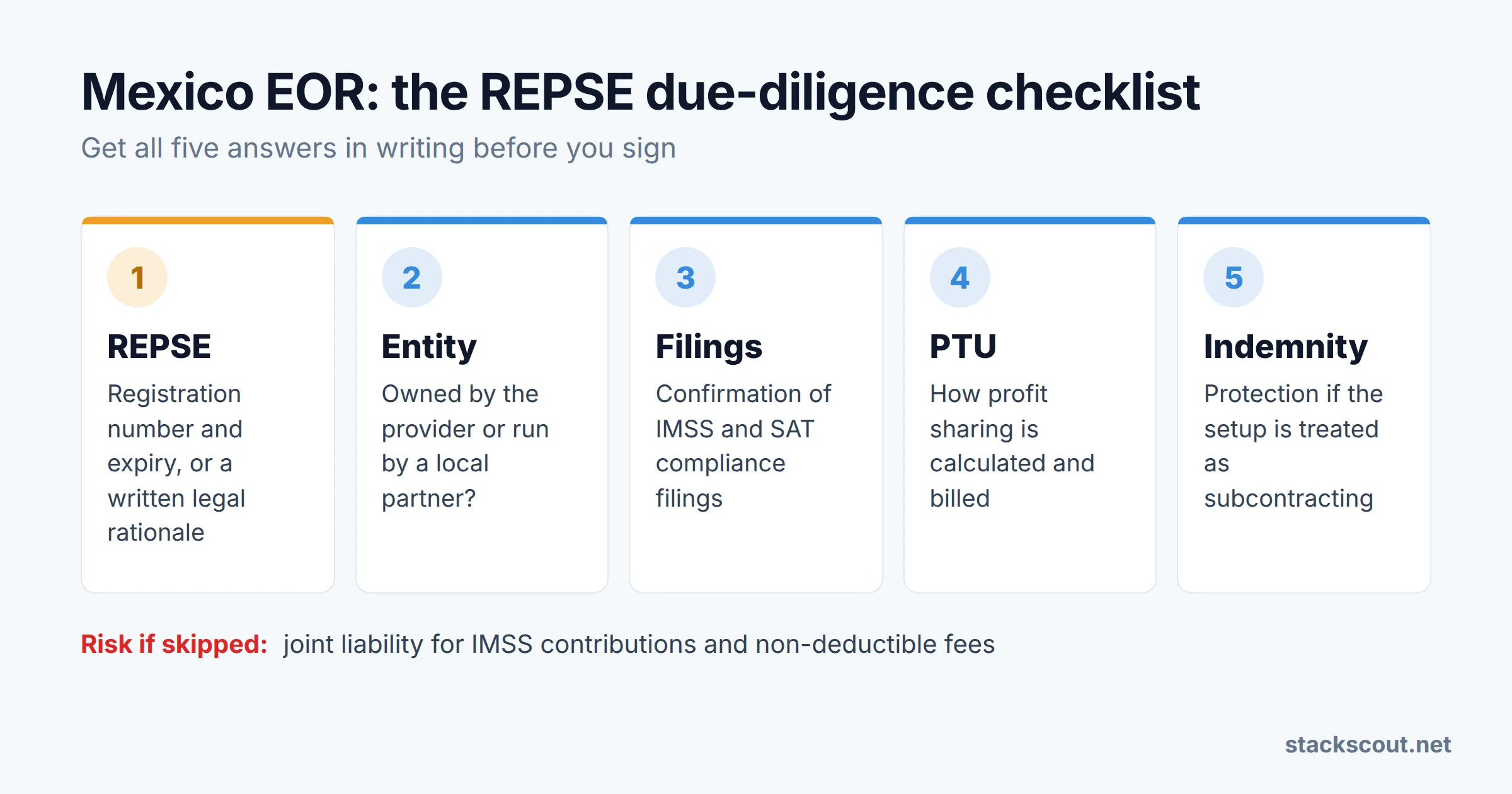
- REPSE: Is your Mexican entity registered in REPSE? If yes, what is the registration number, and when does it expire? (Registrations are public and can be checked on the STPS registry.) If no, send your legal rationale in writing.
- Entity: Is the Mexican employing entity wholly owned by you, or run by a local partner? If it's a partner, who is the partner, and does the partner hold REPSE?
- Filings: Will you give us copies or confirmations of the periodic IMSS and SAT compliance filings for our workers?
- PTU: How is profit-sharing calculated and paid for our employees, and is it billed to us?
- Indemnity: Does the contract indemnify us if a Mexican authority treats the arrangement as prohibited subcontracting?
If your company already has, or plans to have, a Mexican subsidiary that receives the workers' output, raise this with Mexican counsel before signing. That is the situation where the tax-deductibility and joint-liability consequences matter most. If you're unsure whether ongoing EOR employment could create a taxable presence for you anyway, our guide to EOR mistakes that trigger permanent establishment risk covers the red flags.
04 · ReviewsThe 8 Providers, Reviewed
Each review covers what we could verify publicly: published price, what the provider says about its entity model, and where it fits. We don't claim hands-on payroll runs. Where a detail isn't published, we say so and tell you what to ask.
1. Remote Safest default
Remote's main selling point is structural: the company says it owns every entity it employs through rather than renting capacity from local partners. In Mexico, where a partner's registration status and payroll quality become your risk, that shortens the due-diligence chain by a full link. Its list price of $699 per employee per month is the highest in this group. Teamed's comparison reports $599 on annual billing, so ask about annual commitments.
Remote suits companies whose legal or finance teams will ask the REPSE and PTU questions above and want one accountable counterparty. It is less compelling if you're hiring a single, junior role and every $100 a month matters.
Pros
- Owned-entity model reduces partner risk
- Flat, published pricing
- Low-cost contractor tier for LATAM freelancers
Cons
- Highest list price here
- Annual discount not shown on the pricing page
- Mexico-specific REPSE status still needs a written answer
2. Deel Best platform breadth
Deel lists EOR at $599 per employee per month, contractors at $49, and a contractor-of-record option at $325. For Mexico, the practical advantage is breadth. Many companies entering LATAM start with contractors in Mexico, Colombia, or Argentina, then convert the ones who become full-time. Keeping both groups on one platform keeps those conversions tidy.
Deel doesn't publish whether its Mexico employing entity is owned or partner-run, so this is question #2 on your list. Also ask for FX terms in writing. Salary is paid in pesos while you're likely invoiced in USD, and the spread over a year can exceed the difference in platform fees between vendors.
Pros
- $100/mo cheaper than Remote at list
- Strong contractor → employee conversion path
- Mature HRIS and integrations ecosystem
Cons
- Mexico entity model not published
- Add-ons and FX can erode the headline saving
- Contractor-of-record tier ($325) costs more than plain contractor management
Weighing Deel against a payroll-first alternative? Our Deel vs Papaya Global comparison covers that trade-off.
3. Oyster
Oyster lists EOR at $699 per employee per month and says annual discounts are available without publishing the rate. Its positioning has long centered on distributed-team onboarding and employee experience, which matters in Mexico, where employees expect clear explanations of aguinaldo, vacation premium, and PTU on their payslips.
Teamed's comparison notes that deposit and currency-conversion fees apply on top. Ask for a sample invoice for a Mexican hire before you compare it with Deel or Remote.
Pros
- Employee-experience focus
- Transparent list price
- Annual discount available
Cons
- Same list price as Remote without the stated owned-entity commitment
- Deposit and FX fees on top
4. Atlas HXM Owned entity, mid-price
Atlas publishes a starting rate of $599 per employee per month for teams of up to five, with volume discounts above that. It markets a "direct" EOR model built on its own entities. Boundless's competitive review credits Atlas with more than 160 owned entities. That makes Atlas the closest thing in this list to Remote's structure at Deel's price.
Atlas is also publishing aggressively on LATAM hiring, including Costa Rica. If you're planning a regional footprint rather than a single Mexico hire, that regional depth is worth probing in demos.
Pros
- Owned-entity model at $599
- Volume discounts for growing teams
- Strong LATAM content and coverage
Cons
- Smaller integrations ecosystem than Deel or Rippling
- Discount tiers not fully published
5. Multiplier
Multiplier's EOR starts around $400 per employee per month according to multiple third-party pricing reviews (its own pricing page blocked automated access when we checked). It uses flat pricing with no separate onboarding or exit charges, but it requires a deposit or pre-funding. In Mexico, that deposit typically needs to cover potential severance exposure, which can be large; see the severance example below.
Pros
- ~$200/mo below Deel/Atlas at list
- No onboarding/offboarding surcharges
Cons
- Deposit/pre-funding ties up cash
- Confirm Mexico is an owned-entity market
6. Rippling
Rippling doesn't publish EOR pricing. Third-party reviews report roughly $499–$599 per employee per month on top of platform fees, varying by country and headcount. Rippling makes the most sense when your US team already runs on Rippling HRIS and payroll: Mexican employees then share one directory, one device-management setup, and one set of approval workflows with everyone else.
Pros
- Unified HRIS + IT + payroll with your existing team
- Strong workflow automation
Cons
- No published EOR price
- Less compelling if you're not already on Rippling
7. RemoFirst Budget pick
RemoFirst advertises EOR "starting at $199 per person/month" and notes that pricing "may vary based on local country requirements." It also promises a full cost breakdown before you commit. That's the right promise to test in Mexico: ask for an all-in monthly figure for your actual salary band, including IMSS, INFONAVIT, state payroll tax, and PTU treatment.
Pros
- Lowest published starting price
- Up-front cost breakdown
Cons
- Mexico rate not published
- Entity/REPSE details need written confirmation
8. Boundless
Boundless starts at $199 (€175) per employee per month, with final pricing depending on "the complexity of the legislative environments" involved. It publishes unusually detailed Mexico content (SDI ceilings, state payroll tax, PTU mechanics) and is open about its own REPSE position, which is useful even if you don't choose it. Its own comparison describes its Mexico setup as partner-based, so apply question #2 to the partner.
Pros
- Low starting price
- Transparent about legal positioning
- Separates genuine contractors into an AOR product
Cons
- Partner-based model in Mexico
- Smaller platform than Deel/Rippling
Several local firms, such as Human Resources Mexico (HRM) and Alcor (focused on software developers), rank in Mexico-specific lists. Local specialists often answer REPSE and PTU questions more precisely than global platforms because Mexico is their whole business. The trade-off is a separate vendor for every other country. If Mexico will be your only international hire for the foreseeable future, add one local specialist to your RFP as a benchmark.
05 · CostWhat the EOR Fee Doesn't Cover: The Real Cost of a Mexican Hire
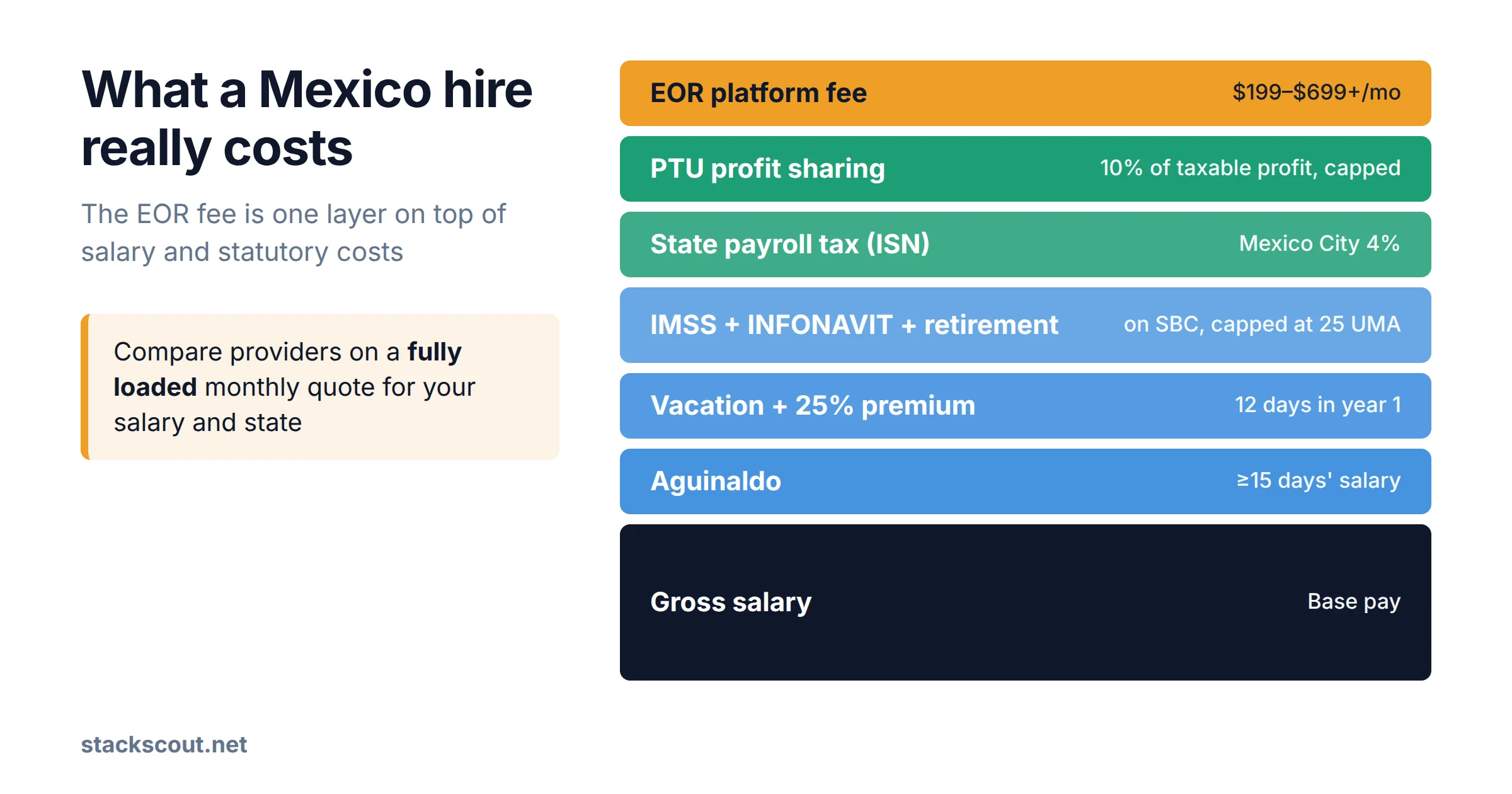
The platform fee is usually the smallest number in your Mexico budget. Here's what sits on top of gross salary. All figures are 2026 values from the sources listed at the end.
| Cost layer | 2026 rule | Budgeting note |
|---|---|---|
| Minimum wage | MXN 315.04/day general zone; MXN 440.87/day Northern Border Free Zone (up 13% in the general zone) | Irrelevant for most professional hires but drives some caps (see seniority premium) |
| Aguinaldo | At least 15 days' salary, paid before December 20 | ≈4.1% of annual base; many employers pay more, so match market |
| Vacation + premium | 12 days in year 1, rising 2 days a year to 20 by year 5 (2023 reform), plus a 25% vacation premium | Premium is cash on top of normal pay for vacation days |
| IMSS social security | Employer and employee contributions on SBC, capped at 25 UMA = MXN 2,932.75/day | High earners hit the cap, so percentage cost falls as salary rises |
| INFONAVIT + retirement | 5% INFONAVIT housing fund; employer retirement/old-age contributions are on a scheduled annual increase through 2030 | Check that your EOR's quote uses the current-year rate |
| State payroll tax (ISN) | Set by each state: Mexico City 4% since January 2025; most states 2%–4% | Where the employee lives changes the cost |
| PTU profit sharing | 10% of taxable profit; per-employee cap = greater of 3 months' salary or 3-year average; companies pay by May 30 | Depends on the EOR entity's profits; clarify in contract |
| EOR fee | $199–$699+/employee/month (see table above) | Plus FX spread, deposits, and optional add-ons |
UMA (Unidad de Medida y Actualización) for Feb 2026–Jan 2027: MXN 117.31/day per INEGI.
Vendor estimates of total employer on-costs in Mexico vary widely because they depend on salary level (the IMSS cap), state, and how generous the benefits package is. Don't compare providers on the platform fee alone. Ask each one for a fully loaded monthly cost for your exact salary and state, then compare those numbers. For the broader build-vs-buy question, including when a Mexican entity starts to beat EOR fees, our EOR vs setting up a foreign entity break-even analysis walks through the math.
For professional roles, competitive offers in Mexico often include private major-medical insurance (seguro de gastos médicos mayores), grocery vouchers (vales de despensa), and a savings fund (fondo de ahorro). Some of these become part of SDI and raise your contribution base, so ask your EOR how each benefit is treated before you add it to an offer letter.
06 · ExitTerminations: A Worked Severance Example
Mexico has no at-will employment. Dismissal without one of the legally recognized causes is treated as unjustified, and the statutory components stack. This is the number your EOR's deposit is really protecting, and the one most "best EOR" lists leave out.
Illustrative scenario (not legal advice): an engineer earning MXN 60,000/month (MXN 2,000/day base), employed for 2 full years, dismissed without justified cause. In year 2 they are entitled to 14 vacation days.
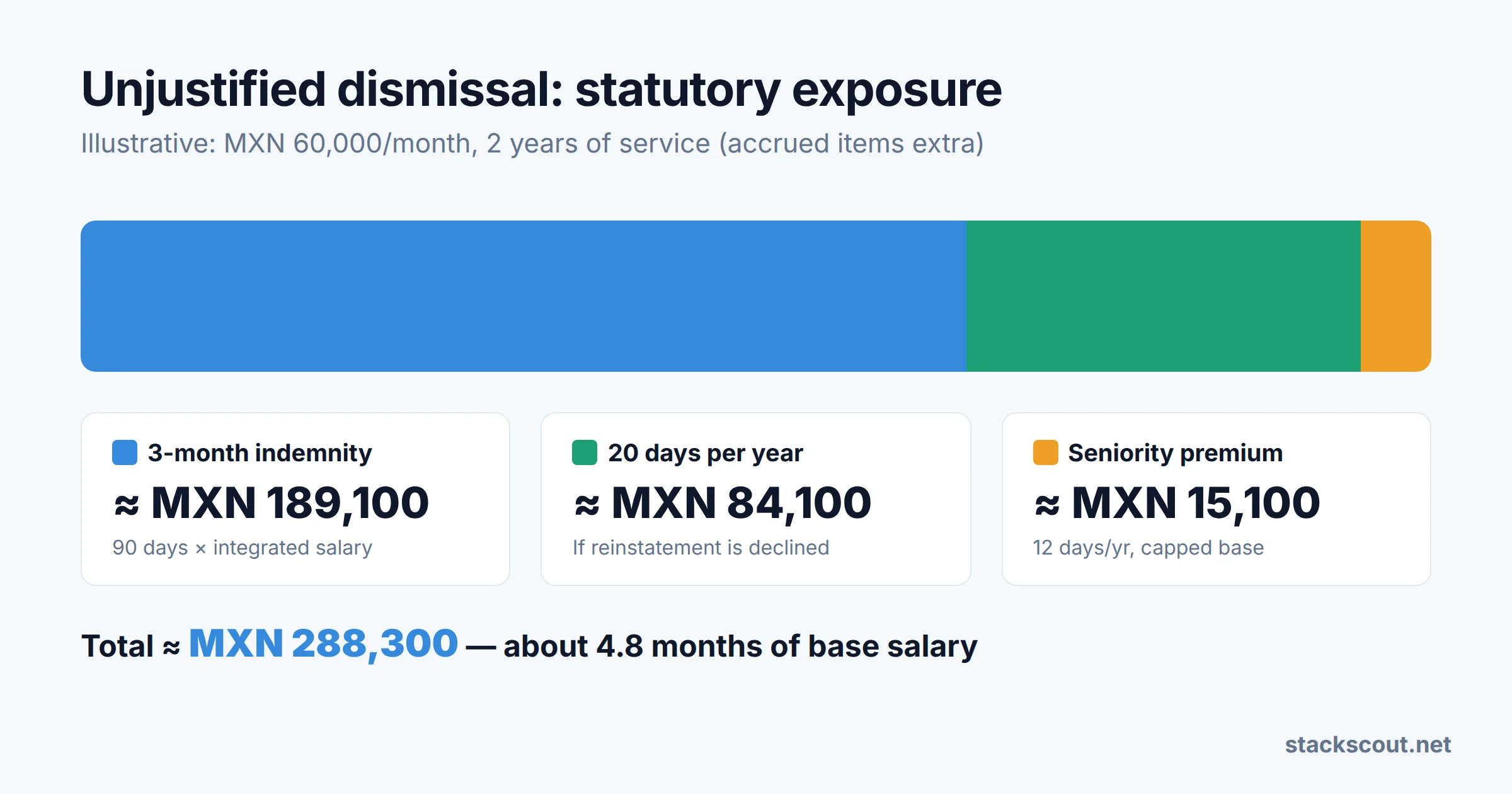
That's roughly 4.8 months of base salary for a two-year employee, before accrued items. In practice, many terminations are settled by mutual agreement and ratified before the labor authorities, but the statutory figures set the negotiation baseline. Two practical consequences:
- Ask each EOR who runs the termination process, including documentation, settlement negotiation, and ratification, and whether any of it is billed as an add-on.
- Check the deposit. If a provider requires a deposit, find out whether it's sized to cover severance and when it's refunded.
07 · Coming changeThe 40-Hour Workweek Phase-In (2027–2030)
Mexico enacted a constitutional reform in 2026 to cut the maximum workweek from 48 to 40 hours without reducing pay. The legal reform is already in force, and the actual hour reductions start on January 1, 2027, falling two hours per year.
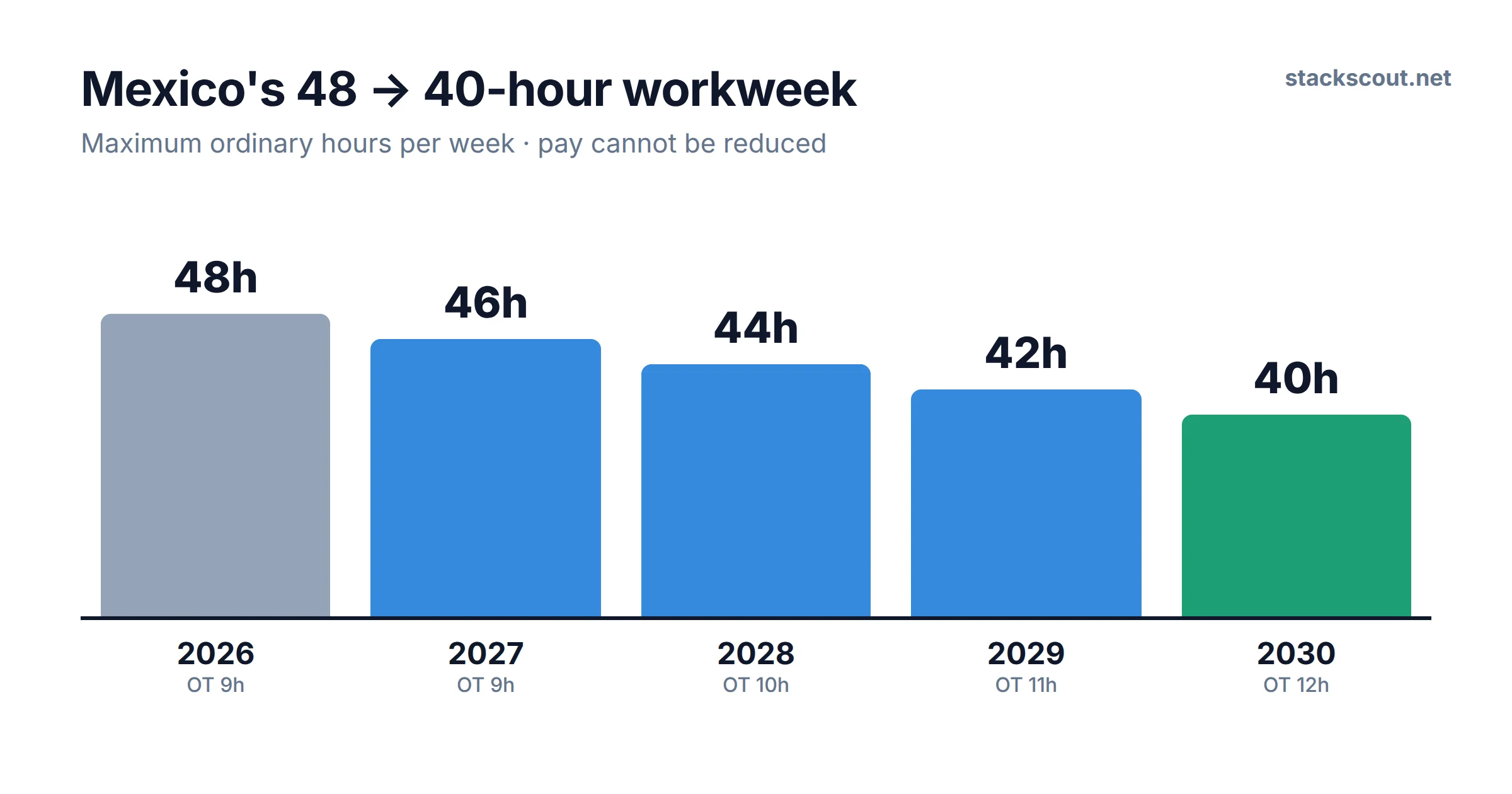
| Year | Max ordinary hours/week | Double-rate overtime allowance |
|---|---|---|
| 2026 | 48 | 9 hours |
| 2027 | 46 | 9 hours |
| 2028 | 44 | 10 hours |
| 2029 | 42 | 11 hours |
| 2030 | 40 | 12 hours |
The reform also requires employers to keep an electronic record of working time (shift start and end) under STPS guidelines, and it caps combined ordinary and overtime hours at 12 per day. For salaried knowledge workers who already work around 40 hours, the headline change matters less than the record-keeping. Ask each EOR:
- Will you provide a time-recording tool that meets the STPS requirement, or do we need our own?
- How will you update employment contracts for the 2027 step-down, and will that cost extra?
- For hourly or shift roles, how will overtime be calculated and approved in each phase?
08 · Model choicePEO vs EOR in Mexico
Buyers coming from the US often search for a "Mexico PEO." In US terms, a PEO is a co-employment arrangement where you already have a legal entity and the PEO shares employer responsibilities. Mexico's 2021 reform makes that model awkward to reproduce: putting your core workforce on someone else's payroll is exactly what the reform prohibits. Some "PEO" offers you'll see in Mexico are EOR services under another name. Others are REPSE-registered specialized-service arrangements that only work for activities outside your core business.
The EOR's entity is the sole legal employer. Apply the REPSE questions above.
Hire on your own entity and use a payroll provider. Don't outsource core staff to a third party.
For example, facilities or specialist services outside your corporate purpose, provided the vendor holds REPSE.
Manufacturing operations are a different regime. Talk to Mexican counsel, not an EOR sales team.
For the general distinction, see our explainer on EOR vs PEO and which your B2B team needs. If you're consolidating an existing co-employment setup elsewhere, our PEO-to-EOR migration guide covers the payroll cutover.
What about contractors?
Many companies start in Mexico with independent contractors because it's faster and cheaper. That works for genuine, project-based engagements. When a contractor works fixed hours, reports to your managers, and does core work indefinitely, Mexican labor authorities can treat the relationship as employment, and the severance math above then applies retroactively. The usual pattern is to convert long-term contractors to EOR employment once the role is clearly permanent.
09 · VerdictWho Should Choose Which
| Your situation | Shortlist | Why |
|---|---|---|
| First 1–3 hires, legal team wants one accountable entity | Remote, Atlas HXM | Owned-entity models shorten the REPSE/partner due-diligence chain |
| Mix of contractors and employees across LATAM | Deel, Remote | Low-cost contractor tiers plus conversion paths to EOR |
| Already on Rippling for US HR/IT | Rippling | One directory, device management, and workflow layer |
| Tight budget, single junior hire | RemoFirst, Boundless, Multiplier | Lowest starting fees, but insist on an all-in Mexico quote |
| Mexico is your only international market | One global EOR + one local specialist in the RFP | Local firms often answer REPSE/PTU questions more precisely |
| Planning 15+ Mexican employees within 2 years | Model the entity route now | Past a certain headcount, your own entity plus local payroll often beats per-head fees |
If you're still defining your evaluation criteria, our 7-question framework for choosing an EOR provider gives you the country-agnostic checklist; this guide adds the Mexico-specific layer on top.
Expanding beyond Mexico?
Mexico is often the first step in a broader Latin America plan. Costa Rica (a common nearshore hub for customer success and engineering) and Brazil (the region's largest labor market, with its own complex rules) come up most often next. We're preparing a guide to choosing an EOR for hiring in Costa Rica and a guide to choosing an EOR for hiring in Brazil. If you shortlist a provider for Mexico, ask about its entity model in those countries too, because consolidating LATAM on one EOR simplifies vendor management.
10 · FAQFrequently Asked Questions
What is an EOR in Mexico?
How do I hire employees in Mexico without a local entity?
Does my Mexico EOR need to be registered in REPSE?
Do employees hired through an EOR receive PTU profit sharing?
How much does an EOR cost in Mexico?
11 · MethodMethodology
Based on our research in September 2026, we started from the providers that appear most often in current Mexico EOR rankings and kept those with a published or widely reported EOR price and multi-country coverage. We checked each provider's own pricing page where it was accessible and used third-party pricing reviews only where the provider doesn't publish a fixed price (Multiplier, Rippling). Mexican statutory figures (minimum wage, UMA, SBC cap, vacation, PTU, severance, state payroll tax, and the 40-hour workweek schedule) come from government data and law-firm publications listed below. We did not run live payroll through any provider, and nothing here is legal or tax advice. Confirm REPSE, PTU, and termination terms with the provider and with Mexican counsel.
12 · SourcesSources & References
- Deel — Pricing: deel.com/pricing
- Remote — Pricing: remote.com/pricing
- Oyster — Pricing: oysterhr.com/pricing
- RemoFirst — Pricing: remofirst.com/pricing
- Boundless — Pricing and "Best Employer of Record services in Mexico (2026)": boundlesshq.com
- Atlas HXM — EOR Pricing: atlashxm.com/pricing
- Teamed — Best EOR providers in Mexico (pricing and compliance comparison): teamed.global
- Holland & Knight — Adjustments to Minimum Wages in Mexico for 2026: hklaw.com
- INEGI — UMA 2026 press release: inegi.org.mx
- Baker McKenzie — Mexico: Major Labor Reform to Gradually Reduce the Work Week: bakermckenzie.com
- Start-Ops Mexico — Employer of Record Mexico: A Guide for Foreigners (2026): start-ops.com.mx
- CMS — Expert Guide to Dismissals: Mexico: cms.law
- De la Vega & Martínez Rojas — Everything you need to know about profit sharing (2021 reform): dlvmr.com
- Factorial México — Impuesto Sobre la Nómina 2026 by state: factorial.mx

Technology consultant with 10+ years in the Japanese tech industry. Specializing in SaaS evaluation, workflow automation, and B2B tool integration.