Best EOR for Hiring in Australia (2026): 8 Providers Compared on Price, Payday Super, and Labour-Hire Licensing
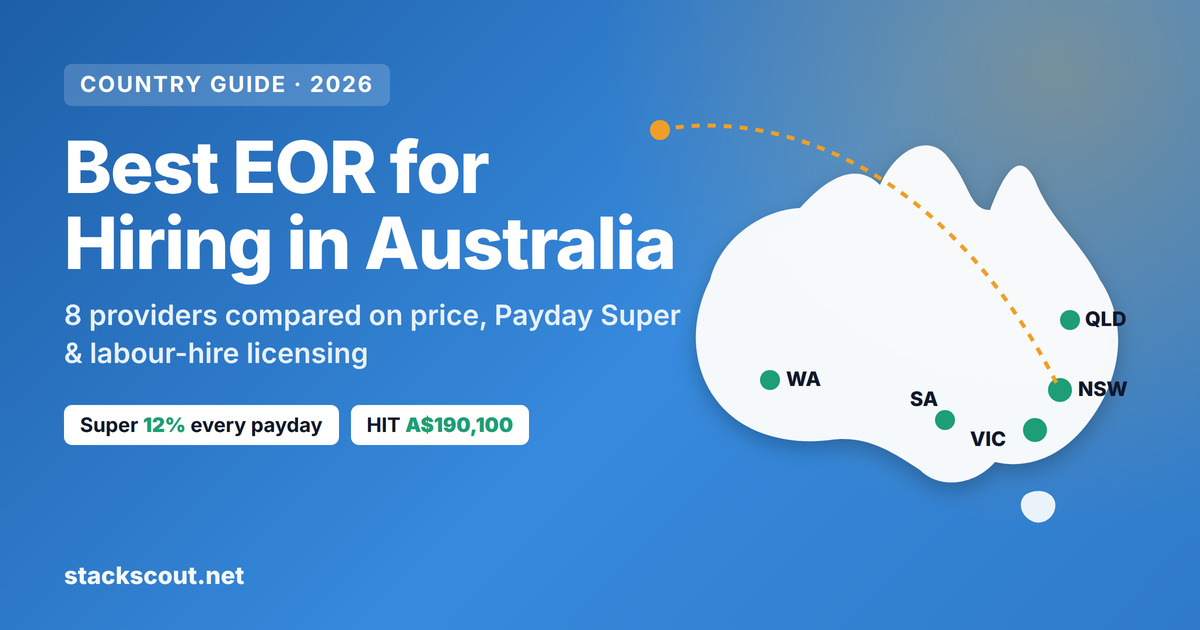
For most companies making their first one to ten Australian hires, Remote is our default pick: it publishes an Australian-dollar price (A$1,069 per employee per month as of September 2026), so your budget doesn't move with the exchange rate, and it runs employment through its own entities. Deel ($599/month, month-to-month) suits teams that also pay Australian contractors. Multiplier (from $400/month) is the value pick for companies expanding across Asia-Pacific.
In 2026 the price gap between providers matters less than two local issues. First, Payday Super: since 1 July 2026, super must be paid every payday, not every quarter. Second, labour-hire licensing: in Victoria, Queensland and South Australia, the EOR supplying your worker generally needs a state licence. Check both before comparing prices.
Australia looks like an easy market to hire in. The work culture is English-speaking, the legal system is common law, and payroll is digitized through Single Touch Payroll. Most "best EOR in Australia" lists treat it that way: ten logos, a price column, and a note that super is 12%.
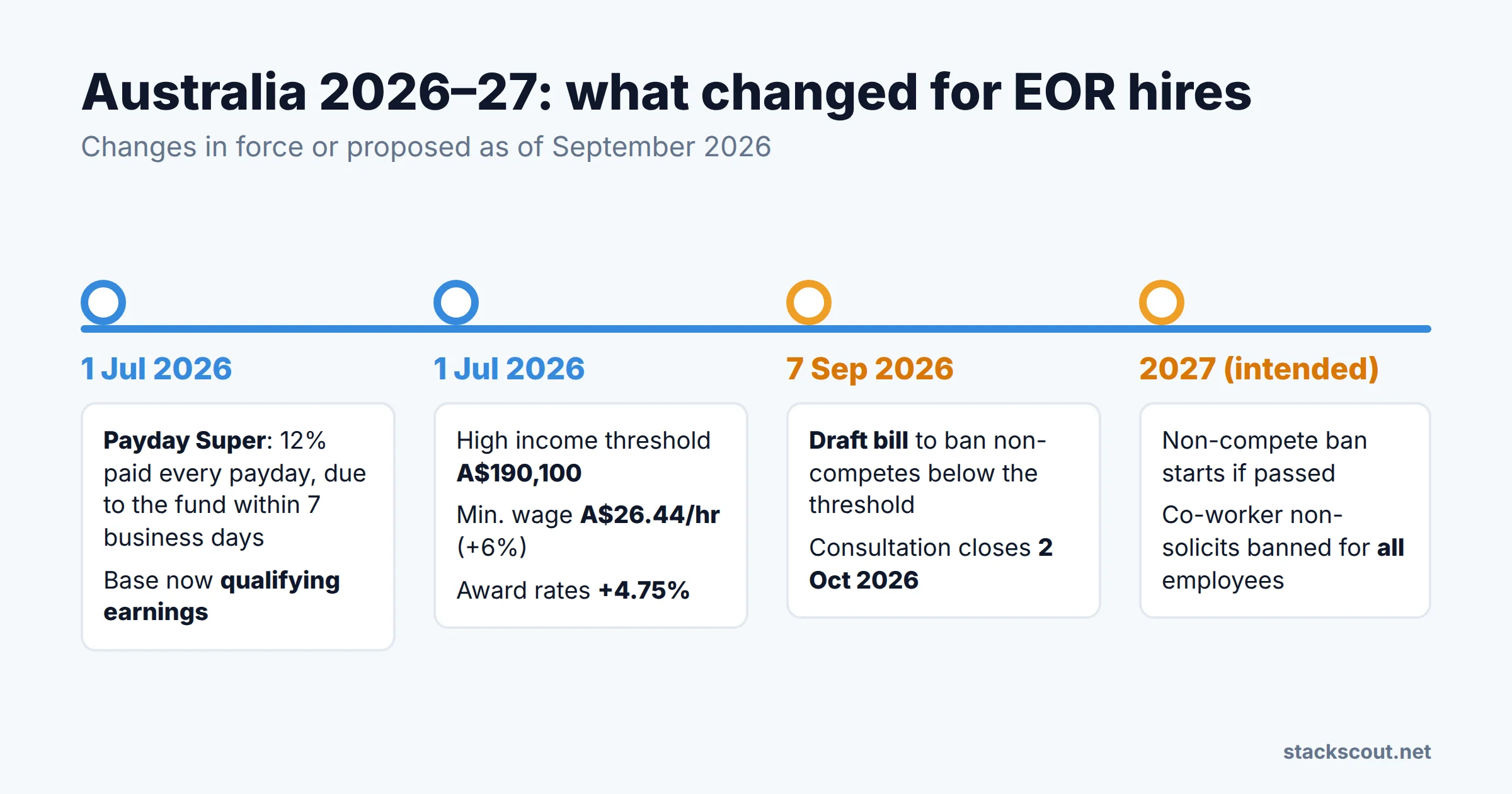
That misses what changed this year. On 1 July 2026, the super guarantee moved to a per-payday cycle with a new earnings base. The unfair-dismissal high income threshold rose to A$190,100. The minimum wage went up 6%. And in September, the federal government published draft legislation to ban non-competes for most employees. None of this makes Australia a hard market. It does mean the EOR you choose has to have its payroll engine, contract templates and state licences up to date, and it's worth checking that they do.
This guide is for founders, heads of People, and finance leads at companies without an Australian entity who want to hire full-time staff there. We compare eight EOR providers on published pricing, cover the Australia-specific checks that pricing pages leave out, and work through the real annual cost of an A$150,000 hire in Sydney. If you're still deciding whether an EOR is the right model at all, start with our EOR vs PEO explainer.
01Quick answer: our top 3 picks
Published AUD price, owned-entity model, no onboarding or setup fees. Our default for 1–10 Australian hires.
$599/month, month-to-month, plus $49 contractor seats. The easiest option if your Australian team is part-contractor.
Advertised from $400/month, with an Asia-Pacific footprint for teams adding Singapore, India or the Philippines next.
02Comparison table: 8 Australian EOR providers
Prices are the published or widely reported starting EOR fee per employee per month, in US dollars unless noted, checked in September 2026. The fee is charged on top of salary, super, payroll tax and workers' compensation. We cover those in the real-cost section.
| Provider | Starting EOR fee | Billing terms | Best for | Watch out for |
|---|---|---|---|---|
| Remote | $699 / A$1,069 | Monthly; no platform, onboarding or setup fees | Compliance-first teams, first 1–10 hires | Highest list price in USD |
| Deel | $599 | Month-to-month, no long-term commitment | Mixed employee + contractor teams | FX and add-on terms vary by contract |
| Oyster | $699 | Monthly; annual discounts on request | Distributed teams wanting guided onboarding | Annual price not published |
| Multiplier | from $400 | Flat fee; no onboarding or exit charges advertised | Cost-conscious APAC expansion | Confirm deposit and Australian entity model |
| Atlas HXM | $599 | 1–5 employee tier; volume discounts negotiated | Owned-entity model at mid-market price | Larger-team tiers not published |
| Rippling | Quote only | Reported ~$499–$599 plus platform fees | Companies already on Rippling HRIS | No published EOR price |
| Skuad | from $199 | Discounts with more hires; "may vary by location" | Budget-first hires with APAC support | Get the Australia-specific quote in writing |
| RemoFirst | from $199 | No annual contract, no minimums, no setup or termination fees | Budget-first first hire | Rate "may vary based on local country requirements" |
Two patterns stand out. The $199 providers state that their price varies by country, and Australia, with its award system, super clearing and state licensing, is a market where you should expect a quote above the advertised floor. And only Remote, among the providers we checked, publishes an Australian-dollar price. For an A$150,000 employee, a 10% move in AUD/USD changes the salary's USD cost by far more than the gap between a $599 and a $699 fee. If your finance team budgets in AUD, that matters. We compare the fee structures in more depth in our guide to flat-fee vs percentage-of-payroll EOR pricing.
03Why Australia is different in 2026: five checks before you compare prices
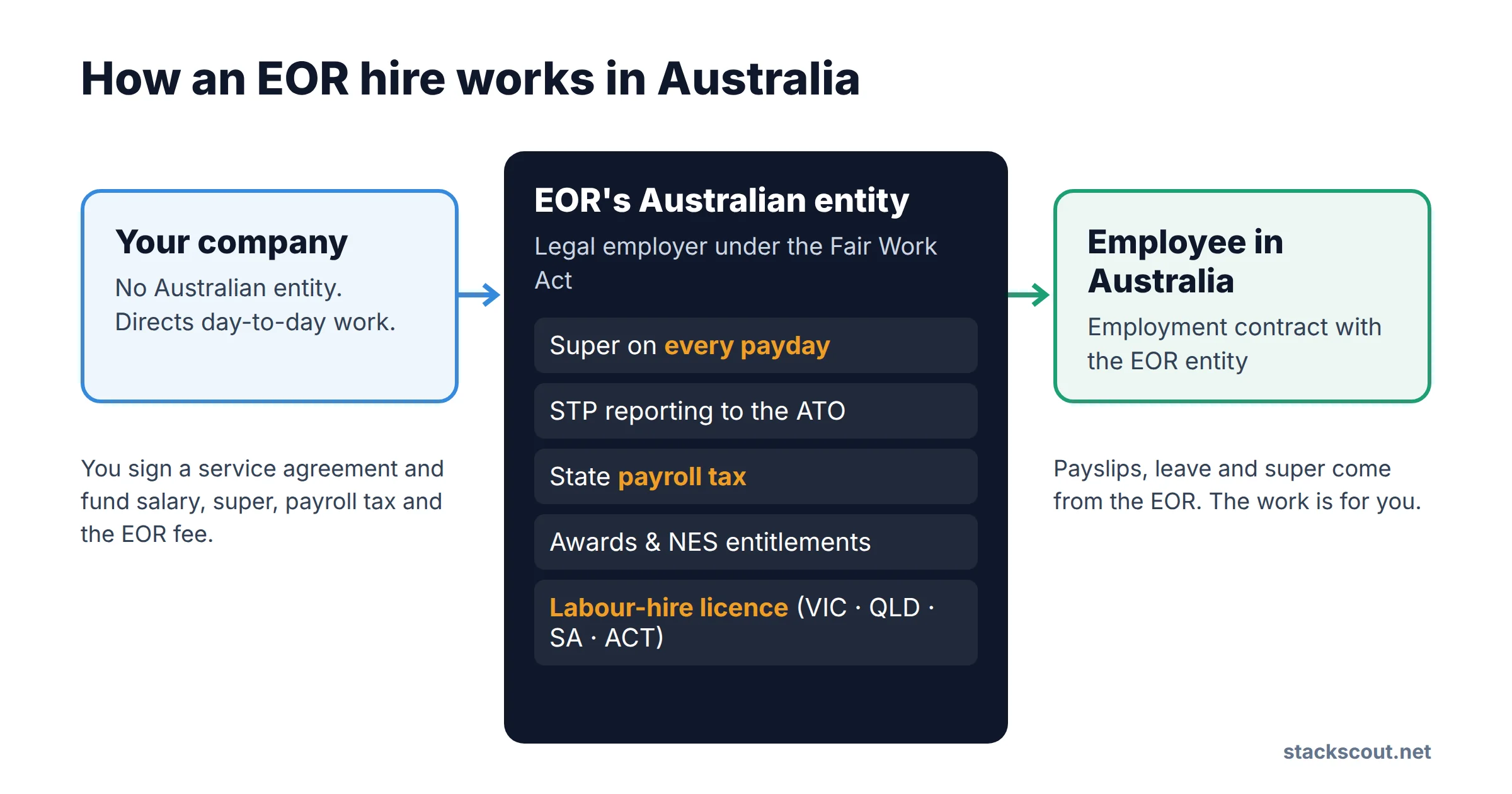
Every EOR in the table above can legally employ someone in Australia. What separates them is how well they handle five local issues, and several of these changed in the last three months.
1. Payday Super: super now leaves with every pay run
The super guarantee rate stays at 12% for 2026–27, but two things changed on 1 July 2026. Employers now pay super every payday instead of quarterly, and it must reach the employee's fund within seven business days of payday (longer for some new employees). The base also changed, from ordinary time earnings to qualifying earnings, which add all commissions and salary-sacrifice contributions. Late payment triggers the super guarantee charge, which now includes compounding interest and penalties of 25% or 50% of the charge. The ATO has said it will take a risk-based approach during the first year.
For an EOR customer, this changes cash flow. Under the old quarterly cycle, many EORs could collect your funding once a month and pay super later. Now the super has to be funded with each pay run. Ask each provider two things: when they need your funds relative to the Australian payday, and whether their payroll engine has been reporting qualifying earnings through STP since July. If a sales rep can't answer either question clearly, treat that as a warning.
2. Labour-hire licensing: the check most buyers skip
This is the part most comparison lists leave out. Victoria, Queensland and South Australia run labour-hire licensing schemes, and the ACT has its own. Victoria's Labour Hire Authority defines a provider as someone who supplies a worker to another business and is responsible for paying them. That describes an EOR arrangement. South Australia widened its scheme to all industries from 29 January 2026.
The obligation isn't only the provider's. In these states, hosts, meaning you, must only use licensed providers, and the penalties for using an unlicensed one are significant. Licences are also state-specific: a Queensland licence doesn't cover a worker based in South Australia.
If your hire lives in Victoria, Queensland, South Australia or the ACT, ask the EOR for the name of the Australian entity that will employ them and its licence number in that state. Then look it up yourself on the state register (Victoria's Labour Hire Authority has a public licence check). This takes five minutes and is the most important compliance step in this guide.
3. Payroll tax: the cost that grows when you use an EOR
Payroll tax is a state tax on wages above an annual threshold. In NSW it's 5.45% above A$1.2 million for 2026–27. Victoria, Queensland and WA have thresholds between roughly A$1 million and A$1.3 million, with rates between 4.75% and 5.5%. Super contributions count as taxable wages.
Here is the point competitors miss. If you set up your own Pty Ltd and hire three engineers in Sydney, your total wages are well under A$1.2 million, so you pay no payroll tax. Hire the same three people through an EOR and they join a large employer whose Australian wage bill is already above the threshold. Every extra dollar of wages is taxed, and you should expect payroll tax as a line item in your cost estimate. On an A$150,000 salary in NSW, that's around A$9,000 a year per hire. This is a real cost of using an EOR in Australia, and it should be part of your break-even calculation for when to set up your own entity instead of using an EOR.
4. Awards, the NES, and the A$190,100 line
Every Australian employee is covered by the National Employment Standards: four weeks of annual leave, ten days of personal/carer's leave, and minimum notice and redundancy pay. Many employees are also covered by one of the modern awards, which set minimum pay rates, overtime and allowances by industry and role. Senior tech roles are often award-free or paid well above the award, but your EOR still needs to classify each role correctly. Award rates went up 4.75% on 1 July 2026, and the national minimum wage rose 6% to A$26.44 an hour.
The number to know is the high income threshold: A$190,100 for dismissals on or after 1 July 2026. Award-free employees who earn less than this can bring an unfair-dismissal claim once they finish the minimum employment period. The compensation cap is A$95,050. Most mid-level engineers, designers and account executives earn below the threshold, so your EOR's performance-management and termination process needs to be solid, not a template email.
Termination also has fixed costs that don't depend on who you hire through. Notice starts at one week and rises to four weeks after five years of service, plus one more week for employees over 45 with at least two years' service. Redundancy pay starts at four weeks' pay after one year of service and rises to twelve weeks after ten years. Small businesses with fewer than 15 employees are exempt from redundancy pay, but your EOR is not a small business, so assume redundancy pay applies to every EOR hire.
5. Non-competes: don't copy your US template
On 7 September 2026, the government released an exposure draft of the Competition and Fair Work Legislation Amendment (Banning Unfair Non-Competes) Bill 2026. It would ban non-compete clauses for employees earning below the high income threshold (measured on base earnings) and ban co-worker non-solicitation clauses for all employees. It would also prohibit the "cascading" restraint clauses that Australian contracts have long used to improve their chances of being enforced. Consultation closes on 2 October 2026, and the reform is intended to start in 2027. It isn't law yet, and it would apply to new arrangements and existing ones amended after it takes effect.
In practice, protect your business with confidentiality terms, client non-solicits, and notice or gardening-leave provisions. Don't rely on a 12-month non-compete. Check whether your EOR's standard Australian contract already reflects the draft, and whether they'll update it when the bill passes.
Australia's right to disconnect lets employees refuse unreasonable after-hours contact, and it now applies to small businesses too. If your HQ is in the US or Europe, your Sydney hire's evening is your morning. Agree on overlap hours in writing, and don't expect after-hours responses to be the norm.
04The 8 best EOR providers for Australia, reviewed
We ranked providers on the criteria described in our methodology: published pricing, how clearly they explain their Australian employment model, how their product fits Payday Super and state licensing, and who each one suits. All prices were checked on the providers' official pricing pages in September 2026 unless noted.
1. Remote Best overall
- $699/employee/month (USD)
- A$1,069/employee/month (AUD page)
- No platform, onboarding or setup fees
Remote is the most expensive provider here in US dollars, and for many teams hiring in Australia it's still the best value. The reason is the Australian-dollar price. Remote's Australian pricing page lists EOR at A$1,069 per employee per month, and it lets customers choose from multiple billing currencies. If your budget, board reporting or local revenue is in AUD, that removes FX guesswork from a fee that runs for years.
Remote says it has no platform, onboarding or setup fees for EOR, with extra charges only for services you specifically request. It also publishes a free employee cost calculator that breaks down Australian employer costs by salary, which is useful before you make an offer. It's a good fit for compliance-sensitive buyers who want a single provider for their first handful of Australian hires. It's a weaker fit if your only requirement is the lowest monthly fee.
- Published AUD price, which removes FX exposure on the fee
- No setup or onboarding fees
- Public Australian cost calculator for offer planning
- Highest USD list price in this group
- Annual-commitment discounts not published
- Extra charges possible for non-standard requests
2. Deel Best for mixed teams
- $599/employee/month
- Contractors $49/month
- Month-to-month
Deel's EOR is $599 per employee per month, billed month-to-month with no long-term commitment. What sets it apart for Australia is the contractor side. Many companies start with an Australian contractor and convert them to an employee once the role proves itself. Deel handles both on one platform: $49 per month for a standard contractor and $325 for contractor-of-record coverage, where Deel takes on the classification risk.
That matters in Australia because the line between contractor and employee is actively enforced, and a "contractor" working full-time hours for one company under your direction looks a lot like an employee. Moving from a Deel contractor to a Deel EOR employee is simpler than switching providers at the moment of conversion. The downside is contract variability: FX terms and add-ons depend on your agreement, so get the all-in Australian quote in writing. For a head-to-head comparison, see our Deel vs Remote pricing comparison.
- Month-to-month, no lock-in
- Contractor, contractor-of-record and EOR in one platform
- $100/month below Remote and Oyster in USD
- FX and add-on terms vary by contract
- No published AUD price in our check
- Large feature set can be more than a one-hire team needs
3. Multiplier Best value for APAC
- From $400/employee/month
- Flat pricing
- No onboarding or exit charges advertised
Multiplier advertises EOR from $400 per employee per month on a flat-fee model, with no separate onboarding or offboarding charges. At that price it costs about a third less than Deel or Atlas and noticeably less than Remote or Oyster. It covers contracts, payroll, benefits, taxes and compliance, and handles offboarding.
The APAC angle is the main reason to consider it. If Australia is the first step in a regional expansion, with Singapore, India or the Philippines to follow, keeping one provider across the region simplifies payroll, invoicing and reporting. Before you sign, ask three questions: does Multiplier employ Australian staff through its own entity or a partner, which state labour-hire licences does that entity hold, and is a security deposit required?
- Lowest price among providers with a full EOR suite
- Flat fee with no onboarding or exit charges advertised
- Good fit for multi-country APAC plans
- Deposit terms not clearly published
- Confirm owned-entity vs partner model for Australia
- Pricing page not always publicly accessible
4. Oyster Guided onboarding
- $699/employee/month
- Annual discounts on request
- Contractors $29/month after 30 days
Oyster charges $699 per employee per month, the same USD price as Remote, and offers annual discounts on request (the discounted rate isn't published). Its People Partner service costs $300 an hour, which can be worth it if you have no HR lead and your first Australian hire needs help with offer structure, leave or performance issues.
Oyster is a good fit for distributed-first companies that want more hands-on help than a self-serve platform provides. For Australia specifically, confirm how it handles award classification for each role and ask for its Payday Super funding schedule. Its contractor tier ($29/month after a free 30 days) is the cheapest here if you want to trial a contractor first.
- Hands-on support options for teams without HR
- Low-cost contractor tier for trial engagements
- Annual discount available
- $699 USD list price with no published AUD option
- Annual rate only available via sales
- People Partner hours cost extra
5. Atlas HXM Owned-entity model
- $599/employee/month (1–5 employees)
- Volume discounts negotiated
- No setup or offboarding fees reported
Atlas HXM lists $599 per employee per month for teams of one to five employees, with per-employee rates falling as you grow. Discounts above that tier are negotiated rather than published. Atlas positions itself on a "direct" model, running employment through its own entities, and presents its pricing as itemized with no setup, offboarding or minimum-term fees.
The owned-entity model matters more than usual in Australia because of labour-hire licensing: it's easier to verify one licensed Australian entity than a chain of subcontracted partners. Atlas is a strong mid-market option if you expect to grow past five Australian employees and want a volume discount negotiated upfront.
- Owned-entity model with an easier licence audit trail
- Tiered pricing that falls with headcount
- No setup or offboarding fees
- Tiers above five employees not published
- Same price as Deel, with a smaller contractor offering
- Discounts depend on negotiation
6. Rippling Best path to your own Pty Ltd
- Quote only (reported ~$499–$599)
- Base platform fee on top
- Australian payroll product
Rippling doesn't publish an EOR price. Third-party reviews report roughly $499–$599 per employee per month plus Rippling's platform fees, and implementation costs can apply. We treat that range as a reported estimate, not a list price.
Rippling makes our list because of what happens later. Rippling runs its own Australian payroll product, so companies that plan to set up an Australian Pty Ltd once headcount justifies it can move employees from Rippling's EOR to their own entity's payroll without changing HR platforms. If you already use Rippling for HRIS and IT in the US, this is the lowest-friction path. If you don't, the platform fees make it an expensive way to hire one person.
- Same platform from EOR to your own Australian payroll
- Strong fit for existing Rippling customers
- HR, IT and payroll in one system
- No published EOR price
- Platform and implementation fees on top
- Overkill for a single hire
7. Skuad Budget with APAC support
- From $199/employee/month
- Discounts with more hires
- Contractors (AOR) from $99
Skuad lists EOR from $199 per employee per month, with larger discounts as you add hires and a note that pricing may vary by location and role. It also offers agent-of-record coverage for contractors from $99 per month, and it pays in more than 70 currencies.
The $199 figure is a starting price, not an Australian quote. Australia's award classification, Payday Super and state licensing are exactly the kind of "local requirements" that push the price up, so ask for the Australia number in writing before comparing it with Deel or Remote. If the quote is well below $599 and Skuad can show a licensed Australian employing entity, it can be the best value for a price-sensitive single hire.
- Lowest advertised floor price
- Dedicated account managers
- Contractor coverage from $99
- Australian price depends on the quote
- Confirm entity model and state licences
- Smaller brand footprint than the top three
8. RemoFirst Lowest commitment
- From $199/person/month
- No annual contract or minimums
- No setup, onboarding or termination fees
RemoFirst starts at $199 per person per month and states there are no setup, onboarding or termination fees, no annual contracts and no minimums. The price "may vary based on local country requirements", and it doesn't publish a separate Australian rate.
Having no termination fee matters more in Australia than in many markets, because statutory notice and redundancy costs are already significant. You don't want an EOR exit fee on top. RemoFirst suits a company testing Australia with a single hire and a limited budget. As with Skuad, get the Australian quote and the employing entity's licence details before committing.
- Low starting price
- No termination fee or minimum term
- Simple for a single test hire
- No published Australian rate
- Confirm award classification support
- Fewer advanced HR features
Also worth a quote: Globalization Partners (G-P) and Safeguard Global both employ in Australia but only quote pricing on request. They're most relevant to enterprises hiring at volume that want negotiated contracts and dedicated in-country support rather than a self-serve platform.
05What an Australian hire really costs through an EOR
The EOR fee is usually the smallest of the four main cost lines. Below is an illustrative scenario: one software engineer in Sydney on an A$150,000 base salary, employed through Remote at its published AUD price, compared with the same hire through your own Pty Ltd with fewer than seven employees.
| Base salary | A$150,000 |
| Super guarantee (12% of qualifying earnings) | A$18,000 |
| NSW payroll tax (5.45% × salary + super) | A$9,156 |
| EOR fee (A$1,069 × 12) | A$12,828 |
| Total via EOR (before workers' comp) | A$189,984 |
Three things stand out from this breakdown:
- The EOR premium is about A$22,000 a year per hire, not the A$12,828 fee alone. Payroll tax makes up about 40% of the difference, because a small Pty Ltd in NSW can employ roughly seven people at this salary level (including super) before reaching the A$1.2 million threshold.
- Your own entity isn't free. An Australian proprietary company needs at least one director who ordinarily lives in Australia, plus an accountant, payroll software, workers' comp insurance, and someone who understands awards and Payday Super. For one or two hires, that overhead can easily exceed the EOR premium.
- Leave loading and bonuses add to this. If an award applies, many include a 17.5% annual leave loading, and commissions now attract super under qualifying earnings. Model on-target earnings, not base salary.
A rule of thumb from these numbers: EOR is almost always right for your first few Australian hires. Start planning an entity once you pass five or six people or once Australia becomes a long-term market. Our PEO-to-EOR migration guide covers the mechanics of moving employees between models without disrupting payroll, and the same principles apply in reverse.
06Who should choose which
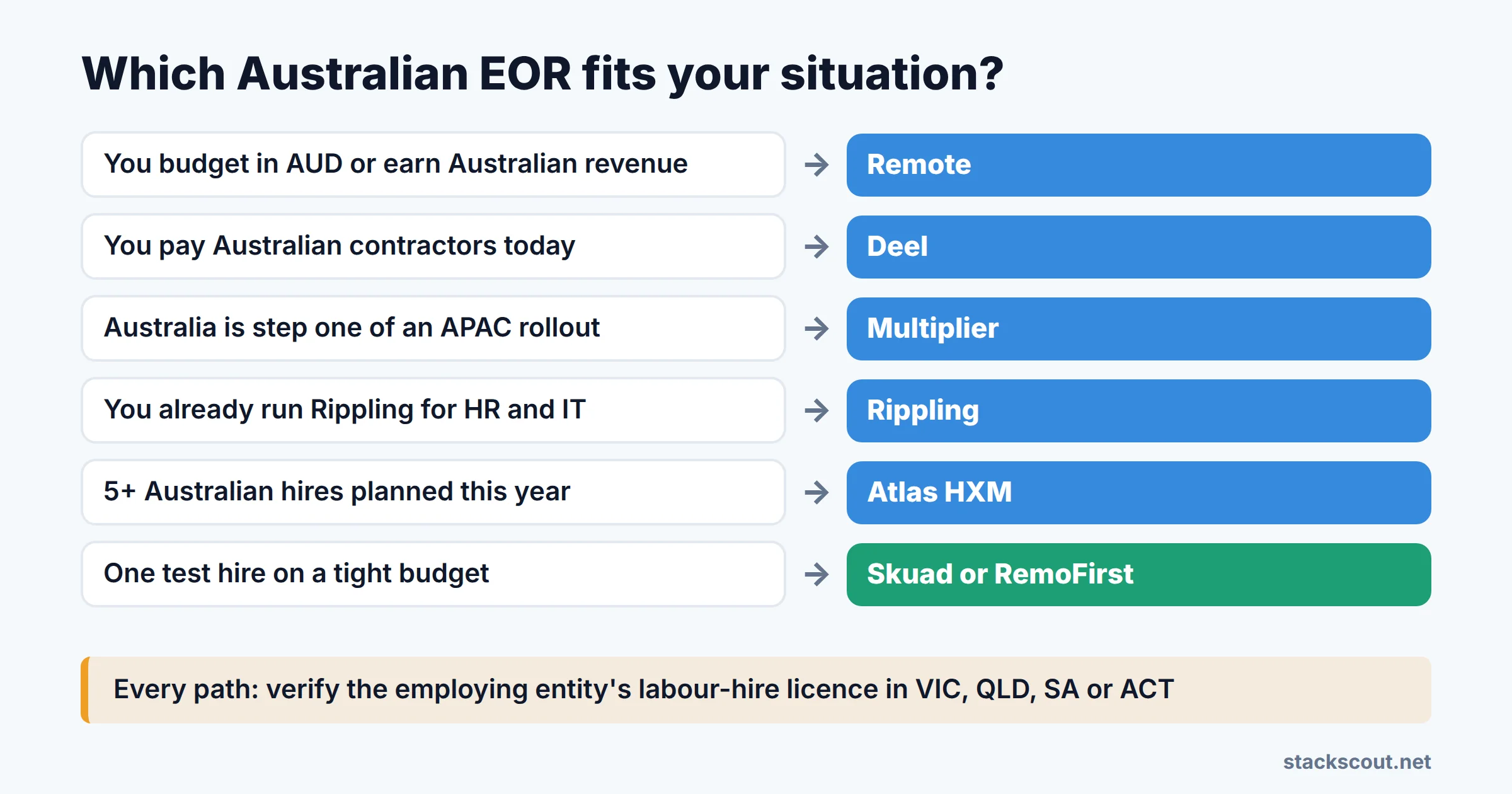
Choose Remote. The A$1,069 price removes currency risk from the fee.
Choose Deel. It's straightforward to convert contractors to employees later, and billing is month-to-month.
Choose Multiplier. It has the lowest full-suite price and regional coverage.
Choose Rippling. You get one system from EOR through to your own Australian payroll.
Choose Atlas HXM. Negotiate a volume tier upfront and benefit from the owned-entity audit trail.
Choose Skuad or RemoFirst, but only after getting the Australian quote and licence details.
Seven questions to ask every Australian EOR
For a general framework for choosing a provider, see our 7-question EOR decision framework. For Australia specifically, add these:
- Which Australian entity will employ my hire, and is it your own entity or a partner's?
- What is that entity's labour-hire licence number in my hire's state (VIC, QLD, SA or ACT)?
- When do you need funding relative to payday, now that super must be paid every payday?
- Does your cost estimate include payroll tax and workers' comp, and at what rates?
- Which modern award, if any, applies to this role, and how did you classify it?
- Does your standard contract still include a non-compete, and will you update it when the ban passes?
- Can you sponsor a visa if the candidate needs one? (Many EORs won't. Confirm before you make an offer.)
Beyond Australia, the same issues show up in other markets under different names. Compare our guides to the best EOR for hiring in the UK, Canada and Mexico, and if you're expanding further across the region, our guide to choosing an EOR for hiring in Singapore is coming next. Using an EOR also doesn't remove every tax risk. Our guide to EOR mistakes that create permanent establishment risk explains when an Australian employee's activities can still create a taxable presence for your company.
07FAQ
Is using an employer of record legal in Australia?
How much does an EOR cost in Australia in 2026?
What is Payday Super and does it affect EOR customers?
Can I put a non-compete in an Australian employee's contract?
When should I set up my own Australian entity instead of using an EOR?
08How we chose
We started with the providers that appear most often in current "best EOR in Australia" rankings, then kept those that publish an EOR price or have a widely reported one, plus Rippling for its Australian payroll path. For each, we checked the official pricing page in September 2026 and recorded the starting fee, billing terms and stated fees. Where the official page wasn't accessible or had no price, we say so and use reported ranges. We then checked each provider against Australian requirements in force or proposed as of September 2026: Payday Super, the 2026–27 high income threshold, state labour-hire licensing, payroll tax, and the draft non-compete ban, using government and law-firm sources listed below. We did not open accounts or run payroll with these providers. Ratings reflect published information and the questions a buyer should ask, not hands-on testing. Nothing in this article is legal or tax advice. Confirm details with the provider and an Australian employment lawyer before hiring.
09Sources
- Fair Work Ombudsman — Minimum wages increase from 1 July 2026: fairwork.gov.au
- Fair Work Commission — High income threshold: fwc.gov.au
- Addisons — Employment changes from 1 July 2026 (high income threshold, super, minimum wage): addisons.com
- Australian Taxation Office — About Payday Super: ato.gov.au
- Fair Work Ombudsman — Payday Super: new rules starting 1 July 2026: fairwork.gov.au
- Fair Work Ombudsman — Notice of termination and redundancy pay fact sheet: fairwork.gov.au
- Revenue NSW — Payroll tax thresholds and rates: revenue.nsw.gov.au
- Labour Hire Authority (Victoria) — Labour hire providers: labourhireauthority.vic.gov.au
- Baker McKenzie — Australia: Draft legislation takes hammer to non-competes (September 2026): bakermckenzie.com
- Remote — Pricing (USD) and Australian pricing (AUD): remote.com/pricing, remote.com/en-au/pricing
- Deel — Pricing: deel.com/pricing
- Oyster — Pricing: oysterhr.com/pricing
- Multiplier — Employer of record cost: usemultiplier.com
- Atlas HXM — Employer of Record pricing: atlashxm.com/pricing
- Skuad — Pricing: skuad.io/pricing
- RemoFirst — Pricing: remofirst.com/pricing

Technology consultant with 10+ years in the Japanese tech industry. Specializing in SaaS evaluation, workflow automation, and B2B tool integration.