Deel Alternatives for Global Hiring (2026): 7 Competitors Compared by Why You're Leaving
Most "Deel alternatives" lists rank the same ten vendors by the same generic criteria. That's not very useful if you already run people on Deel, because you're not picking a first EOR. You're leaving one, and the reason you want out should decide where you go. A team leaving over per-seat cost needs a different vendor from a team leaving because it wants its payroll, HRIS, and device management in one system.
This guide compares seven alternatives — Remote, Oyster, Multiplier, Globalization Partners (G-P), Rippling, Papaya Global, and RemoFirst — against Deel's current list prices. Every price was checked on the vendor's own site in late September 2026 unless we say otherwise. We also cover a step most comparisons skip: in most countries, moving an employee to a new EOR means a new employment contract, and that creates costs of its own.
TL;DR
If you want Deel's breadth with a more compliance-first model, Remote is our default recommendation. It employs people through its own entities, doesn't take deposits outside rare high-risk cases, and publishes a flat $699/employee/month EOR price. If cost drove the decision, Multiplier is the most credible full-featured cut: $499/month billed monthly, or $459 on an annual contract. For enterprise coverage in unusual markets, G-P covers 180+ countries starting at $599. Whatever you pick, get a written plan for re-contracting each employee before you give Deel notice. The switch is a termination and re-hire, not a data export.
01Why teams look for a Deel alternative in 2026
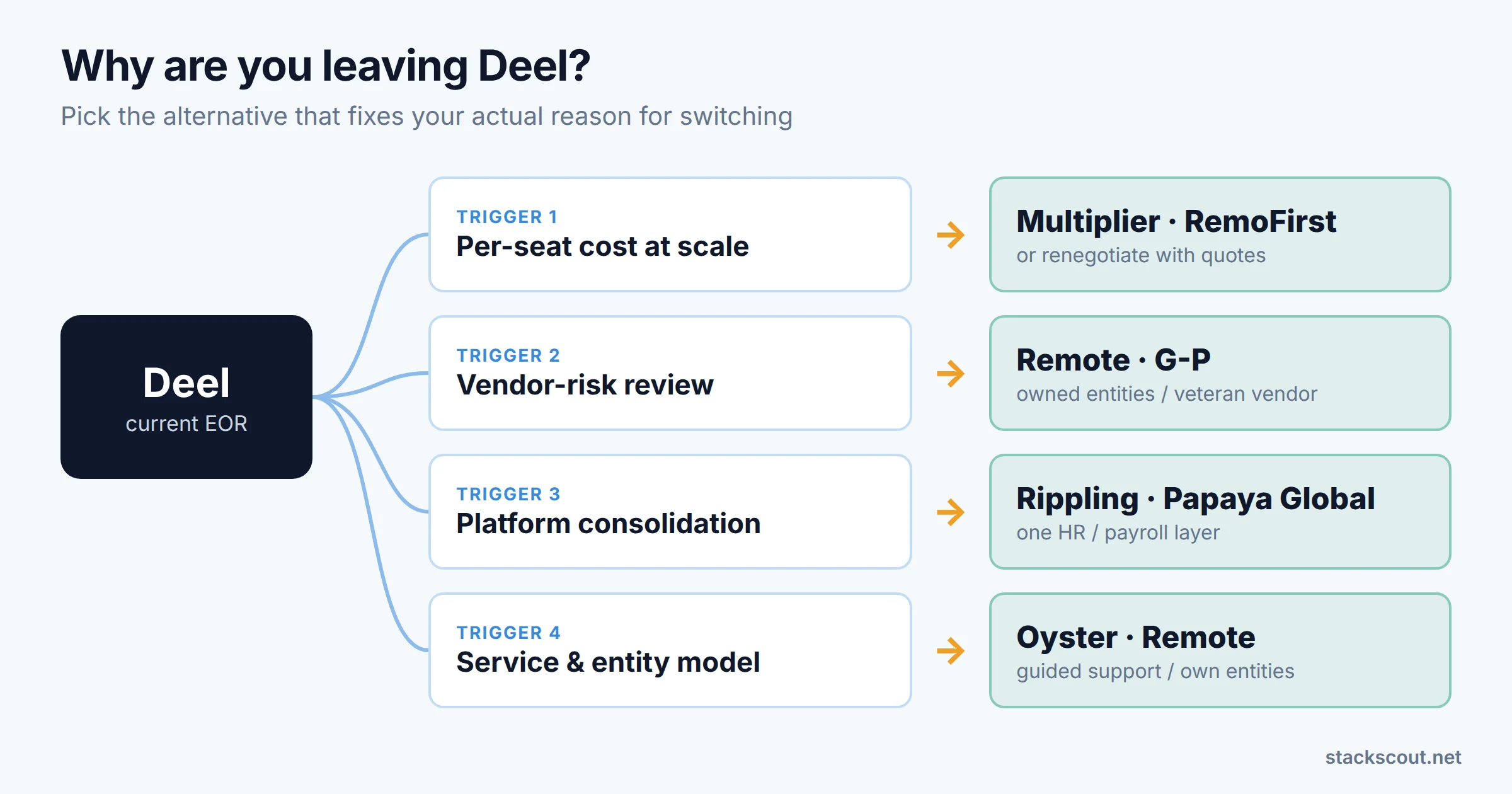
Deel is still the largest name in the category. It now lists EOR coverage in 130+ countries on its pricing page and says it operates owned entities in 100+ of them. Pure feature gaps are rarely why buyers leave. Based on our research into competitor migration guides, review sites, and this year's news, four triggers come up again and again:
Per-seat cost at scale
Deel's EOR is $599/employee/month, billed month-to-month. At 20+ employees, that fee is the biggest line item you can actually negotiate.
Vendor-risk review
Rippling's corporate-espionage lawsuit against Deel is still in active litigation. Procurement teams increasingly ask about it at renewal.
Platform consolidation
Some companies want EOR inside the same system as US payroll, HRIS, and IT, so they don't have to run a second HR tool.
Service & entity model
Buyers want to know who actually employs their people in a given country, and who answers when payroll breaks.
A factual note on the Rippling v. Deel case
Rippling sued Deel in March 2025. It alleges that Deel paid a Rippling payroll-compliance employee to pass along confidential information. In early 2026, a federal judge allowed Rippling's civil RICO and trade-secret claims to proceed. Deel filed counterclaims in April 2026. On September 26, 2026, Bloomberg reported that the judge had rejected Deel's bid to strike a central witness's testimony, sent Deel's most serious counterclaims to arbitration, and dismissed some of Deel's false-advertising claims while letting others proceed. No trial date has been reported.
These are allegations, not findings, and nothing in the case so far concerns how Deel handles customers' payroll. Still, if your vendor-risk policy flags active litigation against a critical supplier's executives, that's a legitimate reason to re-bid. Keep one conflict of interest in mind: Rippling, one of the alternatives below, is the plaintiff.
02Quick comparison: Deel vs. 7 alternatives
Every EOR figure below is a platform fee per employee per month. It sits on top of gross salary, employer social contributions, and benefits, and those are what dominate your real cost. As of September 2026:
| Provider | EOR list price | Billing / deposit | EOR coverage | Contractors | Best fit when leaving Deel for… |
|---|---|---|---|---|---|
| Deel (baseline) | $599 | Month-to-month; EOR deposit refunded after termination | 130+ countries | $49; CoR $325 | — |
| Remote | $699 | No routine deposits; no EOR setup fees | 90+ countries | $29; Plus $99; CoR from $325 | Compliance-first model |
| Oyster | $699 | Annual discounts available; startup credit up to $1,200 | 120+ countries | Free 30 days, then $29 | Guided, hands-on support |
| Multiplier | $499 monthly / $459 annual (Core) | Adjusted pricing in some countries | 150+ countries | $40 (annual) | Lower per-seat cost |
| G-P | From $599 | Volume discounts; proposal-based | 180+ countries | From $39 | Enterprise reach |
| Rippling | Quote only | Base platform + modules | Quote-dependent | Module-based | One HR/IT/payroll system |
| Papaya Global | Quote only | Quote-based; deposits reported | Custom scope | Quote-based | Payroll-heavy, multi-entity |
| RemoFirst | From $199 | "May vary" by country; no hidden fees stated | 185+ countries | Free to manage; $25 to pay | Budget-first early hires |
Prices come from each vendor's public pricing page, checked September 2026. Rippling and Papaya Global don't publish an EOR rate we could verify, so the table shows them as quote-only instead of repeating third-party estimates. "Coverage" is each vendor's own claim, and it can mix owned entities with local partners.
The spread between the cheapest and most expensive published fee is about $500 per employee per month. That's real money at 30 employees, but it's small next to a German or French employer contribution rate. Before you switch for price alone, read our explainer on flat-fee vs. percentage-of-payroll EOR pricing across 8 countries. It shows where the platform fee actually matters. For a line-by-line breakdown of Deel against its closest rival, see our Deel vs. Remote total-cost comparison.
03The 7 Deel alternatives, reviewed
1Remote Best overall switch
Remote is the closest like-for-like replacement for Deel, and it's the one we'd shortlist first for most teams. Its pricing page lists EOR at $699 per employee per month. Global payroll for your own entities costs $29/employee/month, and contractor management costs $29/contractor/month. There's also a $99 "Contractor Management Plus" tier with indemnity up to $100,000 per contractor, and Contractor of Record starts at $325.
The practical difference for a team leaving Deel is the cash-flow policy. Remote says deposits are reserved for "rare, high risk circumstances." It charges no platform, onboarding, or setup fees for EOR, and it can bill in 12 currencies, including USD, EUR, GBP, and JPY. If a Deel deposit has been sitting on your balance sheet, moving to Remote usually means you won't post a new one.
The trade-off is coverage. Remote's EOR list is 90+ countries, against Deel's 130+. Check every country on your roadmap before you commit, not just today's headcount. Remote runs EOR through its own entities, which is the main reason compliance-led buyers pick it. See our Deel vs. Remote analysis for Germany for how that plays out in a strict labor-law market.
- No routine deposits
- No EOR setup or onboarding fees
- Cheaper contractor seats than Deel ($29 vs. $49)
- Bills in 12 currencies
- $100/month above Deel's EOR list price
- Narrower EOR country list
- Annual-prepay pricing isn't on the public page
2Multiplier Best for lowering cost
Multiplier restructured its pricing into Core, Growth, and Enterprise tiers. As of September 2026, Core EOR costs $499 per employee per month billed monthly, or $459 on an annual contract. Growth costs $559 monthly or $519 annually and adds more HR tooling. Enterprise is custom. Contractors cost $40/month on annual billing, and global payroll for your own entities starts at $20/employee/month. Many older comparison posts still quote a flat "$400." That was the earlier rate, so don't budget on it.
Even at the new prices, Multiplier's Core tier is $100–$140 per employee per month under Deel's list price. At 25 employees, that's roughly $30,000–$42,000 a year in platform fees. Multiplier says a minority of countries carry adjusted pricing, so ask for the rate in each of your markets in writing. It covers 150+ countries for full-time employees and has particular depth in Asia-Pacific. We made it our value pick in our Australia EOR comparison for the same reason.
- Lowest full-featured published EOR fee in this group
- Monthly and annual prices are both public
- Cheap standalone payroll if you later open entities
- Country-specific surcharges in some markets
- The best rate needs an annual commitment
- Smaller brand for enterprise procurement reviews
3Globalization Partners (G-P) Best for enterprise reach
G-P is one of the category's original EOR providers. On price it looks the most like Deel: EOR starts at USD 599 per employee per month, with volume discounts on a proposal basis. Its contractor product starts at $39/contractor/month and covers 190+ countries. G-P says it can go below $39 for customers paying more than about ten contractors a month.
The reason to pick G-P over Deel is reach, not savings. Its 180+ country EOR footprint is the widest among the providers here that publish a price. It suits enterprises with long-tail hiring in markets that smaller platforms reach only through partners. Expect a more traditional, sales-led buying process than you'd get with Deel's self-serve onboarding.
- Widest published EOR footprint here
- Mature enterprise procurement and legal processes
- Volume discounts available
- No savings at list price versus Deel
- Final pricing needs a proposal
- Less self-serve than Deel or Remote
4Oyster Best for guided support
Oyster lists EOR at $699 per employee per month, with annual seat-based billing at reduced rates available through sales. It doesn't charge for setup, onboarding, or offboarding. Its contractor product is free for 30 days and then costs $29/contractor/month. Startups can save up to $1,200 on EOR fees, and it offers discounts for nonprofits and B-corps.
Where Oyster differs is support. If you're leaving Deel because tickets went unanswered, Oyster's People Partner service gives you project-based senior HR advisory for $300 an hour. That's expensive for routine work, but it's worth it if you have no in-house HR lead and a tricky hire in a new market. Keep currency in mind: Oyster bills in USD, EUR, GBP, or CAD, and it charges conversion fees if you pay in a different currency from your contract.
- Hands-on advisory available
- Cheap contractor tier with a free trial
- Startup and nonprofit discounts
- $699 list price, $100 over Deel
- Annual rates only via sales
- FX fees on currency mismatches
5Rippling Best for one HR + IT + payroll system
Rippling doesn't publish an EOR price. You buy a base platform and add modules such as payroll, benefits, IT, and EOR, so the quote depends on what you bundle. Third-party pricing trackers put its EOR in roughly the same band as Deel's, plus platform fees. Treat that as a starting point for negotiation, not a quote.
Rippling makes sense when trigger #3 is your reason for leaving. You already run (or want to run) US payroll, HRIS, and device management in Rippling, and you'd rather manage your international employees in the same employee record. It makes less sense if you mainly hire contractors, or if you need a price you can check without a sales call. It's also Deel's opponent in active litigation. That doesn't disqualify it, but its sales material about Deel isn't neutral. We cover the product fit in more depth in Deel vs. Rippling for global engineering teams.
- EOR, payroll, HRIS, and IT on one employee record
- Strong if you're already a US Rippling customer
- Path to running your own entities later
- No public EOR price
- Module stacking makes total cost opaque
- Litigation party: discount its claims about Deel
6Papaya Global Best for payroll-heavy, multi-entity teams
Papaya Global started as a payroll and payments company, and that's still where it's strongest. It suits companies that already run some of their own entities and use EOR only to fill gaps. For them, the value is one payroll layer across both. Papaya's pricing page blocked our automated check, and third-party trackers disagree about its EOR rate. We'd rather not print a number we couldn't verify, so treat it as quote-based. Several review sites also report a security deposit. Ask about deposit terms up front if you're leaving Deel partly to free up cash.
If you're weighing Papaya specifically against your current setup, our head-to-head Deel vs. Papaya Global comparison goes through the fit question in detail.
- Strong global payroll and payments layer
- Good fit for a mix of owned entities and EOR
- Mature finance and reporting tooling
- No verifiable public EOR price
- Deposits reported
- More setup than a self-serve EOR
7RemoFirst Best for budget-first early hires
RemoFirst publishes the lowest starting price in this group: EOR from $199 per employee per month across 185+ countries. Contractor management is free, and it costs $25/contractor/month if you also want RemoFirst to process payments. Its RemoHealth add-on for international health insurance starts at $55 per person per month.
Read the FAQ before you budget, though. RemoFirst says the fee "may vary based on local country requirements." It also says it works with vetted in-country partners in many markets, so it doesn't use its own entity everywhere. For a first hire or two in a lower-cost market, that's often a sensible trade. For senior hires in a strict market, weigh it against the partner-entity questions in the next section.
- Lowest published starting fee
- Free contractor management
- Wide claimed coverage
- Price varies by country; $199 is a floor
- Partner-delivered in many markets
- Less enterprise tooling
04Owned entity vs. partner: the question behind every price
Every provider here, Deel included, advertises a country count. That number mixes two very different setups. In one, the provider's own local subsidiary is the legal employer. In the other, a local partner company employs your person and the platform sits on top. Deel says it owns entities in 100+ countries. Remote positions its whole EOR on owned entities. RemoFirst openly uses in-country partners in many markets.
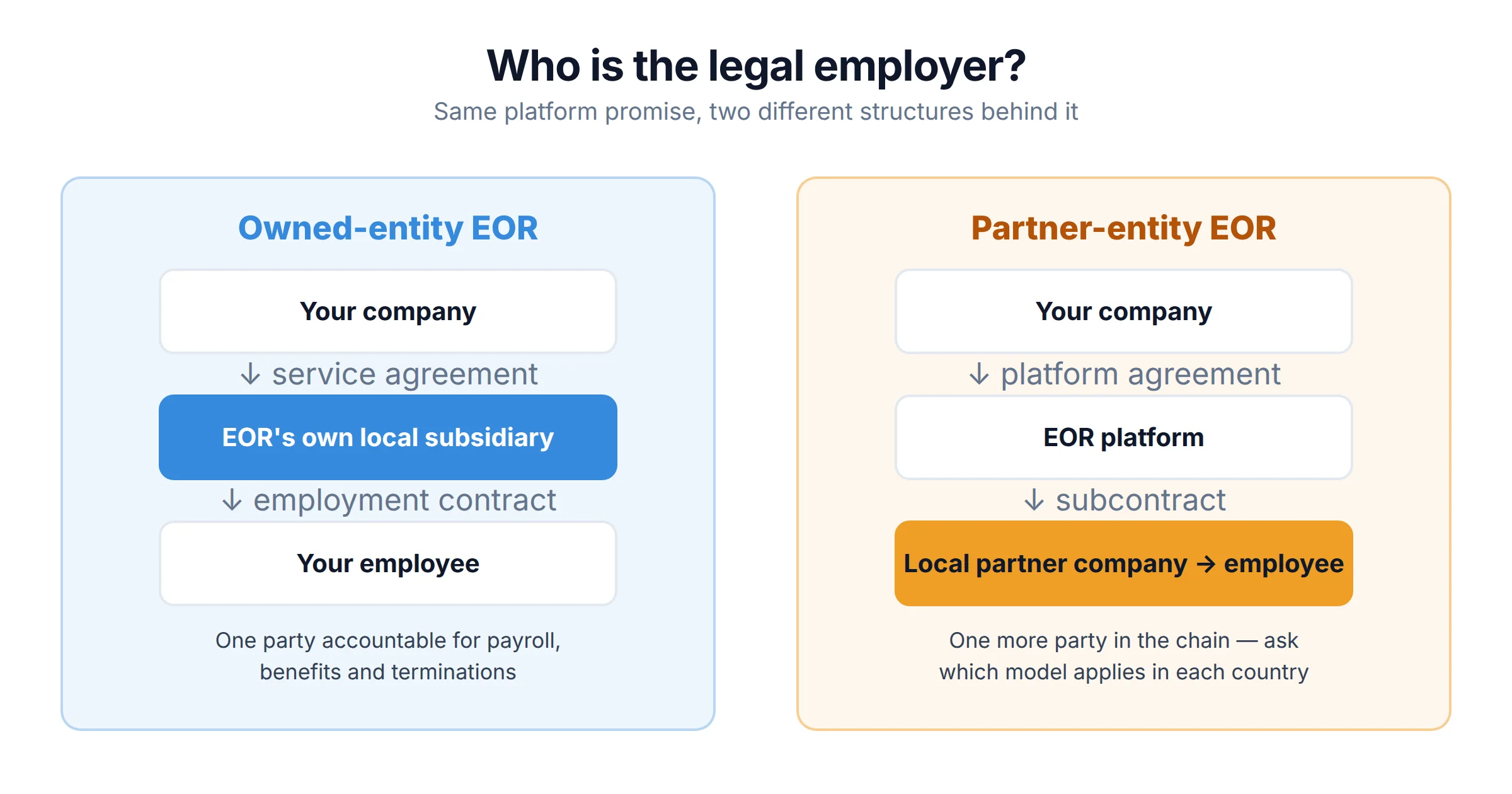
Partner delivery isn't automatically worse. Some local partners have run payroll in their market for decades. But it adds one more party to payroll errors, benefits changes, and terminations. It can also mean a different contract template from the one you negotiated. When you ask for quotes, ask each vendor one question per country: "Who is the legal employer on my employee's contract?" Our guide to EOR mistakes that create permanent-establishment risk explains why that answer matters beyond payroll.
05What switching away from Deel actually involves
Buyers underestimate this step more than any other. An EOR is the legal employer, so you can't move an employee to another EOR like you'd move a SaaS subscription. Deel's own help center says that when an employer moves someone into Deel from a third-party EOR, "this is not a transfer in the traditional sense – it is a new employment": the worker resigns from the old EOR and signs a new agreement. The same applies in reverse.
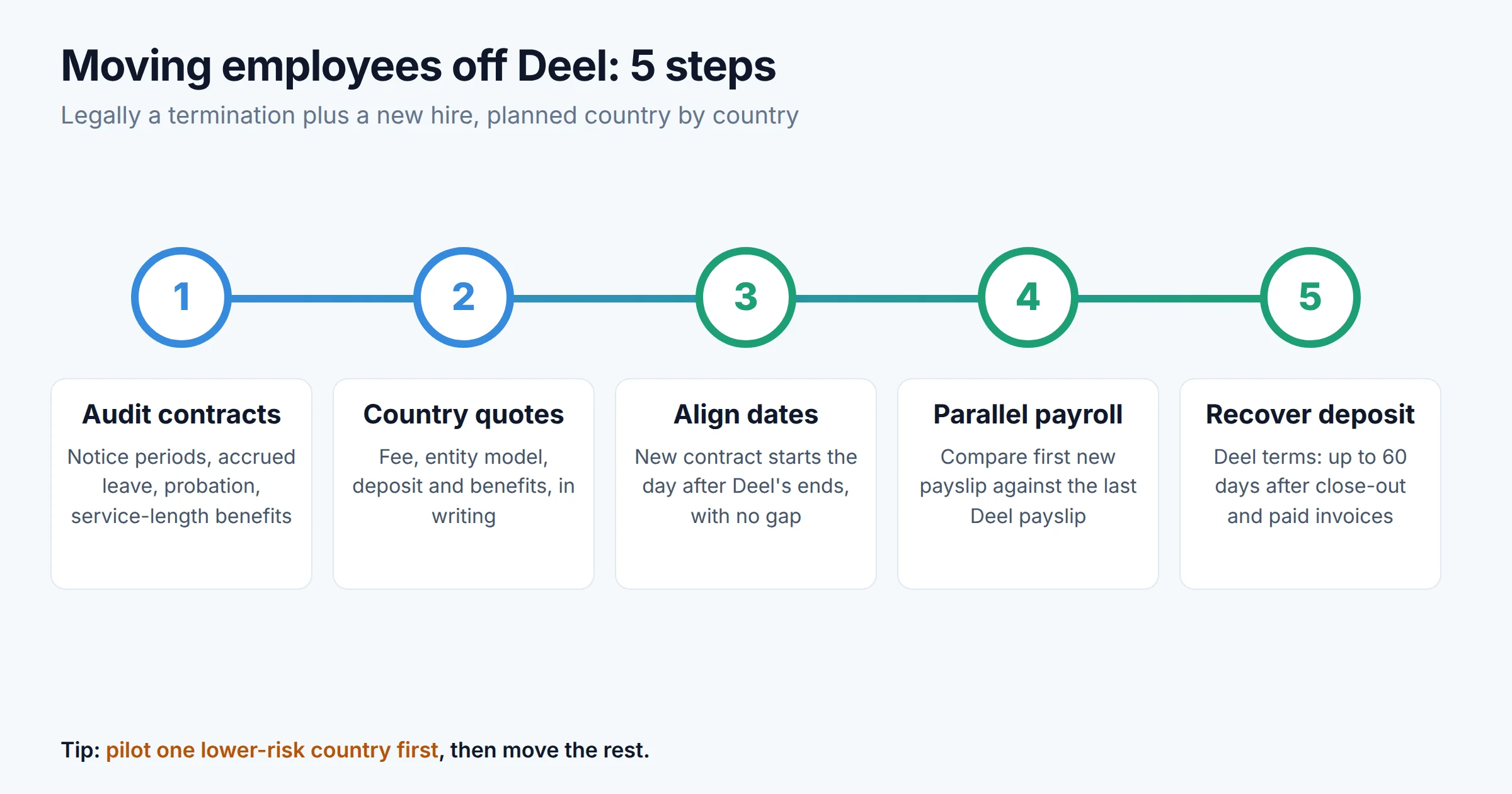
- Audit every contract before giving notice. List each employee's country, notice period, accrued leave, probation status, and any service-length benefits. In some countries, ending the Deel employment can trigger an accrued-leave payout or severance. Recognizing prior service in the new contract is something you negotiate. It isn't automatic.
- Get quotes country by country, in writing. Ask each finalist for the per-country EOR fee, the entity model (owned or partner), deposit requirements, and how its benefits compare with what employees have today. Headline prices hide country surcharges.
- Line up end and start dates. The new EOR's contract should start the day after the Deel contract ends, so there's no gap in salary, health cover, or pension contributions. Tell employees early. For them, this is a new employer name on their payslip.
- Plan at least one parallel payroll cycle. Check the new provider's first payslip against the last Deel payslip line by line (gross, employer contributions, and allowances) before you close out.
- Recover the deposit. Deel's help center says EOR deposits are refunded minus any outstanding dues, and that its terms give up to 60 days after termination is complete and all invoices are paid. Build that lag into your cash plan.
Timing tip: Don't switch everyone on one date. Move one lower-risk country first, check the full cycle from payroll to payslip to benefits, then move the rest. If you're also bringing some employees onto your own entity, our EOR vs. foreign-entity break-even analysis helps you decide which countries to take in-house instead of re-contracting through another EOR.
06Who should choose which
That last row is a real option. Switching EORs means re-contracting every employee, so a competing quote you use to renegotiate can be worth more than the move itself. If you're still unsure what matters most, our 7-question framework for choosing an EOR provider walks through the full evaluation.
07Frequently asked questions
What is the cheapest Deel alternative for EOR in 2026?
Is Remote better than Deel?
Can I move employees from Deel to another EOR without a gap?
How long does it take to get a Deel EOR deposit back?
Does the Rippling lawsuit affect Deel customers?
08How we chose and evaluated
We started from the providers that the top-ranking "Deel alternatives" pages mention most often. We then narrowed them to seven that each fit a distinct reason for leaving Deel, so this isn't a single ranked list of interchangeable vendors. We compared them on four things: published EOR price, checked on each vendor's own pricing page between September 27 and 29, 2026; billing and deposit policy; claimed EOR country coverage and entity model; and contractor pricing, since most Deel customers run both employees and contractors. If we couldn't load a vendor's official price or it doesn't publish one (Rippling and Papaya Global), we list it as quote-only rather than repeating unverified third-party estimates. We didn't run payroll through these platforms. This comparison is based on our research, not hands-on testing, and it wasn't paid for by any vendor.
Sources
- Deel — Pricing: deel.com/pricing
- Deel — "Deel's owned infrastructure and entities are now available in over 100 countries" (Sept 2025): deel.com/blog
- Deel Help Center — Transferring employees into Deel EOR: help.letsdeel.com
- Deel Help Center — About EOR deposit refunds: help.letsdeel.com
- Remote — Pricing: remote.com/pricing
- Oyster — Pricing: oysterhr.com/pricing
- Multiplier — Pricing: usemultiplier.com/pricing
- G-P — Pricing: globalization-partners.com/pricing
- RemoFirst — Pricing: remofirst.com/pricing
- Bloomberg — "Deel Dealt New Setbacks in Rippling Case Over Alleged Spying" (Sept 26, 2026): bloomberg.com
- TechCrunch — Rippling/Deel corporate spying case coverage (Jan 2026): techcrunch.com

Technology consultant with 10+ years in the Japanese tech industry. Specializing in SaaS evaluation, workflow automation, and B2B tool integration.