Gusto Pricing 2026: Every Plan, Every Add-On Fee, and What a US Startup Really Pays After the October 1 Repackaging
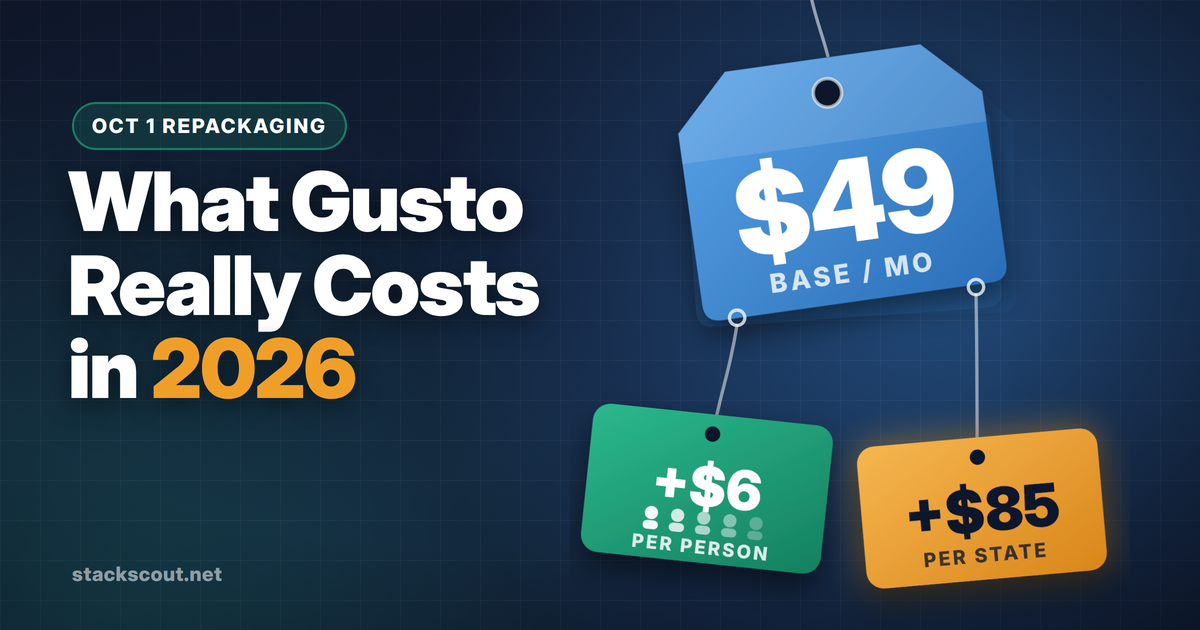
As of October 24, 2026, Gusto charges Simple $49/mo + $6 per person, Plus $80/mo + $12 per person, and Premium $180/mo + $22 per person. The list prices did not change on October 1, but what you get for them did. If you sign up now, you can't buy the Contractor-only plan anymore, Premium no longer includes broker integration ($6 per employee), and Business Compliance is an $85 per state per month add-on on Simple and Plus with a 12-month commitment. For most single-state teams under about 15 people, Simple is the cheapest option. If you'd add both time tracking and next-day pay to Simple anyway, Plus costs about the same and does more. Premium only pays for itself once you'd otherwise buy Business Compliance in several states. A 25-person team needs about five states before that happens.
Most Gusto pricing pages you'll find still describe the pre-October lineup. They list a Contractor-only plan you can no longer buy and Premium features new customers now pay extra for. This guide uses only Gusto's own pricing page and Help Center. It covers what a US startup's HR or ops lead actually gets billed: the base fee, the per-person fee, the add-ons that are easy to miss, and the per-payment fees that show up on the invoice. It finishes with three worked monthly bills and a published-price comparison with Rippling.
If you're still deciding between platforms, our stage-by-stage Rippling vs Gusto comparison for startups is the better place to start. This article is about what Gusto costs once it's on your shortlist.
01 · The price card
Gusto plans and prices (October 2026)
Source: gusto.com/product/pricing, checked October 24, 2026. A fourth plan, Solo, is listed under the "Pay Myself" tab for owner-only businesses at $49/mo + $6 per person. Gusto sells all plans month to month: "No contracts. Free account setup. Switch or cancel anytime."
The fee has two parts. A flat monthly base fee pays for the account. A per-person fee is charged for each active, onboarded employee, according to Gusto's Help Center, "regardless of how often they are paid." Three billing rules affect the total more than people expect:
- US contractors count as people, but only in months you pay them. Gusto bills them at your plan's per-person rate (so $6, $12 or $22), "only… in months when you've paid them." A contractor you pay quarterly costs you four months a year, not twelve.
- Non-US contractors have no monthly fee. You pay a fee on each payment instead (see section 04).
- Plan changes are prorated in one direction only. Upgrades take effect immediately. Downgrades take effect "at the beginning of the next billing period (the first of the month)." If you upgrade to Premium to get through one complicated month, you pay for the whole month.
What each plan costs as you grow
The formula is just base + (per-person fee × people), but the gap between plans grows quickly with headcount. At 25 people, Plus costs 1.9× as much as Simple, and Premium costs 3.7× as much.
| People billed | Simple | Plus | Premium | Premium − Plus |
|---|---|---|---|---|
| 5 | $79 | $140 | $290 | $150 |
| 10 | $109 | $200 | $400 | $200 |
| 25 | $199 | $380 | $730 | $350 |
| 50 | $349 | $680 | $1,280 | $600 |
| 100 | $649 | $1,280 | $2,380 | $1,100 |
| 25 people, per year | $2,388 | $4,560 | $8,760 | $4,200 |
Monthly list price before add-ons, using the public rate card as of October 24, 2026. Gusto doesn't publish an annual-prepay discount on its pricing page.
The last column is the one to remember. Premium costs $100 + $10 per person more than Plus every month. Every Premium decision later in this guide comes down to whether the things Premium includes would cost you more than that if you bought them on Plus.
02 · What changed
The October 1, 2026 repackaging: same prices, different bundles
On September 21, 2026, Gusto announced plan changes taking effect October 1. Its Help Center summary is short: "No price change. What you pay today is what you'll pay after October 1," and "No plan name change." It also says, though: "Anyone signing up on or after October 1, 2026 will get the new packaging." So two companies on the same plan at the same price can now have different features, depending on when they signed up.
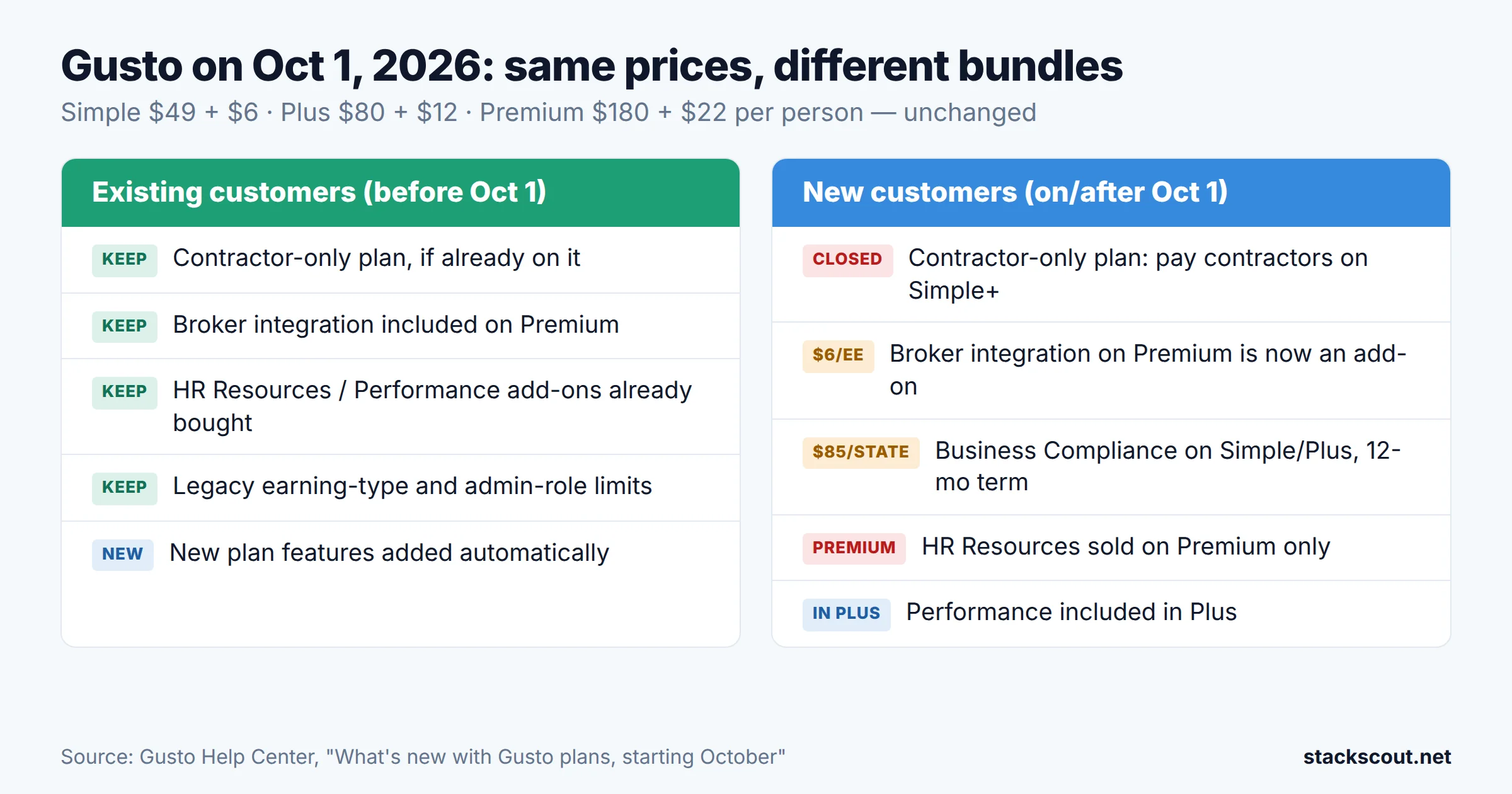
| Item | Existing customers (before Oct 1) | New customers (on/after Oct 1) |
|---|---|---|
| Contractor-only plan | Keep it; nothing changes | Closed. Pay contractors from Simple, Plus or Premium |
| Broker integration on Premium | Stays included at no cost | Paid add-on, $6 per employee/month |
| Gusto Business Compliance | Included on Premium. New add-on on Simple and Plus at $85 per state/month, 12-month term per state | |
| HR Resources | Current add-on holders keep it (moving from Mineral to Gusto's own suite) | No longer sold on Simple or Plus; Premium only |
| Performance | Current add-on holders keep it | No longer an add-on; included in Plus |
| Custom earning types (accounts opened from Aug 31) | Legacy limits kept | Simple: 1. Plus and Premium: unlimited |
| Custom admin roles (accounts opened from Aug 31) | Legacy limits kept | Simple: standard roles only. Plus: 1 custom role. Premium: multiple |
Every plan also got new features at no extra cost. Simple and Solo gained expenses and reimbursements, time off requests with accrual tracking, and new-hire check-ins. Plus gained time-off policy customization (tenure-based accruals, unpaid leave) and contractor invoice upload. Premium gained the built-in HR Resources suite, Business Compliance, same-day and instant pay at no extra cost (subject to eligibility), labor cost allocation, and a named Premium Account Partner (previously called a Dedicated Service Advisor).
What this means if you're buying now: two of the cost assumptions that most 2026 comparison sites still repeat are now wrong for new accounts. One is that a 1099-only company can use the Contractor-only plan; it now needs Simple at $49 + $6 per contractor paid. The other is that Premium includes broker integration; new customers now pay $6 per eligible employee for it. If a sales rep quotes you "legacy" features, ask for them in writing on your order. Gusto's Help Center says the old entitlements stay with accounts that existed before October 1.
The admin-role limit deserves a note too. A new Simple account can only use Gusto's standard admin roles. A seed-stage company that wants its outsourced bookkeeper to see payroll reports without being able to change bank details has to move to Plus (one custom role) or Premium (several). This change only shows up as a row in the comparison table, but for a finance or ops lead it may be the most practical reason to choose Plus over Simple.
03 · The add-on price book
Every Gusto add-on with a published price
Gusto publishes prices for most of its add-ons on the pricing page and in the Help Center. All of them are listed below in one place, grouped by how they're billed. That matters for budgeting, because a monthly add-on and a per-payroll fee affect your bill very differently.
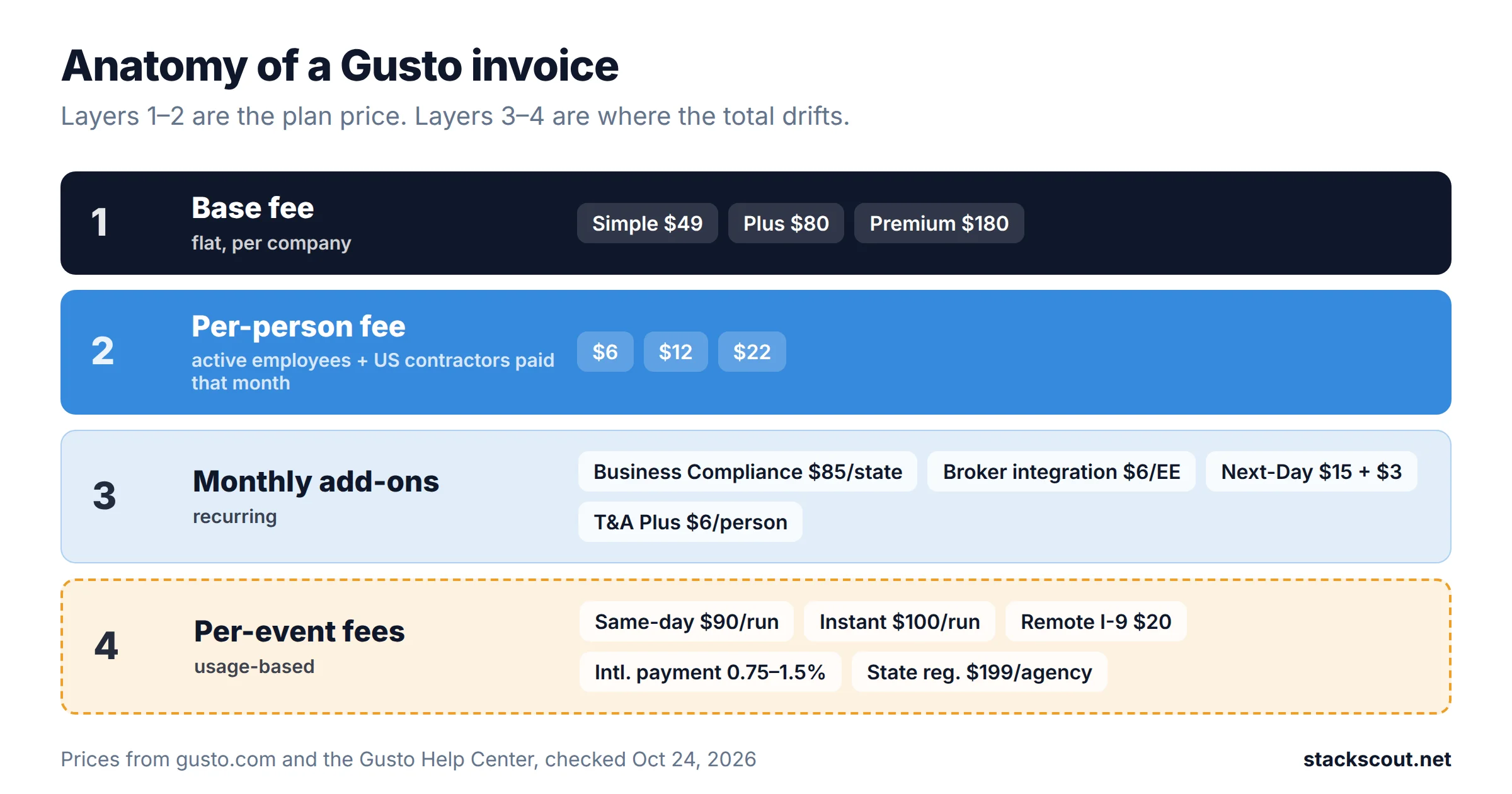
Monthly recurring add-ons
| Add-on | Price | Simple | Plus | Premium |
|---|---|---|---|---|
| Gusto Business Compliance (registered agent, annual reports, mail monitoring, compliance alerts) | $85/state/mo, 12-month term | Add-on | Add-on | Included |
| Health insurance broker integration (keep your own broker) | $6/eligible employee/mo | Add-on | Add-on | Add-on (new) |
| Next-Day pay | $15/mo + $3/person | Add-on | Included | Included |
| Time & Attendance Plus (time tracking, scheduling, projects) | $6/person/mo after free trial | Add-on | Included | Included |
| Priority Support | $30/mo + $3/person | Add-on | Add-on | Premium Account Support |
| Gusto Money Plus | $19/mo | Add-on | Add-on | Add-on |
| Workers' compensation (pay-as-you-go, via NEXT Insurance) | From $14/mo | Add-on | Add-on | Add-on |
| Gusto HR Partners (fractional HR) | Quote only | No | If eligible | If eligible |
Per-event and one-time fees
| Fee | Price | Where it applies |
|---|---|---|
| Same-day pay | $90 per payroll | Simple, Plus (included on Premium; eligibility applies) |
| Instant pay | $100 per payroll | Simple, Plus (included on Premium; eligibility applies) |
| Remote I-9 verification | $20 per submission | Simple, Plus (included on Premium) |
| E-Verify | $5 per submission, on top of the $20 Remote I-9 | Simple, Plus (included on Premium) |
| State tax registration (payroll tax accounts) | $199 per state agency, one-time | All plans. Gusto says most states need 1–2 agencies, so $199–$398 per state; PFML or local agencies add $199 each |
| Certificate of good standing | $99 each | Business Compliance customers, plus state filing fees at cost |
| State account closure (payroll accounts + SOS withdrawal) | $549 per state | Business Compliance customers, plus state filing fees at cost |
| R&D tax credits | 15% of identified credits | All plans; Gusto says discounts are available on Premium |
Tax-advantaged benefits
Gusto charges a single $200 annual service charge that covers all four account types, plus per-participant fees: HSA $2.50/participant/month with no minimum, and $4/participant/month with a $20 monthly minimum each for health FSAs, dependent care FSAs and commuter benefits. A 10-person company that offers an FSA to three participants pays the $20 minimum, not $12. Health insurance through Gusto's own brokerage has no Gusto administration fee ("Pay only for premiums"), and the 401(k) price "varies by 401(k) integration."
The fee people most often expect but won't see: extra payroll runs. Every plan includes unlimited payrolls, and Gusto's FAQ says it will "never charge you extra for things like off-cycle payrolls." The per-payroll charges are only the speed upgrades: same-day ($90) and instant ($100) on Simple and Plus.
04 · Contractors
What contractors cost on Gusto now that Contractor-only is gone
Before October 1, a 1099-only company could pay contractors on the Contractor-only plan, listed at $35/mo (often promoted at $0) plus $6 per person. New customers can't buy that plan anymore. Gusto's Help Center says "Contractor management isn't going away… If you need to pay contractors, you can do so directly within each plan." For a company with no W-2 staff, the cheapest current option is Simple, and Solo if the owner is the only W-2 employee.
US contractors
They're billed at your plan's per-person fee, but only in months you pay them. Ten contractors paid every month on Simple cost $49 + $60 = $109/month. If only four of them invoice in a given month, that month's bill is $73.
Non-US contractors
There's no monthly per-contractor fee. Instead, each payment has one fee, which depends on how the contractor gets paid. Gusto's Help Center lists:
| How the contractor is paid | What you pay per payment |
|---|---|
| To a US bank account | $5 |
| To a bank account in their country, in USD | 0.75%–1.5% of the payment, minimum $15, maximum $100 (minimum $18 for Ukraine, Taiwan and Turkey) |
| Converted to local currency | The fee is built into the exchange rate Gusto shows you. Gusto says rates include "fees (some shown, some hidden), and any markups" |
| Failed debit from your company bank account (from November 2, 2026) | $100, at most once per calendar day |
Run the numbers on a real payment. A $5,000 monthly invoice paid in USD to a local bank costs between $37.50 and $75 per payment. Over a year that's $450–$900 per contractor, which is more than many teams pay per W-2 employee on Simple. The $100 cap means the percentage fee stops growing above about $6,667 (at 1.5%) to $13,333 (at 0.75%) per payment. Paying a senior contractor monthly instead of twice a month keeps you at one fee instead of two. Gusto also requires at least one US employee (or a US contractor, on legacy contractor-only plans) set up before you can pay anyone abroad.
The new $100 debit-failure fee is easy to miss in the help article. It applies when Gusto can't pull the money from your account by 4:00 pm PT on the debit date, not when a payment to the contractor bounces. For a startup that keeps a small operating account and moves cash in just before payroll, a single late transfer now costs $100. If you're comparing per-payment costs with Wise, Payoneer, Deel or bank wires, our guide to how to pay international contractors and what each payment rail really costs covers each option. If a long-term contractor is turning into a full-time hire, see how to convert a contractor to an employee through an EOR.
05 · Worked bills
Three realistic monthly Gusto bills
List prices don't tell you much until you apply them to an actual headcount. Each scenario below uses only the published prices above. Usage-based items (same-day pay, I-9s, international payments) are shown as ranges or assumptions you can change. Health premiums and 401(k) costs are excluded because they depend on your carrier and provider, not on Gusto.
Scenario A — Seed stage, one state, 8 employees + 2 contractors
This team has 8 W-2 employees, all in California, and two US contractors who are both paid this month. It wants hourly time tracking and next-day direct deposit.
What to take from this: If you want both time tracking and next-day pay, Simple loses its price advantage. If you only want one of them, Simple is still $43–$52 a month cheaper. If you want neither, it's about $90 cheaper. For most seed-stage teams the decision comes down to which add-ons you'd actually use, not the list price.
Scenario B — Series A, 25 employees across 3 states, 4 international contractors
This company has 25 W-2 employees in three states, Gusto as its health broker, and four contractors abroad paid $5,000 each per month in USD to local bank accounts. It's comparing Plus with Business Compliance against Premium.
What to take from this: In this scenario, Premium is close to the Plus total. One same-day payroll per month, or a hiring month with five Remote I-9s, makes up most of the $95 difference. If you already pay a registered agent elsewhere and don't need Business Compliance, Plus costs $380 against Premium's $730, and Plus is clearly the better buy.
Scenario C — 60 employees in 6 states, keeping an outside broker (new customer)
This company has 60 W-2 employees in six states and an existing benefits broker it doesn't want to replace. It signs up after October 1.
What to take from this: At 60 people, Premium costs $700 more per month than Plus before add-ons. Business Compliance in all six states saves only $510 of that, so Plus plus add-ons is cheaper. Premium is worth it here only if you'd use its per-run payment features and HR Resources often enough to cover the remaining $190. At this size, it's also worth getting a quote from an all-in-one platform (see section 07).
06 · Choosing a plan
When to move from Simple to Plus, and from Plus to Premium
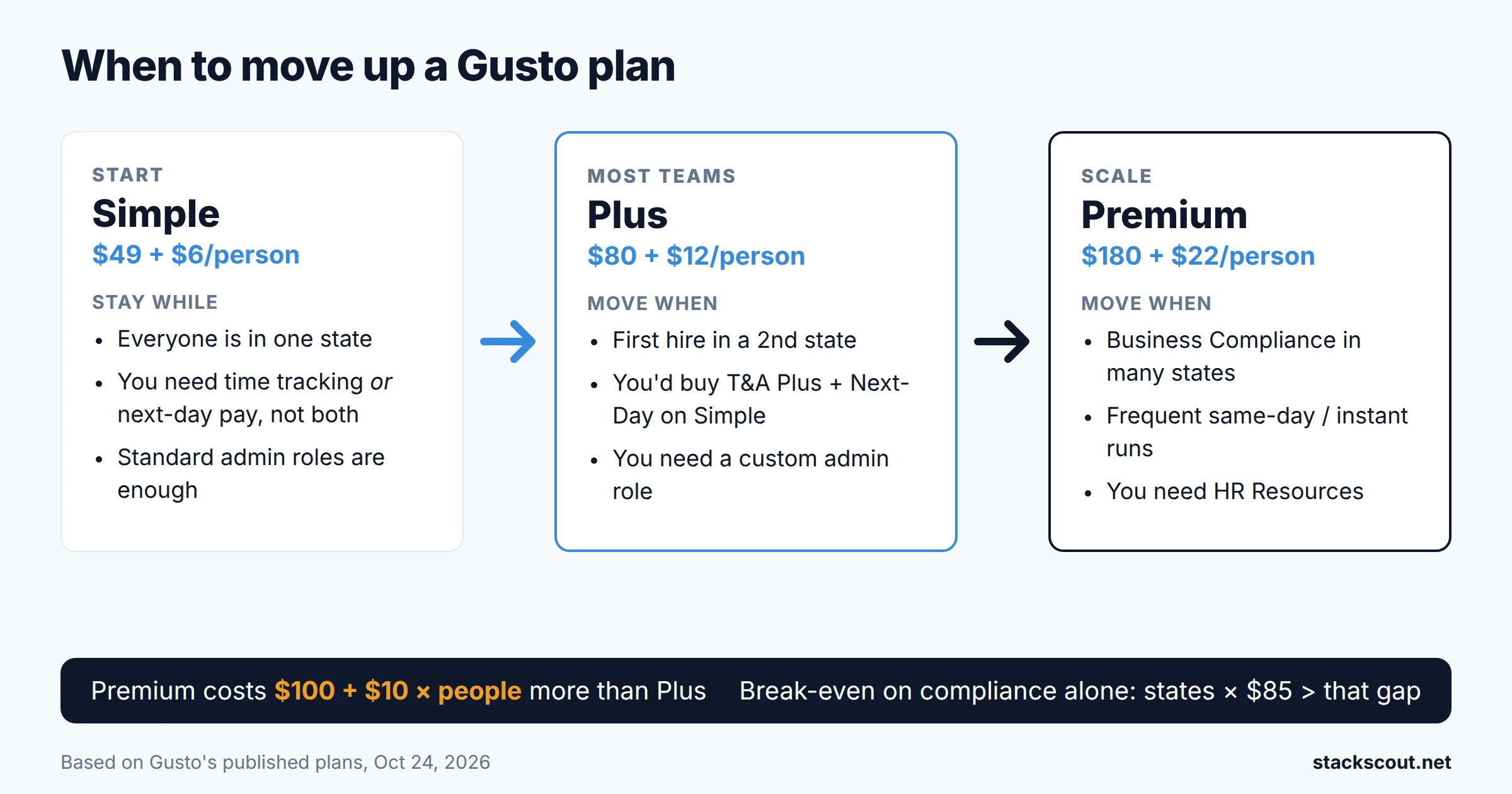
Simple → Plus: four triggers
- You hire your first employee in a second state. Gusto describes Simple as "basic payroll in one state," and Plus lists multi-state payroll as a main feature. For remote-first startups this is usually the first trigger, and it often comes before you reach ten people.
- You'd add both Time & Attendance Plus and Next-Day pay to Simple. As Scenario A shows, at that point Plus costs about the same.
- You need a custom admin role. For new accounts, Simple only offers standard roles.
- You need more than one custom earning type (for example, separate codes for on-call stipends, referral bonuses and commissions). New Simple accounts get one.
Plus → Premium: the break-even formula
Premium costs $100 + $10 × people more than Plus each month. Business Compliance is the biggest item it includes that Plus customers can buy separately, at $85 per state. If Business Compliance were the only reason to upgrade, Premium becomes cheaper once:
10 people → 3+ states · 25 people → 5+ states · 50 people → 8+ states · 100 people → 13+ states
The other included items move the break-even point lower, depending on how often you'd use them:
- Same-day or instant pay: each run costs $90 or $100 on Plus. A team that runs one same-day correction payroll a month gets about $90 back from Premium.
- Remote I-9 and E-Verify: $25 per new hire on Plus. Hiring 4 people a month adds $100.
- Priority/Premium support: Priority Support on Plus costs $30 + $3 per person ($105/month at 25 people), and Premium Account Support is a level above it. If you'd buy Priority Support anyway, that cost counts toward Premium.
- HR Resources: new customers can't buy it on Plus at all, so there's no add-on price to compare. If you need an employee handbook generator and Ask-an-HR-Expert inside the payroll tool, Premium is the only way to get them on Gusto.
Going the other way, two items make Premium look worse for new customers: broker integration is now an extra $6 per employee if you keep your own broker, and Business Compliance doesn't help if your company is a sole proprietorship or partnership. Gusto says it's "not available yet for sole proprietors, general partnerships, limited partnerships, or limited liability partnerships."
Where Gusto's pricing works in your favor
- Every rate card and most add-on prices are published, so you can work out a quote yourself
- Month to month, with no contract on the plans themselves
- Unlimited payroll runs, including off-cycle, on every plan
- US contractors billed only in months they're paid
- No Gusto admin fee when Gusto is your health broker
Where it costs more than expected
- The per-person fee nearly doubles on each step up ($6 → $12 → $22)
- Business Compliance requires a 12-month commitment per state on a plan that's otherwise month to month
- New Premium customers pay $6 per employee to keep their own broker
- FX markup on local-currency contractor payments is built into the rate, not shown as a separate fee
- $100 debit-failure fee on international contractor payments from November 2, 2026
07 · Gusto vs Rippling
How Gusto's total compares with Rippling's published starting prices
Rippling is the alternative most US startups compare against. A direct comparison is hard because Rippling's pricing page shows a quote form, not prices, and Rippling's own pages describe its starting price in two ways. Both were checked on October 24, 2026:
- rippling.com/small-business: "$8 per user per month… Plus, a $40 per month base fee," described as the starting price "for payroll."
- Rippling's own payroll review: "Payroll is an add-on to the core Rippling HRIS platform. Core HRIS starts at $8 per employee per month. Domestic Payroll starts at $8 per employee per month if billed annually, or $10… if billed monthly."
Under the second reading, running payroll on Rippling costs at least $16 per employee per month on annual billing, plus the base fee. The chart below shows both readings next to Gusto's rate cards, using Rippling's $40 base in each case.
Monthly list price by headcount (USD)
Three conclusions are reasonable from published prices alone:
- For basic single-state payroll, Gusto Simple costs less than either Rippling starting point once you have five or more people. Against the $40 + $8 headline, Simple ($49 + $6) is cheaper from five people up; at 25 people it's $41 a month cheaper. Against HRIS + payroll, it's cheaper at every headcount.
- Gusto Plus and Rippling's HRIS + payroll starting point cost the same at 10 people ($200). Above that, Plus gets cheaper because its $12 per person is lower than Rippling's $16, and the $12 already includes time tracking, scheduling, next-day pay, performance reviews and multi-state payroll. Rippling quotes those modules separately.
- Rippling's real price for the same feature set is quote-only. Rippling's own HRIS review estimates "$15-25 per employee per month" for a 100-person company using HRIS, payroll, benefits administration and time and attendance. That range is similar to Gusto Plus ($12.80 per person at 100 people) and Premium ($23.80).
So the useful comparison is Gusto Plus against a written Rippling quote for the same modules, not against the $8 headline. Our Rippling pricing breakdown sorts each Rippling module price by whether it's published or only reported by third parties. If you need a co-employment model instead of payroll software, our comparison of PEOs for startups covers minimums and fees.
One more option for very small teams that already use Xero: Xero's US payroll is "powered by Gusto" and was listed at $36 + $6 per person when we checked in October. That's cheaper than Simple's $49 base, but it comes with Xero's feature set. Details are in our Xero pricing and user-limits guide.
08 · Cutting the bill
Five ways to lower a Gusto bill without changing providers
- Time your contractor payments. US contractors only count in months you pay them. Combining small quarterly invoices into one month avoids paying per-person fees in the other two.
- Pay non-US contractors monthly, in USD, at amounts where the $100 cap applies. Fewer, larger payments mean fewer minimum fees ($15 each). Larger payments also reach the $100 cap sooner.
- Only buy Business Compliance for states where you need its services. It's priced and committed per state for 12 months. If you already have a registered agent in your home state, you may only need it in the newer states.
- Plan payroll so you don't need same-day pay. Two same-day runs on Plus cost $180. Running payroll on time with AutoPilot and using the included next-day pay costs nothing extra.
- Make sure the cash is in the account before the debit date. From November 2, a failed debit on an international contractor payment costs $100.
Frequently asked questions
How much does Gusto cost per month in 2026?
Does Gusto charge per payroll run?
Can I still sign up for Gusto's Contractor-only plan?
What does Gusto charge to pay international contractors?
Does Gusto have a free trial?
Methodology
We collected every price in this article from gusto.com/product/pricing (including the plan rate cards in the page's embedded data) and from Gusto Help Center articles on the October 2026 plan changes, plan billing, Business Compliance, state tax registration and international contractor payments, all checked on October 24, 2026. Rippling figures come only from rippling.com pages. We used a third-party pricing tracker (UsagePricing) only to confirm the pre-October Contractor-only price, and we checked that against Gusto's own page. Scenario totals are arithmetic on those published list prices with the assumptions stated in each bill. They aren't quotes, and they exclude insurance premiums, 401(k) provider fees, state filing fees and sales tax. We haven't run payroll on Gusto ourselves; this is based on our research of published terms. Gusto says "features, timing and prices are subject to change," so check your order screen before you commit.
References & sources
- Gusto — Pricing, plans & fees: https://gusto.com/product/pricing
- Gusto Help Center — What's new with Gusto plans, starting October: https://support.gusto.com/article/178940181843255/whats-new-with-gusto-plans-starting-october
- Gusto Help Center — Understanding Gusto plans: https://support.gusto.com/article/178093167290313/understanding-gusto-plans
- Gusto Help Center — Add and pay non-US (international) contractors: https://support.gusto.com/article/106622337100000/add-and-pay-non-us-international-contractors
- Gusto Help Center — Let Gusto help you with state tax registration: https://support.gusto.com/article/222579327100000/let-gusto-help-you-with-state-tax-registration
- Gusto — Terms for promotional offers & discounts: https://gusto.com/legal/promotions/promotional-terms
- Rippling — Small business payroll and HR (published starting price): https://www.rippling.com/small-business
- Rippling — Rippling payroll review (HRIS + payroll module pricing): https://www.rippling.com/blog/rippling-payroll-review
- Rippling — Rippling HRIS review (per-employee estimates): https://www.rippling.com/blog/rippling-hris-review
- UsagePricing — Gusto repackages all plans for 1 October 2026: https://www.usagepricing.com/blueprint/activity/gusto-2026-09-21-october-plan-repackaging

Technology consultant with 10+ years in the Japanese tech industry. Specializing in SaaS evaluation, workflow automation, and B2B tool integration.