PCI DSS Compliance Software Comparison (2026): 22 Tools Across the 3 Layers a SaaS Actually Needs
No single product "does PCI DSS." A PCI program has three separate jobs: a compliance platform that tracks requirements and evidence, a PCI SSC-approved scanning vendor (ASV) that runs the quarterly external scans, and, if your payment page runs scripts, a script monitor for requirements 6.4.3 and 11.6.1. Your SAQ type decides which jobs you need.
Using Stripe Checkout or Elements usually puts you on SAQ A. You need an ASV scan, which starts at $185/year, and you probably don't need a $15,000 compliance platform for PCI alone. If you are a service provider heading for a Report on Compliance (ROC), Thoropass is the only one of the eight compliance platforms we checked that is listed by the PCI SSC as both a QSA company and an ASV.
Quick answer: the picks by situation
Platform, QSA assessment and ASV scanning in one company. It's the shortest vendor list for a Level 1 service provider.
Drata scopes requirements by SAQ type and shows all 280 for the ROC path. Vanta documents SAQ A, A-EP, D (merchant and service provider) and ROC. You bring your own QSA and ASV.
Quarterly ASV scans from $185/year (Clone Systems, 1 asset) or $399/year with an online SAQ and portal (SecurityMetrics).
The clearest public pricing in the script-monitoring category: free up to 2,000 payment-page views a month, then from $99/month.
Why "PCI DSS software" is really three products
Most "best PCI compliance software" lists put Vanta, Drata and a dozen GRC suites side by side, as if picking one finishes the job. It doesn't. PCI DSS v4.0.1 has requirements that a checklist tool can track but cannot carry out:
- Requirement 11.3.2 asks for external vulnerability scans at least once every three months, done "by a PCI SSC Approved Scanning Vendor (ASV)." Most compliance platforms can't produce that scan. Drata, for example, has you upload ASV results as evidence.
- Requirements 6.4.3 and 11.6.1 ask you to inventory, authorize and check the integrity of every script on the payment page, and to detect unauthorized changes to those scripts and the page's HTTP headers. None of the eight compliance platforms we reviewed documents a native feature for this.
- Requirement 11.3.1.2 requires authenticated internal vulnerability scans. It was a best practice until March 31, 2025 and is mandatory now. A scanner does this job, not a policy library.
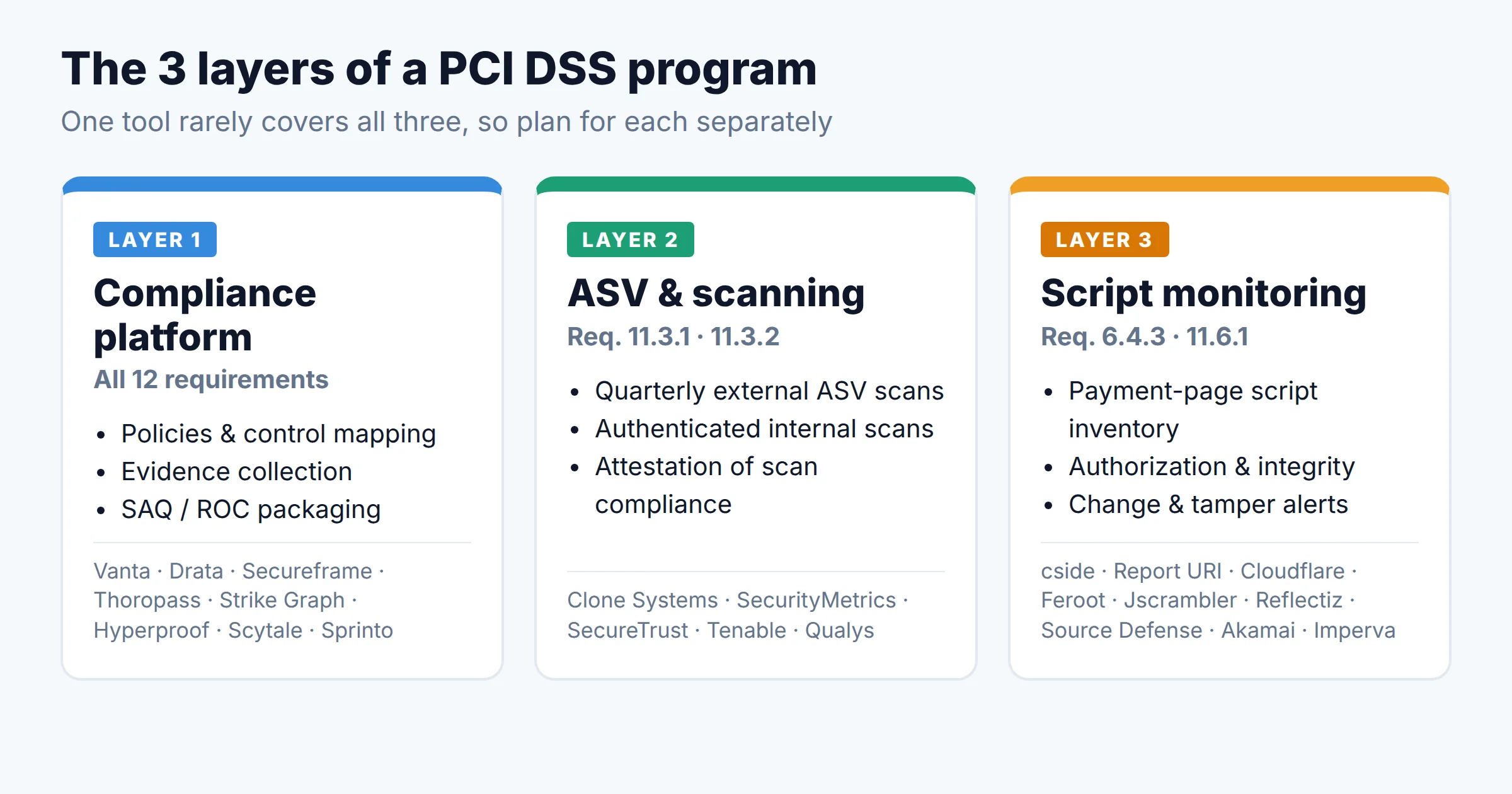
This article sorts 22 tools into those layers: 8 compliance platforms, 5 ASV and scanning vendors, and 9 payment-page script monitors. It then maps each SAQ type to the layers you need. If you are still choosing a general compliance platform for SOC 2 or ISO 27001, start with our decision framework for choosing a compliance automation platform and come back here for the PCI-specific gaps.
Step zero: your SAQ type decides your stack
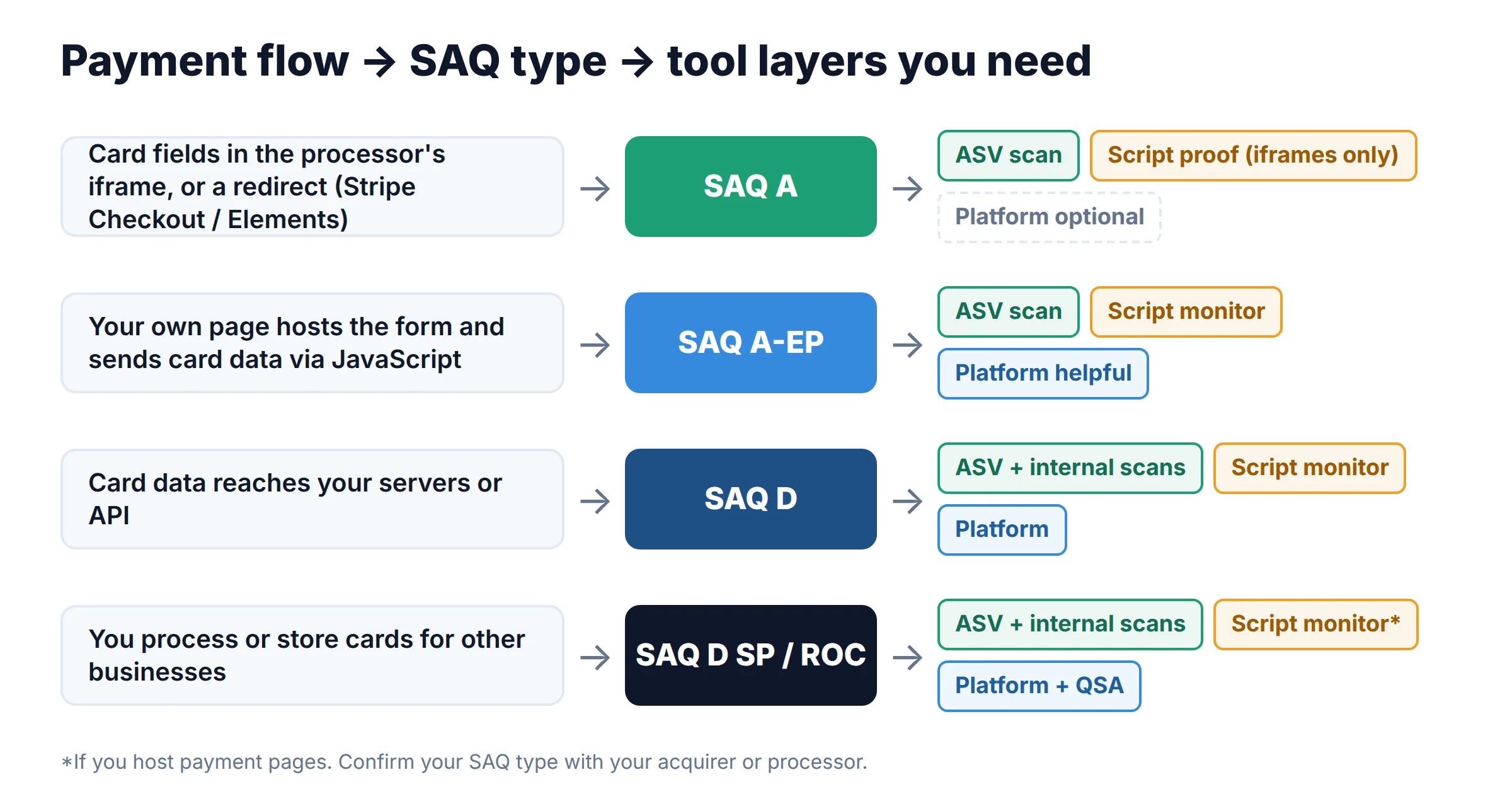
PCI DSS validation runs through one of ten Self-Assessment Questionnaires (A, A-EP, B, B-IP, C, C-VT, P2PE, SPoC, D for merchants, D for service providers) or a full ROC from a Qualified Security Assessor. For a SaaS company the useful split is how card data reaches your processor:
| Your payment flow | Typical validation | ASV scan (11.3.2) | Script controls (6.4.3 / 11.6.1) | Compliance platform |
|---|---|---|---|---|
| Stripe Checkout, or Stripe.js + Elements (card fields in a Stripe-served iframe) | SAQ A | Required | Not as requirements, but an eligibility criterion applies | Optional |
| Your own form posts card data via JavaScript (e.g., legacy Stripe.js v2 hosted on your site) | SAQ A-EP | Required | Required | Helpful |
| Card data hits your servers or API | SAQ D | Required | Required | Strongly advised |
| You process, store or transmit cards for other businesses (gateway, PayFac, platform) | SAQ D Service Provider or ROC | Required | Required if you host payment pages | Strongly advised, plus a QSA |
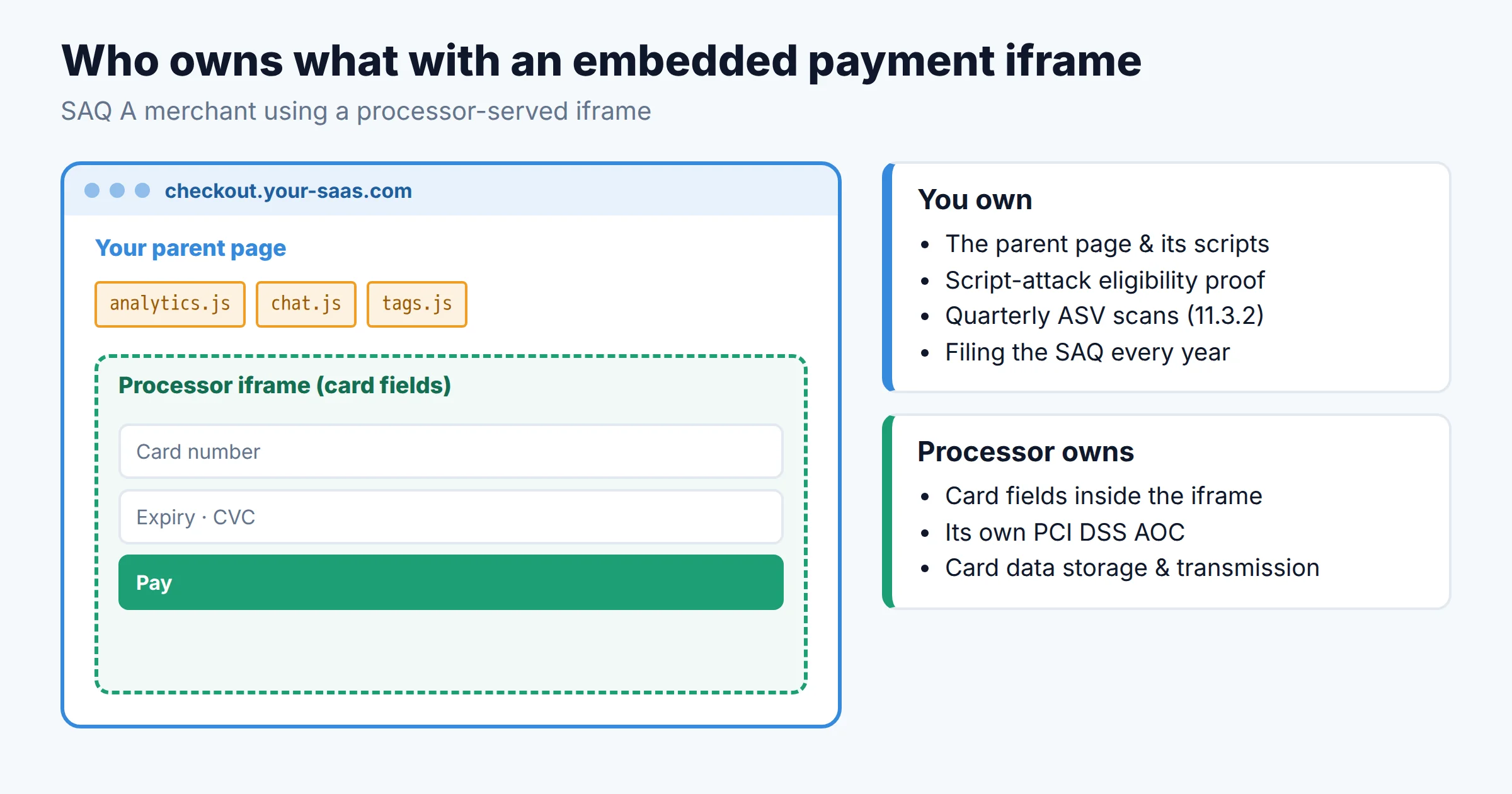
Stripe's own PCI guide puts Checkout and Elements in the SAQ A column: they "host all card data collection inputs within an iframe served from Stripe's domain (not yours)." Stripe.js v2 with a form on your own site maps to SAQ A-EP, and sending card data straight to the API maps to SAQ D. Stripe says its Dashboard detects your integration and tells you which SAQ to file.
In January 2025 the PCI SSC removed 6.4.3, 11.6.1 and 12.3.1 from SAQ A. In their place it added an eligibility criterion: the merchant must "confirm their site is not susceptible to attacks from scripts that could affect the merchant's e-commerce system(s)." The new SAQ A took effect March 31, 2025.
PCI SSC FAQ 1588 (February 28, 2025) says you can meet that criterion either with script-attack protections like those in 6.4.3 and 11.6.1, or with confirmation from your PCI-compliant service provider. It applies only to embedded payment forms (iframes), not to full redirects or fully outsourced payment pages.
So if you embed an iframe, a script monitor is often the simplest proof you have. If you redirect to a hosted checkout, you can usually skip that layer.
Two things changed in 2026. In August the PCI SSC revised FAQ 1331: if you are writing a ROC, you must now ask your acquirer or payment brand before using SAQ eligibility to decide which requirements apply. And from June 3 to July 20, 2026 it ran a request for comments on v4.0.1, opening work on "the next iteration of PCI DSS," with questions on future technology and AI. No release date for a new version has been announced. Claims you may see online about a "PCI DSS v5.0 RFC" mix up the roadmap: in the PCI SSC's 2025 annual report, the v5.0 RFC row belongs to the PTS HSM standard, not PCI DSS.
Layer 1Compliance platforms compared
These tools hold your policies, map controls to the PCI DSS requirements, collect evidence from cloud and HR systems, and package it for a QSA or for your own SAQ. All prices below are 12-month list prices from vendor AWS Marketplace listings or the vendor's site, checked October 26, 2026.
| Platform | PCI paths documented | Version documented | ASV scans | In-house QSA | Published price |
|---|---|---|---|---|---|
| Thoropass | SAQ, AOC, ROC | PCI Level 1–4 (AWS) | Own ASV | Yes (PCI SSC-listed) | Platform incl. first framework from $8,700; PCI audit is quote-only |
| Drata | SAQ scoping; 280 requirements for the ROC path | 4.0.1 (Jan 2025) | Upload as evidence | No | Foundation $15,000 (1–50 FTE); frameworks included not stated |
| Vanta | SAQ A, A-EP, D Merchant, D SP; ROC (merchant and SP) | Help center says "4.0" | Separate cost | No | Essentials $14,000 / Plus $21,500 / Professional $23,000 (1–20 employees) |
| Secureframe | SAQ A, A-EP, D; ROC | 4.0.1 only in the full PCI DSS (ROC) framework | Partner ASVs | No | $7,500 platform + $7,500 first framework (PCI DSS eligible) |
| Strike Graph | SAQ process; arranges QSA/ASV | Not stated | Partner ASVs | No | Scale $18,000 on AWS (site: from $21,500) + PCI framework $5,000 |
| Hyperproof | SAQ A framework; ROC-level controls | 4.0.1 in library | Not documented | No | Quote-only |
| Scytale | Not specified on official pages | Not stated | Not documented | No | $7,500 incl. 1 framework; extra framework (PCI DSS named) from $2,100 |
| Sprinto | SAQ and ROC; bring your own QSA | Not stated | Not documented | No | $7,500 + $2,000 first framework (PCI not among the listed options) |
The column that matters most is "PCI paths documented." A platform that maps SOC 2 controls well can still leave you working PCI out by hand. A sign of that is an SAQ framework pack that still tracks v3.2.1. Ask each vendor to show you the v4.0.1 requirement list for your SAQ type in a live demo.
Thoropass from $8,700 + audit
Thoropass appears on the PCI SSC's list of QSA companies as "Thoropass, Inc." and on the ASV list as "Thoropass PCI ASV." We checked both lists on October 26, 2026; they hold 417 QSA companies and 85 ASVs. Thoropass announced its QSA status in January 2024, added ASV scanning in May 2025, and also offers PCI Level 1 penetration testing in-house. Its AWS listing starts the platform, including the first framework, at $8,700. It publishes a SOC 2 audit price (from $5,800) but no PCI assessment price, so expect a quote for the ROC.
One structural point to weigh: when the same company prepares your evidence and assesses it, scoping arguments happen inside one firm rather than between two. That saves time. It also means you lose a second, independent opinion on your scope.
- Only platform here that is both a listed QSA company and an ASV
- ROC, AOC and SAQ under one contract
- In-house pentesting covers requirement 11.4
- PCI audit and ASV pricing are quote-only
- Platform and assessor in one firm means no second opinion on your scope
- Doesn't document payment-page script monitoring
Drata Foundation $15,000
Drata moved its PCI DSS framework to v4.0.1 in January 2025. Its help center describes the scoping model: you choose your SAQ type, and requirements outside it are marked out of scope. Choosing "None" shows all 280 requirements, which is the ROC path. The v4.0 framework mapped 260 controls. ASV results are uploaded as documents, so you still buy scans elsewhere. On AWS, the Foundation package is $15,000 a year for 1–50 FTE, and the listing doesn't say how many frameworks that includes.
- Explicit 4.0.1 update with SAQ-based scoping
- Good fit if you already run SOC 2 in Drata
- A published v4.0.1 checklist in its help center
- No native ASV; scans are uploaded evidence
- The list of SAQ types appears only in screenshots
- Framework count in the AWS package isn't stated
Vanta $14,000–$23,000
Vanta's PCI FAQ (dated October 16, 2025) lists support for SAQ A, SAQ A-EP, SAQ D Merchant and SAQ D Service Provider, plus separate ROC products for merchants and service providers. That is the broadest SAQ list any vendor here documents. Its product page is clear that Vanta doesn't replace a QSA and that ASV fees are a separate cost. Its help center still refers to "4.0" rather than "4.0.1," so confirm in the demo that the requirement list matches the current text. On AWS, Vanta lists Essentials at $14,000, Plus at $21,500 and Professional at $23,000 for 1–20 employees. The listing doesn't say which frameworks each tier includes. For a head-to-head against Drata on non-PCI criteria, see our Vanta vs Drata comparison.
- Widest documented SAQ coverage, including SAQ D for service providers
- Separate ROC products for merchants and service providers
- Clear about what it doesn't do (QSA, ASV)
- Help center names 4.0, not 4.0.1
- Highest entry price of the AWS-listed tiers
- ASV and QSA are extra line items
Secureframe $7,500 + $7,500
Secureframe markets SAQ A, A-EP and D support, a ROC path, "300+ control requirements," and a partner network of ASVs. Its help center adds two limits. First, the older SAQ D framework packs were built on v3.2.1 and don't track v4.0.1, so you need the full PCI DSS (ROC) framework to get requirements like 6.4.3 and 11.6.1. Second, Secureframe doesn't generate the SAQ PDF itself. On AWS, the platform is $7,500 and the first framework is another $7,500, and PCI DSS is one of the named first-framework choices. That makes Secureframe the platform with the clearest published price for PCI as your first framework: $15,000 a year.
- Published price that explicitly covers PCI DSS as the first framework
- Partner ASV network
- ROC framework tracks the current requirements
- SAQ D packs still on v3.2.1
- No SAQ PDF generation
- SAQ A-only merchants would pay for far more than they need
Strike Graph Scale $18,000 + PCI $5,000
Strike Graph is the one vendor that prices PCI as a line item. On AWS, PCI DSS sits in its "Tier 2" framework group at $5,000, on top of the Scale plan at $18,000. Its own pricing page shows Scale from $21,500 a year, and its entry "Certify" plan covers only Tier 1 frameworks, so PCI isn't included there. Strike Graph frames PCI around the SAQ process and arranges outside QSAs and ASVs. It doesn't state a PCI DSS version on its PCI page.
- Transparent per-framework PCI price
- Arranges outside QSAs and ASVs for you
- AWS and website Scale prices differ ($18,000 vs from $21,500)
- PCI DSS version not stated
- Entry plan excludes PCI
Hyperproof, Scytale and Sprinto
Hyperproof lists "PCI DSS v4.0.1" in its framework library. It shipped a PCI v4 SAQ A framework in June 2023, and in July 2024 added detailed controls based on the ROC testing procedures. That suits teams who want to test controls the way a QSA will. It has no public price and no AWS listing that we could find.
Scytale lists $7,500 a year including one framework on AWS, with an additional framework (PCI DSS is named) from $2,100, an audit from $4,200 and a pentest from $4,500. Its official PCI page doesn't document the version, SAQ types or ASV handling, so you will have to ask.
Sprinto says it supports both the SAQ and the ROC path and lets you bring your own QSA through an auditor directory. Its AWS listing is $7,500 plus $2,000 for the first framework, but PCI DSS isn't among the frameworks listed for that $2,000 option, so treat its PCI price as unconfirmed.
- Hyperproof: ROC-procedure controls, 4.0.1 named
- Scytale: cheapest published PCI add-on ($2,100)
- Sprinto: explicit bring-your-own-QSA model
- Hyperproof: no public price
- Scytale and Sprinto: no 4.0.1 or SAQ detail on official pages
- None documents ASV scanning
Layer 2ASV and vulnerability scanning vendors
Every SAQ type in the table above, SAQ A included, requires quarterly external scans by a PCI SSC-approved ASV. Adyen's SAQ A guide states it plainly: the merchant still owns 11.3.2 even when the processor supplies its own Attestation of Compliance. In the first year you don't need four passing scans, provided the most recent one passed. After significant changes you must rescan, but that rescan doesn't need to be done by an ASV. Internal scans (11.3.1) every three months don't need an ASV either, but they do need qualified, independent staff and, since March 31, 2025, authenticated scanning.
| Vendor | Published price | What's included | Best for |
|---|---|---|---|
| Clone Systems | $185/yr (1 asset) · $625/yr (≤10) · $1,575/yr (≤25) | Quarterly ASV scans, free rescans, SAQ support, Attestation of Scan Compliance | Lowest-cost ASV for a small external footprint |
| SecurityMetrics | From $399/yr | ASV scan (1 IP), online SAQ, portal, processor reporting, PANscan card-data discovery, breach warranty up to $100,000 | SAQ A/A-EP merchants who want the SAQ in the same portal |
| SecureTrust (VikingCloud) | $40/month | PCI Manager: SAQ with express renewal, instant AOC, ASV scans (monthly, quarterly or on demand) | Small businesses; VikingCloud also runs acquirer-mandated programs |
| Tenable | Vulnerability Management $3,700/yr (100 assets) · Nessus Pro $4,790/yr | VM includes one PCI ASV asset, swappable every 90 days; more need the PCI ASV add-on (price not published) | Teams that also need authenticated internal scanning (11.3.1.2) |
| Qualys | Quote-only | Qualys PCI: ASV with online SAQ; ASV scanning bundled with VMDR per Qualys' brief | Larger estates already on Qualys VMDR |
ControlScan's domain now redirects to VikingCloud, and VikingCloud also runs Trustwave's former small-business PCI brand, SecureTrust. If an acquirer has pushed a "PCI program" portal at you, it may be VikingCloud under another name. Some vendor pages, including SecurityMetrics' and Tenable's, still cite the external-scan requirement as "11.2.2," its v3.2.1 number. In v4.0.1 it is 11.3.2. Use the v4.0.1 numbers in your own evidence.
Clone Systems from $185/yr
Clone Systems says it has been an ASV since 2007. Its PCI pricing is the lowest published that we found: $185 a year for one asset, $625 for up to 10 and $1,575 for up to 25, with quarterly scans, free rescans, SAQ support, exception handling and an Attestation of Scan Compliance. Internal, agent-based and web-application scans are priced separately.
- Lowest published ASV price
- Free rescans and exception handling
- Internal and authenticated scans cost extra
- No compliance-platform features
SecurityMetrics from $399/yr
SecurityMetrics' small-business PCI package starts at $399 a year, and processors may discount it. It bundles an ASV scan for one IP with unlimited rescans, an online SAQ, a compliance portal, reporting to your processor, a certificate, PANscan card-data discovery on one machine, a breach warranty of up to $100,000 and one training seat. Its separate Shopping Cart Monitor (quote-only, in Basic, Plus and Pro tiers) is marketed as fulfilling 6.4.3 and 11.6.1, which puts layers 2 and 3 with one vendor. Note: the $1,499–$4,999 figures on the same pricing page are HIPAA packages, not PCI.
- ASV, SAQ and processor reporting in one portal
- Card-data discovery (PANscan) included
- Can also cover 6.4.3 / 11.6.1
- Shopping Cart Monitor is quote-only
- Single IP at the entry price
Tenable $3,700/yr VM
Tenable is the choice when internal scanning is the harder part. Tenable Vulnerability Management costs $3,700 a year at the default 100 assets. That subscription includes one PCI ASV asset, which you can swap every 90 days, so it covers a single-IP external scan plus your internal, authenticated scans (11.3.1.2). Additional ASV assets need the PCI ASV add-on, which has no published price. Nessus Professional is $4,790 a year, but it is a scanner, not an ASV service.
- Covers authenticated internal scans and one ASV target
- Published multi-year prices
- Only one ASV asset included
- ASV add-on price unpublished
Layer 3Payment-page script monitoring (6.4.3 and 11.6.1)
Requirement 6.4.3 asks you to keep an inventory of every script on the payment page, with a written justification and an authorization for each, and to check that each script hasn't been tampered with. Requirement 11.6.1 asks you to detect unauthorized changes to those scripts and to the page's security-relevant HTTP headers, and to alert on them. Both are mandatory for SAQ A-EP, SAQ D and ROC entities whose pages run scripts. For SAQ A iframe merchants, they are the cleanest way to meet the eligibility criterion described above.
| Tool | Published price | Free option | How it deploys | PCI evidence |
|---|---|---|---|---|
| cside | $99–$499/mo by payment-page views (100K–500K); $999–$4,999/yr annual | Free ≤2,000 views/mo | Script tag + CSP reporting + crawler | 6.4.3/11.6.1 dashboard; Vanta and Drata integrations |
| Report URI | PCI support from Business: $164.99/mo billed yearly ($1,979.88/yr) | 30-day trial | CSP and browser reporting | Script Watch (Business+); integrity suite on Ultimate ($274.99/mo yearly) |
| Cloudflare Client-Side Security Advanced | $0.099 per 1K requests, on top of your Cloudflare plan | Basic script monitoring on Free/Pro | Edge-injected CSP headers | Advanced is required for 6.4.3/11.6.1; self-serve since March 30, 2026 |
| SecurityMetrics Shopping Cart Monitor | Quote-only | — | Monitoring service | Marketed as fulfilling 6.4.3 and 11.6.1 |
| Feroot PaymentGuard | Quote-only | — | AI agents + crawler + script tag | Script inventory and authorization evidence on every tier |
| Jscrambler | Quote-only | Free trial | Agentless or agent-based (switchable) | Assessment-ready reports for QSAs; includes headers for 11.6.1 |
| Reflectiz | Quote-only | — | Remote crawler, no code on your site | One-click QSA evidence export; header change detection |
| Source Defense | Quote-only | 30-day trial | Script ("two lines of code"); Protect sandboxes JS | Push-button compliance reporting |
| Akamai / Imperva | Quote-only | — | Edge or origin injection (Akamai); CSP headers (Imperva) | PCI dashboards; Imperva requires its Cloud Application Security |
The deployment column matters more than it looks. Crawler-only tools such as Reflectiz install nothing on your site, but they see the page as a bot sees it, which can differ from what a real customer's browser loads. Script-tag tools see real sessions but add one more script to the page you are trying to secure. CSP-based tools (Report URI, Cloudflare) rely on the browser's own reporting, so they break nothing, but they only see what your Content Security Policy is set up to report.
cside free, then from $99/mo
cside counts only views of payment and checkout pages, plus pages that embed a payment iframe, which keeps the bill tied to the PCI scope instead of total traffic. The free plan covers up to 2,000 payment-page views a month and includes the 6.4.3/11.6.1 dashboard, 7-day script history and CSP-only blocking. Business runs from $99 a month (100K views) to $499 a month (500K), or $999 to $4,999 a year, with 30-day history and hybrid blocking. Enterprise starts above 500K views. It integrates with Vanta and Drata, so its script evidence can flow into layer 1.
- Real free tier for low-volume checkouts
- Billed on payment-page views only
- Vanta/Drata evidence integrations
- Adds a script to the payment page
- Free plan keeps only 7 days of history
Report URI PCI from $1,979.88/yr
Report URI is built on browser reporting. You set a Content Security Policy, and browsers send violations to Report URI. Its FAQ says PCI support starts at the Business plan ($164.99 a month billed yearly, 3 domains, 750K events, 60-day retention). Script Watch is on Business and above, and the integrity suite and threat intelligence are on Ultimate ($274.99 a month yearly). There is no free tier, but every self-service plan has a 30-day trial with no card. In July 2026 Report URI reported that Stripe's PCI wizard now asks merchants to confirm they have deployed a CSP following Stripe's guidance. We couldn't confirm this ourselves because the wizard is behind a login, but it is worth checking in your Stripe account.
- Nothing extra loads on the page; uses native CSP
- Published prices with a no-card trial
- PCI features need Business or Ultimate
- Only as good as your CSP
Cloudflare Client-Side Security $0.099 per 1K requests
If your checkout is already behind Cloudflare, this is the least-effort option. Cloudflare's PCI reference says "you must have Client-Side Security Advanced" for 6.4.3 and 11.6.1. Free and Pro plans only monitor scripts. Advanced adds code-change and malicious-script detection and positive blocking rules, and it became self-serve on March 30, 2026. It costs $0.099 per 1,000 requests on top of the plan, and the estimate is based on your previous month's HTTP requests. Cloudflare's pages don't make clear whether "requests" means all zone traffic or only HTML responses, so model your cost against a real month before committing.
- No code change; CSP applied at the edge
- Self-serve since March 2026
- Usage-based cost is hard to predict
- Only for zones proxied through Cloudflare
What each stack costs: three worked examples
These are list-price software costs only, from the published prices above. QSA assessment fees and pentests are quote-only for every vendor here, so they are left out rather than guessed.
- ASV: Clone Systems $185 or SecurityMetrics $399
- Script proof for iframes: cside Free, or Business $999/yr
- No compliance platform needed for PCI alone
- ASV: $185–$625
- Script monitor (required): cside $999–$4,999 or Report URI Business $1,979.88
- Optional platform: Scytale $7,500 + $2,100, or Secureframe $15,000
- Platform: Vanta from $14,000 or Drata $15,000 (confirm PCI is in the tier), or Strike Graph $18,000 + $5,000
- Scanning: Tenable VM $3,700 (internal authenticated + 1 ASV asset)
- Script monitor if you host payment pages
- QSA: quote (or Thoropass bundled)
The gap between Stack A and Stack C is the main reason to get scoping right first. A SaaS company that moves its checkout from a self-hosted form to Stripe Checkout or Elements can move from SAQ A-EP toward SAQ A. That removes 6.4.3 and 11.6.1 as formal requirements, along with most of the platform spend. If a compliance platform is on the table anyway because customers are asking for SOC 2, see our breakdown of SOC 2 Type 1 vs Type 2 and our compliance automation picks for early-stage B2B SaaS. Adding PCI to a platform you already pay for is often cheaper than running it alone.
Who should choose which
- Seed-stage SaaS on Stripe Checkout, no SOC 2 yet: an ASV scan (Clone Systems or SecurityMetrics) and the SAQ in Stripe's Dashboard. If you embed Elements in an iframe, add cside's free tier or Report URI to back up the script-attack eligibility criterion.
- SaaS that already runs SOC 2 in Vanta, Drata or Secureframe: turn on the PCI framework in the tool you have, check it tracks v4.0.1 for your SAQ type, and buy ASV scanning separately. Moving tools for PCI alone rarely pays off; if you are considering a move anyway, our Vanta-to-Drata migration guide covers the timing.
- Platforms, PayFacs and anyone storing card data for customers: plan for a ROC. Visa puts service providers handling more than 300,000 transactions a year at Level 1. Mastercard puts third-party processors, gateways and similar provider types at Level 1 regardless of volume. Thoropass shortens the vendor list. Otherwise pair Drata or Vanta with an independent QSA and Tenable for scanning.
- Teams with a self-hosted payment page and heavy third-party JavaScript (tag managers, analytics, chat): layer 3 is your biggest risk. Compare a crawler tool (Reflectiz) with a real-session tool (cside, Source Defense) in a trial, because they will report different script inventories.
How we chose
We started from the three jobs PCI DSS v4.0.1 actually requires (track and evidence, external ASV scanning, payment-page script control) and placed each tool in the layer it can do natively, based on its own documentation. A tool's marketing page was not enough. We graded compliance platforms on whether they document SAQ-type scoping, v4.0.1 coverage, ASV handling and in-house QSA status, and we checked QSA and ASV status against the PCI SSC's own lists. Prices come from vendor pricing pages or AWS Marketplace listings, as of October 26, 2026. Third-party price estimates and reseller listings were left out. Where a vendor publishes no price, we say so instead of estimating. We did not test the products hands-on; this is a documentation-and-pricing review.
FAQ
Does using Stripe make my SaaS PCI compliant?
Do SAQ A merchants still need to meet requirements 6.4.3 and 11.6.1?
Can Vanta or Drata run my ASV scans?
Is PCI DSS v5 coming in 2026?
What is the cheapest way to pass the ASV requirement?
Planning the checkout change itself? We are preparing a guide on moving from SAQ A-EP to SAQ A. If Stripe is also your billing system, our guide to connecting Stripe to QuickBooks Online covers the accounting side.
Sources
- PCI SSC, "Important Updates Announced for Merchants Validating to SAQ A" — https://blog.pcisecuritystandards.org/important-updates-announced-for-merchants-validating-to-self-assessment-questionnaire-a
- PCI SSC, "FAQ Clarifies New SAQ A Eligibility Criteria for E-commerce Merchants" (FAQ 1588) — https://blog.pcisecuritystandards.org/faq-clarifies-new-saq-a-eligibility-criteria-for-e-commerce-merchants
- PCI SSC, "Just Published: PCI DSS v4.0.1" — https://blog.pcisecuritystandards.org/just-published-pci-dss-v4-0-1
- PCI SSC, FAQ 1331 bulletin (August 2026) — https://www.pcisecuritystandards.org/wp-content/uploads/2026/08/2026_FAQ_1331_Bulletin_FINAL.pdf
- PCI SSC, Request for Comments: PCI DSS v4.0.1 — https://blog.pcisecuritystandards.org/request-for-comments-pci-data-security-standard-pci-dss-v4.0.1
- PCI SSC, SAQ D for Merchants v4.0 (requirements 11.3.1, 11.3.1.2, 11.3.2) — https://listings.pcisecuritystandards.org/documents/PCI-DSS-v4-0-SAQ-D-Merchant.pdf
- PCI SSC, Qualified Security Assessor and Approved Scanning Vendor lists — https://www.pcisecuritystandards.org/assessors_and_solutions/qualified_security_assessors/
- Stripe, "A guide to PCI compliance" — https://stripe.com/guides/pci-compliance
- Adyen, SAQ A eligibility — https://docs.adyen.com/development-resources/pci-dss-compliance-guide/saq-a-eligibility
- Visa, compliance validation levels — https://caribbean.visa.com/run-your-business/small-business/information-security/compliance-validation.html
- Vanta PCI FAQ — https://help.vanta.com/hc/en-us/articles/19111377347732 ; Drata PCI scoping — https://help.drata.com/en/articles/8732413 ; Secureframe PCI help — https://support.secureframe.com/en/articles/15111482
- Thoropass QSA announcement — https://thoropass.com/blog/thoropass-qsac-for-pci-payments
- Strike Graph pricing — https://www.strikegraph.com/pricing
- Clone Systems pricing — https://www.clone-systems.com/pricing?mode=pci&product=pci ; SecurityMetrics pricing — https://www.securitymetrics.com/pci-small-business-pricing ; Tenable — https://www.tenable.com/buy
- cside pricing — https://cside.com/pricing ; Report URI pricing — https://report-uri.com/pricing/ ; Cloudflare Client-Side Security PCI reference — https://developers.cloudflare.com/client-side-security/reference/pci-dss/

Technology consultant with 10+ years in the Japanese tech industry. Specializing in SaaS evaluation, workflow automation, and B2B tool integration.