HR & Payroll · Singapore · APAC first hire
Best EOR for Hiring in Singapore (2026): 8 Providers Compared, and the Work-Pass Rule That Decides If You Can Use One
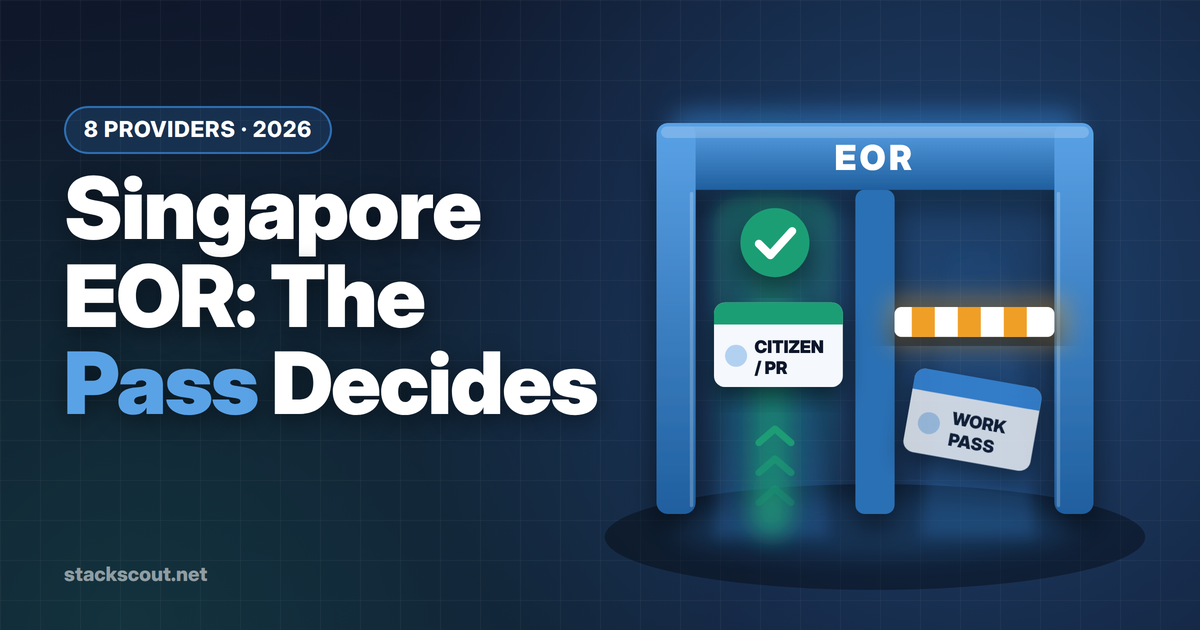
Answer one question before you compare prices. Is your Singapore hire a citizen or permanent resident (PR)? If yes, an EOR works well. Remote and Deel ($599/month) are the safest defaults, Multiplier ($459/month on an annual contract) is the best value among the large platforms, and RemoFirst, Skuad and Payoneer start at $199. If the person needs an Employment Pass or S Pass and your company has no Singapore entity, no EOR can legally sponsor them. Singapore's Ministry of Manpower (MOM) says an EOR that applies for a work pass for someone working for an overseas company "would be committing an offence." In that case you need your own Singapore company or a representative office, not a cheaper EOR.
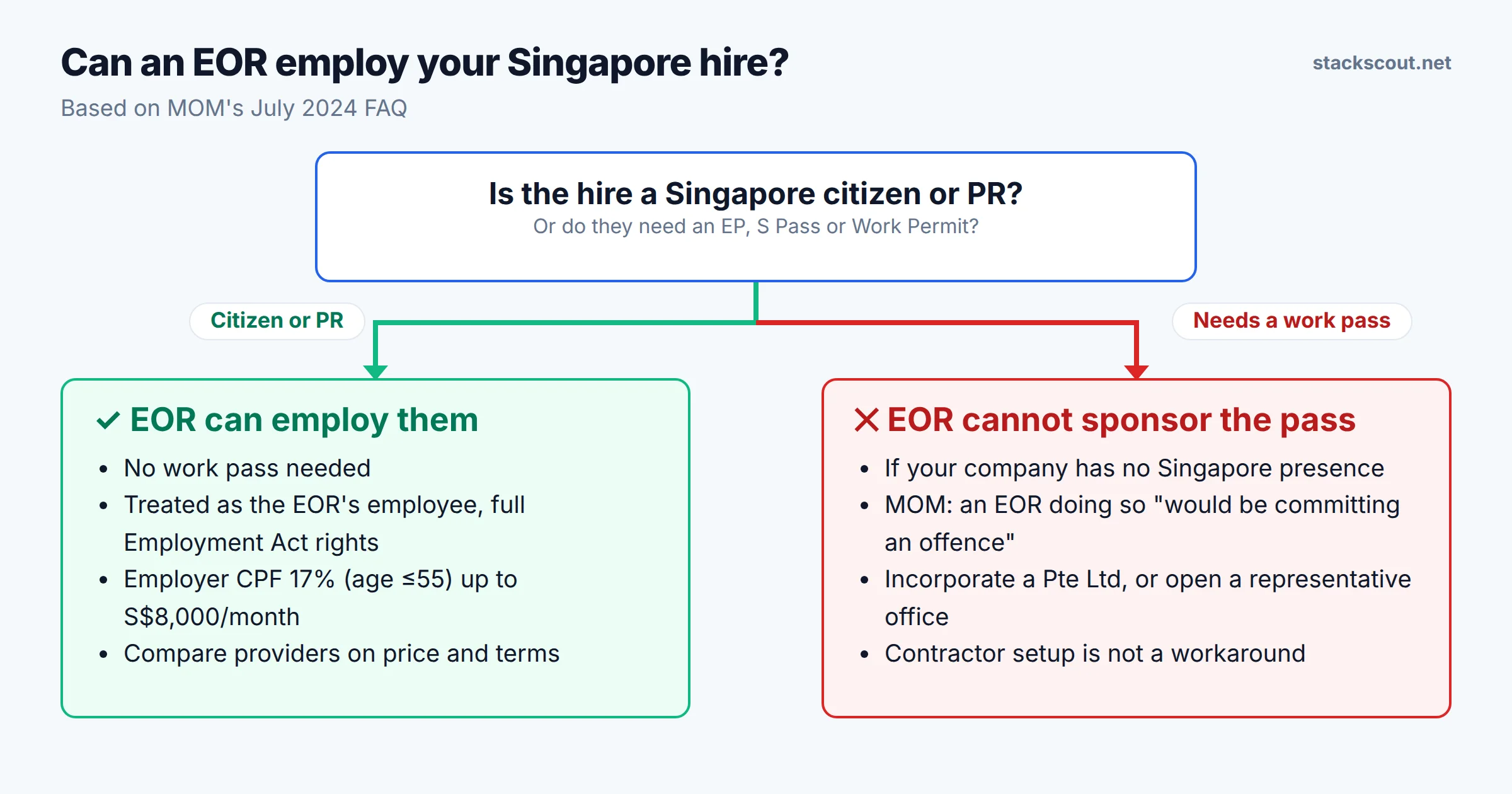
✓ EOR route works
Singapore citizens and PRs. They need no work pass, and MOM treats them as genuine employees of the EOR, with full Employment Act rights.
✗ EOR route is closed
Foreigners who would need an EP, S Pass or Work Permit to work for a company with no Singapore presence. That includes your US engineer who wants to relocate.
This guide is for companies making their first hire in Asia-Pacific in Singapore: CTOs, heads of people and founders at US, European or Japanese firms. Most of the Singapore EOR "best of" lists we read in the current top results never mention the 2024 MOM clarification. Several providers' Singapore pages still list work-pass support among their services. So we start with the gate, then compare providers only for the hires that pass it. If you are new to the model, our explainer on what an employer of record is and how it works covers the contracts and money flow.
Quick answer: top 3 picks for a citizen or PR hire
- Remote: best overallEOR from $599/month, says it uses "100% owned entities, no third parties," and offers Global Payroll from $29 per employee if you later set up your own Singapore company.
- Deel: best if foreign hires come nextEOR $599/month. Deel's own Singapore guidance tells overseas companies to incorporate locally for foreign staff, and it sells entity setup plus $29 payroll to run that entity.
- Multiplier: best value among global platformsEOR $459/month on an annual contract ($499 month to month). Its Singapore page cites the 2026 CPF rates and the $8,000 wage ceiling correctly.
If price matters most, RemoFirst, Skuad and Payoneer (formerly Boundless) all publish "from $199." Treat that as a starting point. Each says the final fee depends on the country.
The rule every Singapore EOR comparison has to start with
MOM put its position in a short FAQ, published July 9, 2024 and still live. Asked whether an EOR can apply for work passes for foreigners based in Singapore who work for overseas companies, it answers: "No. Work passes are for foreigners to work for Singapore-based companies." It ends: "Employers of Record that apply work passes for foreigners to be based in Singapore while working for overseas companies would be committing an offence."
Three points follow from that wording:
- It covers every pass type. Deel's own write-up reads the clarification as applying to all passes that allow work in Singapore, including the Employment Pass, S Pass and Work Permit. Playroll, another EOR, says the same.
- A contractor agreement is not a workaround. Deel notes that the Employment Pass and Personalised Employment Pass are employment-based and don't let the holder contract with an overseas company. If your candidate is a foreigner living in Singapore, there is no contractor workaround either.
- Citizens and PRs are fine. In a November 2023 written answer in Parliament, the Minister for Manpower said a worker employed by an EOR "is considered an employee as long as there is a contract of service between the worker and the EOR, and they are accorded the entitlements under the Employment Act," even though the work is done for the EOR's client.
Lawyers have noted that MOM hasn't named the statute behind the "offence." A July 2025 Law Gazette article argues that a policy position can't create an offence by itself. That debate doesn't change the practical answer. MOM approves or rejects the pass, and no reputable EOR will file an application MOM has said is unlawful. If an EOR sales rep tells you they can get an EP for your foreign hire without a Singapore entity, get that in writing with the legal basis, then show it to Singapore counsel.
"Confirm in writing that this hire is a Singapore citizen or PR, and that you will not apply for any MOM work pass for this employee." Several Singapore EOR pages, including Skuad's (checked October 25, 2026), list work-pass or visa support among their services without mentioning the restriction. That support can still apply to companies that already have a Singapore presence, so ask how it applies to you.
Comparison table: 8 Singapore EOR providers
| Provider | Published EOR price (USD/mo) | ≈ SGD/mo | Entity model (as stated) | Deposit policy (as published) | Best for |
|---|---|---|---|---|---|
| Remote | from $599 | S$766 | "100% owned entities, no third parties" | Only in rare, high-risk cases (per Remote, Sept 2026) | Default choice, citizen/PR hire |
| Deel | $599 | S$766 | Owned entities in many countries; ask for Singapore | Standard 1–1.5× monthly charges (help center) | EOR now, own entity later |
| Multiplier | $459 annual / $499 monthly | S$587 / S$638 | Not stated on the page we checked | Not published | Lowest large-platform price |
| G-P | from $599 | S$766 | Not stated on pricing page | Not published | Enterprise buyers, 180+ countries |
| Oyster | $699 | S$894 | Not stated on pricing page | Refundable deposit required | Startups using the discount |
| RemoFirst | from $199 ("may vary") | from S$254 | Partner model (says so openly) | Not published | Lowest cost, single hire |
| Skuad | $199 | S$254 | "Owned entities… across APAC" | Not published | Budget APAC platform |
| Payoneer (Boundless) | from $199 / €175 | from S$254 | Not stated | Not published | Teams already paying through Payoneer |
Prices are list prices per employee per month from each provider's official pricing page, checked October 24–25, 2026. SGD conversions use 1 USD = S$1.2785 (ECB reference rate, October 23, 2026) and are rounded. "Not published" means the pricing page we checked doesn't say. It doesn't mean there is no deposit. Rippling and Papaya also operate in Singapore but don't publish an EOR price, so they're left out of the ranking.
Six Singapore checks to run before you compare prices
1. CPF only applies to citizens and PRs, and it's capped at S$8,000 a month
Under the Central Provident Fund Act, you (through the EOR) contribute for Singapore citizens and PRs earning more than $50 a month. From January 1, 2026, the rates for employees aged 55 and below on wages above $750 are 17% employer and 20% employee, applied to Ordinary Wages up to the $8,000 monthly ceiling. The employer share therefore tops out at S$1,360 a month, however high the salary.
Bonuses ("Additional Wages") have their own ceiling: $102,000 minus the year's Ordinary Wages subject to CPF. For anyone earning $8,000 or more a month, that leaves only $6,000 of bonus attracting CPF in the year. A good EOR quote models this correctly. A careless one charges 17% on the whole 13th-month payment.
Ask: "Show the employer CPF line for month 13, and the Additional Wage ceiling you applied." If the hire is over 55, also ask whether the quote already uses the 2027 rates. From January 1, 2027, employer CPF rises to 16.5% for ages above 55 to 60 and 13% for above 60 to 65.
2. A new PR is cheap in year one and gets more expensive in years two and three
PRs in their first two years can contribute at graduated rates. For a PR aged 55 or under, CPF's own 2026 tables set the total contribution at 9% in year one (4% employer) and 24% in year two (9% employer). From year three, the full 37% applies (17% employer). On an $8,000+ salary, the employer share moves from S$320 to S$720 to S$1,360 a month.
So: if your hire became a PR recently, a year-one quote understates your year-three cost by more than S$12,000 a year. Budget on the full rate.
3. The Skills Development Levy applies to everyone, but it's tiny
SDL is 0.25% of monthly total wages, minimum $2 and maximum $11.25 per employee (reached at $4,500 a month). It applies to all employees working in Singapore, foreigners included. The amount is trivial. It's still worth checking that the EOR lists it separately rather than folding it into a vague "statutory costs" line.
4. Most of the Employment Act applies, but not the overtime rules for your engineer
The Employment Act covers local and foreign employees under a contract of service. But Part 4, which covers hours of work, overtime and rest days, only applies to workmen earning $4,500 or less and to other employees earning $2,600 or less in basic salary. It doesn't cover managers or executives. A typical tech hire is outside Part 4, so their hours and overtime come from the contract the EOR drafts.
The core statutory minimums still apply:
- Annual leave: 7 days in year one, rising by one day a year to 14 from year eight, after 3 months' service. Tech offers usually exceed this. Agree the number before the EOR issues the contract.
- Sick leave: up to 14 days outpatient and 60 days hospitalisation (the 60 includes the 14), in full after 6 months.
- Salary timing: at least monthly, within 7 days of the end of the salary period.
- Notice: as set in the contract and the same for both sides. If the contract is silent, it ranges from 1 day (under 26 weeks of service) to 4 weeks (5+ years). Notice must be in writing, and no reason is required.
Ask: "What leave, notice and probation terms does your Singapore template use, and can we match our global policy?"
5. There's no statutory severance, but there is a market norm
Singapore law doesn't require retrenchment pay. Under MOM's tripartite guidance, employees with at least 2 years' service are eligible, and the prevailing norm is 2 weeks to 1 month of salary per year of service, depending on the contract and industry practice. Wrongful-dismissal claims go to the Tripartite Alliance for Dispute Management. The EOR is the legal employer, so check how its contract with you passes those costs through.
6. Several rules change in the next 15 months, so ask whether the quote reflects them
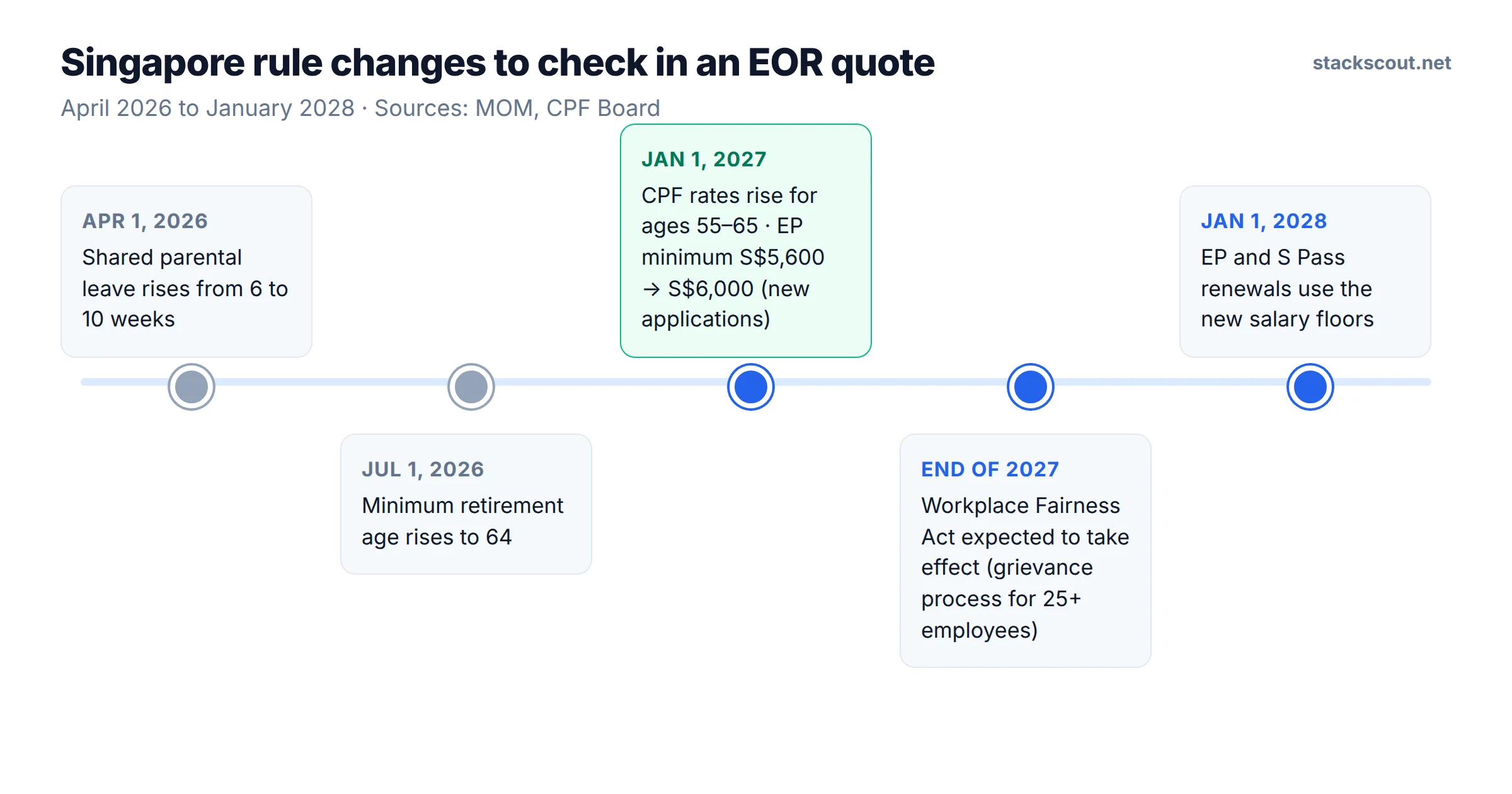
- July 1, 2026: minimum retirement age rose to 64 for citizens and PRs.
- April 1, 2026: shared parental leave went from 6 to 10 weeks for Singapore-citizen children born from this date. The employer pays and claims reimbursement from the government. Maternity leave is 16 weeks government-paid for a Singapore-citizen child.
- January 1, 2027: CPF rates rise for ages above 55 to 65, and new EP and S Pass qualifying salaries take effect (see the next section).
- End of 2027: the Workplace Fairness Act, Singapore's first workplace anti-discrimination statute, is expected to take effect. It requires employers with 25 or more employees to have a formal grievance process. Most EORs are above that size, so ask for their policy.
The 8 providers, reviewed
We looked at the published price, how each provider describes its Singapore entity, its deposit policy, and what happens when you outgrow the EOR. That last point matters more in Singapore than almost anywhere else. The moment you want to hire a foreigner, you'll need your own company, so a provider that can also run payroll for that entity saves a second migration.
1. Remote Best overall
As of October 2026, Remote's pricing page lists EOR "Starting at $599 employee per month," down from the $699 it displayed in September. It says the platform is included with no base fee. Remote's EOR page says it employs through "100% owned entities, no third parties" and claims "an average three-day onboarding time." Its Singapore country guide covers CPF, maternity leave rules and the work injury compensation insurance requirement. If you later incorporate in Singapore, Remote's Global Payroll starts at $29 per employee per month, so the same vendor can run your own entity's payroll.
Remote's pricing page doesn't mention a deposit. In September 2026 it said deposits are only taken in "rare, high risk circumstances," which helps cash flow for a single first hire.
Pros
- Owned-entity model, stated explicitly
- $599 list price, no platform fee
- $29 payroll for your future Singapore entity
Cons
- 3× the price of the $199 tier
- Supplementary benefits are priced separately
- Doesn't change the work-pass rule (no EOR can)
2. Deel Best if foreign hires come next
Deel's pricing page lists EOR at $599 per employee per month, contractors at $49 and Global Payroll at $29 (checked October 2026). Deel has published the clearest guidance we found on the MOM rule. Its article says plainly that overseas companies "cannot engage foreign employees who reside in Singapore through an Employer of Record." The fix it recommends, and sells, is "accelerated entity setup and management." That's useful if you expect to need an EP for a foreign hire in the next year or two: the citizen or PR stays on Deel EOR while Deel helps set up the entity for everyone else.
The trade-off is cash. Deel's help center sets the standard EOR deposit at 1 to 1.5 times total monthly charges, more if you remove probation or offer extra leave. It's refunded within 60 days after termination is finalized and invoices are paid.
Pros
- Explicit, accurate guidance on the MOM rule
- EOR, entity setup and payroll from one vendor
- Contractor product for non-Singapore team members
Cons
- Deposit of 1 to 1.5× monthly cost is standard
- Entity setup is a separate, quoted service
- Ongoing Rippling v. Deel litigation may worry some procurement teams
3. Multiplier Best value (global platform)
Multiplier's pricing page lists EOR at $459 per employee per month on annual contracts and $499 month to month. Growth plans are $519 and $559, and payroll starts at $20. Its Singapore EOR page states the 2026 CPF split (17% employer, 20% employee for ages 55 and under, capped at $8,000), which matches CPF Board's table. It also gives the current EP floor of S$5,600 but not the January 2027 increase, so don't use that page for 2027 planning.
Over a year, the annual contract saves about $480 per hire against the monthly price. It also commits you for 12 months, which may not suit a trial hire.
Pros
- Lowest list price among the large platforms
- Accurate 2026 CPF figures on its Singapore page
- Payroll from $20 if you incorporate later
Cons
- Cheapest price needs an annual commitment
- Entity model in Singapore not stated on the page we read
- Deposit terms not published
4. G-P (Globalization Partners) Enterprise
G-P's pricing page lists "G-P EOR… Starting at USD 599 per employee/month" across 180+ countries, with contractors from USD 39. It's a common choice for larger companies whose procurement process favors long-established vendors. For a single Singapore hire, it offers nothing on price over Remote or Deel. Pick it if you're already a G-P customer elsewhere.
Pros
- Long track record, broad coverage
- Same list price as Remote and Deel
Cons
- No Singapore-specific advantage we could verify
- Entity and deposit details not on the pricing page
5. Oyster Startup discount
Oyster lists EOR at USD 699, the highest list price here. It offers startups up to $1,200 off EOR subscription fees and an annual "seat" option that lets you reuse a seat for a backfill. Its pricing page says a refundable deposit is required for EOR team members. Over a 12-month hire, the startup discount brings it close to the $599 tier. Without the discount, it's the most expensive option for a single Singapore employee.
Pros
- Startup discount of up to $1,200
- Reusable annual seats
Cons
- Highest list price ($699)
- Deposit required
6. RemoFirst Lowest commitment
RemoFirst's pricing page says EOR "starts from $199 per employee, per month… may vary based on local country requirements," with no setup fees, annual contracts or minimums. It's also open about using a partner model, and argues on the same page that owning entities "doesn't guarantee better compliance." For a citizen or PR hire, that can be fine. Ask which Singapore entity will actually be the employer on the contract and the CPF account, and what the Singapore price is. "From $199" isn't a quote.
Pros
- Lowest published starting price
- No annual contract or minimums
- Says openly that it uses partners
Cons
- Partner entity, so one more party in the chain
- Singapore price not on the page
7. Skuad Budget APAC platform
Skuad lists EOR at $199 per employee per month, contractors at $19 to $99, and says it has "owned entities, presence and expertise across APAC." Its Singapore EOR page covers CPF correctly, including the point that CPF doesn't apply to EP or S Pass holders. It also lists "supporting work permit and visa applications for foreign employees" among its services without mentioning the 2024 MOM restriction. If you're an overseas company with no Singapore entity, confirm in writing that this support doesn't apply to your hire.
Pros
- $199 list price
- States owned entities in APAC
- Solid CPF explanation on its Singapore page
Cons
- Singapore page doesn't mention the MOM work-pass restriction
- Deposit terms not published
8. Payoneer Workforce Management (Boundless) For Payoneer users
Boundless now runs under Payoneer Workforce Management. Its pricing starts at "€175/$199 per employee per month," and the final cost depends on "the complexity of the legislative environments" in each country. Payoneer's EOR page says immigration help is available "in select countries… subject to local regulations." For Singapore, that means it's not available to an overseas client with no local presence. It makes most sense if your finance team already pays suppliers through Payoneer.
Pros
- Low starting price
- Sits inside an existing Payoneer account
Cons
- Country price only on request
- Entity model not stated
- Employer CPF on Ordinary and Additional Wages, with the ceilings applied
- SDL, deposit amount, and the employing entity's name
- Written confirmation that no MOM work pass will be filed
What a Singapore engineer really costs through an EOR
Here's an illustrative citizen software engineer aged 32 on S$8,500 a month plus a common one-month year-end bonus (the "13th month," which is customary, not statutory). Figures use CPF Board's 2026 rates and ceilings.
| Line | How it's calculated | Per year (SGD) |
|---|---|---|
| Base salary | S$8,500 × 12 | 102,000 |
| 13th-month bonus | S$8,500 × 1 | 8,500 |
| Employer CPF on salary | 17% × S$8,000 ceiling = S$1,360 × 12 | 16,320 |
| Employer CPF on bonus | 17% × S$6,000 (= 102,000 − 96,000 Additional Wage ceiling) | 1,020 |
| SDL | S$11.25 cap × 12 | 135 |
| Statutory employer cost | Before EOR fee and benefits | 127,975 |
| + EOR fee at $199/mo | $2,388 ≈ | 3,053 |
| + EOR fee at $459/mo (Multiplier annual) | $5,508 ≈ | 7,042 |
| + EOR fee at $599/mo (Remote, Deel, G-P) | $7,188 ≈ | 9,190 |
| + EOR fee at $699/mo (Oyster list) | $8,388 ≈ | 10,724 |
Illustrative only. Excludes private medical insurance, equipment, and any FX margin the EOR applies when invoicing in USD. The employee's own 20% CPF (S$1,600 a month at the ceiling) comes out of the S$8,500. It isn't an extra cost to you, but it does affect take-home pay, which matters when you negotiate with candidates moving from abroad. Conversion at S$1.2785 per USD.
Two things stand out. First, the employer on-cost is low by international standards: about 16% on top of salary before the EOR fee, and it falls as salary rises above the ceiling. Second, the gap between the cheapest and most expensive EOR (about S$7,700 a year) is roughly 6% of total cost. That's real money, but it's smaller than the cost of picking a provider whose contract terms don't hold up. For the break-even point where your own entity becomes cheaper, see our EOR vs. setting up a foreign entity cost comparison.
If your Singapore hire needs a work pass: the three real routes
If your candidate is a foreigner, here's what MOM points overseas companies to instead.
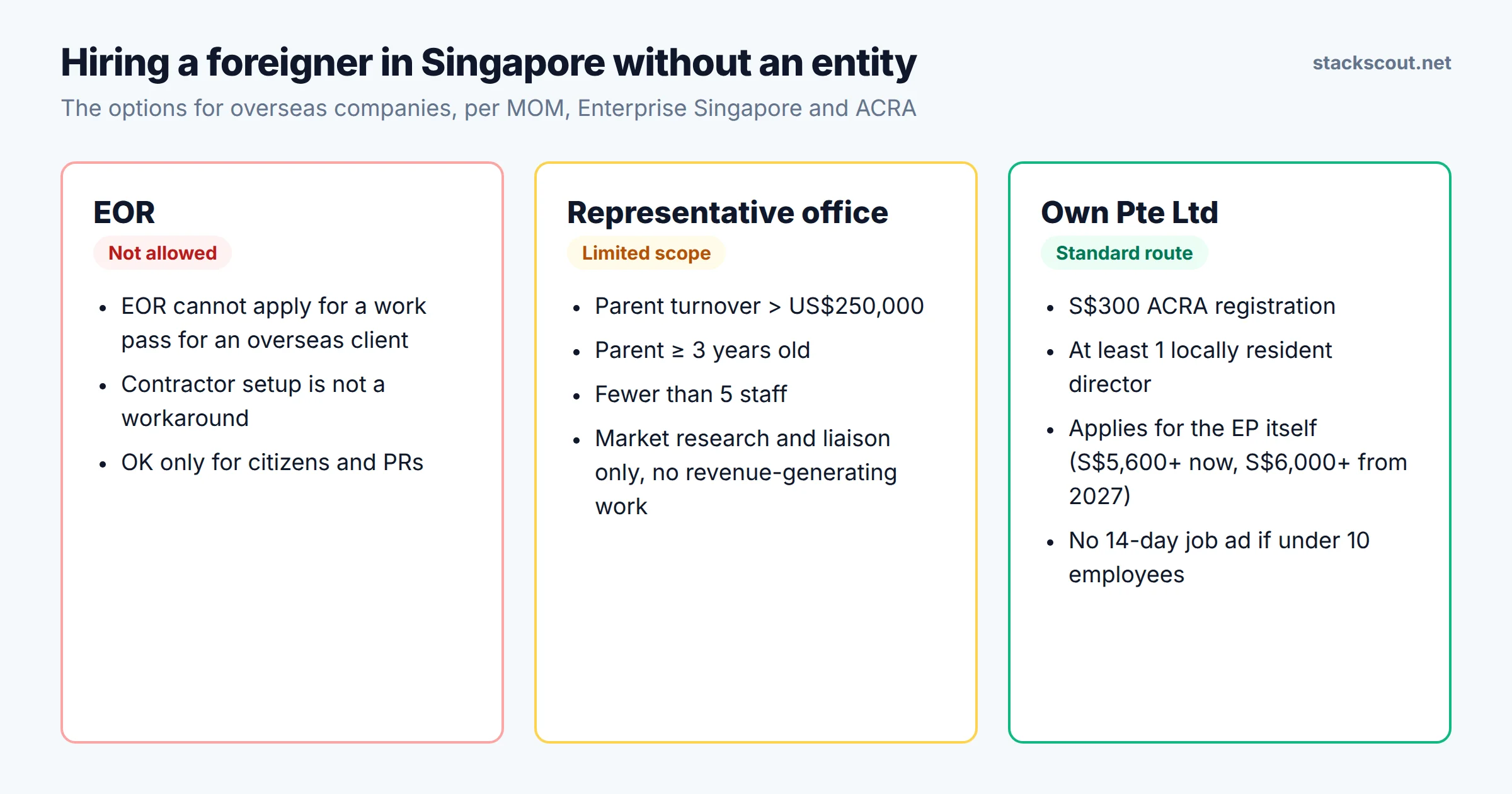
Route A: Incorporate a Singapore private limited company
This is the standard answer. ACRA's registration fee is S$300, and most registrations are approved soon after payment. You must appoint at least one director who meets local residency rules, which is usually the hardest part for a first hire. Corporate service providers offer nominee directors, and those must be declared on ACRA's nominee registers. Once the company exists, it applies for the EP itself.
The EP has two stages. The candidate must earn at least the qualifying salary and then pass the COMPASS points test unless exempt. The current minimum is S$5,600 a month, rising with age to S$10,700 at 45 and above (higher in financial services). For new applications from January 1, 2027, it rises to S$6,000 (S$11,500 at 45+), and renewals expiring from January 1, 2028 follow. The S Pass floor goes from S$3,300 to S$3,600 on the same dates.
A new subsidiary has one advantage: the Fair Consideration Framework rule that you advertise on MyCareersFuture for 14 consecutive days before filing an EP doesn't apply to companies with fewer than 10 employees, or to roles paying a fixed S$22,500 a month or more.
Route B: A representative office
Enterprise Singapore's representative office scheme is for market research and liaison, not revenue-generating work. The parent needs sales turnover above US$250,000 and at least 3 years of history, and the office must have fewer than 5 staff. Licences are granted for one year at a S$200 processing fee. For applications from April 1, 2027, licences run three years upfront, with an extra S$400 on approval. It suits a regional sales scout. It doesn't suit an engineering team.
Route C: Wait for PR, or hire someone else
If your candidate becomes a PR, the EOR route opens. But PR approval isn't guaranteed and can take months, so it's not a hiring plan. Deel's guidance also suggests relocating the person to a country where an EOR can sponsor a visa, which only works if the role doesn't need to be in Singapore.
Hire your first Singapore citizen or PR through an EOR to start selling or supporting customers. Then incorporate once you need a foreign hire or reach a few employees. Pick an EOR that also offers payroll for your own entity (Remote, Deel and Multiplier all do), so that move is a contract transfer, not a vendor change. Our guide to switching providers without disrupting payroll covers the cut-over steps, and keeping the EOR period clean also helps avoid permanent establishment risk before you incorporate.
Who should choose which
| Your situation | Choose | Why |
|---|---|---|
| First APAC hire, a citizen or PR, quality over price | Remote | Owned entities, no stated deposit for normal cases, payroll for later |
| Citizen/PR now, a foreign hire likely within 12–24 months | Deel | Clear MOM guidance plus entity setup and payroll in one place |
| Several hires, happy with an annual commitment | Multiplier | $459/month annual, the lowest among large platforms |
| One hire, tight budget, short horizon | RemoFirst or Skuad | $199 starting price, no annual lock-in (RemoFirst) |
| Already a G-P or Payoneer customer | G-P / Payoneer | Consolidate vendors; no Singapore price advantage either way |
| Candidate needs an EP or S Pass, no Singapore entity | None of the above as EOR | Incorporate (Route A) or open a representative office (Route B) |
If you're still deciding on a provider for several countries, our 7-question framework for choosing an EOR and the best EOR for startups comparison cover minimums, deposits and equity across markets. For other Asia-Pacific hires, see our guides for India and Australia.
FAQ
Is EOR legal in Singapore?
Can an EOR sponsor an Employment Pass in Singapore?
Can I hire a foreigner living in Singapore as a contractor instead?
How much does an EOR cost in Singapore?
What is the best EOR for international hiring overall?
How we chose
We started from the hire types an overseas company can legally employ through an EOR in Singapore, based on MOM's July 2024 FAQ and the November 2023 parliamentary answer. We then compared providers on four criteria a buyer can check: (1) the list price on the provider's own pricing page, checked October 24–25, 2026; (2) how the provider describes the entity that will employ your hire; (3) published deposit terms; and (4) whether the provider can also run payroll for your own Singapore entity later. Statutory figures come from CPF Board, MOM, ACRA and Enterprise Singapore. We didn't test the platforms with a live hire, and no provider reviewed this article. Where a provider doesn't publish something, we say so rather than estimate it.
Sources
- Ministry of Manpower, "Can Employers of Record in Singapore apply for work passes for foreigners to be based in Singapore while working for overseas companies?" (July 9, 2024): mom.gov.sg (mirrored at ask.gov.sg)
- MOM, Written answer to PQ on Employers of Record (November 7, 2023): mom.gov.sg
- Law Society of Singapore, Law Gazette, "Employers of Record in Singapore: A Critical Overview" (July 2025): lawgazette.com.sg
- CPF Board, How much CPF contributions to pay (2026 rates) and contribution rate tables from January 1, 2026: cpf.gov.sg; CPF contribution changes from January 1, 2027: cpf.gov.sg
- CPF Board, Skills Development Levy: cpf.gov.sg; What constitutes wages (OW/AW ceilings): cpf.gov.sg
- MOM, Employment Pass eligibility (current and 2027 qualifying salaries): mom.gov.sg; S Pass eligibility: mom.gov.sg; Fair Consideration Framework advertising: mom.gov.sg
- MOM, Employment Act coverage, annual leave, sick leave, salary payment, termination with notice, retirement, shared parental leave and maternity leave pages: mom.gov.sg
- Enterprise Singapore, Representative Office: enterprisesg.gov.sg; ACRA, Setting up a local company: acra.gov.sg
- Deel, "Employer of Record Singapore: Retain Foreign Talent Under MOM Regulation": deel.com; Playroll, "Singapore MOM Update: EORs Cannot Sponsor Work Passes": playroll.com
- Provider pricing pages (checked October 24–25, 2026): Remote, Deel, Multiplier, G-P, Oyster, RemoFirst, Skuad, Boundless / Payoneer; Skuad Singapore EOR page: skuad.io
- Workplace Fairness Act timing: BritCham Singapore, "Parliament passes second Workplace Fairness Bill, paving way for roll-out in end-2027": britcham.org.sg

Technology consultant with 10+ years in the Japanese tech industry, specializing in SaaS evaluation, workflow automation and B2B tool integration. Every price and regulatory figure in this article was checked against the official source on the date shown.
Technology consultant with 10+ years in the Japanese tech industry. Specializing in SaaS evaluation, workflow automation, and B2B tool integration.