What Is an Employer of Record and How Does It Work? The Contracts, the Money Flow, and Who Is Actually Liable
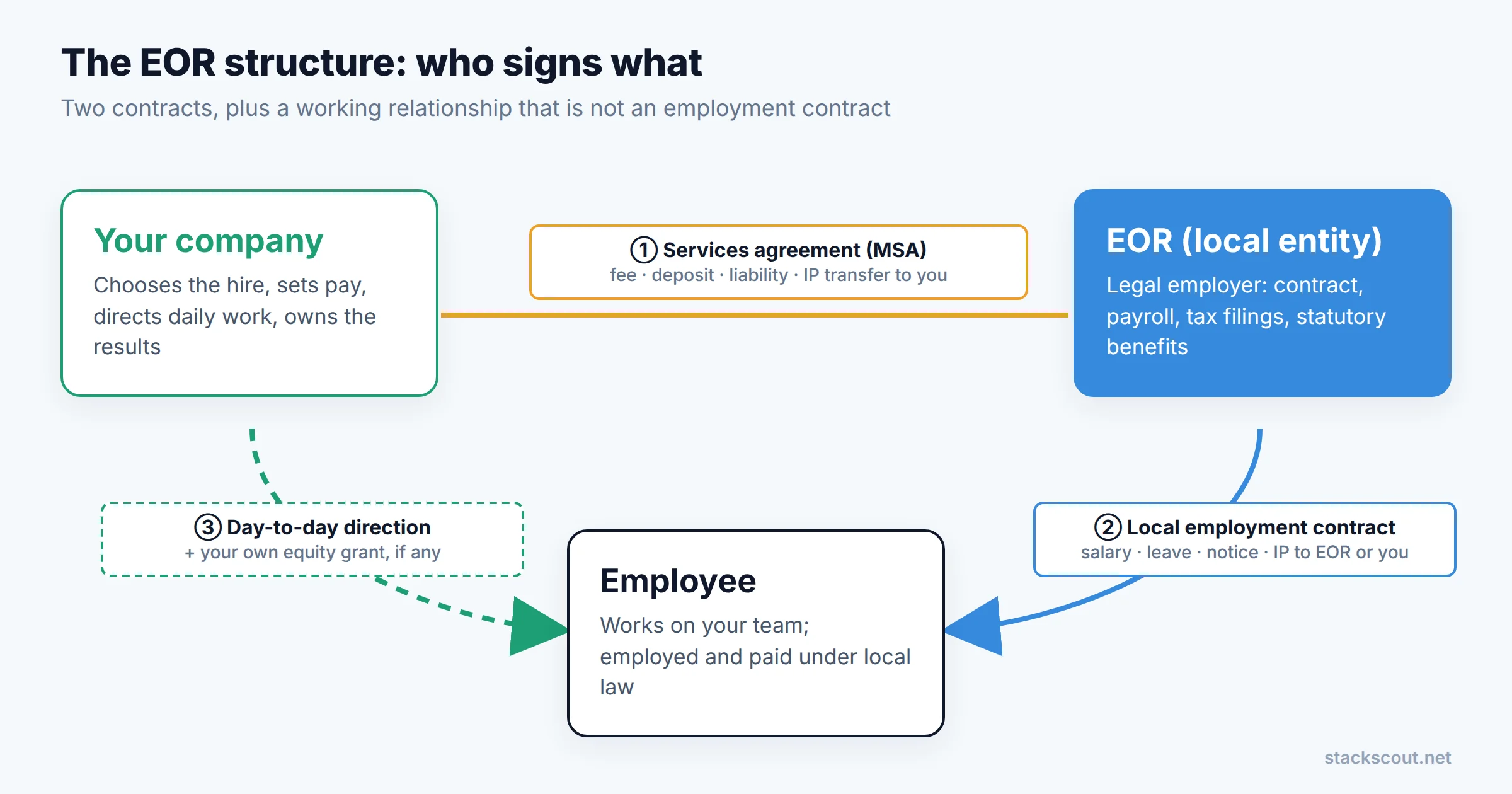
An employer of record (EOR) is a company that becomes the legal employer of someone who works for you, in a country where you have no legal entity. You choose the person and direct the work. The EOR signs the local employment contract, runs payroll, withholds tax, and pays statutory benefits, then bills you for all of it plus a fee.
That definition is on every EOR vendor's homepage. What most explainers leave out is the part that matters when you are about to sign: what contracts exist, where the money goes each month, which liabilities the EOR actually takes off your plate, and which ones stay with you. Some countries also treat the arrangement as regulated staff leasing, which comes with time limits. This guide covers those mechanics for HR leads and founders making their first international hire.
Quick answer
- What it is: a provider that legally employs your hire in their country through its own entity (or a local partner's), so you don't have to set one up.
- How it works: you sign a services agreement with the EOR. The EOR signs a local employment contract with the worker. You manage the work. Each month the EOR invoices you for salary, employer taxes and contributions, benefits, and its fee, and then pays the worker and the authorities.
- What it costs: as of October 2026, Deel lists $599 and Remote $699 per employee per month, on top of the fully loaded employment cost. Some providers also take a refundable deposit.
- What it doesn't do: it doesn't remove permanent-establishment tax risk, doesn't give you IP ownership automatically, and in some countries (Germany, for example) it can't run indefinitely.
01 · DefinitionWhat "employer of record" actually means
"Of record" is the key phrase. It refers to whoever is on the paperwork: the name on the employment contract, the registration with the tax and social-security authorities, and the payslip. The company that benefits from the work and decides what the person does all day is a separate party. An EOR splits these two roles.
The term predates the global-hiring platforms. In US tax law, the idea is written into Internal Revenue Code section 3401(d)(1). If the business the person works for "does not have control of the payment of the wages," the employer for withholding purposes is "the person having control of the payment of such wages." The IRS calls this party the "section 3401(d)(1) employer" or "statutory employer."
The IRS also adds a qualification that is useful to know. Its Internal Revenue Manual says a third party controls wages only if paying them "is not contingent upon, or proximately related to," first receiving funds from the client. If wages only go out after the client sends money, the IRS generally treats the client as still in control. Its guidance to agents is blunt: the common-law employer "is not relieved of its employment tax obligation" just by using a PEO. Certified PEOs under section 3511 are the statutory exception.
Most cross-border EOR hiring isn't covered by US payroll-tax rules, but the same pattern shows up everywhere. Each country decides for itself who counts as the "real" employer, and the answer depends on its own definitions, not on your contract. The EOR contract moves the paperwork and most of the day-to-day obligations, but your company stays in the picture.
Practically, an EOR does the work an in-country HR, payroll, and legal function would do: drafting compliant contracts, registering the employee, calculating gross-to-net pay, filing tax and social contributions, enrolling the person in mandatory benefits, handling statutory leave, and processing terminations under local law. It does this through a legal entity in that country, and that entity is the part you are paying for.
02 · StructureThe contracts behind an EOR arrangement
There are usually two or three legal documents, and sometimes a fourth party you never meet.
1. The services agreement (you ↔ EOR)
This is a B2B contract, usually a master services agreement (MSA) plus a country-specific order or schedule for each hire. It sets the fee, payment terms, deposit, liability caps, indemnities, data-processing terms, and, importantly, what happens to intellectual property. The worker is not a party to it.
2. The local employment contract (EOR ↔ worker)
This is the actual employment relationship. It is drafted under local law, signed by the EOR's local entity, and sets salary, working hours, leave, probation, notice, and local benefits. Your company isn't named as the employer. The worker's rights, including dismissal protection, flow from this contract and from local statute.
3. Your direct side agreements (you ↔ worker)
Some things the EOR can't provide because they are yours to give. The most common is equity. Deel's own guidance says US incentive stock options (ISOs) can only go to direct employees of the issuing company, so EOR employees typically receive NSOs, RSUs, SARs, or phantom equity under a grant you set up with the worker directly. Confidentiality or invention-assignment agreements may also sit here, depending on how the IP chain is drafted (see below).
The hidden fourth party: owned entity vs. partner network
EOR platforms tend to describe their country coverage in one number, but the coverage is built two ways:
Owned entity
The provider's own subsidiary is the legal employer. Contract, payroll bank account, and compliance staff sit inside one corporate group. Accountability is direct.
In-country partner (aggregator)
The platform subcontracts the employment to a local firm, which becomes the employer on paper. Coverage can be wider, but rule changes and payroll issues pass through an extra party.
Both models are legal, and many providers mix them across countries. The question to ask, for each country you hire in, is: which legal entity will sign my employee's contract, and is it yours? We go further into how to vet this in our 7-question framework for choosing an EOR provider.
Where IP ownership actually lands
This is the gap first-time buyers miss most often. Because the EOR is the legal employer, work product may by default belong to the EOR, not to you. Freshfields' analysis of EOR arrangements sets out the fix as a chain. The employment agreement should assign the employee's IP "to either the EoR or the end user company," and if it goes to the EOR, "the commercial agreement between the EoR and the end user company should contain a further assignment." The same analysis warns that the EOR "may be less likely to have an interest" in enforcing confidentiality against its own employee. So check that you have direct enforcement rights, or a contractual obligation on the EOR to act.
Open the template employment contract the EOR will use in your hire's country, find the IP clause, and trace the assignment to your company. If you can't follow the chain from the worker to you in two documents, ask the provider to fix it before onboarding, not after the first product ships.
03 · Money flowHow the money moves each month
The monthly cycle is where an EOR looks like an outsourced payroll department with its own balance sheet. The order matters, because in most setups you pay before the employee does.
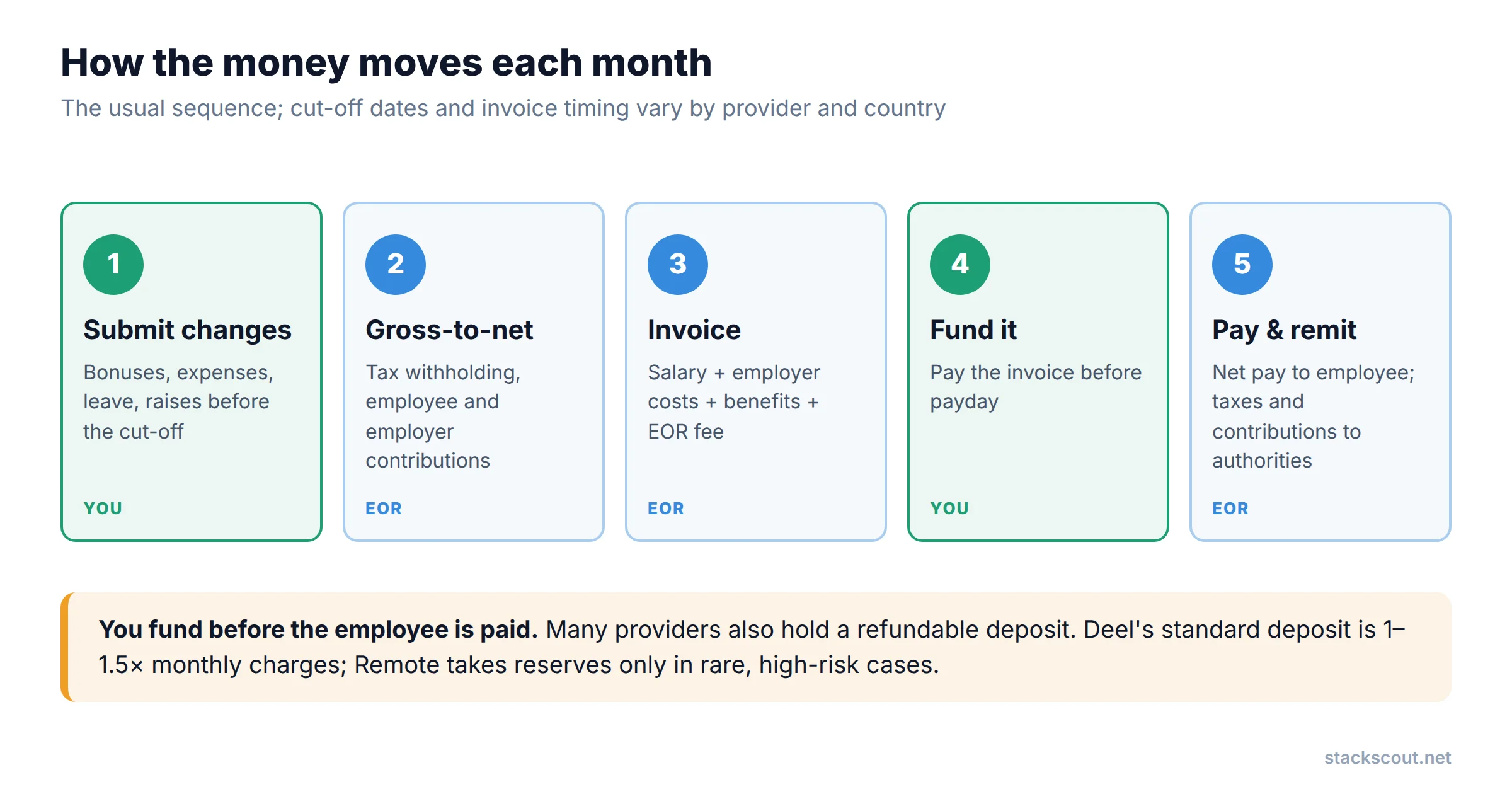
- You submit the month's changes. Bonuses, commissions, expense claims, unpaid leave, a raise. Each provider has a monthly cut-off. Anything late rolls into the next cycle.
- The EOR calculates gross-to-net. Its local payroll team (or partner) applies income tax withholding, employee and employer social contributions, and any mandatory items such as a 13th-month salary where the country requires one.
- The EOR invoices you. One invoice line covers the employee's gross salary, the employer-side statutory costs, benefits, and reimbursements, and another covers the EOR's service fee. Expect foreign-exchange conversion if you pay in a different currency from the payroll.
- You fund the invoice. Typically before payday, so the EOR can pay on time.
- The EOR pays and remits. Net salary goes to the employee. Withheld tax and contributions go to the authorities under the EOR's local registrations, and the EOR files the returns.
The deposit: the line item nobody mentions in the demo
Because the EOR is the legal employer, it carries the risk of paying wages and severance if you stop paying. Many providers hedge that risk with a deposit. Deel's help center, for example, describes its standard deposit as "between 1 - 1.5" times "all monthly charges, including employee salary, employer costs, fixed allowances, and management fees." It may require more for terms that raise its exposure:
- Removing probation → a two-month deposit
- Paid time off more than 8 days above the legal minimum → two months of salary
- Notice period longer than one month → one additional month of deposit per extra month of notice
Deel says refunds are processed once the termination is finalized and invoices are paid, and its terms allow up to 60 days after that point. Remote takes the opposite position on its pricing page: it collects reserve payments only "in rare, high risk circumstances" and says it doesn't charge extra deposits for above-minimum PTO, removed probation, incentive plans, or severance accruals. For a startup hiring in an expensive country, the difference between those two policies can be a month or more of tied-up cash per hire. Our EOR comparison for startups lines up minimums and deposits across six providers.
04 · LifecycleThe lifecycle: from offer to exit
Onboarding
You pick the candidate and agree salary and start date. The EOR checks that the package meets local minimums and mandatory benefits, issues the local contract, collects the employee's tax and banking details, registers them with local authorities, and enrolls them in statutory schemes. Where the worker needs a work permit, sponsorship has to come from the legal employer, which is the EOR. Not every provider sponsors visas in every country, so confirm this before you make an offer to a non-resident.
During employment
Day to day, the employee works like anyone else on your team: your tools, your manager, your goals, your performance reviews. The EOR handles leave balances, sick pay rules, payslips, benefits questions, and annual statutory changes (new minimum wage, new contribution ceilings). Changes to the employment terms, such as a raise, a title change, or a move to part time, usually need a contract amendment issued by the EOR, not just an email from you.
Termination
This is where the split between deciding and executing matters most. You decide that the employment should end. The EOR executes the termination under local law: notice, consultation if required, final pay, accrued leave, and statutory severance. You pay all of it. An EOR can't make a termination legal that local law wouldn't allow, and in protective jurisdictions the process can take weeks; Deel's help center says terminations "can take up to 60 days depending on the nature and jurisdiction."
Moving off the EOR
When you outgrow the EOR (usually by opening your own entity), the employee signs a new contract with your entity. Whether service time, accrued leave, and seniority carry over depends on local law and what you negotiate. Treat it as a new hire with continuity terms, not a transfer of paperwork.
05 · LiabilityWho is responsible for what
This matrix is the core of the arrangement. "The EOR handles compliance" is true for some rows and not true for others.
| Area | Owner | What that means in practice |
|---|---|---|
| Local employment contract | EOR | Drafts and signs under local law; must meet statutory minimums. |
| Payroll, tax withholding, social contributions | EOR | Calculates, pays, files under its registrations, but only after you fund the invoice. |
| Mandatory benefits and statutory leave | EOR | Enrolls the employee and administers leave. Supplemental benefits are a cost you choose. |
| Work permit sponsorship | EOR | Only where the provider supports it in that country. |
| Day-to-day direction, goals, performance | You | You manage the work. The EOR doesn't supervise output. |
| Compensation decisions | You | You set salary and raises; the EOR checks them against local law. |
| Termination | Shared | You decide and pay; the EOR runs the legal process. |
| IP and confidentiality | Shared | Depends on the assignment chain across both contracts; enforcement often needs you. |
| Workplace conduct, harassment, health & safety of remote setup | Shared | The EOR holds the legal duty; your managers create most of the facts. |
| Equity compensation | You | Granted by your company; the EOR may need to run the local tax reporting. |
| Corporate tax / permanent establishment | You | Driven by what the employee does for your business, not by who employs them. |
The last row needs emphasis. If your EOR employee habitually negotiates and concludes contracts for you, or runs what looks like a fixed place of your business, a tax authority may find that your company has a taxable presence in that country, no matter who is on the payslip. We cover the six activities that trigger this, and how to fix them, in EOR compliance mistakes that trigger permanent establishment risk.
06 · JurisdictionSame model, different legal box: how countries classify EORs
"Employer of record" is a commercial label, not a legal category in most countries. Each jurisdiction fits the arrangement into one of its existing categories, and that category determines the rules. Here are four worked examples.
| Country | How the law sees it | What it means for you |
|---|---|---|
| Germany | Temporary agency work (Arbeitnehmerüberlassung, AÜG) | The provider needs an agency licence from the Federal Employment Agency. Assignment to the same client is generally capped at 18 months; equal pay applies after 9 months at the latest. |
| Netherlands | Payrolling | Payroll employees are entitled to at least the same employment terms as your own staff. If you have no Dutch staff, the terms for similar work in your sector apply. |
| Mexico | Subject to the April 2021 subcontracting reform | Personnel outsourcing was banned; specialized services need REPSE registration. Sources disagree on how this applies to EORs, so get your provider's legal position in writing. |
| United States | Third-party payer (IRC 3401(d)(1)) or co-employment (PEO/CPEO) | Who controls wage payment determines tax liability; a non-certified arrangement often leaves the client liable. |
Germany: the 18-month clock
The Federal Employment Agency's information sheet on agency work is direct: the assignment of a temporary worker "ist grundsätzlich auf 18 Monate begrenzt" (is generally limited to 18 months). Earlier assignments to the same client count toward the limit if the break between them is three months or less. The licence is granted for one year at a time and can become indefinite after three consecutive years of lawful operation, and no agency work may happen before it is granted. The same sheet requires equal pay with comparable client employees "spätestens nach 9 Monaten" (after 9 months at the latest) unless a qualifying sector collective agreement applies. If you expect a German hire to stay beyond 18 months, plan for a local entity or a properly structured alternative from the start. Our Germany EOR comparison covers how each provider handles this.
Netherlands: equal terms
The Netherlands Enterprise Agency's description of payrolling closely matches the EOR model: "You recruit the payroll employees yourself, determine their salary, and have complete supervision of their work," while "the payroll company formally hires and employs" them. The rule that follows is that payroll workers are "entitled to at least the same terms of employment" as your fixed-term or permanent staff. Pension must come from your scheme or a qualifying scheme from the payroll company.
Mexico: a reform that changed the question
Mexico's April 2021 labor-law amendment banned most personnel outsourcing and created the REPSE registry for specialized services. Commentary disagrees on whether EOR employment of workers for a foreign client with no Mexican entity falls inside the ban. We explain where providers stand in our Mexico EOR guide. The practical step is the same either way: ask for the provider's REPSE status and its written legal position before signing.
07 · CostWhat an EOR costs (the structure, not just the fee)
The headline price is the smallest part of the bill. A typical monthly invoice has four layers:
- Gross salary: what you'd pay anyway.
- Employer-side statutory costs: social security, pension, health, and other contributions the employer must pay on top of salary. These vary widely by country and are often the second-largest line.
- Benefits and allowances: mandatory items (some countries require meal vouchers or a 13th month), plus anything supplemental you choose.
- The EOR fee: a flat per-employee monthly fee or, at some providers, a percentage of payroll.
Published flat fees, checked on the official pricing pages in October 2026:
| Provider | EOR list price | Coverage claim | Deposit policy (published) |
|---|---|---|---|
| Deel | $599 / employee / month | 130+ countries | Standard 1–1.5× monthly charges; higher for some terms |
| Remote | $699 / employee / month | 90+ countries | Reserve payments only "in rare, high risk circumstances" |
Two things move the real number more than the list price: the pricing model (flat vs. percentage of payroll, which crosses over at a predictable salary level) and one-off charges such as offboarding fees, foreign-exchange spreads, and deposits. Our EOR pricing models explained works through the break-even formula across eight countries, and Deel vs. Remote pricing compares total cost of ownership for the two largest providers.
What the fee buys you
- Hiring in weeks, without registering a company
- Local contracts, payroll, and filings handled under someone else's registrations
- A clean exit if the market doesn't work out
- One invoice and one platform across countries
What it doesn't
- Protection from permanent-establishment exposure
- Automatic IP ownership
- Lower employment costs (statutory costs are the same)
- Unlimited duration in countries that regulate staff leasing
08 · LimitsWhen an EOR is the wrong tool
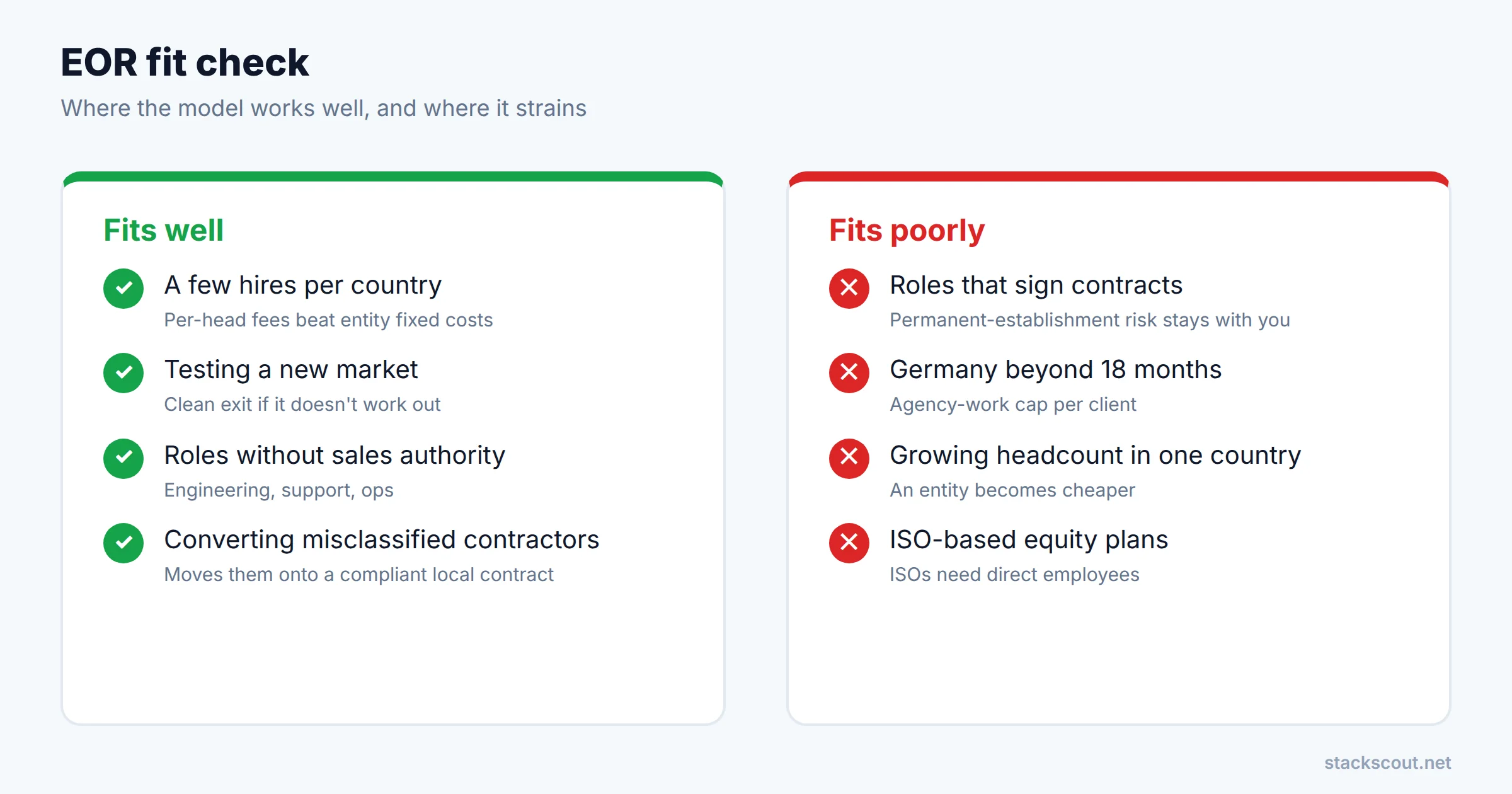
The regulatory sources above and our country-by-country research point to six situations where an EOR either doesn't fit or needs to be paired with something else:
- The role signs deals or runs a local office. Country managers and quota-carrying sales staff are the classic permanent-establishment trigger. The EOR doesn't change that.
- The assignment will run past a statutory cap. In Germany, plan your exit from the EOR before month 18, not at month 17.
- Headcount in one country keeps growing. Per-employee fees scale linearly; an entity's fixed cost doesn't. The break-even point depends on the country. See EOR vs. setting up a foreign entity for the math.
- Your equity plan depends on ISOs. Use NSOs, RSUs, or phantom equity for EOR employees, and get local tax advice on each.
- You're hiring in the US and own a US entity. You probably want a PEO (co-employment), not an EOR. Our EOR vs. PEO breakdown explains the legal difference.
- The person is a genuine independent contractor. If they control how, when, and for whom they work, a contractor agreement (or a contractor-of-record service) may fit better. If they don't, an EOR is the safer way to avoid misclassification.
09 · Next stepsHow to start: a five-step sequence
- Write down the role's scope. Title, duties, whether it has any authority to bind your company, and expected duration. This drives the PE and duration analysis.
- Get a full cost estimate per country. Ask each provider for gross salary, every employer cost line, the fee, the deposit, and offboarding charges. Compare the totals, not the fees.
- Confirm which entity employs your hire. Owned entity or partner? Licensed where required (Germany)? Registered where relevant (Mexico)?
- Read the two contracts together. Trace IP assignment, confidentiality enforcement, liability caps, and termination cost allocation across the MSA and the local employment template.
- Set your exit trigger. Decide in advance what headcount or duration will make you open your own entity, and put a reminder on the calendar.
For a worked example of these steps in practice, see how a remote-first startup onboarded 12 employees across 5 countries with an EOR.
10 · FAQFrequently asked questions
What is the difference between an EOR and a payroll provider?
What is the purpose of an EOR?
Who is the employee's real employer under an EOR?
Is using an employer of record legal?
Can EOR employees receive stock options?
MethodologyHow we researched this guide
Based on our research, we built this explainer from primary sources: the IRS Internal Revenue Manual and its third-party payer guidance for the US definition, the German Federal Employment Agency's agency-work information sheet, and the Netherlands Enterprise Agency's payrolling page. Provider pricing and deposit terms come from Deel's and Remote's official pricing pages and Deel's help-center articles, checked on October 6, 2026. Legal summaries are general information, not legal advice; confirm country rules with local counsel before hiring.
参考・出典
- IRS, Internal Revenue Manual 5.1.24, "Third-Party Payer Arrangements for Employment Taxes": irs.gov/irm/part5/irm_05-001-024r
- IRS, "Third party payer arrangements – Professional employer organizations": irs.gov
- Bundesagentur für Arbeit, "Informationen zur Arbeitnehmerüberlassung" (10/2024): arbeitsagentur.de (PDF)
- Netherlands Enterprise Agency, "What is payrolling?": business.gov.nl/regulations/payrolling
- Freshfields, "Worklife 2.0: Employers of record – the sky is the limit? Part 2 – intellectual property" (2022): freshfields.com
- Deel Help Center, "About EOR Deposit Calculations" and "About EOR Deposit Refunds": help.letsdeel.com
- Deel pricing: deel.com/pricing · Remote pricing: remote.com/pricing
- Deel, "How Deel Simplifies Granting Equity to EOR Employees": deel.com/blog
- Ogletree, "Mexican Labor Law Amendment Abolishes Outsourcing of Personnel": ogletree.com

Technology consultant with 10+ years in the Japanese tech industry. Specializing in SaaS evaluation, workflow automation, and B2B tool integration.