Xero Pricing 2026: 7 Ways to Cut Your Bill After the October Increase (and When Switching Actually Saves)
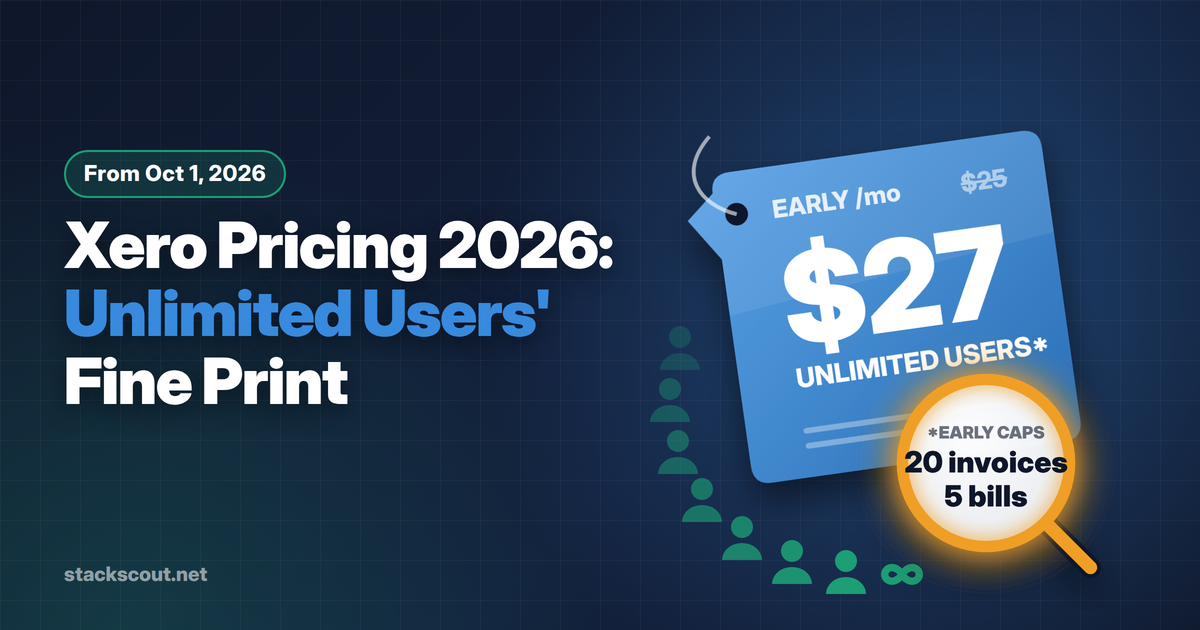
On October 1, 2026, Xero's US plans went to $27 (Early), $59 (Growing), and $97 (Established) a month, up from $25/$55/$90. That's an extra $24 to $84 a year per organization. Xero is also phasing out the multi-organization discount from the same date, which can cost a multi-entity group more than the list-price change.
Downgrading is rarely where the big savings are. Based on our research, the two biggest levers are (1) moving dormant or holding entities to a partner-only Xero Ledger ($4) or Cashbook ($10) plan, and (2) getting large invoices paid by ACH Debit (1%, capped at $9) instead of card (2.9% + 30¢). A single $5,000 card payment costs more in fees than a full year of the price increase on Established. Switching to QuickBooks rarely saves money right now because Intuit raised prices more steeply on August 1. Zoho Books is the one alternative that is clearly cheaper at equal multi-currency capability.
This article is written for the person who already runs on Xero (or is about to) and just saw the new number on an invoice. If you need the plan-by-plan feature breakdown, user limits, and UK and Australia pricing first, start with our full guide to Xero's 2026 plans and user limits. Here we skip ahead to the question that comes next: how do I pay less, and is it time to leave?
01What changed on October 1, and who it hits hardest
Xero announced the US increase in late July 2026. Its price-change notice says the new prices apply to new and existing US subscribers from October 1, 2026 and show on every invoice from that date. No existing account is grandfathered.
| US plan | Before Oct 1 | From Oct 1, 2026 | Change / month | Change / year |
|---|---|---|---|---|
| Early | $25 | $27 | +$2 (8.0%) | +$24 |
| Growing | $55 | $59 | +$4 (7.3%) | +$48 |
| Established | $90 | $97 | +$7 (7.8%) | +$84 |
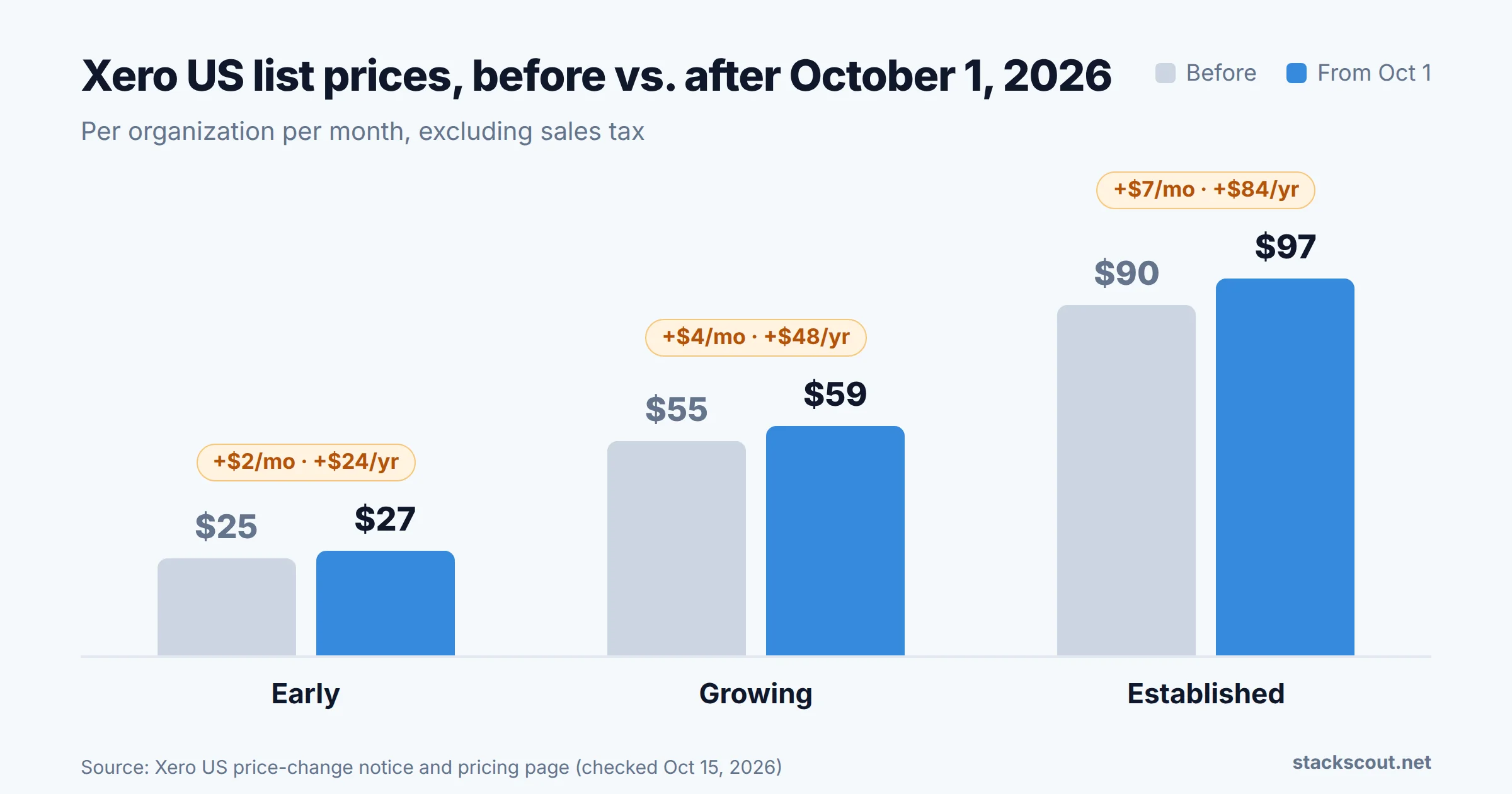
For a single-entity company, that works out to between $2 and $7 a month. Two other parts of the same notice matter more:
- The multi-organization discount is going away. The notice says: "from 1 October 2026, the multi-organization discount will begin to be phased out and will no longer be applied to eligible subscriptions." The discount applied automatically when several Business Edition organizations in the same country edition shared one subscriber email. Xero doesn't publish the percentage, so look for the discount line on your last pre-October invoice. That line is the amount you are about to lose.
- Existing promo codes survive. "If you have a current Xero discount or promo code, it will still apply to the new pricing until the discount or code expires." If you're inside a promo window, don't cancel and re-subscribe to chase a better deal. The current 80%-off offer is limited to customers purchasing their first organization on xero.com.
Some things haven't changed. US Xero is still billed monthly only; the pricing FAQ describes monthly invoicing and has no annual prepay option. Every plan still includes unlimited users. So the usual SaaS tactics, annual prepay and seat trimming, don't exist here. That's why the levers below look different from those for per-seat tools like QuickBooks.
02The 7 levers, ranked by how much they can save
Every dollar figure below is computed from list prices published on xero.com as of October 15–16, 2026. The ranking assumes a typical small B2B company. Your own order depends on how many entities you run and how your customers pay.
1. Move dormant and holding entities to Xero Ledger or Cashbook
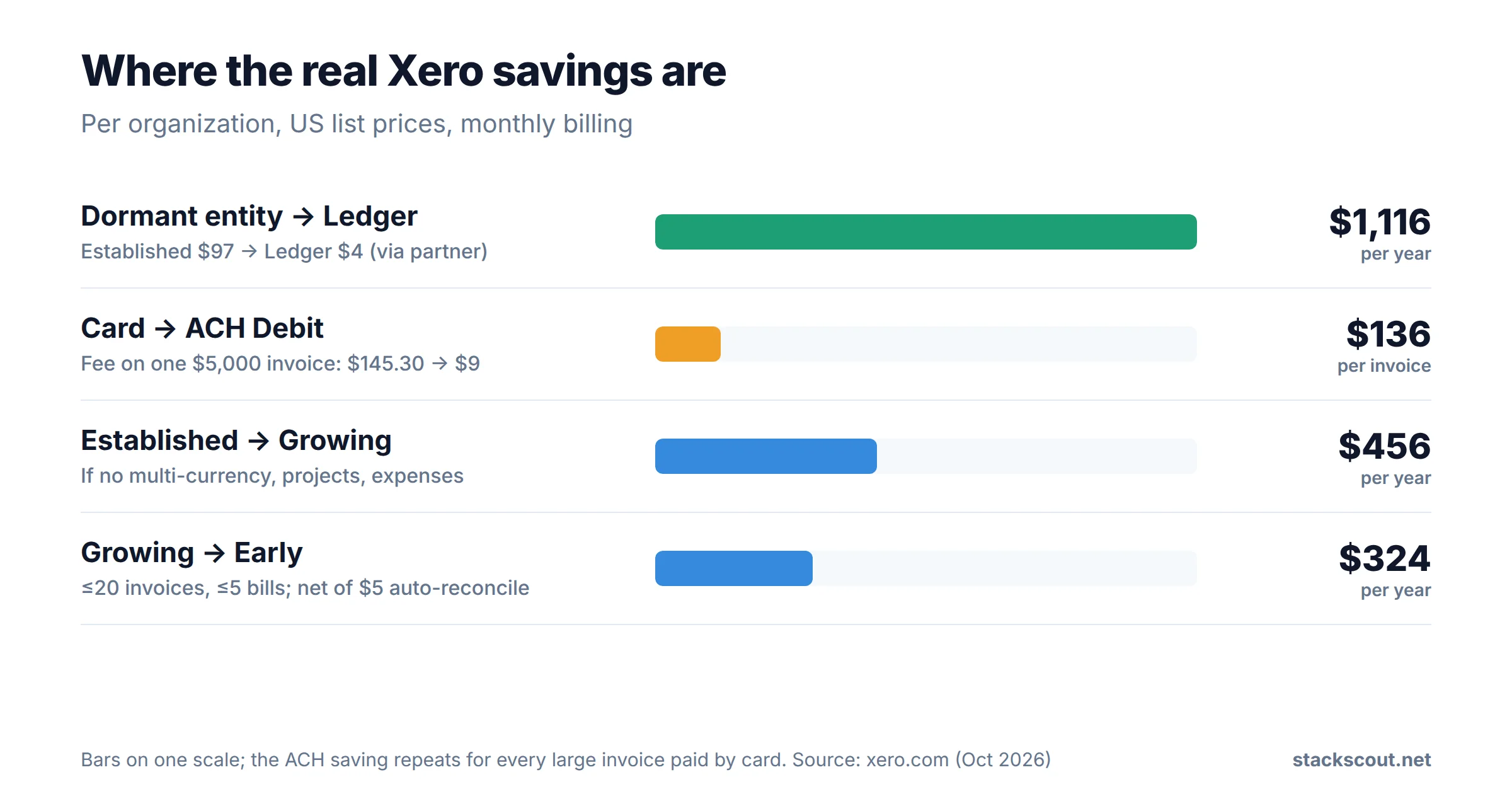
Up to $1,116 / yr per entityXero sells two stripped-down plans that most business owners never see because they're available only through accounting and bookkeeping practices in the Xero partner program. Xero's US page lists them at Xero Ledger $4/month and Xero Cashbook $10/month per client. Those prices include any sales tax; the business plans are quoted before tax.
- Ledger is meant for "clients who need annual accounts preparation." It includes bank reconciliation (from imported statements), budgeting, fixed assets, financial statements, and file storage. Clients can view data and reports but can't code transactions.
- Cashbook adds daily automatic bank feeds and lets the client code their own transactions. It doesn't include invoicing.
A holding company, IP entity, or wound-down subsidiary sitting on Established for historical reasons costs $97 a month. Moving it to Ledger saves $93/month, or $1,116/year. A dormant entity on Growing saves $55/month ($660/year) on Ledger or $49/month ($588/year) on Cashbook.
Catch: the plan has to be set up by your partner practice, and it can't send invoices or pay bills. If the entity still bills customers, it needs a business plan.
2. Get large invoices paid by ACH Debit or bank transfer, not card
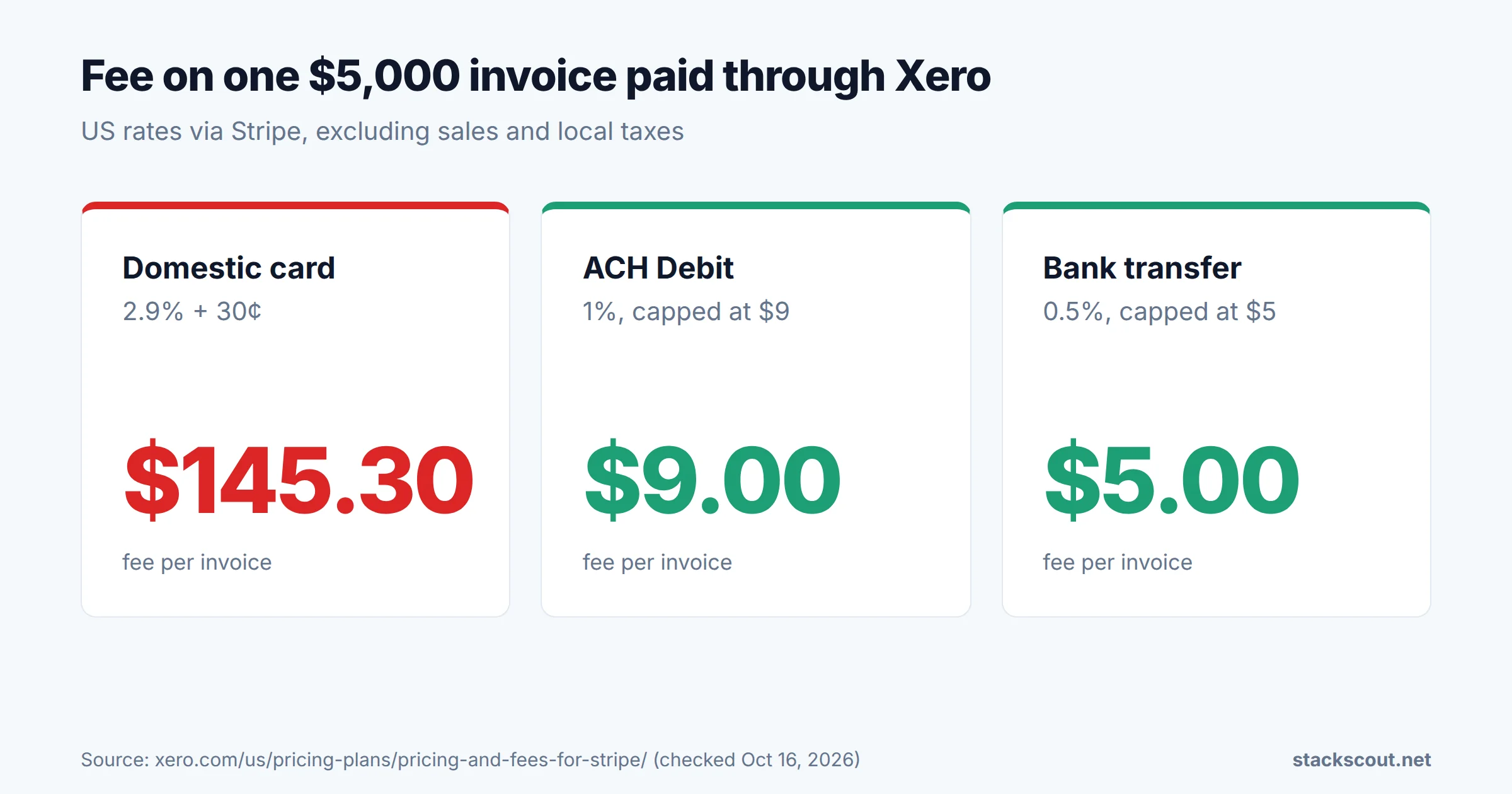
$136 saved per $5,000 invoicePayment fees are never covered by subscription discounts. Xero's terms say payment fees "are not eligible for subscription discounts and offers." For many B2B companies they cost more than the subscription itself. The US Stripe rates on Xero's fee page are:
| Payment method (US, via Stripe in Xero) | Published fee | Fee on a $5,000 invoice |
|---|---|---|
| Domestic card | 2.9% + 30¢ | $145.30 |
| International card | 4.4% + 30¢ (+1% if currency conversion) | $220.30+ |
| ACH Debit | 1%, capped at $9.00 | $9.00 |
| Bank transfer | 0.5%, capped at $5.00 | $5.00 |
One $5,000 card payment costs $145.30, which is more than the $84 the Established increase adds over a whole year. If ten customers a month pay $5,000 invoices by card, switching them to ACH Debit saves about $1,363 a month. The fix is mostly operational: turn on bank-based payment methods on the invoice, put ACH first in your invoice wording, and keep cards for small or overseas clients.
Catch: some customers' AP teams insist on cards for rewards or float. Ask, but don't force it on key accounts.
3. Drop from Established to Growing if you don't use its four exclusives
$456 / yrThe $38 gap between Growing ($59) and Established ($97) pays for a short list of features. On the current US pricing page, these are listed only under Established:
- Use multiple currencies
- Track time and costs for projects
- Employee expense and mileage claims
- Analyze KPIs and ratios, industry benchmarking, and international online bill payments
If nobody in your company invoices in a foreign currency, tracks projects in Xero, or files expense claims there, you're paying $456 a year for features you don't use. Growing still includes performance dashboards, health scorecards, budgets with smart suggestions, a 60-day cash-flow forecast, auto-reconcile, and free domestic ACH bill pay.
Catch: if you upgrade again later, Xero's terms only allow moving to a cheaper plan "1 month after upgrading," so don't flip back and forth. Before you downgrade, export the project and expense reports you need.
4. Drop from Growing to Early if you send 20 or fewer invoices and enter 5 or fewer bills a month
$324 / yr netEarly is $32 a month cheaper than Growing, but it caps you at 20 invoices and 5 bills a month. The cap counts invoices you approve as well as ones you send, and Xero notes that "transactions initiated by app partners may automatically contribute to your invoice limit." So a Stripe, Shopify, or billing-system sync can use up the allowance for you.
Early also doesn't include auto-reconcile; it's an optional add-on. Our October 12 check of the Xero pricing page found it priced at $5/month. If you add it, the net saving is $27 a month, or $324 a year.
Catch: Early fits a services company with a handful of monthly retainers. It doesn't fit a company whose billing system pushes every invoice into Xero.
5. Ask your accountant whether they can bill your subscription
Amount not publishedXero's partner-program page states that "Xero Bronze partners and above are eligible for Xero business edition subscription discounts," and that the discounts grow with partner status (Bronze, Silver, Gold, Platinum). Xero doesn't publish the discount levels on its public US pages. Third-party figures circulate, but we couldn't confirm them on xero.com, so we don't repeat them here.
In practice, this means asking your bookkeeper or CPA one question: "Are you a Bronze-or-higher Xero partner, and would moving our subscription to your practice billing lower our cost?" Firms often pass the discount on, keep part of it, or bundle it into their monthly fee, so compare your all-in cost rather than the subscription line alone.
Catch: when the practice holds the subscription, leaving that accountant also means moving the subscription. Make sure the engagement letter says who owns the organization.
6. Don't pay a separate bill-pay tool for domestic ACH
Varies by volumeXero's US terms state that "standard ACH payments are included in Xero Early, Growing and Established plans." That covers same-currency, standard (not same-day) USD payments. If you also pay for a standalone AP tool only to send domestic ACH, that tool may now be redundant. For comparison, QuickBooks' pricing page lists "$0.50/standard ACH transaction over monthly allotments." If you need approval workflows or international payouts, see our comparison of AP automation tools before cutting anything.
Catch: same-day ACH, international, and cross-border payments carry separate fees on Xero.
7. Keep any promo you already have, and don't let a new entity miss the first-org offer
One-offExisting discount codes keep running at the new prices until they expire. New organizations are different: the 80%-off-for-three-months code (Early $5.40, Growing $11.80, Established $19.40 for months 1–3) is only for US customers "purchasing their first organization on xero.com." A second or third entity added under the same login doesn't qualify. That's another reason to run new non-trading entities on Ledger or Cashbook through a partner from day one.
What doesn't work in the US: annual prepay (Xero US bills monthly only) and removing users (every plan includes unlimited users with "no per-user license fees"). If a reseller offers you "annual Xero pricing," it's their own arrangement, not a Xero list price.
03Multi-entity groups: a worked example
The phase-out of the multi-organization discount hits groups with several entities hardest, so it helps to run the numbers. Take a typical structure: one US operating company, one IP holding company, and one dormant subsidiary from an old acquisition, all on Established for consistency.
That $2,160 is roughly 26 times the $84 a year the October increase adds to the operating company's own subscription. Even if the multi-org discount had been large, the cleanup beats it, and it needs nothing more than a call to your partner practice.
If the IP company does invoice (royalties to an overseas affiliate, say), it needs a business plan. Growing is enough unless those invoices are in a foreign currency, because multi-currency is Established only. In that case the group total would be $97 + $97 + $4 = $198/month.
Before you cut anything, also consider consolidation. None of the three Xero US business plans lists multi-entity consolidation on the pricing page, so groups often pay for a third-party consolidation app. That cost belongs in the same audit. Our accounting software guide for SaaS companies covers which platforms handle consolidation natively.
04When switching away from Xero actually saves
"Is there a cheaper alternative to Xero?" is one of the most common follow-up searches after a price increase. The honest answer depends on what you compare against. Here is annual list cost at equal capability for two common profiles, using each vendor's official pricing page as of October 2026. We assume monthly billing unless a vendor offers annual billing, which is noted separately.
Profile A: 5 people in the books, USD only
| Option | Plan that covers 5 users | Monthly | Annual |
|---|---|---|---|
| Xero | Growing (unlimited users) | $59 | $708 |
| QuickBooks Online | Plus (5 users; Essentials caps at 3) | $140 | $1,680 |
| Zoho Books | Professional (5 users) | $50 ($40 billed annually) | $600 / $480 |
| FreshBooks | Plus ($43) + 4 team members × $11 | $87 | $1,044 |
Profile B: 5 people, invoices in more than one currency
| Option | Cheapest plan with multi-currency for 5 users | Monthly | Annual |
|---|---|---|---|
| Xero | Established | $97 | $1,164 |
| QuickBooks Online | Plus (multi-currency is Essentials+, 5 users needs Plus) | $140 | $1,680 |
| Zoho Books | Professional (lists "Record multi-currency transactions") | $50 ($40 billed annually) | $600 / $480 |
Three conclusions follow from these tables.
- QuickBooks Online isn't the escape hatch. Intuit's August 1, 2026 increase took Essentials from $75 to $85, Plus from $115 to $140, and Advanced from $275 to $340. That's up to 24%, against Xero's 7–8%. QuickBooks also caps users per plan, so at 5 or more people Xero is cheaper on list price. See our QuickBooks Online pricing breakdown for the seat caps, or the QuickBooks vs Xero seat-cost analysis for the trade-offs beyond price. That analysis was written before both 2026 increases, so recheck its dollar figures against current list prices.
- Zoho Books is the one clearly cheaper like-for-like option. At about half of Xero Established's price with multi-currency included, it's the alternative worth piloting. Check two things before committing: whether your outside accountant works in Zoho Books, and whether your payroll, bank, and billing integrations exist there. Zoho Books caps users per plan (Standard 3, Professional 5, Premium 10, Ultimate 15), unlike Xero's unlimited users.
- Wave and FreshBooks win only at the very small end. Wave Pro is $19 a month and is aimed at owner-operators. FreshBooks' Lite plan ($23) limits you to invoicing 5 clients, and every extra team member adds $11 a month, so FreshBooks Plus costs more than Xero Growing once you have three people in the books. For a solo or two-person shop, our Wave vs Xero break-even analysis covers that decision.
Stay on Xero if…
- You have 4 or more people in the books (unlimited users)
- Your accountant is a Xero partner (Ledger, Cashbook, and partner discounts)
- Your integrations and bank feeds already work
- Payment fees, not the subscription, are your bigger cost
Consider leaving if…
- You pay for Established only for multi-currency (Zoho Books is cheaper)
- You need native multi-entity consolidation or rev-rec
- You're a 1–2 person shop that doesn't need bills or bank feeds
- You hit Early's 20-invoice cap and the jump to Growing isn't worth it to you
Switching also costs money even when the new subscription is cheaper. You'll spend time remapping the chart of accounts, rebuilding bank rules, reconnecting apps, and either converting history or keeping a read-only Xero file. Here Ledger at $4 a month is a cheap archive that your accountant can still open. Introductory offers on the other side (QuickBooks 50% off for 3 months, FreshBooks 80% off for 4 months, Wave Pro half price for 3 months) are temporary. Compare the regular prices, not the first-quarter promo. If you do move to QuickBooks, our guide on connecting Stripe to QuickBooks Online covers the payment sync, which works differently from Xero's free Stripe connection. For a structured way to compare, we also have 7 criteria for choosing accounting software and a step-by-step guide to migrating from Xero to QuickBooks or Zoho Books.
05A 20-minute audit checklist
Open Subscription in your Xero account (Xero's notice says the plan is listed there in the "Subscription" column) and your last two invoices, then work through these questions:
- List every organization on the bill. For each one: does it send invoices or pay bills? If not, ask your partner practice about Ledger ($4) or Cashbook ($10).
- Find the multi-organization discount line on your September invoice. That amount disappears as the phase-out proceeds, so budget for it.
- For each Established org, check whether you used multi-currency, projects, expenses, or KPIs in the last 90 days. If none, move it to Growing ($456/yr saved).
- For each Growing org, count invoices approved or sent, including app-created ones, and bills entered last month. If they're at or under 20 and 5, consider Early ($324/yr net).
- Pull your Stripe fee total for the last quarter. If card fees on invoices over about $1,000 are a meaningful share, promote ACH Debit and bank transfer on those invoices.
- Ask your accountant whether partner billing would lower your all-in cost.
- Check for paid apps that duplicate included features, such as domestic ACH bill pay, which every Xero US plan includes.
06Frequently asked questions
Will Xero increase prices in 2026?
How much does Xero cost for a year?
Can I pay for Xero annually to get a discount?
Is there a cheaper alternative to Xero?
What are Xero Ledger and Xero Cashbook, and can I buy them directly?
07Methodology
We retrieved Xero's US pricing page, plan terms, Stripe fee page, payroll page, and Ledger and Cashbook page directly from xero.com on October 15–16, 2026. The pre-October prices and the multi-organization discount wording come from Xero's US price-change notice, which now redirects to the main pricing page; we read the August 25, 2026 copy archived by the Internet Archive. We pulled competitor prices from the official QuickBooks, Zoho Books (US), Wave, and FreshBooks pricing pages on the same dates. Savings are simple list-price differences at monthly billing, excluding tax. They don't account for negotiated, partner, or promotional discounts unless stated. Where Xero doesn't publish a number (partner discount levels, the multi-organization discount percentage), we say so instead of using third-party estimates. We didn't run paid accounts on these plans; everything here is based on our research of published terms.
Sources
- Xero US: Pricing plans, plan features, and offer terms. https://www.xero.com/us/pricing-plans/ (checked October 15, 2026)
- Xero US: price-change notice, effective October 1, 2026 (archived August 25, 2026). https://web.archive.org/web/20260825112656/https://www.xero.com/us/pricing-plans/update/
- Xero US: Xero Ledger and Cashbook for accountants and bookkeepers. https://www.xero.com/us/xero-ledger-and-cashbook/
- Xero US: Pricing and fees for Stripe. https://www.xero.com/us/pricing-plans/pricing-and-fees-for-stripe/
- Xero US: Partner program. https://www.xero.com/us/partner-programs/partners/
- Xero US: Payroll powered by Gusto. https://www.xero.com/us/accounting-software/payroll/
- Insightful Accountant: "Xero Announces U.S. Subscription Price Changes" (July 30, 2026). insightfulaccountant.com
- QuickBooks Online pricing. https://quickbooks.intuit.com/pricing/
- Zoho Books US pricing. https://www.zoho.com/us/books/pricing/
- Wave pricing. https://www.waveapps.com/pricing
- FreshBooks pricing. https://www.freshbooks.com/pricing

Technology consultant with 10+ years in the Japanese tech industry. Specializing in SaaS evaluation, workflow automation, and B2B tool integration.