Ramp vs Brex (2026): Who Qualifies, What Each Plan Really Unlocks, and Which Fits Your Stage
A comparison for startup CFOs and finance ops leads on approval rules, which plan unlocks your ERP, bill-pay fees, and what the rewards are actually worth in cash.
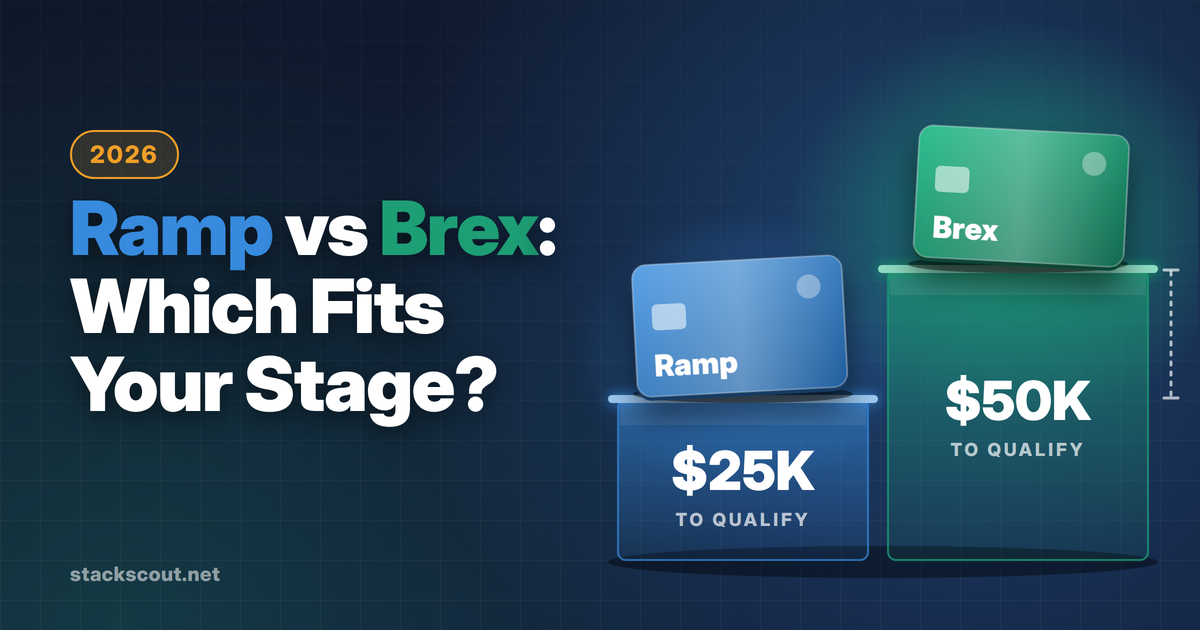
Choose Ramp if you can show $25,000 in a linked US bank account, your books are on QuickBooks Online or Xero, and you want flat cash back with the deepest AP, procurement, and automation stack. Choose Brex if you are venture-backed (or bring in more than $500K a year), you run NetSuite or Sage Intacct and don't want to pay per seat to connect it, or your team spends a lot on travel booked through the platform. The difference most comparisons miss: Brex's free Essentials plan includes the NetSuite and Sage Intacct integrations. Ramp only offers them on Plus, at $15 per user per month plus a platform fee it doesn't publish.
Most Ramp vs Brex articles compare feature checklists. In practice both issue unlimited cards, scan receipts, pay bills, and book travel. The decision usually comes down to four things a checklist doesn't show: whether you qualify, which plan your accounting system requires, what you pay to send vendor payments, and what the rewards are worth once you redeem them. This guide covers those four, using each company's own pricing pages, help center articles, and legal disclosures as of October 21, 2026.
If you're still deciding whether you need a card-led platform at all, our comparison of expense management software for small businesses covers the tools that don't require switching cards. If bill pay is the main job, see our accounts payable automation comparison.
Quick comparison table
| Criterion (as of Oct 2026) | Ramp | Brex |
|---|---|---|
| Free plan | Ramp Free, $0/user/month | Essentials, $0/user/month |
| Paid plan | Plus: $15/user/month + platform fee based on team size (unpublished); 20% off with annual billing | Premium: $12/user/month, flat |
| Minimum to apply (US) | $25,000 cash in a linked US business bank account, for every applicant | Funded startups: $50,000 cash for monthly payments; daily-payment accounts available below that |
| Accounting integrations on the free plan | QuickBooks Online, Xero | QBO, QuickBooks Desktop, Xero, Sage Intacct, NetSuite, Pilot |
| NetSuite / Sage Intacct | Plus and above | Included on Essentials |
| Multi-entity | Plus and above | Essentials: up to 2 entities (1 global); Premium: US and international |
| Local-currency card issuing | Enterprise: 30+ countries | Enterprise: 50+ countries |
| Vendor payment fees | ACH $0.59, check $1.99, wire $15, SWIFT $20 from an external bank; waived when paid from Ramp Checking | $0 for ACH, checks, domestic and international wires from the Brex business account |
| Card rewards | Cash back (rate not published on Ramp's pricing or card pages) | Points: 7x rideshare, 4x Brex travel, 3x restaurants, 2x recurring software, 1x other; 0.6¢/point as cash |
| FX markup on foreign card spend | Up to 3% | Up to 3% |
| Ownership | Independent; raised $1.85B at a $60B valuation (Oct 15, 2026) | Capital One subsidiary since Apr 7, 2026 |
1. Who actually qualifies
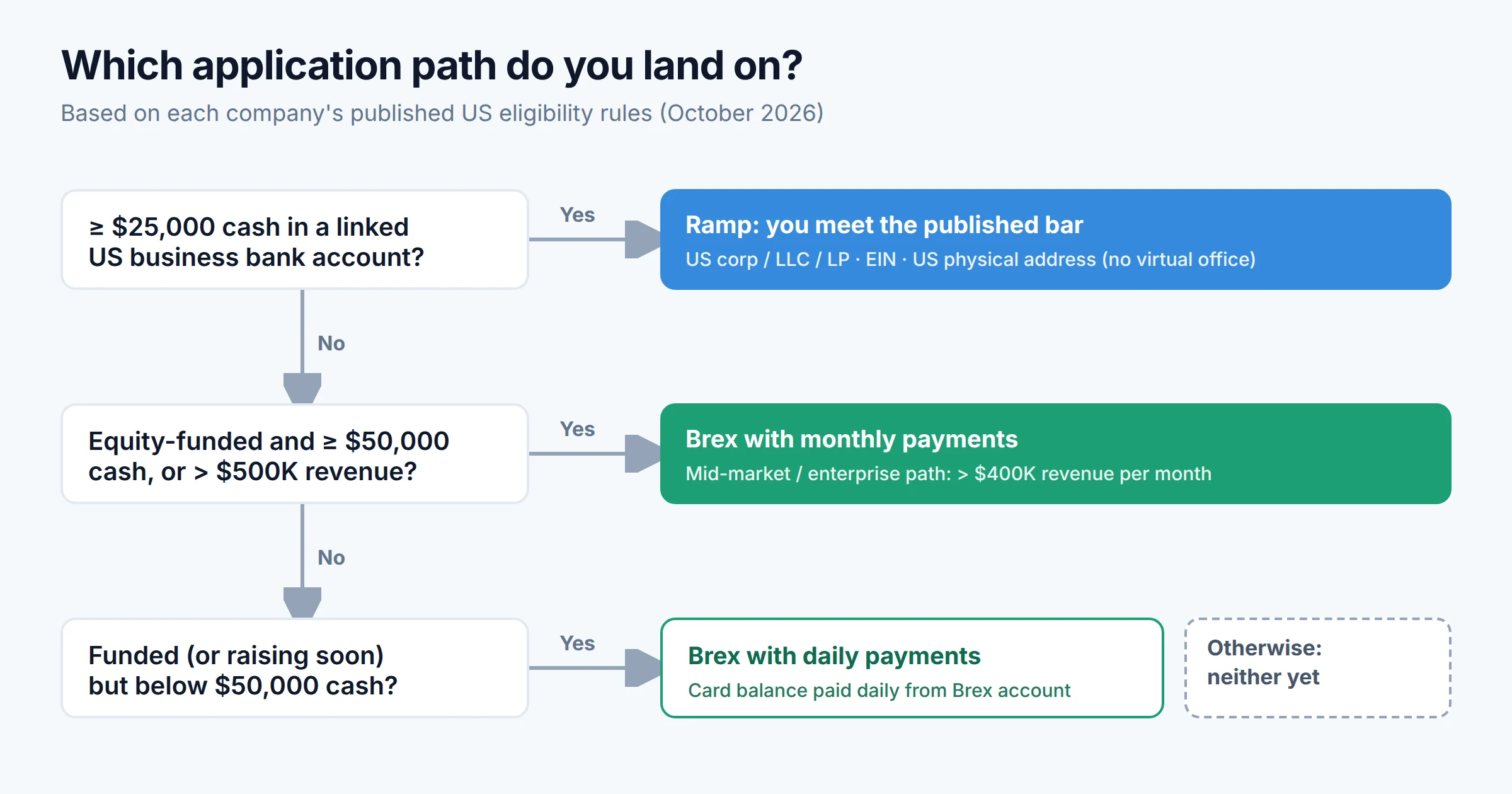
"Is Brex hard to get approved for?" is one of the most common questions about these two products, and the honest answer is that it depends on how your company is funded. Ramp uses the same cash test for every applicant. Brex sorts applicants into segments and offers two kinds of account.
Ramp's bar: one number for everyone
According to Ramp's help center, a US applicant must be registered in the United States as a corporation, LLC, or LP (nonprofits are welcome; sole proprietors are not), have at least $25,000 in cash in a US business bank account linked to the application, have most of its operations and corporate spend in the US, and use a physical US address. PO boxes, virtual office addresses, registered agent addresses, and mail forwarding are not accepted. An EIN is mandatory, and Ramp won't accept applications from a non-business email address.
Two details matter for international founders. A US-incorporated company whose officer doesn't have an SSN can still apply using a foreign passport and proof of address. And Ramp says it doesn't require a personal guarantee. It sets the card limit as a percentage of the cash in your linked accounts, or with revenue-based underwriting.
Brex's bar: depends on your segment
Every Brex applicant needs a US EIN, a valid US incorporation, US operations, and a US physical address. Brex then focuses on companies that meet any of these criteria:
- An equity investment of any amount (accelerator, angel, or VC), or a plan to raise one soon
- More than $500,000 in annual revenue
- A tech startup on track to meet one of these criteria and referred by an existing customer or partner
To get monthly payment terms, Brex lists three paths: funded startups need a $50,000 minimum cash balance (possibly lower through certain partner referrals); mid-market and enterprise companies need more than $400,000 a month in revenue; and commercial businesses need more than $500,000 in annual revenue.
Addresses are another difference. Ramp rejects virtual office addresses outright. Brex accepts a virtual address as long as a beneficial owner or control officer has a verifiable physical presence in the US. A remote-first company registered at a coworking or virtual address may therefore get through Brex's address check and not Ramp's.
2. The plan you need depends on your accounting system
This is where the "both are free" framing stops being useful. Each company's free plan is generous, but they put the paywall in different places, and the line that matters most for a growing finance team is the ERP connection.
Ramp: QBO and Xero on Free, NetSuite on Plus
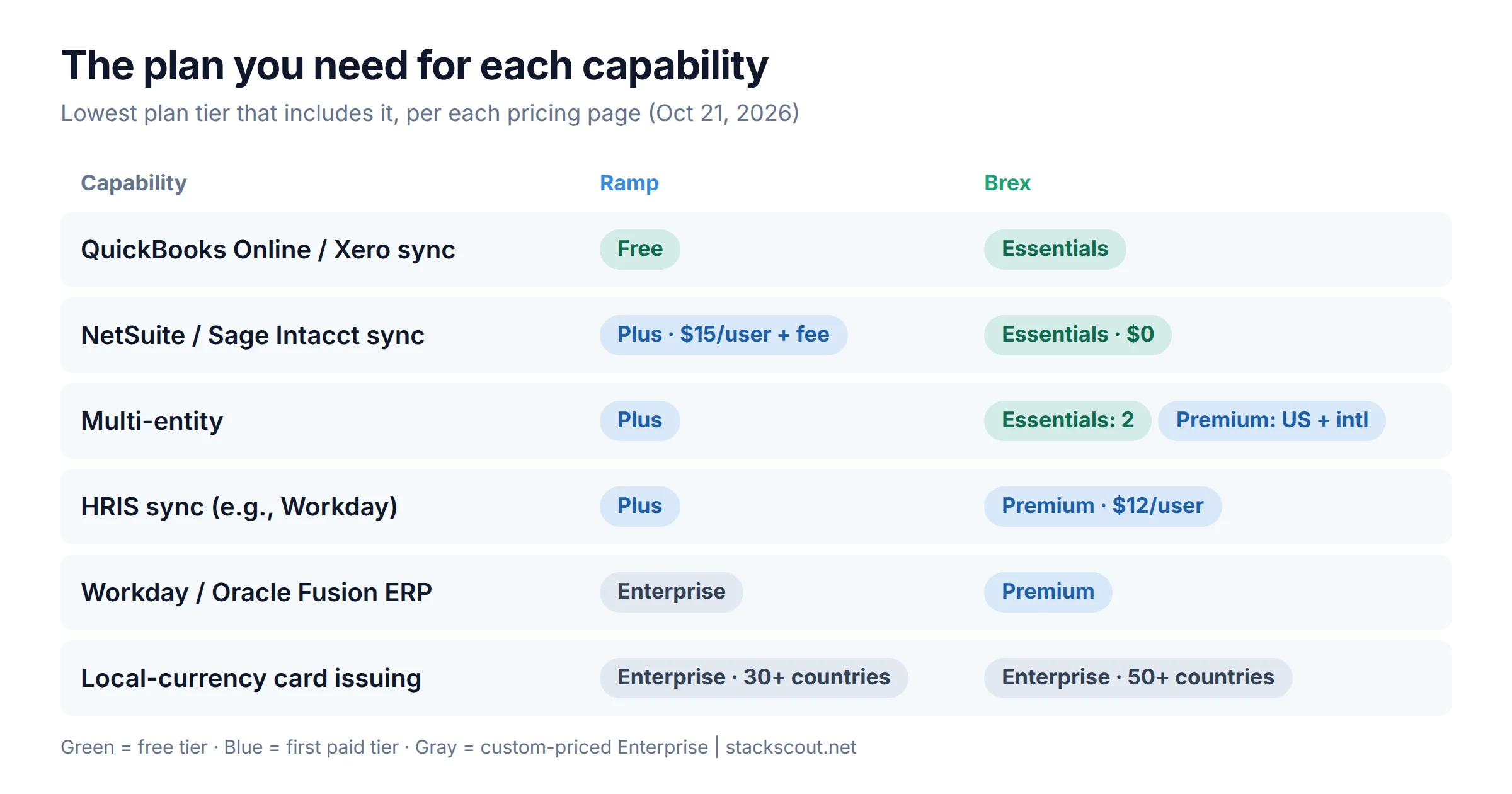
Ramp's pricing page lists QuickBooks Online and Xero as the accounting integrations on Free. NetSuite, Sage Intacct, Acumatica, and Microsoft Dynamics 365 Business Central start at Plus, along with multi-entity support, "AI coding for every field," automated accruals, amortization, and Workday HRIS sync. Workday Financials, Oracle Fusion Cloud, and Dynamics F&O are Enterprise only. Plus costs $15 per user per month, plus a platform fee based on team size that Ramp doesn't publish, with 20% off for annual billing. Plus also comes with a 30-day free trial.
Brex: NetSuite is already on Essentials
Brex's pricing page includes a plan-by-plan comparison grid. The row "Accounting integrations, including NetSuite," described in its tooltip as covering Pilot, QBO, QBD, Xero, Sage Intacct, and NetSuite, is checked for Essentials, Premium, and Enterprise. Premium ($12 per user per month) adds "custom, advanced accounting integrations" (Workday, Fusion, SAP), HRIS sync with org charts (UKG, ADP, Gusto, Deel, Workday, and 35 more), multiple custom expense policies, Live Budgets, multi-entity across the US and international entities, and custom roles with SSO and audit logs.
What a 25-person company pays in software fees
Here's the subscription cost at 25 users, using published list prices only:
| Scenario (25 users) | Ramp | Brex |
|---|---|---|
| Books on QBO or Xero, one entity, basic policies | $0 (Free) | $0 (Essentials) |
| Books on NetSuite or Sage Intacct, one entity | $375/mo + platform fee (Plus, monthly) or $300/mo + platform fee (annual) | $0 (Essentials) |
| NetSuite + multi-entity + role-based policies + HRIS sync | $375/mo + platform fee (Plus) | $300/mo (Premium) |
The platform fee is the unknown in Ramp's numbers, so get it in writing before you sign. On Brex, every user on an account must be on the same plan, and paid plans are billed per provisioned user, with overages charged above your committed seat count.
3. Paying vendors: where small fees add up
Both products include bill pay on the free plan. What it costs depends on where the money comes from.
Ramp introduced per-payment fees on June 1, 2026. Standard ACH is $0.59, standard checks are $1.99, same-day ACH is $10, domestic wires are $15, and SWIFT USD wires are $20. Ramp waives the fees for standard ACH, checks, same-day ACH, domestic wires, and SWIFT when you pay from a Ramp Checking account (overnight check delivery and check attachments are still charged). Ramp bills these fees on a monthly statement, and according to its help center they don't sync to your accounting system, so someone has to book them manually each month.
Brex says it charges no transaction fees for domestic wires, international wires, ACH, or checks sent from the Brex business account. Correspondent and recipient banks may still deduct their own fees, and non-USD wires use an exchange rate set by Brex.
In practice, both companies are offering free payments in exchange for keeping your operating cash with them. Ramp Checking advertised a 2% APY (as of October 20, 2026, with interest paid by First Internet Bank of Indiana). Brex's business account pairs checking at Column N.A. with Treasury and Vault, and lists FDIC coverage of up to $6M through program banks. If your board or investors require you to keep your main operating account at a specific bank, use the "external bank" row above, where Ramp charges per payment and Brex's published fee table doesn't apply.
4. Rewards: what they're worth in cash
Ramp's rewards are simple, and Brex's are higher in some categories but come with conditions. To compare them fairly you have to convert both to dollars.
Brex: multipliers, then a 0.6¢ cash rate
Brex's rewards page lists 7x on rideshare, 4x on Brex travel (flights and prepaid hotels), 3x on restaurants, 2x on recurring software, and 1x on everything else. Its help center gives a worked example: $100,000 a month split $5K rideshare / $25K Brex travel / $10K restaurants / $10K software / $50K other earns 2,820,000 points a year. Brex values that at $28,200 if redeemed for Brex travel (1 point = 1¢). Redeemed as cash or a statement credit, a point is worth 0.6¢, which brings the same points to $16,920.
Three conditions limit how much of that you'll actually earn:
- Points are earned on USD transactions with US merchants. Brex's help center says international bookings processed as international purchases don't earn points.
- The 4x travel rate requires booking through Brex travel and paying with a Brex spend limit or employee card. Brex adds an extra 1x if you also have a Brex business account and pay daily.
- The example puts 25% of spend on Brex travel. A SaaS company whose card spend is mostly cloud and software will land much closer to 2x.
Ramp: cash back, rate set per customer
Ramp's card page says you "earn cashback on every swipe," which can be applied to the card balance, deposited, or redeemed for travel and gift cards. It doesn't publish a rate. Independent reviews such as NerdWallet's list up to 1.5% and note that Ramp sets the rate per customer, so confirm your rate during underwriting. At 1.5%, the same $1.2M a year would return $18,000 in cash.
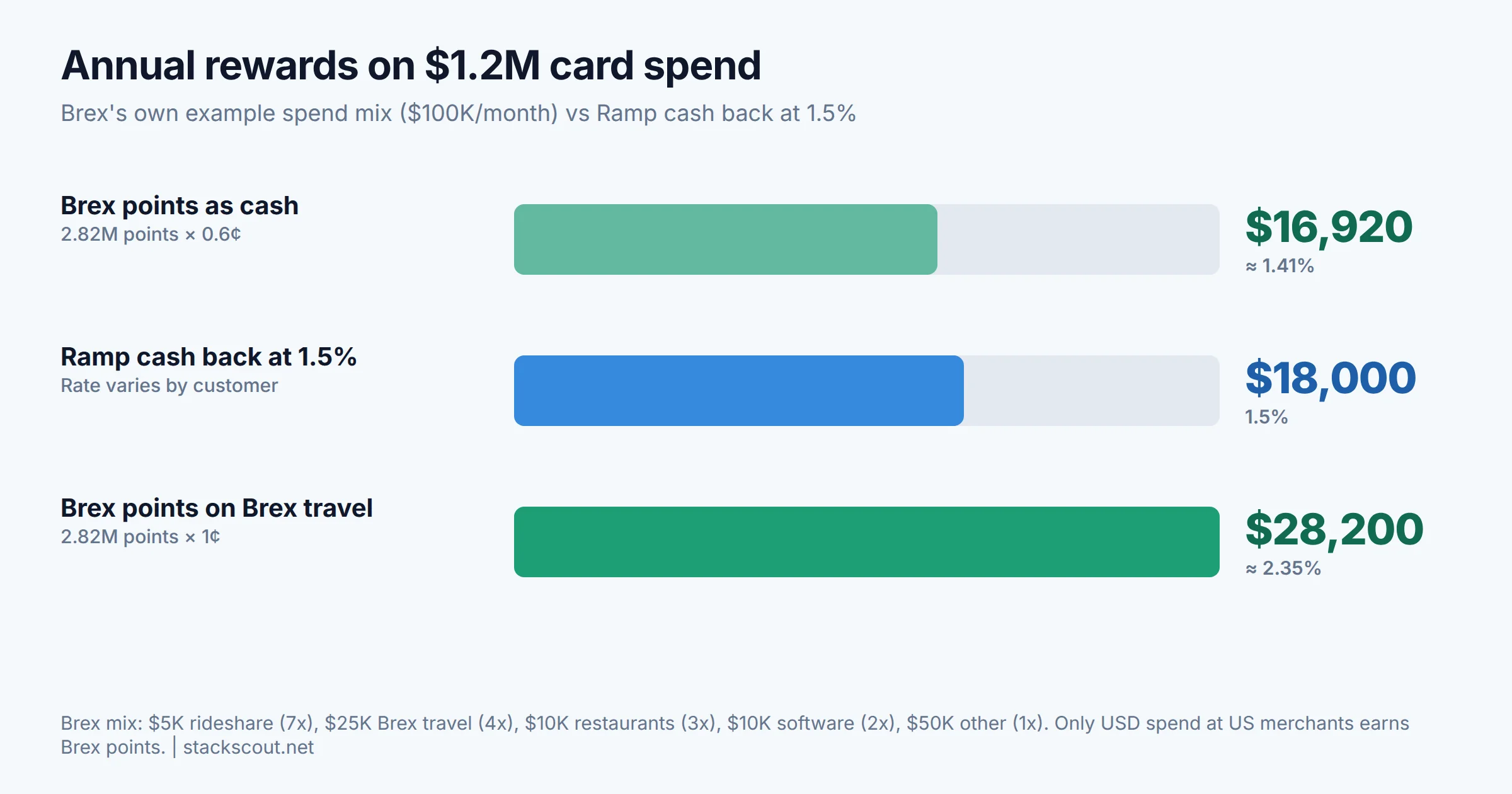
The conclusion: if you want cash, Ramp is likely to match or beat Brex unless a large share of your spend is rideshare and restaurants. If your team travels a lot and is willing to book through Brex travel, Brex comes out ahead.
On foreign spend, neither card is fee-free. Ramp's help center says it includes a margin on the exchange rate that "will not exceed 3%." Brex's cost page says it applies an FX markup "of up to 3%" on transactions that need currency conversion. If your team spends heavily abroad or pays many overseas contractors by card, compare actual rates on sample transactions, or route those payments through a dedicated rail (see our guide to paying international contractors).
5. The Capital One factor (and why Ramp keeps showing up as "winning")
Capital One completed its acquisition of Brex on April 7, 2026, in a stock-and-cash deal valued at about $5.15 billion. Brex's founder and CEO, Pedro Franceschi, continues to run the business. Brex's site footer now reads "Brex LLC is a wholly owned subsidiary of Capital One, N.A." Checking is still provided by Column N.A., and Brex's cards are still issued by Emigrant Bank, Fifth Third Bank, or Airwallex (Netherlands). The published plans and prices above haven't changed since the deal.
Ramp, meanwhile, announced on October 15, 2026 a $1.85 billion round at a $60 billion valuation, more than $2 billion in annualized revenue with positive cash flow, and more than 85,000 customers. That's why searchers ask "why is Ramp beating Brex": one company is still raising money as an independent; the other was bought by a bank. Neither fact tells you which product suits your company better.
What the ownership change does affect is the risk of future changes. A bank owner can change underwriting, rewards, or deposit arrangements over time, and Brex's own rewards terms already reserve the right to cap, charge fees on, or expire points. A venture-backed independent can change its pricing too: Ramp's June 2026 bill-pay fees were exactly that. Plan as if either vendor will change its terms within your contract period, and keep your accounting sync and payment records portable.
Pros and cons
Ramp
Pros
- One published $25,000 cash bar, no funding story required
- No personal guarantee; limits based on cash or revenue
- Free plan includes AP with OCR, AR invoicing, travel, and QBO/Xero sync
- Cash back is simpler to account for than points
- Deep Plus tier: auto-coding, accruals, amortization, three-way match
Cons
- NetSuite and Sage Intacct require Plus
- Plus platform fee isn't published
- Bill-pay fees since June 2026 unless you use Ramp Checking, and they don't sync to your ledger
- Rejects virtual office and registered agent addresses
- Cash back rate isn't published
Brex
Pros
- NetSuite, Sage Intacct, QBD, and Xero integrations on the free Essentials plan
- Premium is a flat, published $12/user/month
- $0 ACH, check, and wire fees from the Brex business account
- High multipliers on rideshare, travel, and dining
- Daily-payment path for companies below the $50,000 bar
Cons
- Monthly terms gated on funding status or high revenue
- Points are worth 0.6¢ as cash
- Only USD, US-merchant spend earns points
- Up to 3% FX markup on foreign card spend
- Long-term roadmap now set by a bank holding company
Who should choose which
Bootstrapped, $25K–$500K revenue, books on QBO or Xero. You clear Ramp's cash bar but likely none of Brex's monthly-terms paths.
Ramp FreeSeed/Series A, VC-backed, on NetSuite or Sage Intacct, one entity. Brex connects your ERP at $0; Ramp needs Plus.
Brex EssentialsTravel-heavy team (sales, field ops) willing to book through the platform. 4x on Brex travel plus 1¢ travel redemption beats flat cash back.
BrexSoftware- and cloud-heavy spend, want cash, run 100+ bills/month and can move operating cash. Cash back plus fee-free bill pay from Ramp Checking.
Ramp + Ramp CheckingController-led team that needs accruals, amortization, and auto-coding on NetSuite. Ramp's Plus accounting automation goes further; get the platform fee quoted.
Ramp PlusMultiple entities, including non-US subsidiaries, at a predictable seat price. Brex Premium covers US and international entities at $12 flat.
Brex PremiumBelow $25K cash, not funded, under $500K revenue. Neither offers you a credit line yet. A bank-linked card such as Mercury's IO (for Mercury account holders) is the usual next step.
Neither, yetMercury comes up often as the third option ("Mercury vs Brex vs Ramp"). It's a bank account first: Mercury's IO card advertises 1.5% cash back and is only available to Mercury account holders, and its bill pay is covered in our AP automation comparison. A full Mercury vs Ramp breakdown is coming.
Frequently asked questions
Is Brex or Ramp better?
Why is Ramp beating Brex?
Is Brex hard to get approved for?
Who are the main competitors of the Ramp card?
Do Ramp or Brex charge foreign transaction fees?
Methodology
Based on our research, every price, threshold, and plan gate in this article comes from Ramp's and Brex's own pricing pages, help center articles, and legal disclosures, all checked on October 21, 2026. For Brex, plan-by-plan availability was read from the comparison grid in its pricing page's source, since the rendered page hides the tooltips. Company facts come from Capital One's newsroom and Ramp's October 15, 2026 press release. The one figure we couldn't confirm on an official page is Ramp's cash back rate. We say so wherever it appears and cite the third-party source. We didn't test either product with a live account; the cost scenarios are calculations from published list prices.
Sources and references
- Ramp, Pricing and plans: ramp.com/pricing
- Ramp Help Center, Qualifications to apply for Ramp (U.S. based): support.ramp.com
- Ramp Help Center, Bill Pay fees: support.ramp.com/bill-pay-fees
- Ramp Help Center, Foreign transaction fees: support.ramp.com
- Ramp, "Ramp Reaches $60 Billion Valuation as Annualized Revenue Tops $2 Billion" (Oct 15, 2026): prnewswire.com
- Brex, Pricing plans: brex.com/pricing
- Brex Help Center, Brex account requirements: brex.com/support
- Brex Help Center, Cost of Brex services: brex.com/support
- Brex Help Center, Earning Brex points and Redeeming your Brex points: earning · redeeming
- Brex, Rewards: brex.com/product/rewards
- Capital One, "Capital One completes acquisition of Brex": capitalone.com
- Mercury, IO card: mercury.com/io
- NerdWallet, Ramp Card review (cash back rate, third-party): nerdwallet.com

Technology consultant with 10+ years in the Japanese tech industry. Specializing in SaaS evaluation, workflow automation, and B2B tool integration.