How to Convert a Contractor to an Employee Through an EOR (2026): A 7-Step Playbook for Startups
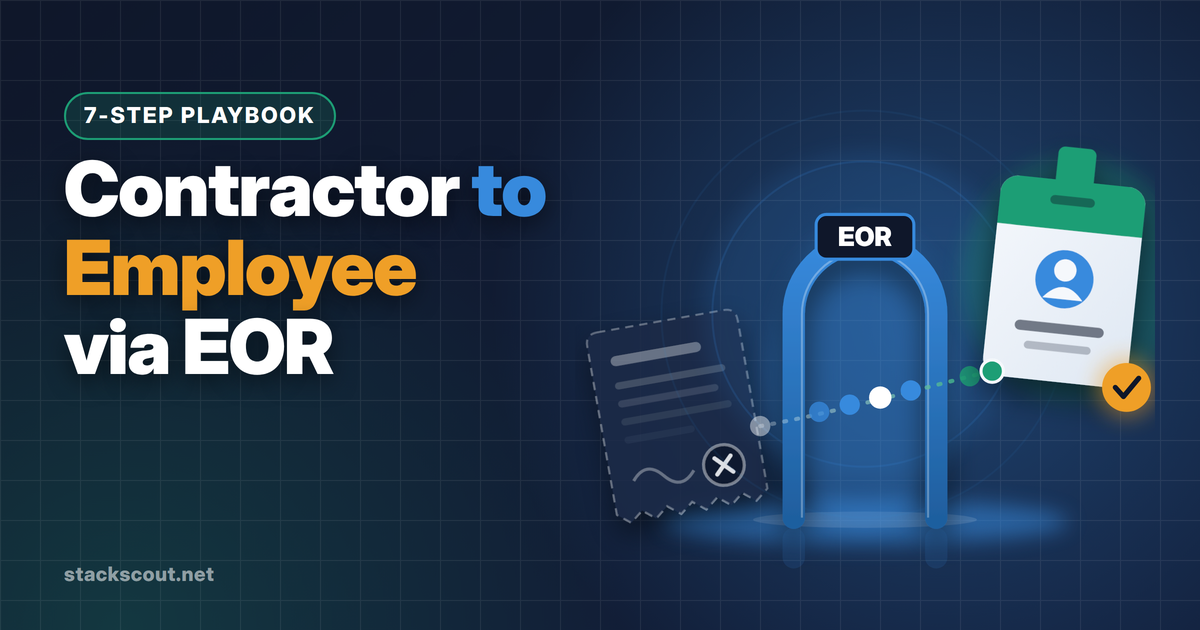
Moving an overseas contractor onto an Employer of Record is not an upgrade of the existing contract. Two things happen: the contractor agreement ends, and a new employment contract starts with the EOR's local entity. Most of the work is in the decisions around that switch. You have to turn the day rate into a gross salary that fits the same budget. You have to decide whether the contractor months count as tenure, and local law may limit probation (in Spain, a probation clause is void if the person already did the same job for you). You need to know what happens to their options: an EOR employee can't hold ISOs, and NSOs keep vesting only if your plan's "Continuous Service" definition covers the change. Finally, you need a clean end date, with no overlap and no gap. Plan two to four weeks. Start the EOR on the day after the last contractor day, ideally on the 1st of a month.
- What legally changes when you convert
- Step 1: Confirm conversion is the right fix
- Step 2: Translate the rate into a salary
- Step 3: Decide what carries over
- Step 4: Handle stock options
- Step 5: Choose the EOR and lock the start date
- Step 6: Close the contractor agreement cleanly
- Step 7: The first 60 days
- Common mistakes
- FAQ
Most guides on this topic stop at "pick an EOR and onboard the person." That's the easy part. Deel says a transition can be done "within days or weeks," and Remote lists a 2–5 working-day minimum for most large markets. The questions that actually stall founders sit around the switch. What salary do you offer someone who used to invoice $8,000 a month? Do they start a new probation? Do their options survive? Which date does the last invoice cover? This guide answers those questions in order, using an Employer of Record setup as the vehicle. It's written for startups that hire people abroad without a local entity, and it's useful whether or not you think the current contractor setup creates a misclassification risk.
What legally changes when you convert
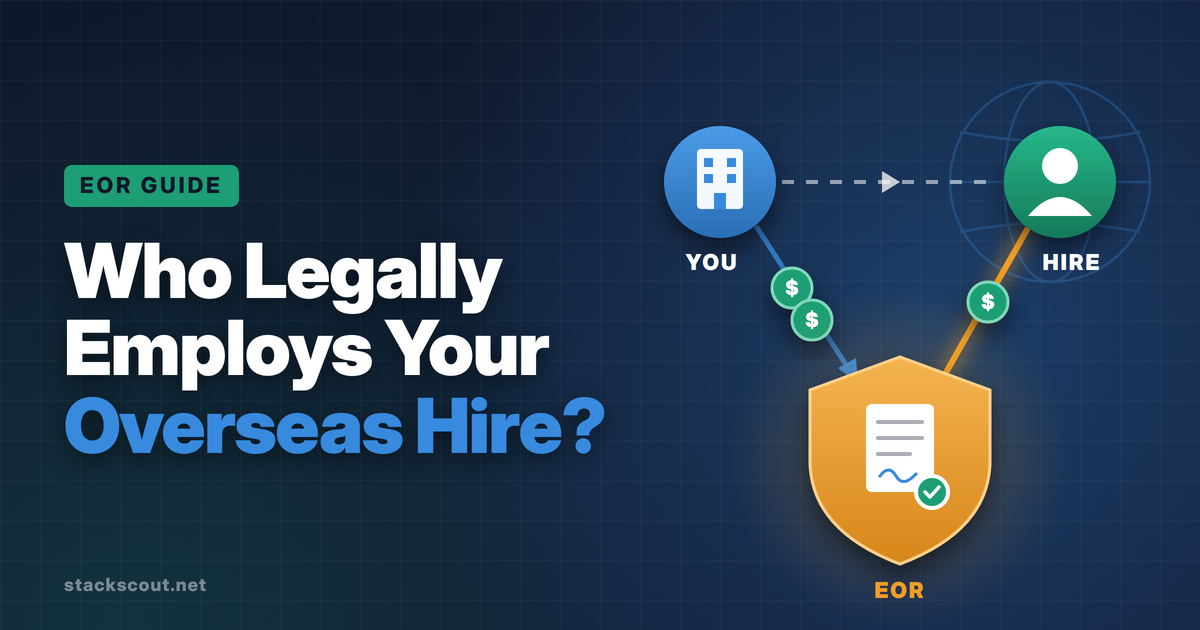
Before the switch, there's one contract: your company and the contractor, usually under your home-country law, with invoices paid gross. After the switch, there are two. One is a services agreement between your company and the EOR. The other is a local employment contract between the EOR's in-country entity and the worker. The EOR runs payroll, withholds tax and social contributions, provides statutory benefits, and bills you for salary plus employer costs plus its fee. You still direct the day-to-day work.
This matters because nothing "converts" in a legal sense. Deel's own help center says so for a similar case. Moving an existing employee onto Deel's EOR "will formally constitute a new employee agreement with Deel," and moving from another EOR provider "is not a transfer in the traditional sense — it is a new employment." A contractor is even further from a transfer, because there was never an employment relationship to carry forward. So every item that would carry over in a transfer — tenure, holiday balance, notice period, equity status — is either something you negotiate into the new contract or something local law sets for you.
1Confirm conversion is the right fix
Teams usually convert for one of three reasons. The contractor has turned into a core team member who works your hours, uses your tools, and reports to your manager. Or the person asks for employment, often for a mortgage, a visa, or statutory benefits. Or someone (an investor, an acquirer's diligence team, a new finance lead) flags the arrangement as a misclassification risk.
If the third reason applies, be clear about what conversion does and doesn't do. It stops the exposure from growing. It doesn't erase what's already there. Germany is a useful example of how long that tail can be. Under §25 SGB IV, claims for social security contributions expire four years after the end of the calendar year in which they fell due. For contributions that were withheld intentionally, the period is thirty years. A company that converts in 2026 can still face an audit covering earlier contractor years.
Don't create evidence against yourself either. Deel warns that reactivating a contractor agreement, or extending one past its initial term, "may significantly raise the risk of misclassification," because it suggests an ongoing employment relationship. If you've decided to convert, don't renew the contractor agreement "just for one more quarter" while you sort things out.
An EOR is the right vehicle when you have one to a handful of people in a country and no entity there. If you expect a large team in one country, compare the cost of an EOR with setting up your own entity. If the work genuinely is project-based, the honest fix may be to tighten the contractor arrangement rather than convert. EORs also don't remove every cross-border tax issue. Our guide to EOR mistakes that trigger permanent establishment risk covers what the EOR doesn't protect.
2Translate the contractor rate into a salary
This is where most conversions go wrong, because the two sides anchor on different numbers. The contractor thinks in invoice totals. The finance team thinks in total cost. Under an EOR, every euro or pound of gross salary brings employer social contributions, mandatory pension or insurance, and the EOR's monthly fee. If you offer a gross salary equal to the old invoice, your cost goes up by 15–40% depending on the country. If you hold the budget flat, the gross salary has to be lower than the invoice. The employee then gets things the contractor never had: paid holiday, sick pay, employer pension, and termination protection.
Worked example: a UK contractor at £6,000 a month
Take a UK-based engineer who invoices £6,000 a month (£72,000 a year), and suppose you want to keep total employment cost at that level before the EOR fee. The 2026–27 UK rules that drive the math:
- Employer Class 1 National Insurance: 15% on earnings above the secondary threshold of £5,000 a year (gov.uk, rates and thresholds for employers 2026 to 2027).
- Auto-enrolment pension: employer minimum 3% on qualifying earnings between £6,240 and £50,270, thresholds kept the same for 2026/27 (DWP review).
Solving for the gross salary that keeps the total at £72,000 gives about £62,100:
| Line | How it's calculated | Annual (£) |
|---|---|---|
| Gross salary | Solved so the total matches the old invoices | 62,112 |
| Employer NI | 15% × (62,112 − 5,000) | 8,567 |
| Employer pension (minimum) | 3% × (50,270 − 6,240) | 1,321 |
| Employment cost before EOR fee | Same as the old £6,000 × 12 | 72,000 |
| EOR fee | Deel and Remote both list EOR from $599 per employee per month (Oct 2026) | + ~$7,188/yr |
Three things in this example are easy to miss:
- The EOR fee is on top, and it's in dollars. At $599 a month, it adds about $7,200 a year, and the pound cost moves with the exchange rate. Decide up front whether that comes out of the worker's package or out of your margin. Then say so in the offer conversation.
- 3% pension is the legal floor, not the EOR default. Some EOR plans offer more. Ask for the quote with the exact pension and benefit package before you name a salary.
- The headline gap closes once you count paid time off. A UK contractor who took 25 days off and 8 bank holidays wasn't paid for them. A UK employee gets at least 5.6 weeks of statutory paid leave. When the worker compares £62,100 with £72,000, show them the effective day rate across days actually worked. That's usually the conversation that lands.
Other countries follow the same structure with very different numbers. In India, for example, the provident fund is calculated on a wage ceiling that rose to ₹25,000 in September 2026 (see our India EOR comparison). Ask every shortlisted EOR for a full employer-cost quote at your target gross. Don't extrapolate from a percentage.
3Decide what carries over
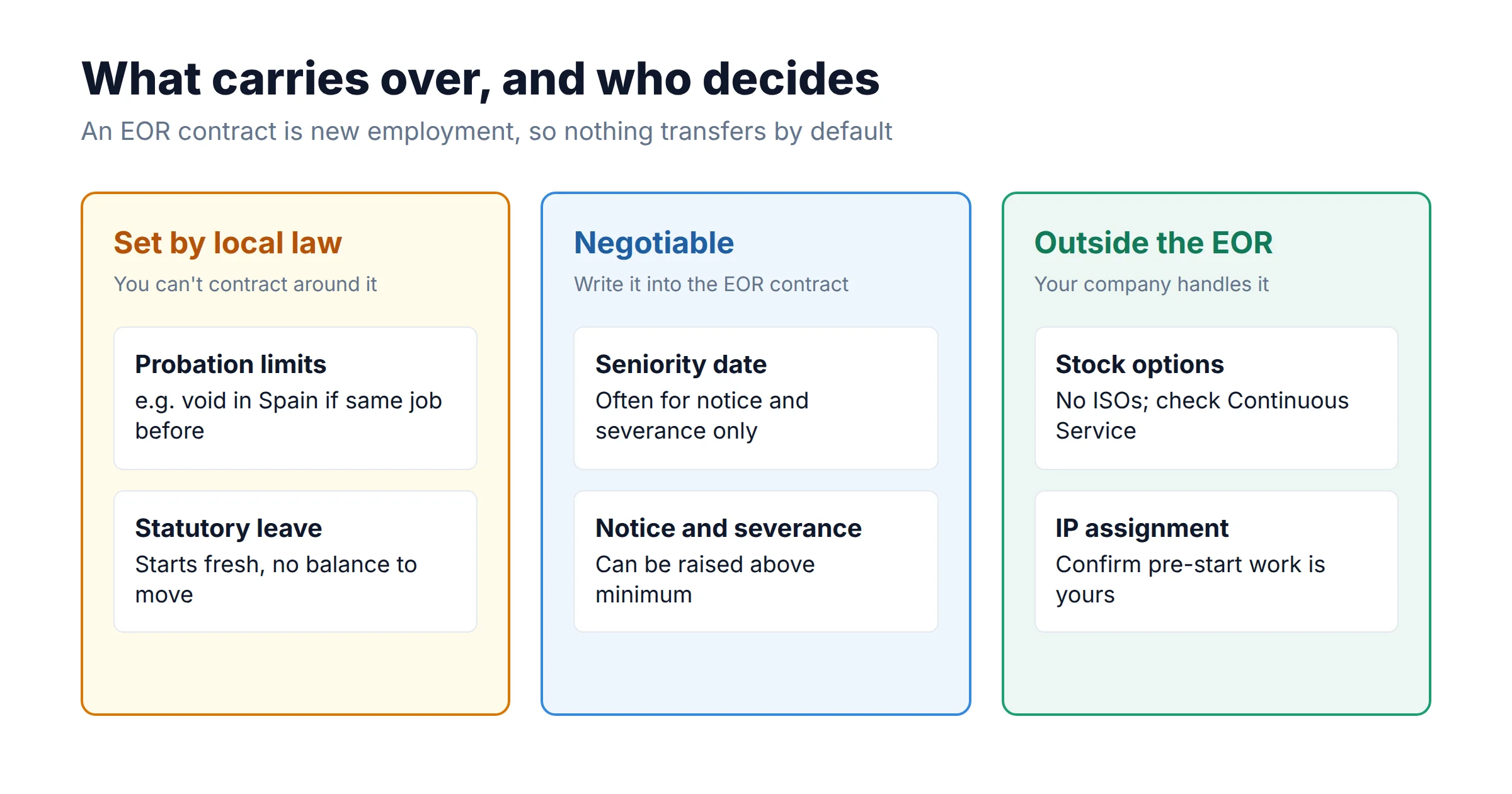
Because the EOR contract is new, the default is that nothing carries over. Each item below either needs an explicit clause or is set by local law no matter what you agree.
Tenure / seniority date
Contractor months aren't employment, so statutory tenure usually starts on the EOR start date. Some EORs let you record an earlier seniority date. For employees moved onto Deel EOR, Deel uses that date only for notice and severance. It gives no seniority rights to holiday, allowances, bonuses, pension accrual, or salary increments. Ask your EOR how it treats a seniority date for a former contractor.Probation
Many countries let a new contract include probation, but some don't if the person already did the job. Spain's Workers' Statute (art. 14.1) makes a probation clause void when the worker "has already performed the same functions previously in the company, under any type of contract." Assume probation may be unavailable or unwise for someone you've worked with for a year.Notice and severance
The EOR contract sets these at the local minimum unless you raise them. Deel's transfer flow allows "only limited changes," such as extending the notice period or increasing severance. Recognizing past tenure here is the most common way to reward a long-standing contractor.Holiday and benefits
Statutory leave and benefits start fresh under the EOR contract. Contractor time off wasn't accrued leave, so there's no balance to transfer. You can add extra leave days, but higher-than-statutory PTO can raise the EOR deposit. Deel, for example, asks for a larger deposit when PTO exceeds the legal minimum by more than 8 days.A worker who was really an employee may later argue that employment began on the first contractor day, whatever the EOR contract says. Recognizing the earlier start date for notice and severance usually costs little and removes one argument. Don't try to fix it with a blanket waiver. In the UK, for example, section 203 of the Employment Rights Act 1996 voids contract terms that exclude statutory rights. A valid settlement agreement must be in writing and relate to particular claims, and the worker must have received independent legal advice.
4Handle stock options
Equity causes the most surprises, because US option rules were written for direct employment.
ISOs are off the table
Under 26 U.S.C. §422(b), an incentive stock option must be granted "for any reason connected with his employment by a corporation," by the employer corporation or its parent or subsidiary. §422(a)(2) also requires the holder to be an employee of that corporate group from grant until three months before exercise. An EOR employee is employed by the EOR's local entity, which isn't in your corporate group. So converting a contractor through an EOR doesn't make them ISO-eligible. Deel's own equity guidance reaches the same conclusion and points EOR employees to NSOs or RSUs instead. In practice this rarely matters. ISO tax treatment is a US concept and usually irrelevant for someone who is tax-resident abroad.
Existing grants: check "Continuous Service"
The more important question is whether the contractor's existing NSO grant keeps vesting. Most venture-style plans define "Continuous Service" broadly. A common startup-template wording, for example in the Kibits Corp. 2011 and Newsle, Inc. 2012 plans (filed with the SEC by Cisco and LinkedIn after they acquired those startups), says a change "in the capacity in which the Participant renders service" (employee, consultant, or director) doesn't end Continuous Service, "provided that there is no interruption or termination" of service. Three implications:
- Read your own plan's definitions, not just this clause. In those templates, a "Consultant" is someone "engaged by the Company or an Affiliate" and compensated for it. An EOR employee is engaged and paid by the EOR, not by you. Before the switch, get counsel to confirm the person still counts as a service provider under your plan. If the definitions don't clearly cover them, have the board approve a plan amendment or a written determination.
- Avoid a gap. A gap of a week or more between the last contractor day and the EOR start date can break the "no interruption" condition. That's one reason Step 5 insists the dates be adjacent.
- Get board approval and update the cap table to record the new service relationship. Don't silently re-grant. A new grant takes a new strike price at the current 409A valuation, which is usually worse for the worker.
Local tax and the EOR's role
Once the person is an employee, their home country may treat option gains as employment income. The EOR, as employer, may then have to report or withhold at vesting or exercise. Tell the EOR about every outstanding grant before onboarding. Deel's platform, for instance, sends EOR equity grants through its equity team, and a client whose EOR worker doesn't yet have options in Deel has to talk to that team before continuing.
5Choose the EOR and lock the start date
If you already pay contractors through an EOR platform, its contractor-to-employee flow is the path of least resistance. Your data is already there, and some providers assign a conversion specialist. If you pay contractors through Wise or wires (see our guide to paying international contractors), shop on the criteria that matter for one hire in one country. Does the provider own its entity there? What's the deposit? What exactly does the employer-cost quote include? Our best EOR for startups comparison goes deeper.
| Item to check | What we found (Oct 2026) |
|---|---|
| List price | Deel: EOR from $599/employee/month. Remote: EOR from $599/employee/month, and pre-seed to Series A startups get 15% off EOR and contractor management for the first 12 months. |
| Deposit | Deel's standard is 1–1.5× monthly charges, or none if you opt into "Early Invoicing" (next month's estimate billed on the 23rd, due within 5 days). Remote says deposits apply only in "rare, high risk circumstances." |
| Minimum onboarding time | Remote's help center lists 2 working days for Canada, Finland, Ireland, the UK, and the US; 3 for France, India, Mexico, the Philippines, Portugal, Spain, and others; 4 for Austria and the Netherlands; 5 for Australia and Germany. The article hasn't been updated in over a year, so confirm in the platform's start-date calendar. |
| First-hire delay | Remote runs a Know Your Business review on your first employee. Onboarding can't finish, and payments can't be made, until it's approved. Budget extra days if this is your first EOR hire. |
Picking the date
The working-day minimums are best cases. They assume the worker completes self-enrollment promptly, has work authorization, and needs no contract changes. A realistic plan for a first EOR hire:
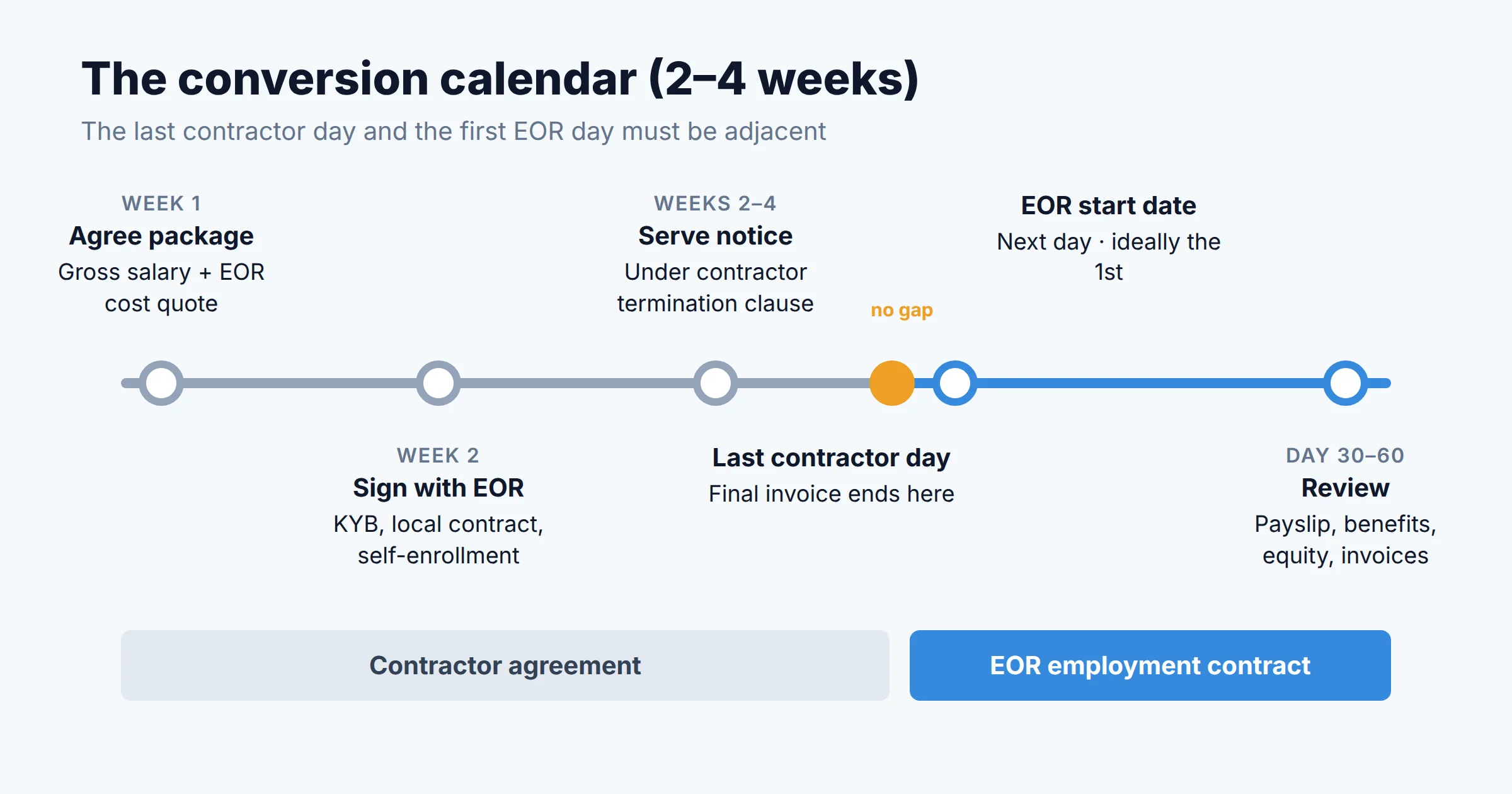
- Week 1: agree on the package with the worker. Get the EOR's employer-cost quote at that gross.
- Week 2: sign the EOR services agreement. Pass KYB if this is your first hire. The EOR issues the local employment contract and the worker self-enrolls.
- Weeks 2–4: serve notice under the contractor agreement's termination clause. Whatever notice period it sets, not the EOR, is often the real constraint.
- Start date: the day after the last contractor day. Where possible, use the 1st of a month so the first payroll isn't prorated and the cutover is easy to audit.
6Close the contractor agreement cleanly
The contractor relationship should end with a document trail that shows a clear stop, not a fade-out.
- Mutual termination letter naming the last day of services, usually the day before the EOR start date, and confirming the final invoice covers work up to that day only.
- Final invoice for the last partial period. If you used a contractor platform, end the contract there too. On Deel, an active contractor contract must be terminated, not cancelled. Ending it also stops the per-contractor seat fee (Deel lists contractor management from $49/month).
- Confirmatory IP assignment covering everything created during the contractor period. The EOR employment contract normally sends new IP to the EOR, which then assigns it to you under the services agreement. It doesn't reach work done before the start date. If the original contractor agreement's IP clause was weak, this is the cheapest moment to fix it.
- Confidentiality and non-solicit obligations from the contractor agreement should survive termination, or be restated in the EOR contract.
- Equipment and access: decide whether equipment you supplied moves under the EOR's equipment policy. Keep system access continuous. Revoking and reissuing accounts creates the gap you're trying to avoid.
- Tax paperwork: for a non-US person working abroad, the W-8BEN you collected covers the contractor payments, and no 1099 is due. From the EOR start date onward, you pay the EOR, not the worker.
7The first 60 days
Deel recommends a post-transition review within the first 30 to 60 days. A practical version:
- First payslip check: compare gross, deductions, and net with what you showed the worker in Step 2. Mismatches here cost the most goodwill.
- Benefits enrollment: confirm statutory registrations (social security, pension, health) went through. Confirm any supplemental benefits you added are active.
- Equity records: make sure the cap table, the EOR, and the grant agreement all show the same service relationship and vesting schedule.
- Invoice reconciliation: confirm the EOR's first invoice matches the quote. Confirm that no contractor fee or payment went out after the cutover.
- Management habits: the person is now an employee of another legal entity that you direct. Leave approvals, performance issues, and any future termination go through the EOR's process, not your Slack DM.
Common mistakes
- Offering a gross salary equal to the old invoice without checking employer costs, then finding a 20%+ budget overrun at the first EOR invoice.
- Leaving a gap between contracts ("let's start on the 15th, they can take a week off"). The gap can interrupt option vesting under a "no interruption" clause, and it leaves the worker uninsured.
- Overlapping the contracts by paying a final contractor invoice that covers days after the EOR start. That pays twice and blurs the line you need to prove.
- Adding a fresh probation period automatically. In Spain it's void for someone who already did the same job. Elsewhere, it can look like an attempt to strip protection from a long-standing worker.
- Assuming the EOR fixes past misclassification. It caps future exposure. Look-back periods such as Germany's four years (thirty for intentional withholding) still apply to the contractor years.
- Forgetting equity until after onboarding, which leaves the EOR unaware of taxable events it may have to report.
よくある質問
How do I get converted from contractor to full-time employee if my client has no entity in my country?
What is the difference between an EOR and payroll?
Which is better for the worker, independent contractor or EOR employee?
What should the EOR agreement include for a converted contractor?
How long does the whole conversion take?
Methodology
We read the top-ranking guides for this query, including pages from Deel, Remote, RemoFirst, and Pebl. We found that they mostly describe the EOR onboarding flow and skip the decisions around the switch. We then checked each claim in this article against primary sources. Prices came from the Deel and Remote pricing pages (checked October 19–20, 2026). Provider mechanics came from Deel's and Remote's help centers. UK employer costs came from gov.uk and DWP. Legal rules came from the statute texts: Spain's Estatuto de los Trabajadores art. 14 (BOE), Germany's §25 SGB IV, the UK Employment Rights Act 1996 s.203, and 26 U.S.C. §422. The "Continuous Service" wording came from startup equity plans filed with the SEC. We did not test the onboarding flows hands-on. The UK salary example is illustrative and excludes the EOR fee, currency movements, and any optional benefits. This article is general information, not legal or tax advice. For a specific worker, confirm with the EOR's in-country team and your counsel.
参考・出典
- Deel Help Center, "How To Transfer Existing On Platform Employees Into Deel EOR" (updated 2026-06-03): https://help.letsdeel.com/hc/en-gb/articles/25654358095761
- Deel Help Center, "How Clients Can Cancel Or Reinstate Contractor Contracts" (updated 2026-07-14): https://help.letsdeel.com/hc/en-gb/articles/4407745399569
- Deel Help Center, "About EOR Early Invoicing": https://help.letsdeel.com/hc/en-gb/articles/20846662104849
- Deel Help Center, "How to Create an Equity Grant for Workers": https://help.letsdeel.com/hc/en-gb/articles/19837271153169
- Deel pricing: https://www.deel.com/pricing/
- Remote pricing: https://remote.com/pricing
- Remote Support, "Remote Onboarding: Everything You Need to Know": https://support.remote.com/hc/en-us/articles/11109199121933
- GOV.UK, "Rates and thresholds for employers 2026 to 2027": https://www.gov.uk/guidance/rates-and-thresholds-for-employers-2026-to-2027
- DWP, "Review of the Automatic Enrolment Earnings Trigger and Qualifying Earnings Band for 2026/27": https://www.gov.uk/government/publications/review-of-the-automatic-enrolment-earnings-trigger-and-qualifying-earnings-band-for-202627
- Employment Rights Act 1996, s.203: https://www.legislation.gov.uk/ukpga/1996/18/section/203
- Estatuto de los Trabajadores, art. 14 (BOE-A-2015-11430): https://www.boe.es/buscar/act.php?id=BOE-A-2015-11430
- §25 SGB IV (Verjährung): https://www.gesetze-im-internet.de/sgb_4/__25.html
- 26 U.S.C. §422, Incentive stock options: https://www.law.cornell.edu/uscode/text/26/422
- Kibits Corp. 2011 Equity Incentive Plan (Cisco Form S-8, Exhibit 99.1), "Continuous Service" and "Consultant" definitions: https://www.sec.gov/Archives/edgar/data/0000858877/000085887714000004/exhibit_991-equityincentiv.htm

Technology consultant with 10+ years in the Japanese tech industry. Specializing in SaaS evaluation, workflow automation, and B2B tool integration.