How to Pay International Contractors (2026): 5 Payment Rails, What Each Really Costs, and the Paperwork a US Company Needs
A US company can pay a foreign independent contractor directly, with no US tax withheld, if the person is not a US person and does the work outside the US. Collect a Form W-8BEN (or W-8BEN-E for a company), keep it on file, and don't issue a 1099.
For one to three contractors, a multi-currency transfer service like Wise Business is usually the cheapest rail. Our live quotes for a $3,000 payment ran from about 0.5% (EUR, GBP, CAD) to 1.9% (ARS). Once you have roughly five or more contractors, or need contracts, invoice approvals and tax forms in one place, a contractor platform is worth its fee. Remote and Oyster list $29 per contractor per month, G-P $39, Multiplier $40 (billed annually) and Deel $49.
Avoid sending USD wires from your bank by default. The fee you see is the small part of the cost; the exchange-rate spread is the large part. If a contractor starts to look like an employee (full-time, exclusive, managed day to day), move them to an employer of record before the local authority makes that decision for you.
This guide is for teams engaging their first few contractors abroad, such as a developer in Poland, a designer in the Philippines or a data analyst in Brazil. It covers the decisions to make before the first payment, the five payment rails a US company can use and what each costs at 1, 5 and 15 contractors, the tax forms, and the point at which contracting stops being the right structure.
We don't cover employer-of-record vendor selection here. If you already know you need employees rather than contractors, start with our comparison of the best EOR providers for startups.
01
Before the first payment: four decisions
Most problems with international contractor payments come from decisions nobody made, not from the payment itself. Settle these four before you send any money.
1. Are they actually a contractor?
The contractor's country decides whether the relationship is genuine self-employment. The US doesn't, and neither does your contract's title. Most countries look at the same core facts: who controls how and when the work is done, whether the person works only for you, whether they use their own equipment, whether they can send a substitute, and whether they carry any business risk. A person who works 40 hours a week for you alone, in your Slack, in your sprint rituals, managed by your engineering lead, looks like an employee in most jurisdictions, whatever the contract says. We cover the warning signs in section 07.
2. What currency is the invoice in, and who pays the transfer costs?
Write both into the contract. "USD 3,000 per month" and "EUR 2,650 per month" put the currency risk on different sides. If you agree to pay in the contractor's currency, you carry the FX cost and the contractor gets a predictable amount. If you pay USD, the contractor's bank converts it at its own rate, and the contractor will eventually price that loss into their rate.
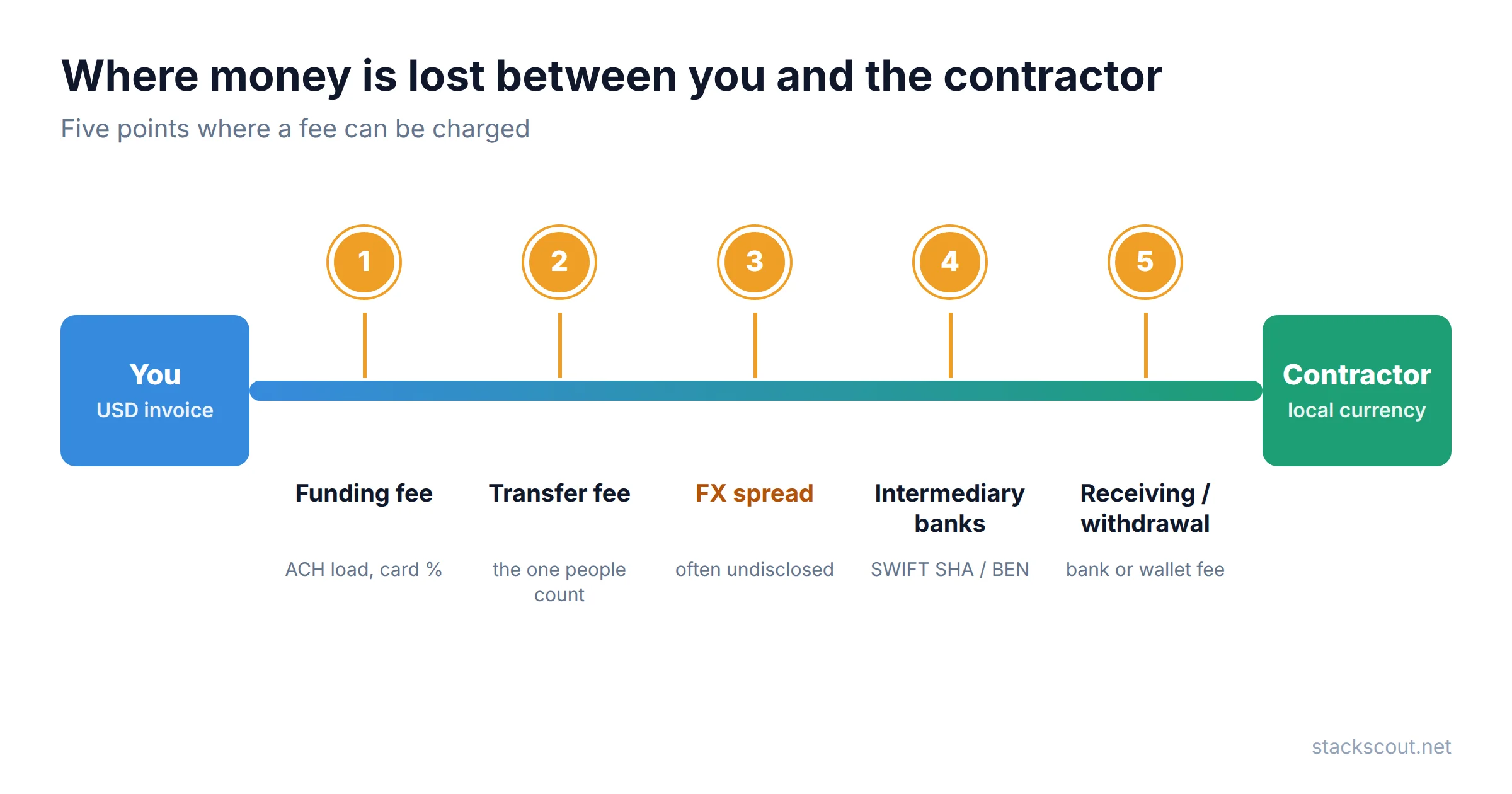
For SWIFT wires, the charge code matters too. OUR means you pay all transfer charges. SHA splits them: you pay your bank, and the recipient's side absorbs intermediary and receiving fees. BEN means the recipient pays all of them. Under SHA or BEN, a $3,000 invoice can arrive short, and then you get a confused email.
3. What tax documents do you need?
For a foreign contractor working from abroad, you need a W-8BEN (individuals) or W-8BEN-E (entities) on file. A US citizen or green-card holder living abroad is a US person, so they give you a W-9 and you may owe them a 1099-NEC. Section 06 has the details.
4. Which payment rail?
This is the decision most guides start with, but it depends on the first three. If you want the contract, tax forms and invoices handled for you, you're choosing a platform. If you already have a contract and the W-8 form on file, you only need a cheap, reliable way to move money.
02
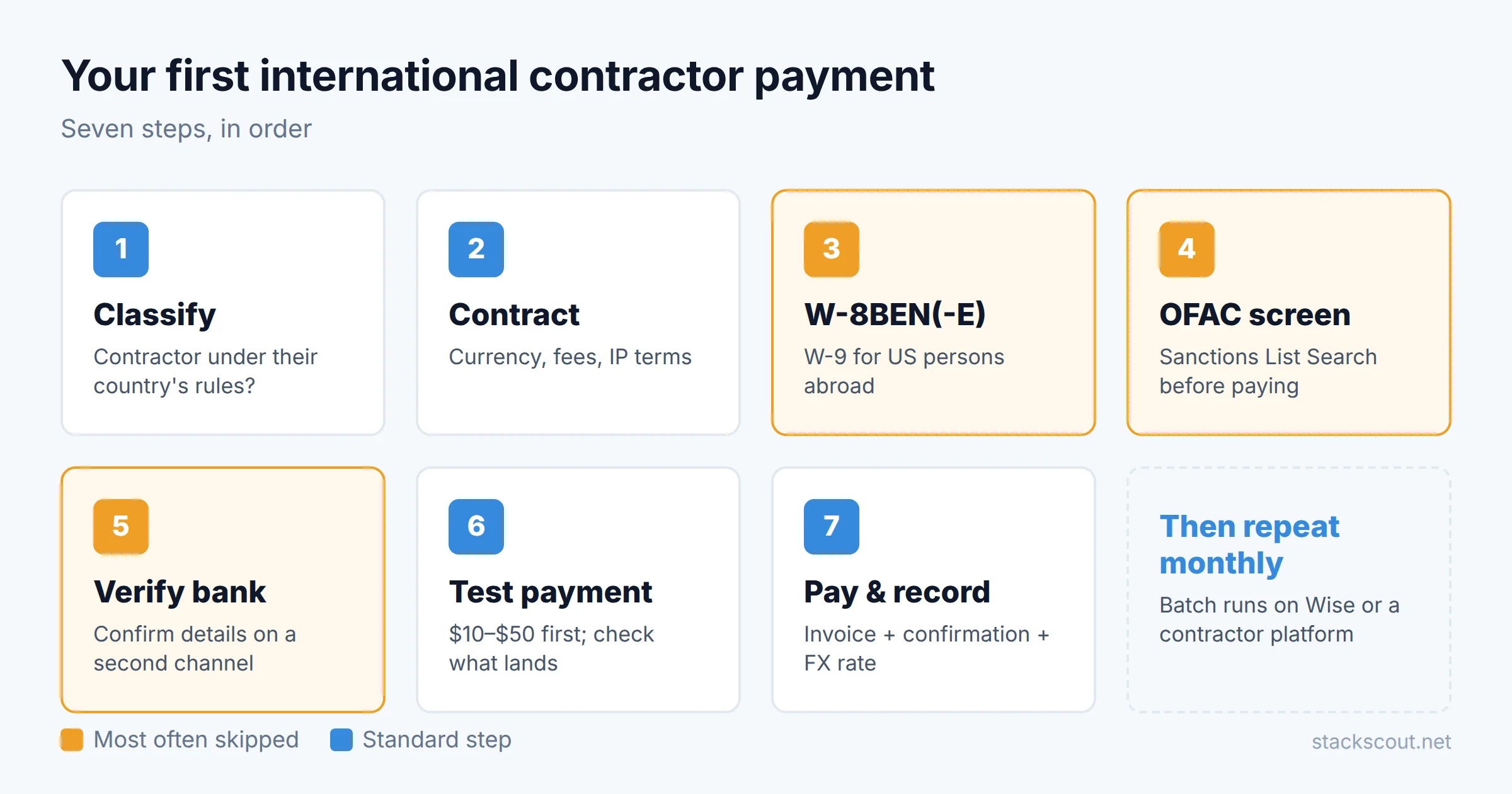
Step by step: your first international contractor payment
- Check the classification. Use the questions above. If the answer is "this is really a full-time hire," stop and look at an EOR instead. Our explainer on how an employer of record works covers the contracts and money flows.
- Sign a written contract. Include the scope, deliverables, rate, invoice currency, invoice cadence, payment terms (e.g., net 15), who bears transfer and FX costs, IP assignment, confidentiality and termination. Platforms such as Deel, Remote and Oyster generate localized templates. If you're going direct, have counsel review an IP assignment that is enforceable in the contractor's country.
- Collect the right IRS form. Get a W-8BEN from a foreign individual, a W-8BEN-E from a foreign company, or a W-9 from a US person living abroad. Don't send the W-8 to the IRS; keep it in your records.
- Screen the payee. US persons can't deal with anyone on the OFAC Specially Designated Nationals list or in comprehensively sanctioned jurisdictions. A search on OFAC's free Sanctions List Search takes about a minute. Payment providers screen too, but a blocked payment caught at their end is a frozen payment and an awkward conversation.
- Collect and verify bank details. Ask for an IBAN in Europe, account number plus IFSC in India, CLABE in Mexico, and account plus bank code elsewhere. Confirm the details over a second channel, such as a video call. Invoice-redirection fraud ("our bank details have changed") targets exactly this step.
- Send a small test payment. On a new corridor, send $10–$50 first and have the contractor confirm the amount that arrived. That shows you the real landed cost and catches bank detail errors cheaply.
- Schedule and record. Pay against an invoice, match each payment to it, and keep the invoice, the payment confirmation and the exchange rate used. Your bookkeeper will need all three. If you already run bill approvals through software, see our accounts payable automation comparison; several of those tools pay foreign vendors as well.
03
The five ways to pay, compared
Every option below is a variation on one of three models. You can wire money yourself through a bank or a transfer service. You can pay through a wallet network such as Payoneer. Or you can pay through a platform that also handles contracts and compliance paperwork, such as a contractor management tool or your payroll provider. Prices are as listed on each vendor's official site on October 16, 2026.
| Rail | What you pay | FX handling | Contracts & tax forms | Best for |
|---|---|---|---|---|
| Bank wire e.g., Chase | Chase business: $40 per online USD international wire, $50 with a banker; online foreign-currency wire $5, or $0 at $5,000+ | Bank-set rate "includes a spread" (Chase's words); amount not disclosed | None | One-off large payments where the contractor's bank receives USD |
| Wise Business | $31 one-time setup; per-transfer fee by currency (0.52%–1.85% in our quotes) | Mid-market rate plus a disclosed fee | None; you handle them | 1–5 contractors, cost-sensitive teams, batch payments |
| Payoneer | Sending from your balance to another country: up to 1% + up to $4; loading via US ACH: 1% | Recipient's withdrawal fee 1.2%–4% | None | Contractors who already use Payoneer, especially in emerging markets |
| Contractor platform Deel · Remote · Oyster · G-P · Multiplier | $29–$49 per contractor per month (see section 04) | Platform rate (Deel: forward rate; Remote: "Remote FX rate") | Localized contracts, W-8/W-9 collection, invoice approvals | 5+ contractors, multiple countries, audit trail |
| Payroll add-on Gusto global contractor payments | No per-contractor fee; "a small service and foreign exchange fee for each payment" | Built into the per-payment fee; not published as a % | Inside your existing US payroll | US companies already on Gusto with a few foreign contractors |
Rail 1: Your bank's international wire
It's the default because it's already there. Chase's business fee schedule (effective June 14, 2026) lists $40 for an online international wire in USD, $50 if a banker sends it, and $5 for an online wire in foreign currency, or $0 when the amount is $5,000 or more. The same document says the foreign currency rate "is determined by us in our sole discretion and includes a spread" and that customers "should expect that these foreign exchange rates will be less favorable than rates quoted online." That's typical of big banks, not specific to Chase.
A USD wire has a further problem. The contractor's bank converts the money at its rate, and intermediary banks in the SWIFT chain can deduct their own charges along the way. You pay $40, and the contractor still receives less than the invoice.
Pros
- No new vendor or onboarding
- Good for occasional large payments
- Foreign-currency wires are cheap on fees at $5,000+
Cons
- FX spread is undisclosed
- Intermediary deductions under SHA/BEN
- No batch payments, invoice matching or tax forms
Rail 2: Wise Business
Wise converts at the mid-market rate and shows its fee separately. That makes it the easiest rail to audit: you know exactly what each payment cost. Setup is a one-time $31. Its batch tool pays up to 1,000 recipients from one CSV or XLSX upload in a single source currency, so a monthly contractor run takes a few minutes. Same-currency transfers between Wise accounts are free, and Wise discounts fees automatically once a business sends more than $25,000 in a month.
We pulled live quotes from Wise's public quote API on October 16, 2026 for a $3,000 USD payment funded by US bank transfer:
| Contractor's currency | Total fee | % of $3,000 | Estimated arrival (quoted Fri Oct 16) |
|---|---|---|---|
| EUR (e.g., Spain, Germany) | $15.66 | 0.52% | Within the hour |
| CAD | $15.74 | 0.52% | By Monday |
| GBP | $16.88 | 0.56% | Within the hour |
| PLN | $17.73 | 0.59% | By Monday |
| INR | $19.62 | 0.65% | Within the hour |
| PHP | $21.61 | 0.72% | By Monday |
| MXN | $22.02 | 0.73% | Within the hour |
| NGN | $22.32 | 0.74% | By Monday |
| PKR | $23.69 | 0.79% | Within the hour |
| BRL | $32.71 | 1.09% | Within the hour |
| COP | $48.63 | 1.62% | About 4 hours |
| ARS | $55.48 | 1.85% | By Monday |
Each total includes a $6.11 pay-in charge for funding by US bank transfer. The rest is Wise's conversion fee. Arrival estimates depend on the day and time you send. A Friday afternoon payment to the Philippines or Poland landed on Monday in our quotes, so if a contractor invoices on the 30th, don't pay on a Friday evening.
Pros
- Fees disclosed per transfer; mid-market rate
- Batch payments up to 1,000 recipients
- No per-contractor monthly fee
Cons
- Moves money only: no contracts, W-8 collection or invoice approval
- You own classification and documentation entirely
- Fees rise in volatile or less liquid currencies (BRL, COP, ARS)
Rail 3: Payoneer
Payoneer works best when the contractor already has a Payoneer account, which is common among freelancers in South and Southeast Asia, Latin America and Eastern Europe. Its pricing page lists sending from your Payoneer balance to a recipient in another country at "up to 1% + up to 4.00 USD." Funding your balance from a US bank via ACH costs 1%. On the contractor's side, withdrawing to a local bank account costs 1.2%–4% depending on the corridor.
So Payoneer often looks cheap to the payer while the contractor absorbs the withdrawal cost. That's fine if it's agreed. It's a problem if the contractor discovers it on the first payment.
Pros
- Contractors may already have accounts
- Free between Payoneer balances in some cases (receive side)
- Broad emerging-market coverage
Cons
- Fees stack on both sides ("up to" pricing)
- Recipient withdrawal of 1.2%–4% is easy to overlook
- No contract or tax-form workflow
Rail 4: A contractor management platform
Deel, Remote, Oyster, G-P and Multiplier all do the same core job. They generate a locally adapted contract, collect the contractor's tax form, take invoices through an approval flow and pay out in local currency. They differ in price and in how much misclassification risk they'll take on (more in section 04).
The real cost includes FX, and FX is where the pricing gets vague. Deel's help center says it uses "a Forward Rate provided by its banking partners" and charges client-side funding fees: $5 per ACH, SEPA or wire funding, or 2.9% + $0.30 for US/EU cards. Remote's support center says Wise-routed payouts use "a Remote FX rate," which "covers the cost of conversion as well as the risk of currency fluctuations." Neither publishes the margin. To compare platforms on FX, run the same invoice through each one's quote screen during the trial.
Pros
- Contracts, W-8/W-9 and invoices in one audit trail
- Contractors self-onboard and choose payout method
- Optional misclassification cover (Remote Plus, contractor-of-record)
Cons
- $29–$49 per contractor per month adds up
- FX margin not disclosed
- A platform contract doesn't make an employee into a contractor
If you're deciding between the two biggest names, our Deel vs Remote total-cost comparison goes further than we can here. Our Deel alternatives roundup covers the rest of the field.
Rail 5: Your US payroll provider's add-on
If you already run US payroll on Gusto, its global contractor payments add-on covers "more than 120 countries, with no monthly per-contractor fee." Instead, "Gusto charges only a small service and foreign exchange fee for each payment." The pricing page doesn't give that fee as a number, so check it in the payment preview before you commit. It's the simplest setup for a US company with two or three foreign contractors alongside domestic staff, because the payments and 1099/W-8 records stay in the system you already use.
For a broader look at platforms that also run employee payroll in other countries, see best payroll software for international teams.
04
What it really costs at 1, 5 and 15 contractors
Per-payment percentages are hard to compare with per-seat subscriptions, so here is one scenario run through each rail. Assume five contractors paid $3,000 a month each in EUR, INR, PHP, BRL and MXN. That's $180,000 a year. Platform figures are list prices. FX margins that vendors don't publish are shown as "not disclosed" rather than estimated.
| Rail | 1 contractor / yr | 5 contractors / yr | 15 contractors / yr | How we got there |
|---|---|---|---|---|
| Chase online FX wire | $60 + spread | $300 + spread | $900 + spread | $5 per wire under $5,000, 12 payments each. Every 1% of spread costs $360 per contractor per year |
| Wise Business | ≈$219–$424 | ≈$1,370 | ≈$4,050 | Quoted fees above × 12, plus $31 setup (1 contractor: EUR to BRL). 15 = the 5-currency mix tripled, before volume discounts |
| Remote | $348 | $1,740 | $5,220 | $29/contractor/month. 15% off the first 12 months for pre-seed to Series A companies |
| Oyster | ≈$319 | ≈$1,595 | ≈$4,785 | Free for 30 days, then $29/month (11 paid months) |
| G-P Contractor | $468 | $2,340 | ≤$7,020 | $39, charged only in months you pay that contractor. Below $39 negotiable above 10 contractors/month |
| Multiplier | $480 | $2,400 | $7,200 | $40/contractor/month, billed annually |
| Deel | $648 | $3,000 | $8,880 | $49/contractor/month + one $5 ACH funding per month |
| Gusto add-on | No per-contractor fee; per-payment fee not published | Requires a Gusto payroll plan | ||
Three things stand out:
- At one or two contractors, a platform roughly doubles the visible cost compared with Wise. That's often still worth it if nobody on your team wants to own contracts and W-8 forms. But it's a choice about convenience, not cost.
- The flat platform fee works in your favor as invoices grow. Wise charges a percentage, so a $10,000 monthly invoice costs more to send than a $3,000 one. A $29–$49 seat fee stays the same. For high-rate contractors (senior engineers, fractional executives), platforms close the gap faster than the table suggests.
- The cheapest-looking bank option is the least transparent. A $5 wire fee is meaningless without the spread. Run one payment through both your bank and Wise on the same day, compare what lands, and you'll know your bank's real cost.
05
The FX spread: the cost you don't see on an invoice
When a bank or platform converts USD into pesos, it quotes a rate slightly worse than the mid-market rate. The difference is a fee, but it never appears as a line item. On $180,000 a year of contractor payments, each percentage point of spread costs $1,800. That's more than most platforms charge for five seats.
The 1% and 3% rows illustrate what each level of spread would cost; they aren't measured Chase rates. Chase doesn't publish its spread, which is the point.
Three practical rules:
- Pay in the contractor's currency wherever possible, using a provider that shows its rate. Deel's help center gives the same advice: pay an invoice in the currency it's issued in, and no conversion applies.
- Don't send USD unless the contractor asks for it. Some do, such as contractors in Argentina or Nigeria who want to hold dollars. That's a legitimate reason. "It's the default in our bank's form" isn't.
- Agree on who absorbs costs, in writing. On SWIFT wires, use OUR if you've promised the full invoice amount. On Payoneer, tell the contractor up front that withdrawal fees fall on them, or gross up the payment.
06
The US tax paperwork: W-8BEN, 1099s and the one trap
The basic rule is simpler than most teams expect. The IRS says the source of personal service income is "the place, where the personal services are performed... regardless of where the contract was made, or the place of payment, or the residence of the payer." A nonresident working from Kraków or Manila earns foreign-source income, even though a US company pays them. In practice:
| Who you're paying | Form you collect | Withholding | Information return |
|---|---|---|---|
| Foreign individual, work done entirely outside the US | W-8BEN (keep on file; don't send to IRS) | None | None: no 1099, no 1042-S |
| Foreign company (e.g., the contractor's LLC or Ltd) | W-8BEN-E | None, for services performed abroad | None |
| US citizen or green-card holder living abroad | W-9 | None (unless backup withholding applies) | 1099-NEC if you pay $2,000+ in the year (threshold for payments after Dec 31, 2025) |
| Foreign individual who does some of the work in the US | W-8BEN, or Form 8233 to claim a treaty exemption | 30% on the US-source portion unless a treaty applies | 1042-S for the US-source portion |
The trap: on-site visits. The IRS allocates personal service income by the number of days worked in the US. If you fly a contractor in for a two-week offsite where they do client work, that portion of their pay is US-source. Withholding at 30% then applies unless a tax treaty exempts it. A planning trip is usually different from productive work, but agree with your accountant how you'll handle visits before booking the flights.
Two more points that come up often:
- The contractor's own taxes are theirs. You don't withhold their home-country income tax or social contributions, because a genuine contractor handles those. If you find you're expected to, that's a sign the relationship is employment.
- EU VAT usually doesn't apply. According to the EU's Your Europe portal, a business that provides services to customers outside the EU usually doesn't charge VAT. If an EU contractor's invoice to your US company includes VAT, ask about it. Their accountant will normally reissue it.
Platforms collect the W-8BEN or W-9 during contractor onboarding and store it. If you're on Wise or a bank wire, use the IRS's fillable PDF and store the signed copy with the contract. The form generally stays valid until the end of the third calendar year after signing, unless the contractor's circumstances change.
07
When to stop paying a contractor and switch to an EOR
Contractor payment tools make it easy to keep paying someone long after the relationship has stopped being a contract. The platform's contract template won't protect you if the facts look like employment. The risk sits in the contractor's country, where it can mean back social contributions, penalties, and in some places a permanent-establishment tax exposure for your company. We explain that last point in EOR compliance mistakes that trigger permanent establishment risk.
Move up a level when several of these are true:
- They work only for you, roughly full-time, and have for more than a few months.
- You set their hours, attend to their day-to-day tasks, and they're in your standups and performance reviews.
- They use your laptop, your email domain and your org chart title.
- They've asked about paid leave, health coverage or equity, or you've offered it.
- The country has an active reclassification regime. Examples include the UK's IR35 off-payroll rules (see our UK EOR guide) and Poland's tests for disguised B2B employment (see best EOR for Poland).
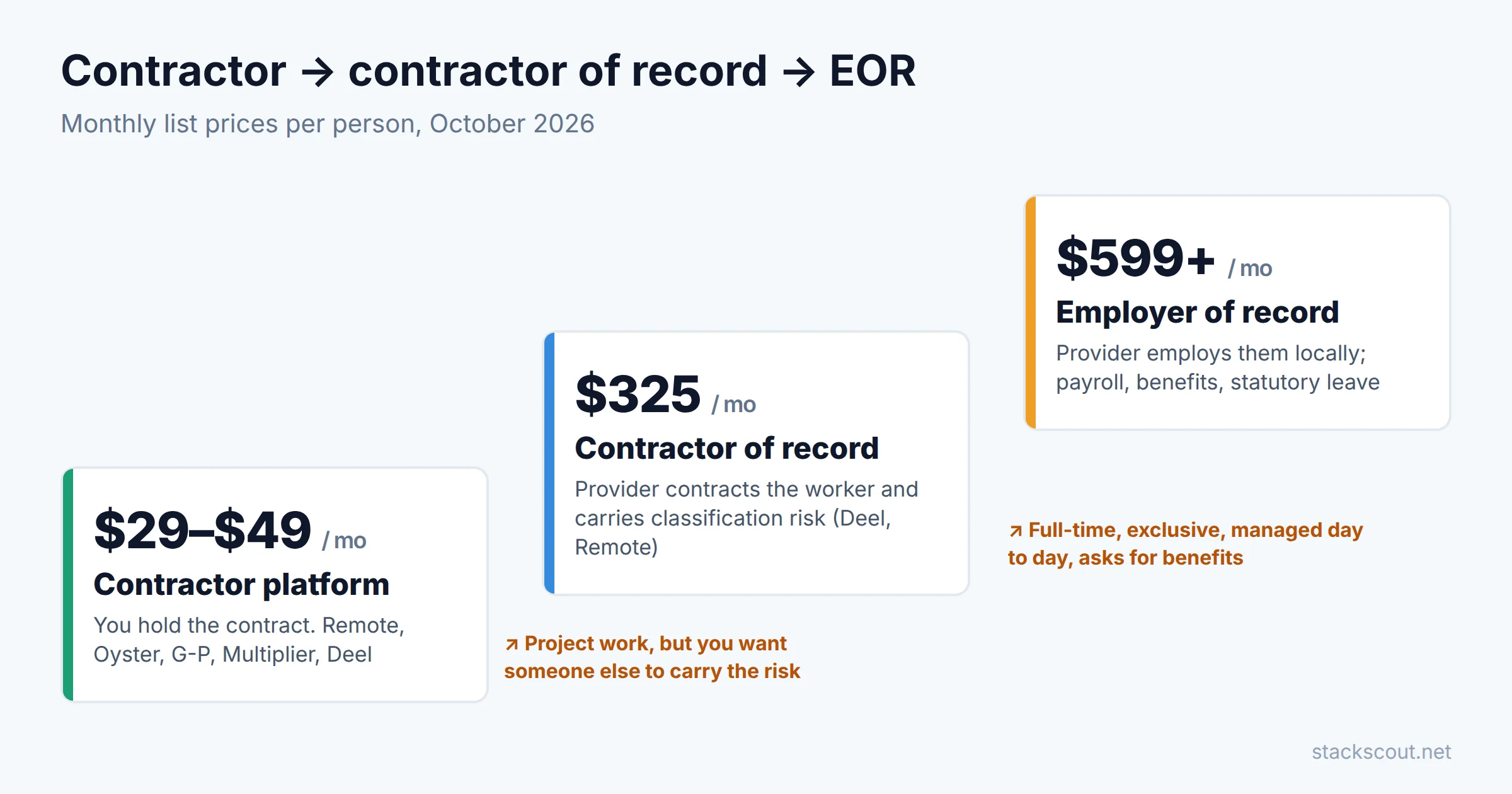
The price steps, as listed on October 16, 2026:
| Structure | Who holds the contract | Deel | Remote | Others |
|---|---|---|---|---|
| Contractor via platform | You | $49 | $29 | Oyster $29 · G-P $39 · Multiplier $40 |
| Contractor + indemnity | You | — | $99 | Remote Plus: $100,000 per contractor, up to $1M per company |
| Contractor of record | The provider | $325 | $325 | Multiplier $400 (billed annually) |
| Employer of record | The provider (as employer) | $599 | from $599 | See our EOR for startups comparison |
Remote's EOR now shows "starting at $599." In September its pricing page showed $699, so check the current figure when you get a quote. A contractor-of-record arrangement makes sense when the work really is project-based but you want the provider to carry the classification risk. If the person is effectively an employee, go straight to EOR. And if you expect five or more people in one country, run the EOR vs. own-entity break-even math.
08
Troubleshooting: why international contractor payments fail
- Payment returned or stuck. The usual causes are a wrong IBAN or bank code, a beneficiary name that doesn't match the account holder, or a missing local field (IFSC in India, CLABE in Mexico). Ask the contractor for a bank-issued account confirmation, not a retyped number.
- The amount that arrived is short. This is usually a SHA/BEN wire with intermediary deductions, or a withdrawal fee on the contractor's wallet. Switch to a local-currency payout, or send the wire as OUR.
- The payment is held for review. Providers check large first payments, new corridors and name mismatches. Upload the contract and invoice when asked; holds usually clear once the provider sees the business purpose.
- The contractor got paid late, but you sent on time. Check the corridor. In our quotes, payments to PHP, PLN, NGN and ARS sent on a Friday were estimated to arrive Monday. Send two business days before the due date.
- The exchange rate moved between invoice and payment. Set the invoice currency in the contract (see section 01). If you invoice in the contractor's currency, the rate risk is yours. That's usually the fairer arrangement and easier to budget for over a quarter.
FAQ
What is the best way to pay international contractors?
Can a US company pay a foreign independent contractor?
What are the steps involved in paying an overseas contractor?
How do I report payments to foreign contractors?
How do I pay an international vendor (a company rather than a person)?
Methodology
Based on our research, we read the official pricing pages of Wise, Payoneer, Deel, Remote, Oyster, G-P, Multiplier and Gusto on October 16, 2026, along with Chase's business fee schedule (effective June 14, 2026), and Deel's and Remote's help-center articles on FX and funding fees. Wise fees are live quotes from Wise's public quote API for a $3,000 USD transfer funded by US bank transfer, taken the same day. Annual costs multiply listed prices by 12 payments a year with no negotiated discounts. Where a vendor doesn't publish its FX margin, we say so rather than estimate it. Tax rules come from IRS pages and the EU Your Europe portal. This is not tax or legal advice; confirm classification and withholding questions with a qualified advisor in each country.
Sources
- IRS, Source of income – personal service income: irs.gov
- IRS, Pay for personal services performed (30% withholding on US-performed services): irs.gov
- IRS, Publication 515 (2026), Withholding of Tax on Nonresident Aliens and Foreign Entities: irs.gov
- NATP, Form 1099 filing changes under the new $2,000 threshold: natptax.com
- OFAC Sanctions List Search: ofac.treas.gov
- Chase, Additional Banking Services and Fees for Business Accounts (eff. 06/14/2026): chase.com (PDF)
- Wise Business pricing and send-money fees: wise.com; batch payments guide: wise.com
- Payoneer pricing: payoneer.com
- Deel pricing: deel.com; About Exchange Rates and Fees: help.letsdeel.com
- Remote pricing: remote.com; contractor payout FX: support.remote.com
- Oyster pricing: oysterhr.com; G-P pricing: globalization-partners.com; Multiplier pricing: usemultiplier.com
- Gusto pricing (global contractor payments): gusto.com
- European Union, Your Europe – cross-border VAT: europa.eu

Technology consultant with 10+ years in the Japanese tech industry. Specializing in SaaS evaluation, workflow automation, and B2B tool integration.