SOC 2 Type 1 vs Type 2 (2026): Which Report to Get First, and the Calendar Math Behind It
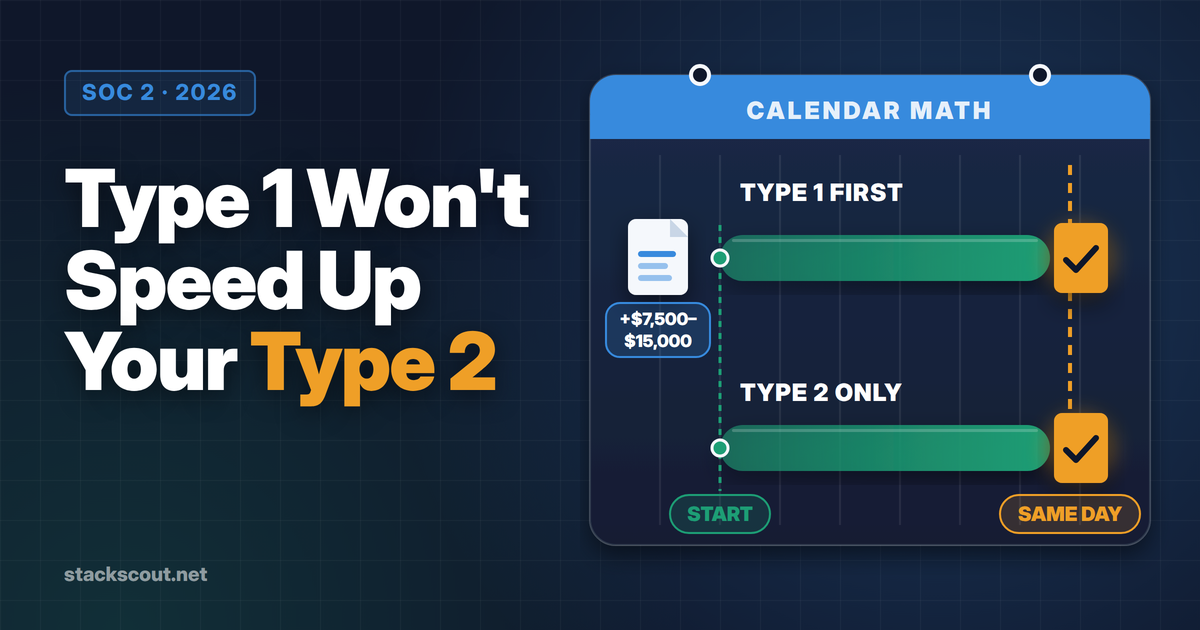
A SOC 2 Type 1 says your controls were designed properly on one date. A Type 2 says they actually worked across a period, usually 3 to 12 months, and it lists every test the auditor ran and every exception found. Most enterprise security teams eventually want the Type 2. The point founders usually miss is this: starting with a Type 1 does not get you to a Type 2 any sooner. In both paths the Type 2 observation window opens once your controls are running. The Type 1 just gives you an extra, earlier document, and you pay for a second engagement to get it (roughly $7,500–$15,000 in audit fees at small-company scope, based on Drata's published ranges).
Get a Type 1 first only if a specific customer has said in writing that they will accept one, and the deal can't wait 7–8 months. Otherwise, put that money into a clean first Type 2 with a 3- to 6-month window.
This guide is for founders and engineering leads who just got their first "please send your SOC 2 report" from a prospect. If you need the basics (what SOC 2 is, the five Trust Services Criteria, the overall process), start with our beginner's guide to SOC 2 compliance. For a full first-year budget, see SOC 2 certification cost and timeline. This article answers one narrower question: which report type to commission first, and what that choice actually buys you.
Quick comparison: Type 1 vs Type 2
Both reports are attestation engagements by a licensed CPA firm. They use the same AICPA Trust Services Criteria and have the same overall structure. What differs is the time dimension, and that drives everything else in the table.
| Dimension | SOC 2 Type 1 | SOC 2 Type 2 |
|---|---|---|
| Core question | Were the controls suitably designed as of a specific date? | Were the controls suitably designed and operating effectively throughout a period? |
| Coverage | A single "as-of" date you agree on with the auditor | An observation window, typically 3–12 months (Vanta) |
| What the auditor tests | Design and implementation (walkthroughs, inspection of policies and configs) | Design, plus samples of the control operating across the window |
| Test results shown to readers | No operating-effectiveness results | Tests performed, results, and any exceptions, control by control |
| Audit fee, small/midsize (Drata) | $7,500–$15,000 | $12,000–$20,000 |
| Audit fee, large orgs (Drata) | $20,000–$60,000 | $30,000–$100,000+ |
| Audit phase duration | About 5 weeks to 2 months after prep (Vanta) | Window length plus fieldwork and report issuance |
| How enterprise buyers treat it | Often accepted only as an interim milestone | The report most security reviews ultimately ask for |
| Shelf life in practice | Ages quickly; it says nothing about operation after the as-of date | Usually refreshed every 12 months, with a bridge letter covering gaps |
Fee ranges are as of October 2026 and include only the auditor's fee. Readiness work, a compliance platform, penetration testing and internal time are separate. Our SOC 2 cost breakdown covers those.
What actually differs inside the report
Many comparisons stop at "snapshot vs. movie." That's accurate, but it doesn't tell you what a buyer's security reviewer sees when they open each PDF. Both report types have the same four main parts. The fourth part is where they differ.
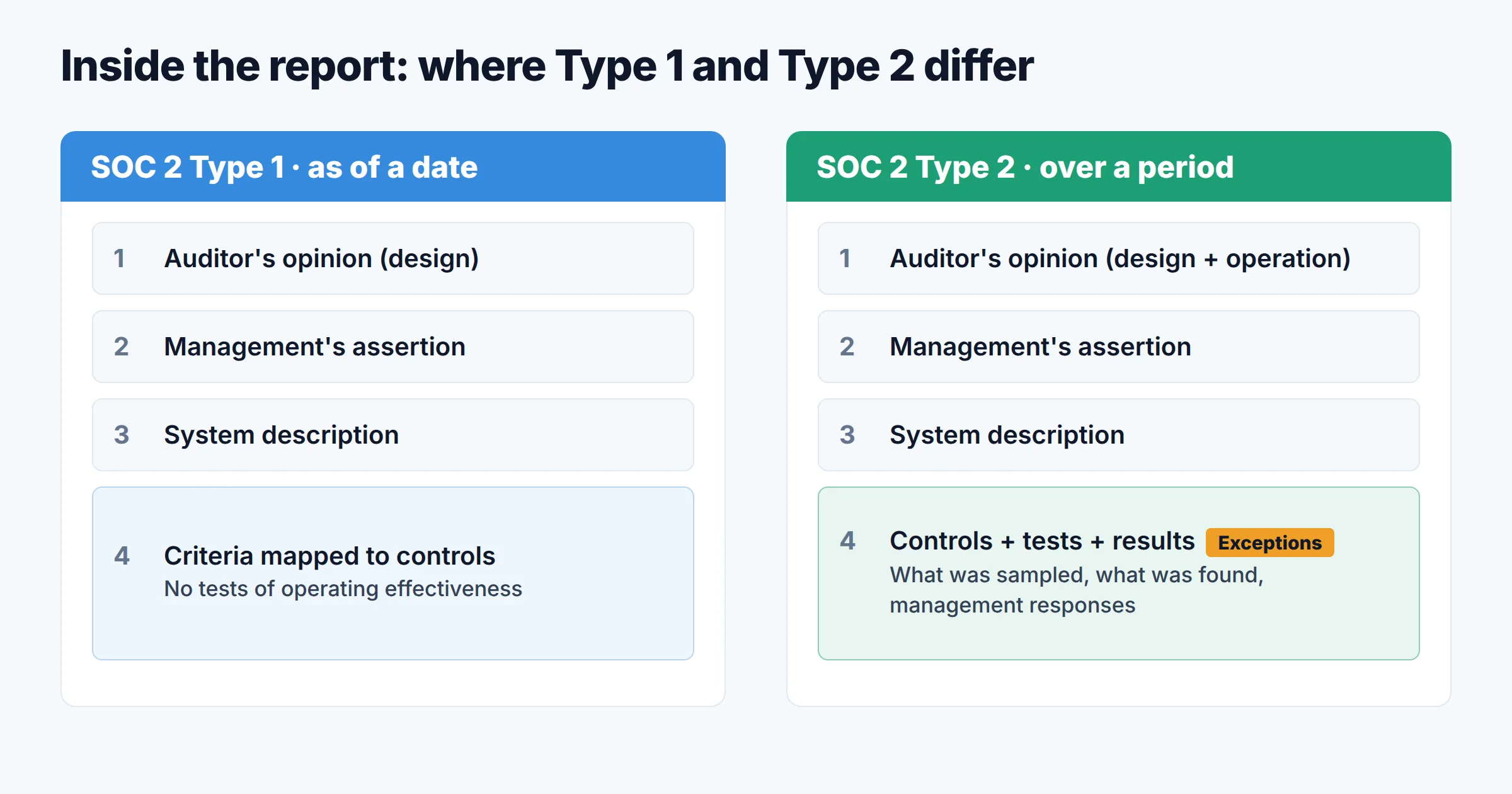
- The independent auditor's opinion. In a Type 1, the opinion covers the fairness of the system description and the suitability of design as of the date. In a Type 2, it also covers operating effectiveness throughout the period. A reviewer reads this first to check whether the opinion is unmodified (clean) or qualified.
- Management's assertion. Your company's signed statement that the description is fair and the controls meet the criteria.
- The system description. Your infrastructure, software, people, data flows, the subservice organizations you depend on (for example your cloud provider), and the complementary user entity controls your customers are expected to perform on their side.
- Trust Services Criteria and controls. A Type 1 maps each criterion to your controls. A Type 2 also states, for each control, what the auditor did ("inspected a sample of 25 terminated users…"), what they found, and any exceptions, such as an access review that was skipped one quarter.
This explains why procurement teams prefer Type 2. With a Type 1, a reviewer can only confirm that the control exists on paper. A Type 2 shows whether people followed it. A Type 2 with a few explained exceptions often looks more credible than a Type 1, because it shows the auditor actually tested something.
A Type 2 can list exceptions and still carry a clean opinion. Reviewers look for patterns, such as several exceptions in access management, and for whether management responded. Expect your first Type 2 to have a few. A first Type 2 with no exceptions at all can make an experienced reviewer ask how hard the auditor looked.
The calendar math: Type 1 doesn't move your Type 2 forward
Most founders assume "Type 1 first" is the fast route to Type 2. Here is how the timeline actually works, using the duration ranges Vanta publishes for its customers: 1–3 months of pre-audit preparation, then about 5 weeks to 2 months for a Type 1 audit, or a 3-month-to-1-year window for a Type 2.
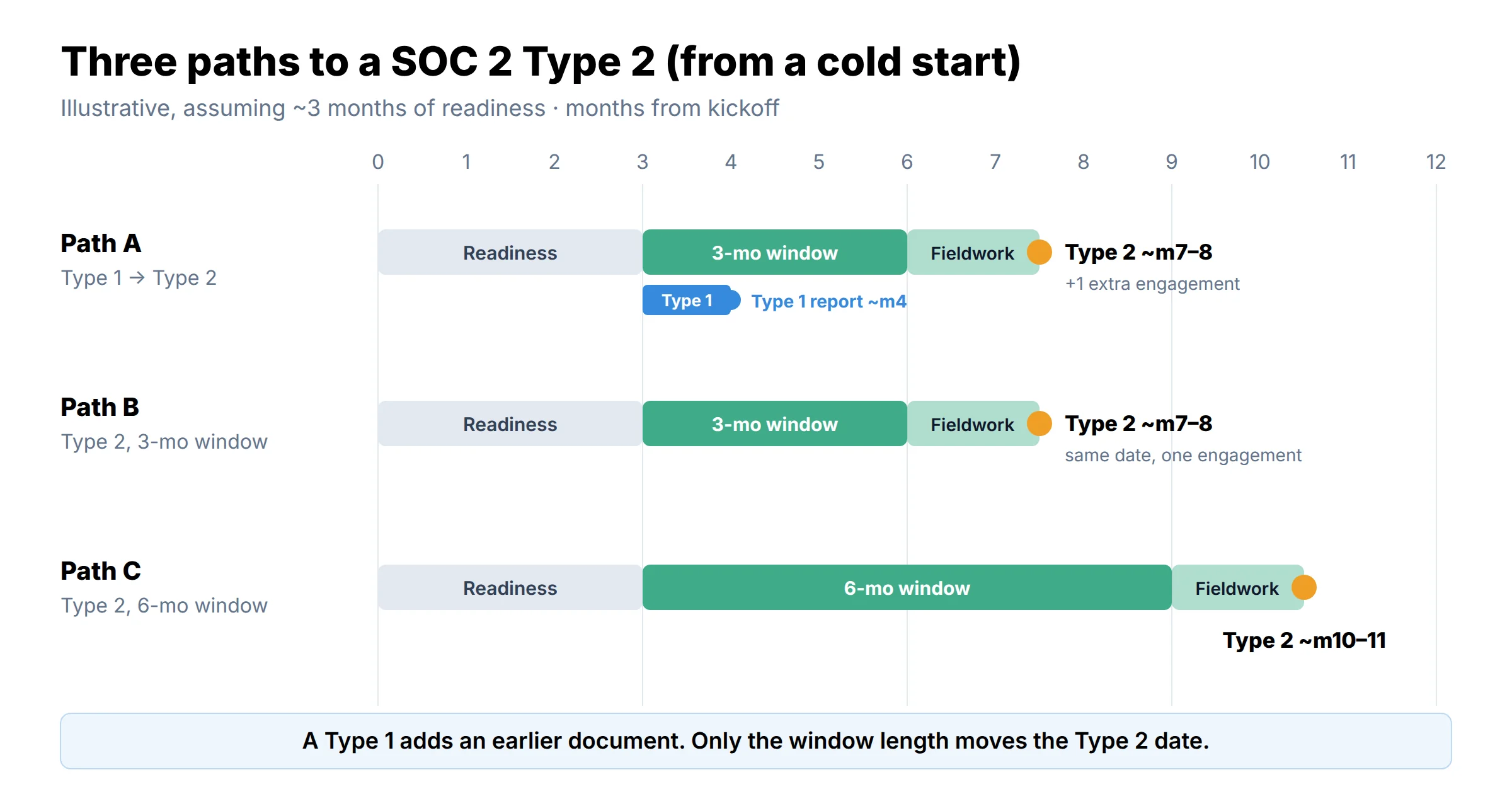
Path A — Type 1, then Type 2
You spend about three months getting controls designed and implemented. The auditor examines them as of a date at the end of month 3, and the Type 1 report arrives around month 4. If the Type 2 window starts the day after the Type 1 as-of date (auditors call this "abutting") and runs three months, it closes at month 6. Fieldwork and report issuance then put the Type 2 in your hands around months 7–8.
Path B — straight to a 3-month Type 2
The same three months of readiness. The window opens once the controls are operating, closes at month 6, and the report arrives around months 7–8, the same date as Path A. There's no interim document, and you pay for one engagement instead of two.
Path C — straight to a 6-month Type 2
The report arrives around months 10–11. It's slower, but a longer first window includes more instances of periodic controls (quarterly access reviews, for example) and answers the common reviewer objection that three months is thin.
The observation window can't start until your controls are actually running, and a Type 1 doesn't speed that up. What a Type 1 does is give you a defensible document about three to four months earlier than you'd otherwise have one. Sometimes that's worth paying for. It doesn't shorten the path to Type 2.
Path A only matches Path B if the Type 2 window opens immediately after the Type 1 date. Teams sometimes "rest" after the Type 1, fix findings, change auditors, or wait for a new budget cycle, and start the window weeks or months later. In that case, the Type 1 has delayed the Type 2. If you go Type 1 first, agree on the Type 2 window start date in the same engagement letter.
The cost delta: what the interim report really costs
Using Drata's published audit-fee ranges for small and midsize companies:
Path A: Type 1 + Type 2
$7,500–$15,000 (Type 1) + $12,000–$20,000 (Type 2) in audit fees, two fieldwork rounds, two sets of evidence requests and two management-review cycles.
Path B: Type 2 only
One engagement. The $7,500–$15,000 you don't spend on a Type 1 can go toward a penetration test or a longer first window.
Two caveats apply. First, ranges overlap more than most comparison tables suggest. SOC2Auditors.org publishes median fee bands from its directory of attestation-capable firms. For assurance specialists, Type 1 runs $10,000–$35,000 and Type 2 runs $15,500–$50,000. At full-service CPA firms it's $20,000–$60,000 vs. $30,000–$80,000, and at the Big Four $40,000–$145,000 vs. $65,000–$200,000. A Type 1 from a premium firm can cost more than a Type 2 from a specialist, so firm type often matters more to your quote than report type.
Second, many auditors will quote a Type 1 + Type 2 package for less than two standalone engagements. That pricing is negotiated per engagement and isn't published, so ask for the package price and the standalone Type 2 price side by side before you sign. The difference between the two is what the interim report really costs you.
Internal effort follows the same pattern. Each engagement brings its own evidence request list, walkthrough meetings and draft-report review. For a 10- to 30-person company, where the CTO is often also the compliance lead, that time comes straight out of product work. A compliance automation platform for early-stage startups reduces the evidence-collection work but not the number of engagements.
How long should the first Type 2 window be?
We couldn't find a fixed minimum in AICPA guidance, and auditors' marketing material agrees. Vanta describes the Type 2 window as "between three months to a year, depending on the length you choose," and notes that some audit firms require a Type 1 first, so you should confirm this with your auditor. In practice, three months is the shortest window most CPA firms will accept for a first Type 2. Later reports normally cover 12 months back to back. AWS, for example, issues SOC 2 reports twice a year, each covering the previous 12 months.
Three factors decide the first window:
- Periodic controls. If your quarterly access review or annual tabletop exercise doesn't happen inside the window, the auditor can't test it. A 3-month window may contain exactly one quarterly review. If that review slips, you get an exception or a control that couldn't be tested.
- What the customer said. Some security teams specify a minimum period in their vendor-risk policy. Ask before you choose. Changing it after the window has closed isn't possible.
- The renewal calendar. Your second report will almost certainly cover 12 months. Choose a first-window end date you can live with every year after, ideally not your busiest sales quarter or the December holidays.
When a Type 1 is the right first move (and when it isn't)
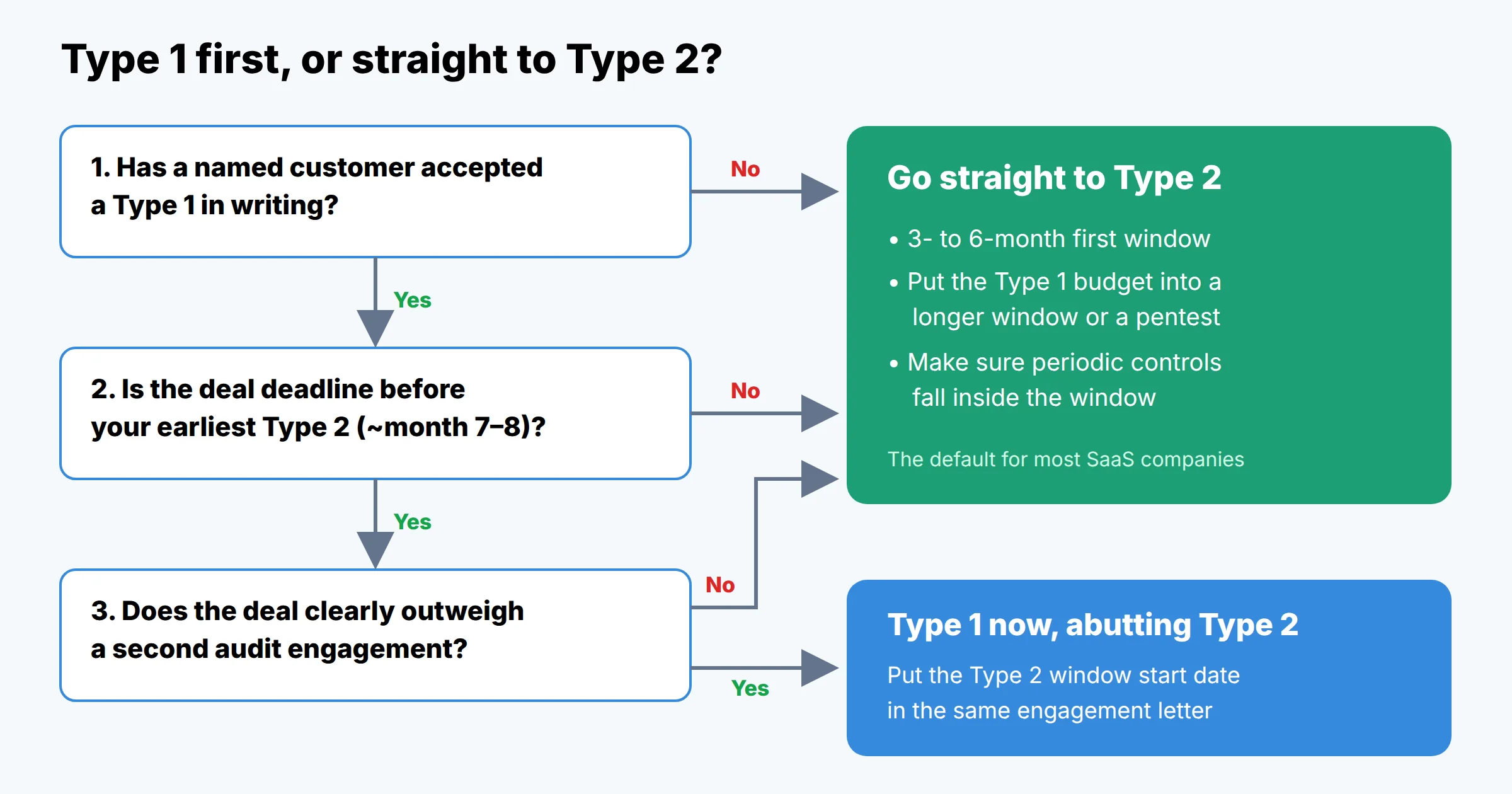
Commission a Type 1 first only when all of these are true:
- A named prospect or customer has confirmed in writing that a Type 1 is acceptable, at least as an interim document. "They'll probably take it" isn't confirmation. Forward the question to their security reviewer.
- The deal deadline falls before your earliest realistic Type 2 date (about 7–8 months out from a cold start with a 3-month window).
- The revenue at stake clearly exceeds the extra engagement, meaning the additional audit fee plus a second round of internal effort.
- You'll contract the Type 2 window start in the same engagement letter, so the Type 1 doesn't become a resting point.
Two other situations favor a Type 1:
- New systems or environments. When an existing company launches a separate product or environment, a Type 1 can confirm the new design before a period of operation exists. AWS did this in March 2026: it published a SOC 2 Type 1 (along with a C5 Type 1) for the new AWS European Sovereign Cloud, covering 69 services, while its long-running regions continued to carry 12-month Type 2 reports.
- A design check before the clock starts. Some teams use a Type 1 as an external check that their control design is sound before they commit to a long Type 2 window. A readiness assessment usually does the same job for less, because it's private and doesn't have to read well to customers.
Skip the Type 1 and go straight to Type 2 when:
- The buyer's questionnaire or contract says "SOC 2 Type II" (common in financial services, healthcare and larger enterprises).
- Nobody is actually waiting on a report yet, and you're preparing ahead of demand.
- Your controls are already running, for example because you've operated under ISO 27001 or completed a thorough readiness project. In that case the Type 1 documents something the Type 2 will prove a few months later anyway. (If you're still choosing between frameworks, see ISO 27001 vs SOC 2: which to get first.)
Pros and cons of each report type
SOC 2 Type 1
Pros
- Fastest route to a CPA-issued SOC 2 document
- Lower standalone audit fee at the same firm
- Validates control design before you commit to a window
- Suitable for brand-new systems with no operating history
Cons
- Says nothing about whether controls operated
- Many enterprise reviews treat it as interim only
- Adds a second engagement on the way to Type 2
- Becomes stale quickly after the as-of date
SOC 2 Type 2
Pros
- The report most enterprise security reviews ask for
- Shows tested results, which makes it more credible
- Sets up a predictable 12-month renewal cycle
- Fewer follow-up questionnaire items from reviewers
Cons
- No report until the window closes and fieldwork finishes
- Missed periodic controls appear as exceptions
- Higher fee and more sustained internal discipline
- Window length is hard to change once it starts
How buyers actually read your report
The report type is only the first thing a security reviewer checks. For a founder deciding between Type 1 and Type 2, it helps to know the rest of the review, because a Type 2 brings each of these items into scope.
- Report date and coverage. How old is the period end or as-of date? Reviewers often ask for a bridge letter if it's more than a few months old.
- The opinion. Is it unmodified or qualified, and if qualified, for which criteria?
- Scope. Does the system description cover the product they're buying, or only part of it? Which Trust Services Criteria are included (Security is mandatory; Availability and Confidentiality are common additions)?
- Subservice organizations. Is your cloud provider "carved out"? If so, the reviewer will go and get that provider's SOC 2 separately.
- Complementary user entity controls. What does the report say their team must do, such as managing their own SSO users? Security teams read this list closely because it becomes their responsibility.
- Exceptions and management responses (Type 2 only). What failed, how often, and what you did about it.
Bridge letters fill the gaps, but not indefinitely
Between reports, vendors provide a bridge letter (also called a gap letter or continued operations letter). It's a statement signed by management, not the auditor, saying that no material changes to the control environment have occurred since the period ended. AWS publishes one monthly, covering the time from the end of the last report's period to the letter date. Bridge letters generally aren't expected to cover more than about three months. A long gap, or a bridge letter on top of a Type 1, gets more pushback than one covering a short gap after a Type 2.
The 2026 factor: reviewers now check report quality, not just type
The choice between Type 1 and Type 2 used to come down to cost and speed. In 2026, buyers are also paying attention to the quality of the report itself.
In February 2026 the Journal of Accountancy reported that CPAs who perform SOC examinations are concerned that tool vendors promising "fast and easy" reports, sometimes in weeks or even hours, put pressure on audit quality. One member of the AICPA's SOC 2 Working Group said that "a savvy partner will spot a cookie-cutter report," and that a rejected SOC 2 report is "not worth the paper it's on." The same month, the AICPA's peer-review program issued a reviewer alert about engagement partners who weren't involved enough in SOC examinations.
In March 2026, allegations surfaced against the compliance startup Delve, including reports that hundreds of its customers' SOC 2 reports contained nearly identical auditor language. Delve denied fabricating evidence, offered customers re-audits, and later parted ways with Y Combinator. The allegations haven't been tested in court, but they changed how many security teams review reports: they now check who the CPA firm is and whether the testing in Section 4 looks specific to the company.
For the Type 1 vs Type 2 decision, this has two practical effects:
- A cheap, fast Type 1 is the report most likely to be questioned. It has no test results, so the reviewer has little to go on beyond the firm's name and the specificity of the description.
- Choose the auditor before the report type. A Type 2 from a recognized, peer-reviewed CPA firm will be accepted more easily than a quick Type 1 from a firm the buyer has never heard of. If your compliance platform bundles an auditor, check that firm's reputation independently. Our comparison of SOC 2 automation tools notes which platforms let you bring your own auditor.
A note on SOC 1 Type 1 vs Type 2
"SOC 1 Type 1 vs Type 2" is a common related search, and the type distinction works exactly the same way: one date vs. a period of operation. What differs is the subject matter. A SOC 1 covers controls relevant to your customers' financial reporting (payroll processors, billing platforms, anything that feeds their general ledger), and its main audience is their financial auditors. A SOC 2 covers security, availability, processing integrity, confidentiality and privacy for a broader audience. Most B2B SaaS companies that get a security questionnaire need SOC 2. If your product calculates numbers that end up in customers' financial statements, you may eventually need both.
Frequently Asked Questions
What does a SOC 2 Type 2 report contain that a Type 1 doesn't?
Is a SOC 2 Type 1 worth it, or should we go straight to Type 2?
What's the minimum observation period for a SOC 2 Type 2?
How long is a SOC 2 report valid?
Can a SOC 2 Type 2 have exceptions and still be "clean"?
How we researched this
Based on our research in October 2026, we compared report structure and timing using AICPA-related coverage in the Journal of Accountancy, AWS's public SOC FAQ, and vendor documentation from Vanta and Drata. Audit fee ranges come from Drata's published small/midsize and large-organization figures and from SOC2Auditors.org's directory median bands. These are planning figures, not quotes. The timelines in the Path A/B/C comparison are illustrative combinations of Vanta's published phase durations, not observed customer outcomes. We have no commercial relationship with any auditor or platform named here.
References & sources
- Journal of Accountancy — "Promises of 'fast and easy' threaten SOC credibility" (Feb 2026)
- AWS — SOC FAQs (report periods, issuance cadence, continued operations letter)
- Vanta — How long does a SOC 2 audit take?
- Drata — SOC 2 audit cost
- SOC2Auditors.org — SOC 2 Type 1 vs Type 2 (directory fee bands)
- heise online — AWS European Sovereign Cloud receives first compliance certifications (Mar 2026)
- Bright Defense — SOC 2 news and updates for 2026 (AICPA reviewer alert, Delve timeline)

Technology consultant with 10+ years in the Japanese tech industry. Specializing in SaaS evaluation, workflow automation, and B2B tool integration.