Make Pricing 2026: The US Price Book, What a Credit Really Costs, and the Overage Math
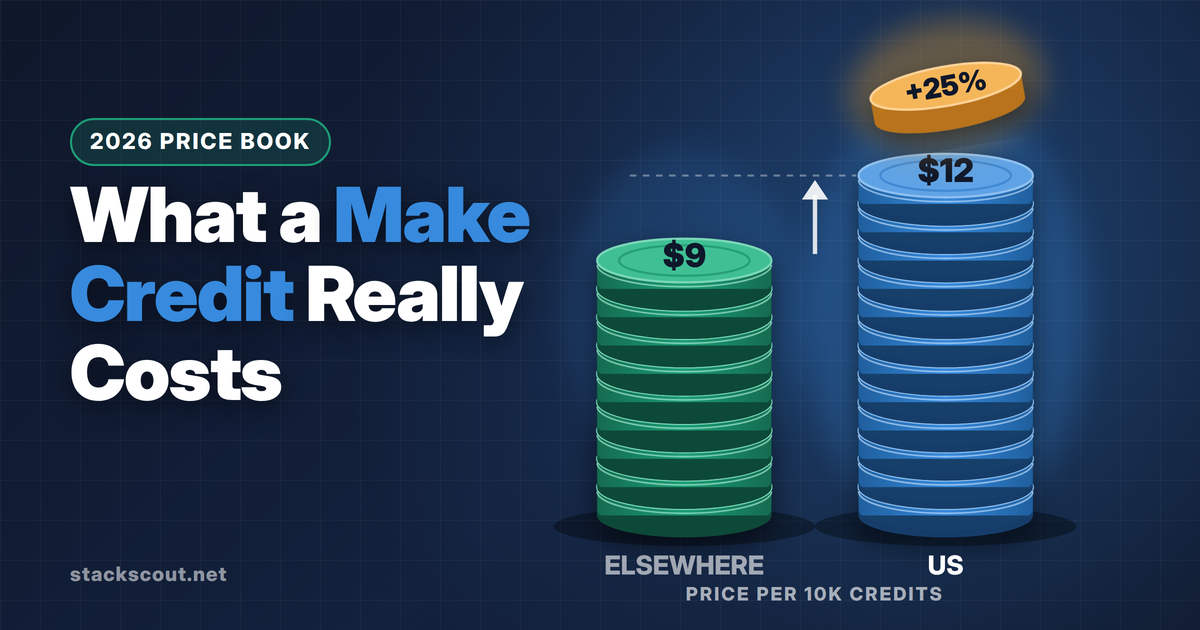
Make bills in credits, and most module actions use 1 credit. Paid plans start at 10,000 credits a month. The catch: Make shows different prices in different countries. On October 21, 2026, the price data behind Make's pricing page returned these annual-billing rates:
- United States: Core $12, Pro $21, Teams $38 per month for 10,000 credits. Monthly billing costs $16 / $28 / $51.
- Most other countries we tested (UK, Germany, Canada, Japan, Brazil and 20 more): Core $9, Pro $16, Teams $29. Monthly billing costs $10.59 / $18.82 / $34.12.
- India and Australia: no Core/Pro/Teams. There is a single "Make Plan" from $9 for 5,000 credits.
For most B2B teams, the overage rules decide the bill more than the sticker price. Extra credits cost 25% more than your plan's per-credit rate. Core credits on annual billing still reset every month. Polling triggers burn credits even when they find nothing. Our recommendation: Core if one person builds everything, Pro if your volume is seasonal or you plan to use your own AI keys, and Teams only when you need team roles.
01Make's plans at a glance (October 2026)
Make has five plans: Free, Core, Pro, Teams and Enterprise. Every paid plan uses the same billing unit and the same volume slider. You pick a monthly credit allowance (10K, 20K, 40K and up), and the price moves with it. The plans differ in features, not in what one credit buys. A Google Sheets "Add a Row" costs 1 credit on Core and 1 credit on Teams. Teams simply charges more per credit.
| Plan | US, annual | US, monthly | Most countries, annual | What it adds |
|---|---|---|---|---|
| Free | $0 | $0 | $0 | 1,000 credits/month, 2 active scenarios, 15-minute minimum interval, 5-minute max run time, 5 MB files, 7-day logs |
| Core | $12 | $16 | $9 | Unlimited active scenarios, 1-minute scheduling, 40-minute runs, 100 MB files, Make API (60 calls/min), 30-day logs |
| Pro | $21 | $28 | $16 | Priority execution, custom variables, full-text log search, 250 MB files, credits pooled across the year on annual billing |
| Teams | $38 | $51 | $29 | Teams and team roles, shared scenario templates, 500 MB files, Make API 240 calls/min |
| Enterprise | Custom | Custom | Custom | SSO, audit logs, custom roles, overage protection, custom functions, 60-day logs, 24/7 support |
Prices are per month for 10,000 credits, in USD, from Make's pricing data on October 21, 2026. Feature limits come from the comparison table on make.com/pricing. Every plan, Free included, allows unlimited users.
Two items in that table matter more than they look. First, every plan allows unlimited users. You never pay per seat on Make. You pay for credits plus feature gates. So "we have 12 people" is not, by itself, a reason to buy Teams. Second, Core tops out at 300,000 credits a month. Pro and Teams scale to 8 million on the public slider. A Core customer who outgrows 300K must move to Pro, whether or not they want Pro's features.
02Why US buyers see higher prices than everyone else
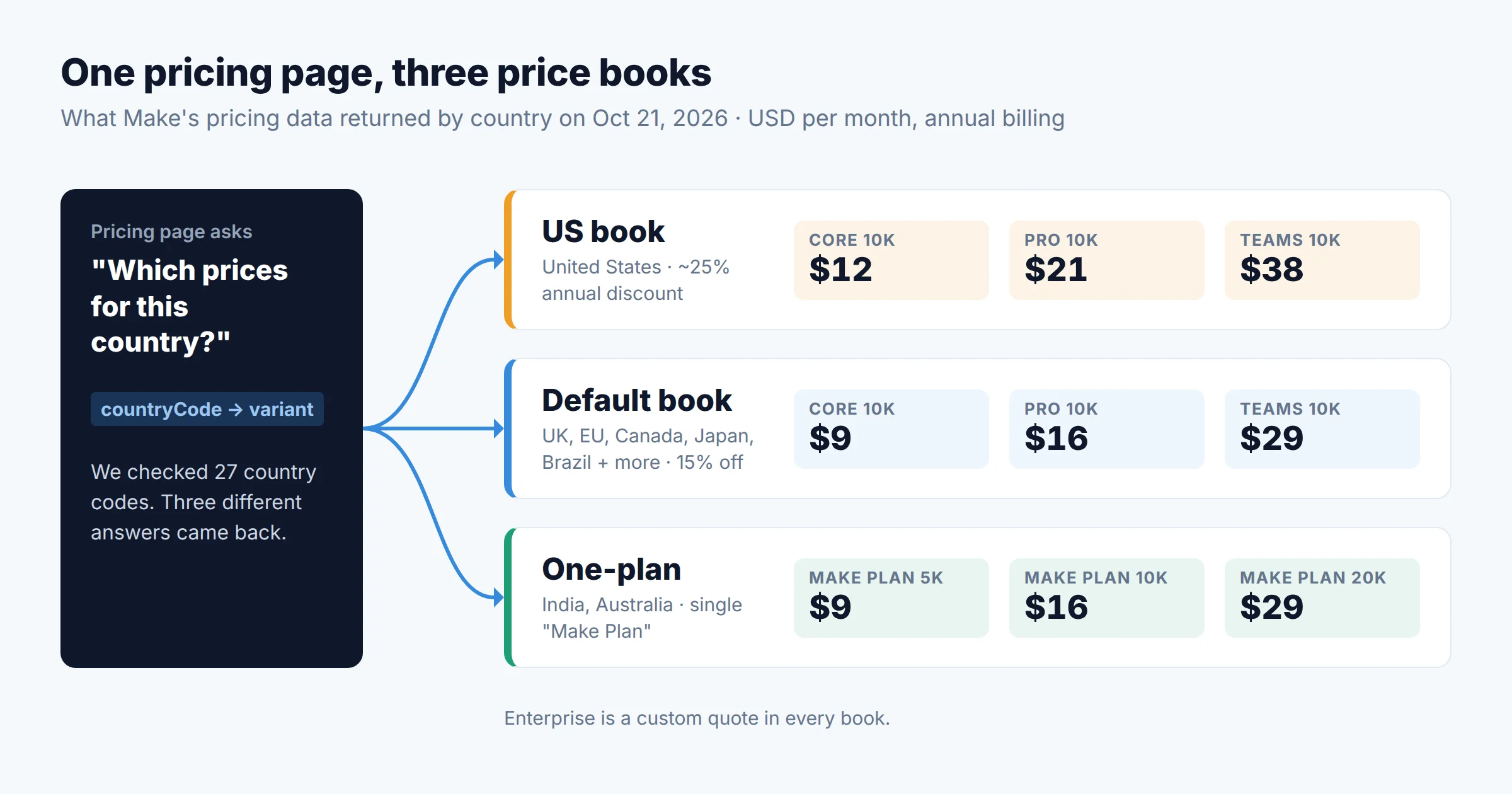
If you've read two Make pricing reviews this year and they disagree, neither one is necessarily wrong. Make's pricing page does not hard-code its prices. A component on the page calls a pricing service, sends the visitor's country code, and gets back a price table plus a "variant" label. We called that same service for 27 country codes on October 21, 2026 and got three distinct price books:
| Variant | Countries we saw it for | Core 10K | Pro 10K | Teams 10K | Annual discount |
|---|---|---|---|---|---|
| us | United States | $12 / $16 | $21 / $28 | $38 / $51 | ~25% |
| default | UK, Ireland, Germany, France, Spain, Italy, Netherlands, Sweden, Poland, Switzerland, Canada, Mexico, Brazil, Japan, Korea, China, Singapore, Philippines, Indonesia, UAE, Israel, South Africa, Nigeria, New Zealand | $9 / $10.59 | $16 / $18.82 | $29 / $34.12 | 15% |
| one-plan | India, Australia | Single "Make Plan": $9 / $10.59 for 5K credits, $16 / $18.82 for 10K, $29 / $34.12 for 20K | 15% | ||
Format: annual-billing price per month / monthly-billing price. All three variants are quoted in USD.
Three practical consequences for a US buyer:
- Every US tier costs about 30–33% more on annual billing than the default book. Core 10K is $12 vs $9 (+33%), Pro 10K is $21 vs $16 (+31%), and at the 8M-credit Pro tier it's $6,255 vs $4,811 (+30%).
- The monthly gap is wider. US monthly Core is $16 vs $10.59 elsewhere (+51%). The US book also gives a bigger annual discount (about 25% vs 15%), so going annual saves US buyers more.
- Third-party reviews often quote the default book. Several 2026 reviews call Core "$9 a month". That figure is correct for a visitor in Berlin or Toronto. For a US company it is out of date by a third. (Our own Make vs Zapier vs n8n comparison uses the US $12 Core rate, which is why it differs from those reviews.)
We could see which price book each country receives. We could not see how Make assigns accounts at checkout (billing address, IP, or card country), and Make's FAQ doesn't say. Budget from the price your finance team sees when it opens the pricing page on the company network. If your company has entities in several regions, ask Make's sales team which entity's price applies before you sign an annual term.
03What one credit actually costs at each tier
Make's slider gets cheaper per credit as you move up, but more slowly than many buyers expect. Here is the effective price per 1,000 credits on annual billing in the US book, with the default book for comparison:
| Credits / month | Core (US) | Pro (US) | Teams (US) | Core (default) | Pro (default) |
|---|---|---|---|---|---|
| 10,000 | $12 · $1.20/1K | $21 · $2.10/1K | $38 · $3.80/1K | $9 · $0.90/1K | $16 · $1.60/1K |
| 20,000 | $21 · $1.05/1K | $38 · $1.90/1K | $69 · $3.45/1K | $16 · $0.80/1K | $29 · $1.45/1K |
| 40,000 | $38 · $0.95/1K | $69 · $1.73/1K | $129 · $3.23/1K | $29 · $0.73/1K | $53 · $1.33/1K |
| 80,000 | $72 · $0.90/1K | $118 · $1.48/1K | $225 · $2.81/1K | $55 · $0.69/1K | $91 · $1.14/1K |
| 150,000 | $129 · $0.86/1K | $199 · $1.33/1K | $379 · $2.53/1K | $99 · $0.66/1K | $153.45 · $1.02/1K |
| 300,000 | $237 · $0.79/1K | $349 · $1.16/1K | $663 · $2.21/1K | $182.16 · $0.61/1K | $268.54 · $0.90/1K |
| 1,000,000 | n/a | $973 · $0.97/1K | $1,821 · $1.82/1K | n/a | $748.73 · $0.75/1K |
Annual-billing price per month and the implied cost per 1,000 credits. Core is not sold above 300,000 credits. Source: Make pricing data, October 21, 2026.
Three things stand out:
- Teams costs roughly 1.8–1.9× Pro at the same volume ($38 vs $21 at 10K in the US, $663 vs $349 at 300K). That premium buys team roles and shared templates. It does not buy users, which every plan already has unlimited.
- Volume discounts flatten out quickly. In the US book, Pro falls from $2.10 per 1,000 credits at 10K to $1.16 at 300K, but only from $0.97 at 1M to $0.78 at 8M. Slider steps are large, so if you sit just above a breakpoint, compare "next tier up" against "current tier plus extras" (see section 06).
- Moving up a plan costs far more than moving up the slider. Doubling Core from 10K to 20K credits adds $9 in the US. Staying at 10K and switching Core to Pro adds the same $9 but gives you no extra credits. Upgrade the plan for features, never for capacity.
04What consumes credits (and what's free)
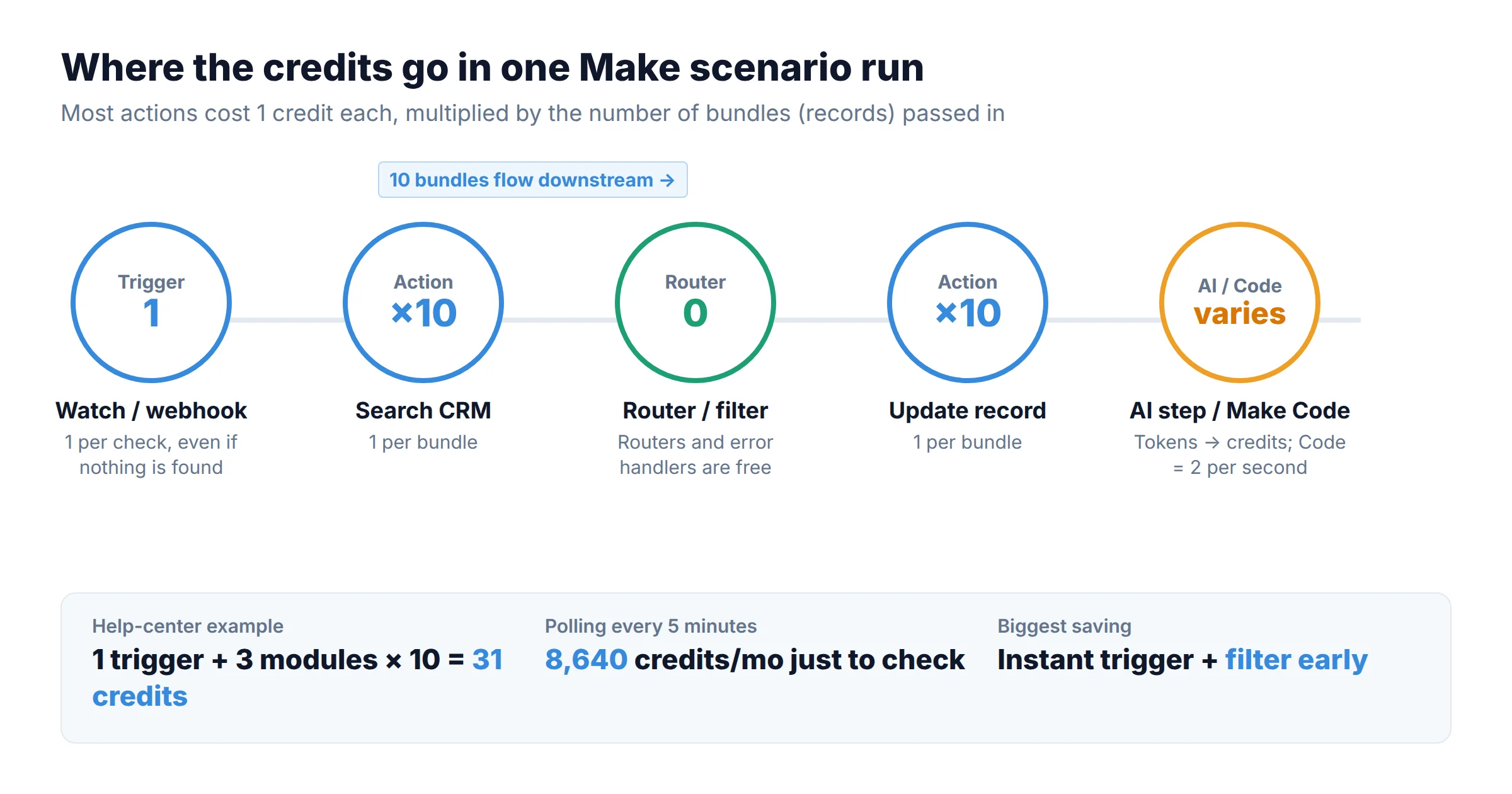
Make's rule is simple: each module action is one operation, and for non-AI apps one operation equals one credit. The multiplier is the part that surprises people. A module runs once for every bundle (record, email, row) it receives. Make's help center gives an example: a Google Forms trigger returns 10 responses, and three modules each process all 10. That one run costs 31 operations: 1 for the trigger plus 30 for the actions.
Counts as credits
- Reading, searching, creating, updating or deleting data in any app
- Transforming data with built-in tools, aggregating rows into an array or text, and iterating over items
- Every polling check. A "Watch" trigger counts as one operation each time it checks for new data, even when it finds nothing.
- The Make Code app: 2 credits for every second of code execution (paid plans only)
- AI modules that run through Make's AI Provider: credits based on tokens as well as operations (section 05)
- Maia, Make's AI build assistant. Chat messages draw from the same credit pool. Paid plans get the first 70 messages free for 30 days, and Make's examples show single replies using 140–160 credits.
Free
- The Router module
- Error handler modules: Rollback, Break, Resume, Commit and Ignore
The polling tax, in numbers
Polling triggers are where Make bills get padded without anyone noticing. Over a 30-day month, a single scheduled "Watch" trigger costs this much just to check:
| Schedule | Checks / month | Share of a 10K plan | US Core cost of checks alone* |
|---|---|---|---|
| Every 15 minutes (the default) | 2,880 | 29% | ≈ $3.46 |
| Every 5 minutes | 8,640 | 86% | ≈ $10.37 |
| Every 1 minute (paid plans) | 43,200 | 432% | Forces the 80K tier |
*At the US Core 10K rate of $1.20 per 1,000 credits. Checks only, before any record is processed.
The fix is almost always an instant trigger (a webhook), which costs a credit only when data actually arrives. Many CRMs, form tools and payment apps offer one. If a service only supports polling, set the interval to how soon you actually need the data. Most back-office syncs don't need a one-minute interval.
05AI steps: how tokens turn into credits
Since Make renamed "operations" to "credits", AI is where usage stops being predictable from the scenario diagram. How you're billed depends on how the AI module connects:
- Make's AI Provider (Make AI Agents and Make AI Toolkit, all plans): you pay Make in credits for operations and tokens. Make publishes a conversion table. Its "Large" tier (GPT-5 mini) gives 3,616 input tokens or 452 output tokens per credit. Claude Sonnet 5 gives 452 input or 90 output tokens per credit, about 8× fewer input tokens per credit.
- Your own API key (custom AI provider connection): Make charges only the operation, and your OpenAI or Anthropic invoice covers the tokens. The help center says this is available on paid plans. The pricing comparison table lists "your own LLM key" for AI Agents and AI Toolkit as Pro and above. If you plan to bring your own key on Core, test it in the account first.
- Automatic connections (Make AI Web Search, AI Content Extractor, and the "Simple Text Prompt" modules): you can't pick a provider, and credits depend on tokens, pages, file size or run time. Some Content Extractor modules use a fixed 2 or 10 credits per operation.
The model you pick can change the AI step's credit cost by more than 6×. Make has also said that the models behind its tiers and their token-to-credit rates will change as new models arrive. On August 25, 2026 it split input and output token rates, which Make described as lowering costs for most workflows. Meter a new AI scenario for a few weeks before you size your plan around it.
06When you run out: extras, auto-purchase, and the 25% surcharge
When credits run out, scenarios stop. Make doesn't throttle them. Incoming webhooks queue up to your allowance: 667 per 10,000 credits, with a maximum of 10,000. Polling scenarios pick up from their last successful run once credits return. You have three ways out:
- Buy extra credits by hand in units of 1,000, from Org → Subscription → Buy extras (card only).
- Turn on auto-purchasing (Core, Pro and Teams). Make buys 10,000 credits each time you hit zero. The total auto-purchased in a cycle is capped at your plan's credit allowance, so an 80K plan can auto-buy at most 8 times.
- Upgrade the tier before the term ends.
Options 1 and 2 cost the same: your plan's per-credit rate plus 25%. Make's own example: on a $9 plan with 10,000 credits, 10,000 extra credits cost $11.25. Two more details:
- Extras expire with the cycle. On monthly billing they last until the cycle ends. On annual billing they last to the end of the billing year, except on Core. Core's annual credits reset monthly, and extras bought on Core expire at that monthly reset.
- Data transfer can trigger an auto-purchase on its own. Each 10,000 credits come with 5 GB of data transfer. A file-heavy scenario can use up the transfer allowance and trigger an auto-buy while credits remain.
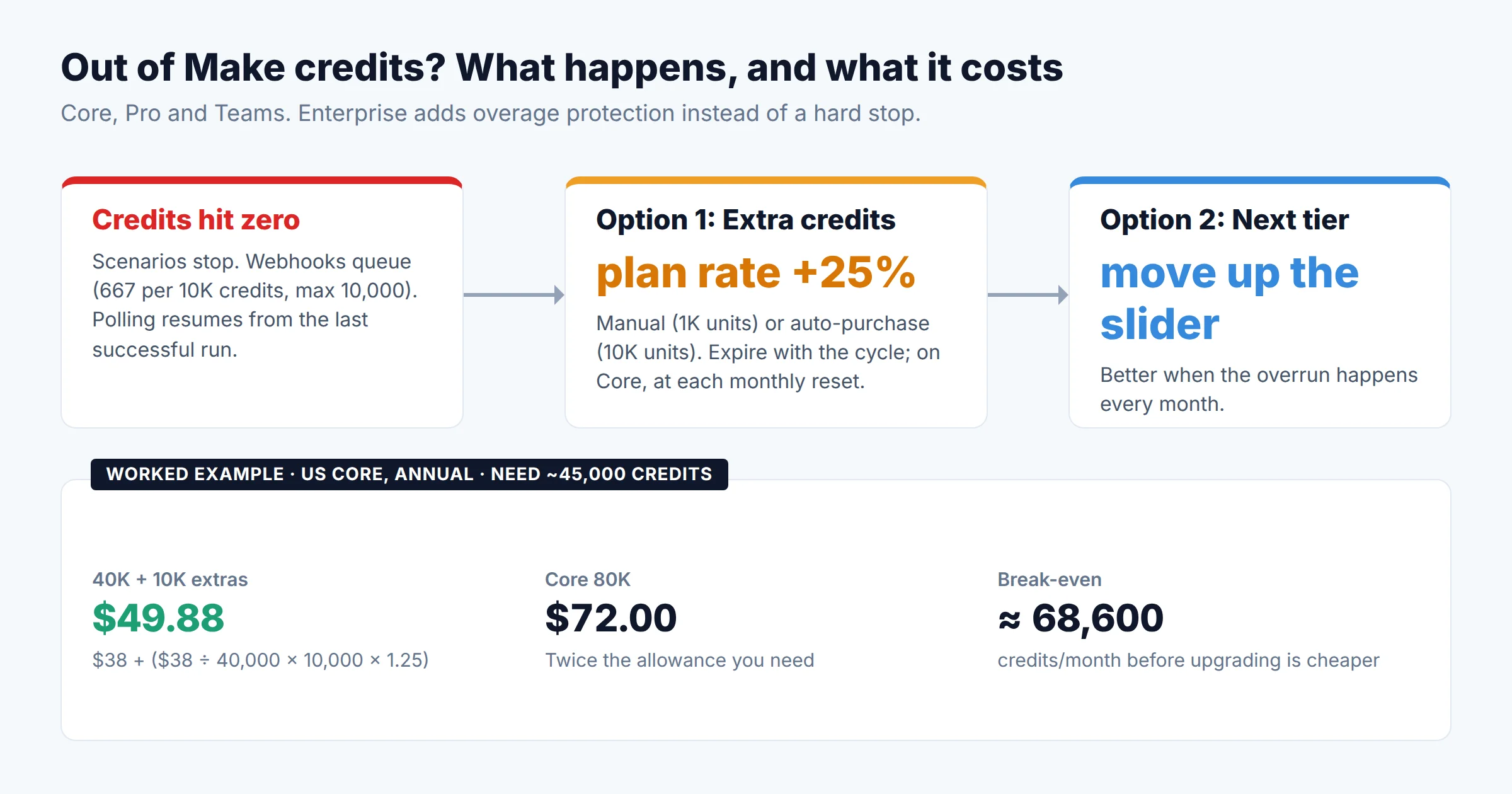
Extras vs the next tier: a worked example
A US team on Core 40K ($38/month, annual) needs about 45,000 credits a month:
Buying extras on top of a lower tier is cheaper than many teams assume. The next slider step often doubles the allowance, and you may not need double. The trade-off is operational. On Core annual those extras vanish at each monthly reset. And if auto-purchase is off and nobody is watching the meter, your scenarios stop mid-month.
07Annual vs monthly billing, and the Core reset trap
Annual billing is cheaper in both price books: about 25% off in the US book and 15% in the default book. But "annual" doesn't mean the same thing on every plan:
- Core, annual: you prepay the year, but your credits reset every month. Unused credits are lost at each reset.
- Pro and Teams, annual: Make lists "credits usage flexibility with yearly billing". You prepay a year of credits that expire only after 12 months. A team that runs 5,000 credits in July and 15,000 in December can size for the average instead of the peak.
That makes Pro the better buy for seasonal workloads (quarter-end finance syncs, annual enrollment HR flows, Black Friday order routing), even if you don't need its other features. In the US book, Pro 10K annual is $252 a year vs $144 for Core 10K. Pro wins whenever pooling saves you from sizing Core one slider step up for the busy months.
Two smaller billing rules are worth knowing before you sign:
- Downgrading charges your card immediately and starts a new billing cycle that day. Unused credits carry over to the new subscription as extras. Scenarios that use features from the higher plan are stopped.
- Cancelling keeps the plan running to the end of the term, then drops the organization to Free.
08Which Make plan should a B2B team buy?
One ops person or RevOps lead building workflows that run every month at a steady volume, under 300K credits. You don't need full-text log search or pooled annual credits.
Seasonal volume (annual credit pooling), more than 300K credits a month, your own AI keys, or debugging production runs with full-text log search and priority execution.
Several departments building in one organization who need team-level permissions on scenarios, connections and templates. Expect to pay roughly 1.8–1.9× Pro for that.
You need SSO, audit logs, custom roles, enforced 2FA, or overage protection (no hard stop at zero credits). This is usually a security review requirement, not a volume one.
What Make's pricing gets right
- Unlimited users on every plan
- Routers and error handlers are free
- Low per-action cost for short, high-frequency workflows
- Annual credit pooling on Pro and Teams
- A volume slider within each plan, so you don't have to change plans to add capacity
Where it bites
- The US price book is about 30% higher, and few reviews mention it
- Every polling check costs a credit
- Iterators multiply every downstream module
- Extra credits carry a 25% surcharge
- Scenarios hard-stop at zero below Enterprise
- AI credit cost depends on the model and can shift as Make changes its rates
09Make vs Zapier vs n8n: the real monthly cost for three B2B workloads
Sticker prices can't be compared directly, because the three platforms count different things. Make counts module actions, including the trigger. Zapier counts only successful action steps; triggers, filters, Paths and Formatter are free. n8n counts whole workflow runs, however many steps they contain. (Our Make vs Zapier vs n8n comparison explains why the billing unit matters more than the feature list.) We priced three typical B2B workloads at US list prices on annual billing:
| Workload | Make (US) | Zapier | n8n Cloud |
|---|---|---|---|
| A. Inbound lead routing 3,000 leads/mo · webhook → CRM search → create/update → router → Slack → Sheets log |
5 credits × 3,000 = 15,000 → Core 20K: $21 | 4 tasks × 3,000 = 12,000 → Pro 20K: $189 | 3,000 runs → Pro 10K: $50 |
| B. Nightly CRM-to-warehouse sync 500 rows/night × 3 modules, 30 nights |
(1 + 1,500) × 30 = 45,030 → Core 40K + 10K extras: $49.88 (or 80K: $72) | 1,500 × 30 = 45,000 → Pro 50K: $289 | 30 runs → Starter: $20 |
| C. AI ticket triage 2,000 tickets/mo · trigger → AI classify → 2 actions |
≈ 4.75 credits × 2,000 = ~9,500 on Make's Large AI tier → Core 10K: $12, with no headroom (Core 20K: $21 is safer) | (5 AI + 2) × 2,000 = 14,000 on the default Premium AI tier → Pro 20K: $189 | 2,000 runs → Starter: $20 + your LLM bill |
Zapier Pro annual tiers as listed on zapier.com/pricing: 10K $129, 20K $189, 50K $289. n8n Cloud as shown to US visitors: Starter $20 (2,500 runs), Pro $50 (10,000 runs). Make AI estimate assumes about 1,500 input and 150 output tokens per ticket, with the AI step also costing its 1 operation credit. All checked October 21, 2026.
How to read this:
- Make costs a fraction of Zapier on every workload here, even on the higher US price book. The gap is widest on step-heavy flows, because Zapier's per-task rate at 20K–50K is several times Make's per-credit rate. See our Zapier pricing breakdown for Zapier's task tiers and overage rules.
- n8n wins on batch jobs that loop over many records in a single run (workload B). Make wins on high-frequency, short workflows where n8n's run count passes Starter's 2,500 limit (workload A). The n8n figures are cloud prices. Self-hosting changes the math, as our n8n pricing guide shows.
- Make's real exposure is design, not price. Add a 1-minute polling trigger to workload A and you add 43,200 credits a month, which moves you from the 20K tier into the 80K-plus range. The same mistake costs nothing on Zapier, where triggers are free.
10Seven ways to cut a Make bill
- Swap polling for instant triggers wherever the source app offers a webhook. This is usually the single biggest saving.
- Filter on the first route, not the last. A filter that drops a bundle stops every downstream module from running on it.
- Use aggregators and bulk modules to write 100 rows in one call instead of 100 operations, where the target app supports batch endpoints.
- Use Pro's annual pooling for seasonal work instead of sizing Core for your peak month.
- Compare "current tier + extras" with the next tier before you upgrade. As section 06 shows, extras can stay cheaper until you need about 1.7× your allowance.
- Pick the AI model on purpose. On Make's AI Provider, the same prompt costs about 6–7× more credits on Claude Sonnet 5 than on the Large tier. On Pro, your own API key reduces the AI step to one operation credit.
- Apply to the Make Startup Program if you qualify. It offers free Teams access for up to 6 months (80,000 credits a month), then 50% off any plan for 3 months. Eligibility: funding up to $5 million, a new Make customer (no paid plan in the last 3 months), and you don't sell automation as a service.
If a single workflow is driving most of your credit use, it's worth seeing how other teams structured it. Our Make lead-routing case study walks through one B2B ops team's scenario design.
FAQ
Is Make free?
What's the difference between Zapier and Make pricing?
Why is Make cheaper on some websites than on others?
Do unused Make credits roll over?
How much does AI cost inside Make?
Methodology
On October 21, 2026, we took prices directly from the pricing service that make.com/pricing loads in the browser. We queried it for 27 two-letter country codes and recorded the variant, tiers, and annual and monthly prices it returned. Feature limits come from the comparison table on the same page. Credit rules, extra-credit pricing, AI token conversion rates and Maia pricing come from Make's help center. Startup terms come from Make's Startup Program page. Zapier prices were read from the plan data embedded in zapier.com/pricing, and n8n prices from n8n.io/pricing as displayed to a US visitor. The workload estimates are our own models built from those published rules, not measurements from a live account. Your actual credit use depends on bundle counts, retries and the apps you connect, so meter a real scenario before you commit to an annual tier.
Sources
- Make — Pricing & Subscription Packages (plans, comparison table, FAQ)
- Make Help Center — Credits (AI provider token-to-credit rates)
- Make Help Center — Operations (bundles, trigger checks)
- Make Help Center — Extra credits (25% surcharge, auto-purchasing)
- Make Help Center — Maia by Make pricing
- Make Help Center — 2026 release notes
- Make — Startup Program
- Zapier — Pricing
- n8n — Pricing

Technology consultant with 10+ years in the Japanese tech industry. Specializing in SaaS evaluation, workflow automation, and B2B tool integration.