Embedded iPaaS vs Unified API (2026): 4 Architectures, the Meter Each One Bills On, and 6 Questions That Decide It
Choose an embedded iPaaS (Prismatic, Paragon, Workato Embedded) when every customer's integration runs different logic: different triggers, field maps, and steps. Choose a unified API (Merge, Apideck, Truto, Unified.to, Bindbee) when your product needs the same records, such as employees, invoices, or contacts, from whichever app each customer happens to use.
"Unified API" covers two different architectures. Sync-and-store vendors (Merge, Bindbee) keep a copy of your customers' data on a schedule. Pass-through vendors (Apideck, Truto, Unified.to) fetch it live. That one difference changes your security review, how fresh the data is, and your rate-limit exposure. A fourth option, code-first integration infrastructure (Nango), handles auth and runtime while your engineers own the logic.
Before comparing features, model the billing meter against your own roadmap, and confirm you own the OAuth app. Those two things decide your 3-year cost and whether you can ever switch vendors.
Every top-ranking page for this query is written by a vendor that sells one side of the answer. Paragon, Prismatic, and Workato sell embedded iPaaS. Truto, Unified.to, and Merge sell unified APIs. Their architecture descriptions are mostly accurate. Their conclusions tend to point back to their own product.
This guide is for CTOs and product leaders at B2B SaaS companies who need to ship customer-facing integrations. It skips the "what is iPaaS" basics (see our plain-English iPaaS explainer). It also skips internal automation, which is covered in our guide to native integrations vs iPaaS vs custom API builds. The focus here is what changes in production: where data sits, how fresh it is, what the meter counts, and what it costs to leave.
Section 1It's four architectures, not two
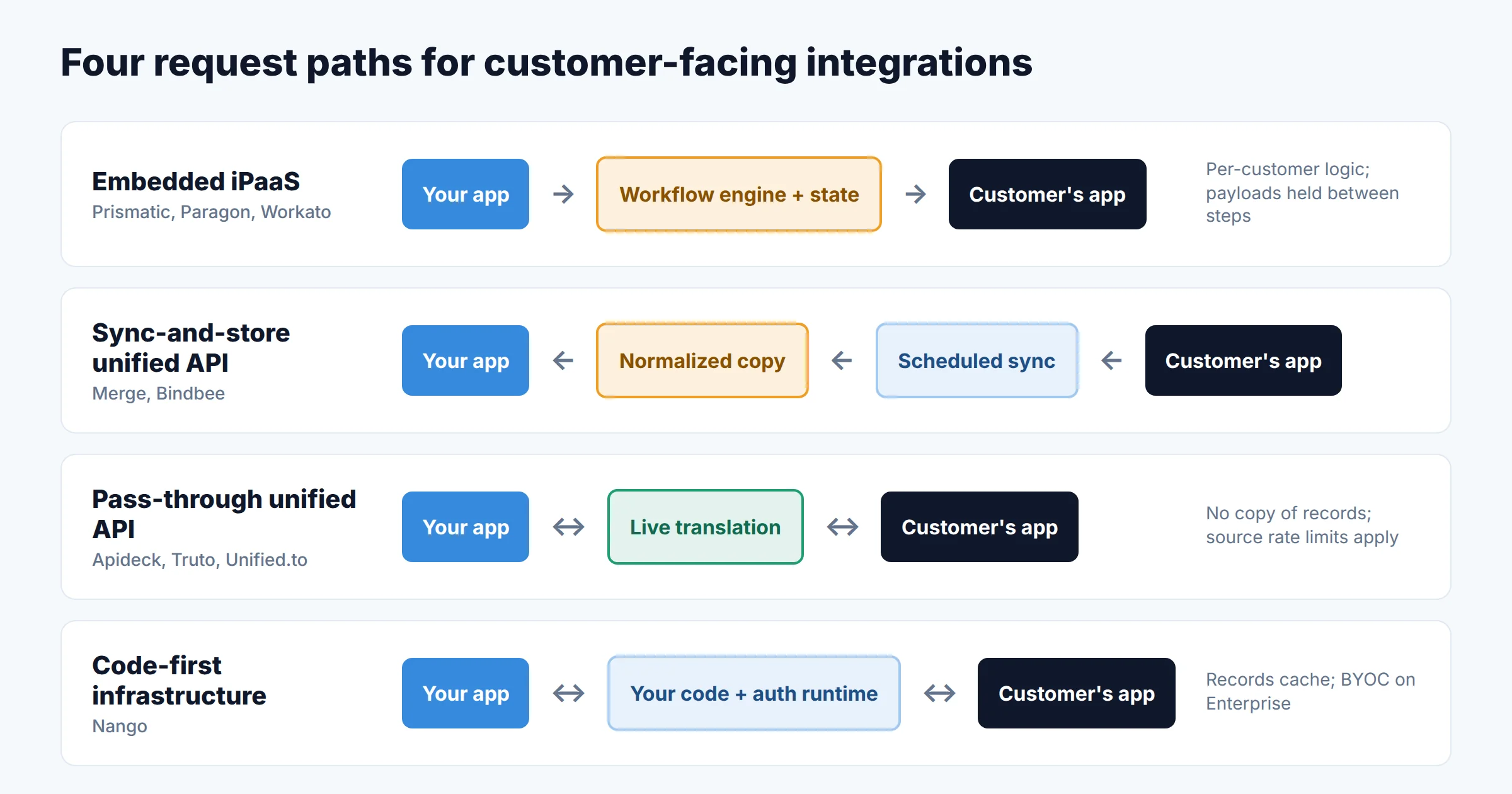
The "embedded iPaaS vs unified API" framing hides a split that matters more than the label. In 2026, the vendors you will shortlist fall into four groups based on how a request travels from your product to your customer's app:
- Embedded iPaaS. A hosted workflow engine you configure per customer. A trigger fires, the platform runs a multi-step flow (branch, transform, call another API), and it stores state between steps. Your customers see a white-labeled marketplace or configuration screen inside your product. Examples include Prismatic, Paragon Workflows, Workato Embedded, Cyclr, and Boomi's OEM program.
- Sync-and-store unified API. One normalized schema per category, such as HRIS "Employee" or accounting "Invoice." The vendor polls each connected app on a schedule, normalizes the records, keeps them, and your backend reads from the vendor's copy. Merge describes its own role this way: it "runs syncs on a schedule, normalizes data into Common Models, and delivers webhooks when data changes." Bindbee (HR and payroll only) works the same way.
- Pass-through unified API. The same normalized schema, but each request is translated and sent to the source app in real time, with no copy of the records kept. Apideck says its cloud Unified APIs "process business records in memory through a real-time pass-through layer, rather than retaining a synchronized copy." Truto's pricing FAQ says: "We don't cache or store any data." Unified.to describes itself the same way.
- Code-first integration infrastructure. The vendor handles OAuth, token refresh, retries, and a runtime, and your engineers write each integration as code. There is no forced common schema. Nango is the clearest example. Its sync functions write to a "records cache," an intermediate store between the external API and your app. You can also run it in your own cloud on the Enterprise plan.
The categories now overlap in marketing, though less in architecture. Paragon's Managed Sync adds normalized "Synced Object" schemas for File Storage, Documents, and CRM on top of its workflow engine. Truto offers an optional 5-minute sync ("RapidBridge") alongside pass-through. Almost everyone now ships an MCP server for AI agents. When a vendor claims to do both, ask which path a request actually takes.
Section 2Quick comparison table
Pricing below was checked on each vendor's official pricing page or docs in October 2026. "Quote" means no public list price.
| Dimension | Embedded iPaaS | Sync-and-store unified API | Pass-through unified API | Code-first infra |
|---|---|---|---|---|
| Examples | Prismatic, Paragon, Workato Embedded | Merge, Bindbee | Apideck, Truto, Unified.to | Nango |
| Who writes the logic | You (low-code or code), per integration; support staff configure per customer | Vendor (common model); you consume it | Vendor (common model); you consume it | Your engineers, in TypeScript |
| Data shape | Each app's native schema | Normalized per category | Normalized per category | Whatever you model |
| Customer records at rest with vendor | Workflow state and payloads | Yes, a synced copy | No (credentials and logs only) | Yes, in a records cache (or your cloud on Enterprise) |
| Freshness | Per trigger (event or schedule) | Sync interval (Merge Launch: daily; Bindbee: 24h default, 6h on Pro) | Live at request time | Your sync schedule, plus webhooks |
| Billing meter | Instances (Prismatic) or connected users (Paragon) | Linked accounts (Merge) or connections (Bindbee) | Active consumers (Apideck), connectors (Truto), API calls (Unified.to) | Connections, compute hours, GB |
| Entry list price | Quote (Prismatic, Paragon, Workato) | Merge: 3 free, then $650/mo for 10; Bindbee: quote | Apideck $599/mo; Truto $999/connector/yr (10 min.); Unified.to $750+/mo | Free tier; $50/mo pay-as-you-go |
| Best at | Deep, per-customer configurable workflows | Bulk reads of standard records across many apps | Live reads/writes, AI agents, tight data-retention rules | Teams that want code ownership |
| Main risk | You maintain every flow's logic | Stale data; your customers' data held by a third party | Source-app rate limits hit you directly | Engineering time is the real cost |
Section 3The 6 questions that decide it
Feature checklists rarely settle this decision, because every vendor checks most of the boxes. The six questions below do separate them. Answer them in order. The first two usually decide the architecture, and the last four decide the vendor.
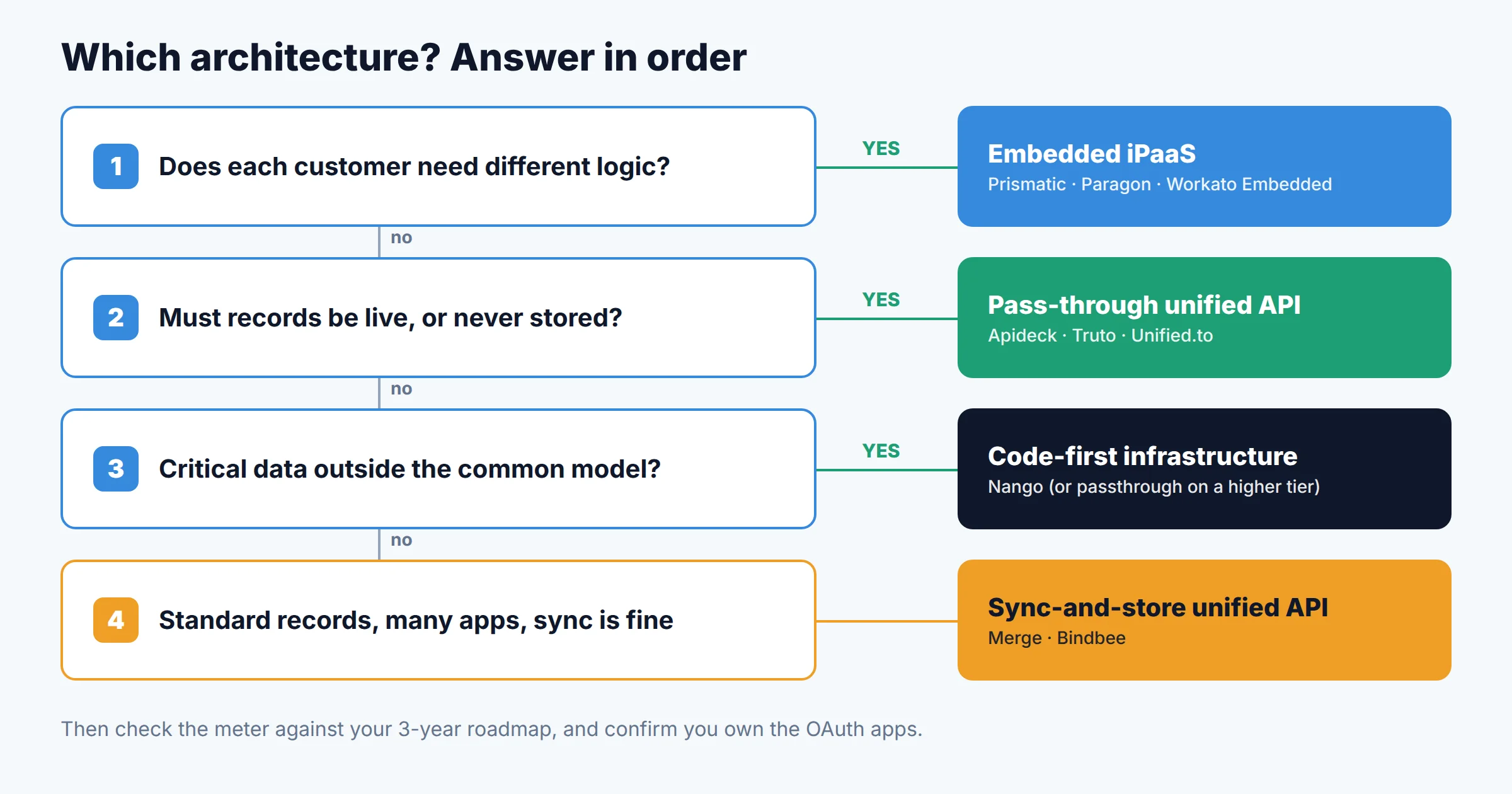
Is the integration moving records, or running logic?
Determines: embedded iPaaS vs everything else
Write the integration as one sentence. If it reads "pull every employee from the customer's HRIS nightly" or "push this invoice into whatever accounting system they use," it moves records. That is unified-API territory, because the same code serves BambooHR, Workday, and Gusto.
If it reads "when a deal closes in Salesforce, create a project in our app, and if the deal is over $50K also notify the account team in Slack and update a custom field," it runs logic. Different customers will also want different versions of that logic. That is what an embedded iPaaS is built for. Prismatic's model makes this explicit: you build an integration once and deploy a configurable instance of it per customer, and support staff can adjust instances without engineering.
Do you need fields the common model doesn't carry?
Determines: whether a unified API is viable at your plan tier
A common model is only as useful as the fields it carries. Most customer complaints about unified APIs trace back to a custom field, a custom object, or an app-specific endpoint outside the model. Every vendor has a workaround, but the workaround is often on a higher plan:
- Merge: Field Mapping requires Remote Data, which is "available to Professional and Enterprise customers." Authenticated Passthrough Requests, which call the underlying API directly, are also "only available to customers on our Professional or Enterprise plans." Both tiers are contract-priced. On Launch, you get the Common Model only.
- Apideck: The Proxy API (passthrough) is included on every plan, including Launch. Custom Field Mapping and Data Scopes start on Scale ($1,299/mo).
- Bindbee: Custom fields, passthrough, and webhooks are Pro features. Starter is read-only and covers only the Employee model.
- Truto: Custom fields and "override mappings with AI" are included on Expansion.
- Embedded iPaaS and Nango: Not applicable, because you work with each app's native schema. That is their main advantage here.
The audit to run before signing: list the 15–30 fields your feature actually reads or writes, for your top five customer apps. Mark each field as "in the common model," "needs custom-field mapping," or "needs passthrough." If more than a handful land in the last column for your most important app, you will be writing native API code anyway. At that point, decide whether a common model is still worth its plan price.
Where are your customers' records allowed to sit?
Determines: sync-and-store vs pass-through, and your security-review workload
This question decides more enterprise deals than any feature. If a vendor keeps a synced copy of your customers' HR or financial records, that vendor holds those customers' data as your sub-processor. It will show up in your DPA, your SOC 2 vendor list, and every security questionnaire your customers send. Customers' security teams look at this.
- Sync-and-store (Merge): Merge addresses this with breadth rather than avoidance. Its docs list SOC 2 Type II, ISO 27001, HIPAA, GDPR, and CCPA, with "data residency in the US, EU, or APAC, single-tenant deployment, and the option to land synced data in your own environment." Single-tenant and self-hosted options are sold as add-ons.
- Pass-through (Apideck): Apideck's security guide explains Zero Data Retention and lists its exceptions. OAuth tokens are stored encrypted. Optional API Logs "can contain full request and response bodies," so set retention to 0 if you need true zero retention. QuickBooks Desktop's on-premises sync "can require temporary data storage." Ask every pass-through vendor for the same list of exceptions.
- Embedded iPaaS: A multi-step workflow has to hold the payload between steps, so assume records rest on the vendor's infrastructure unless a private or self-hosted deployment is offered. Prismatic Enterprise offers private and GovCloud hosting plus on-prem connectivity. Paragon offers self-hosting or forward deployment on Enterprise.
- Code-first (Nango): Synced records live in Nango's Postgres-backed records cache, which keeps only the latest version of each record. BYOC (Nango runs it in your AWS, GCP, or Azure account) and fully self-managed deployment are Enterprise-only.
How fresh does the data need to be?
Determines: whether a sync interval is acceptable
A sync-and-store API is only as current as its last sync. Merge's pricing grid lists daily sync frequency on Launch and "customizable" on Professional and Enterprise. Bindbee syncs every 24 hours by default, and Pro can shorten that to 6 hours. For a nightly roster or a monthly close, that is fine. For a feature where a user edits a record in your app and immediately reads it back, or an AI agent that reads a record and then writes to it, a stale read is a bug.
Pass-through APIs are live but inherit the source app's latency and rate limits. Apideck forwards the provider's limits in x-downstream-ratelimit-* headers and tells developers not to assume a fixed global limit. For apps without native webhooks, Apideck offers "virtual webhooks" that poll for you. Paragon's Managed Sync can run as often as every minute. Truto's optional RapidBridge sync runs every 5 minutes on Expansion.
The vendor's own rate limits matter too. Merge caps requests per linked account at 100 per minute on Launch, 400 on Professional, and 600 on Enterprise. If a single large customer drives heavy traffic, that cap applies to them.
Which meter will your growth actually hit?
Determines: 3-year cost and which vendor wins on price
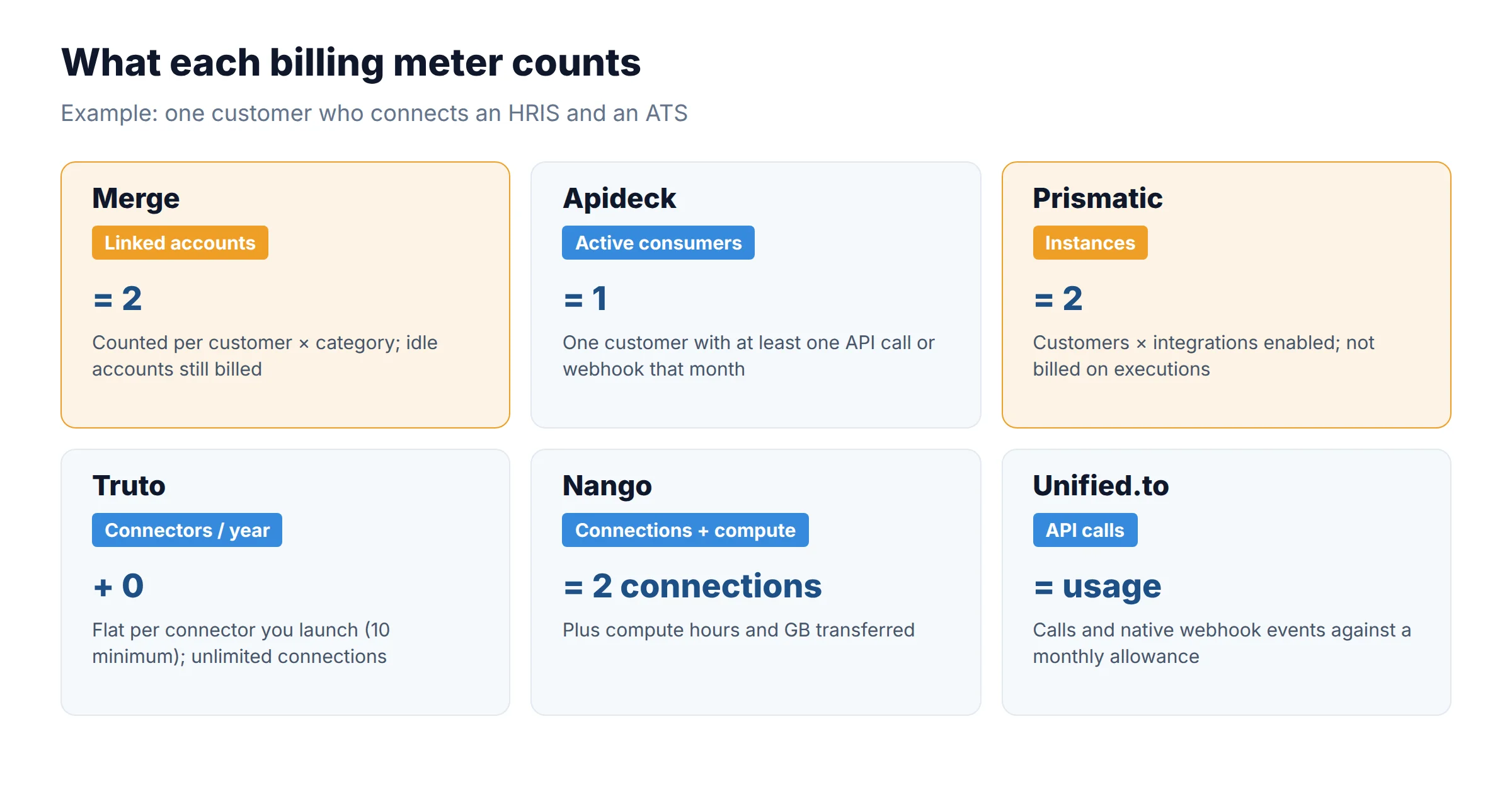
Every vendor counts something different. The same roadmap can be cheap on one meter and expensive on another, so define exactly what is being counted before comparing prices.
| Vendor | What one billable unit is | The detail that surprises buyers |
|---|---|---|
| Merge | A Linked Account: "a single connection between Merge and a third-party platform" | A linked account is unique per end user origin ID + category. One customer connecting an HRIS and an ATS counts as two. "Idle" accounts (valid credentials, no requests for 2 weeks) are still billed. Generating a new origin ID per linking session creates duplicate billable accounts. |
| Apideck | An active consumer: a customer "whose connected account made at least one API call or webhook event that month" | One consumer can have several connections. Launch covers only 1 Unified API category, so a second category means moving to Scale. |
| Prismatic | An active instance. "Active instances ≈ customers × integrations per customer" | Never billed on API calls or executions, so a busy month doesn't change the bill. Adding integrations to your marketplace multiplies the count across every customer who turns them on. |
| Paragon | A Connected User. "Usage costs scale based on the number of tenants (customer orgs) you have using integrations" | Quote-only, so the per-tenant rate is what you negotiate. |
| Truto | A connector per year ($999 on Expansion, $1,999 on Enterprise) | Unlimited connections and API calls, but a 10-connector minimum at launch (60 on Enterprise). You pay for connectors few customers use. |
| Unified.to | API calls (Grow $750+/mo includes 750,000; overage $1.00 per 1,000) | Native webhook calls count. Virtual webhooks count only when new data is found. |
| Nango | Connections ($0.29/mo each), compute ($0.72/hour), and transfer ($0.50/GB) on pay-as-you-go | The $50/mo base includes $50 of credits. Heavy syncs make compute, not connections, the main cost. |
| Bindbee | A customer connection | Unlimited API calls, syncs, and webhooks. Plan prices are not public. |
Sources: vendor pricing pages and help-center articles listed under References, checked October 2026.
What does it cost to leave?
Determines: lock-in, and your negotiating position at renewal
Most buyers skip this question, and it causes the most pain later. If you change integration vendors, your customers may have to log in to Salesforce, BambooHR, or QuickBooks again and re-authorize. That costs you support tickets and goodwill, and some churn. Whether they have to depends mostly on one thing: whose OAuth app issued the tokens.
- Use your own OAuth client ID and secret from day one for every app where it's possible. Truto's FAQ says you can "use your own client ID and secret" instead of its default app. Nango supports "self-managed apps" for a fully white-labeled flow. Tokens minted under a vendor's shared app are tied to that vendor's client.
- Check that the next vendor can import tokens. Apideck's Vault API has an import endpoint that accepts existing access and refresh tokens "without forcing them to reauthorize." Nango's API has an "Import a connection" endpoint. Ask your current vendor in writing how they will export tokens. The import endpoints are only useful if you can get the tokens out.
- For embedded iPaaS, the logic is the hard part to move. Your workflows live in the vendor's format. Prismatic says it makes integration, customer, and instance data available "via our API and CLI," supports source control, and lets paid customers download their content within 30 days after termination. A downloaded workflow definition still has to be rebuilt on another platform. Code-native integrations kept in your repo are easier to port.
Section 4Worked cost example: 80 customers, two categories
Our guide to the best iPaaS platforms for B2B SaaS teams models 200 customers in a single category. Most products reach a second category sooner than planned, so here is a different case: 80 customers, each connecting one HRIS and one ATS (160 connections), spread across about 10 apps per category. We used list prices as of October 2026, before discounts. This is arithmetic from published rates, not a quote.
| Vendor (plan) | Billable count | Math | ≈ Monthly |
|---|---|---|---|
| Merge (Launch) | 160 linked accounts (80 × 2 categories) | $650 covers 10; 150 × $65 = $9,750 | $10,400 |
| Apideck (Scale) | 80 active consumers; 2 categories needs Scale | Scale starts at 100 consumers = $1,299 | $1,299 |
| Truto (Expansion) | ~20 connectors (10 HRIS + 10 ATS) | 20 × $999 = $19,980/yr | $1,665 |
| Unified.to (Grow) | API calls | $750+ if under 750,000 calls/mo; $1.00 per 1,000 above | $750+ |
| Nango (PAYG) | 160 connections + compute | 160 × $0.29 = $46.40, inside the $50 base credit | $50 + compute |
| Prismatic | 160 instances (80 × 2 integrations) | Quote; volume per-instance pricing | Quote |
| Paragon | 80 connected users | Quote | Quote |
Three things stand out from these numbers:
- Merge's per-category count doubles the bill when you add a category. The same 80 customers in one category would be 80 linked accounts, or $5,200/mo at list. Adding ATS adds another $5,200. Merge's value is breadth and maturity, but at this count you would negotiate a Professional contract, not pay Launch list prices.
- Apideck counts the customer, not the connection, so a second category costs nothing extra once you're on Scale (3 categories included). A fourth category, or more than 500 consumers, moves you to an Enterprise contract.
- The cheapest licenses shift the cost to engineering. Nango's $50 is real, but your engineers write and maintain every sync. Truto's price doesn't move with customer count, which helps more as you grow past this example.
Run the same table at three points: today, 12 months out, and your 3-year plan. Run it once with your current categories and once with the next one you expect to add. If the ranking changes between rows, choose based on the 3-year row and negotiate the first year.
Section 5Where MuleSoft, Workato, Boomi, and SnapLogic fit
Buyers researching this topic often end up comparing MuleSoft, Workato, and Boomi. These are mainly internal enterprise iPaaS platforms for connecting your own company's systems, not built-for-SaaS embedded products. Two of them do have embedded offerings:
- Workato Embedded gives each of your customers a "customer workspace" that you manage through Embedded APIs (create recipes, add collaborators, manage versions). It is quote-only. Third-party pricing estimates conflict by an order of magnitude, so get a quote based on your customer count and task volume. For how Workato's task meter and governance compare in an internal setting, see our Workato vs Zapier for enterprise teams comparison.
- Boomi runs an OEM and Embedded Partner Program for software providers, redesigned in October 2023. It is powered by the Boomi Enterprise Platform. It suits vendors whose customers already run hybrid or on-prem systems.
- MuleSoft Anypoint and SnapLogic are built around API-led, internal integration programs. Neither is an embedded marketplace product. If you are evaluating SnapLogic alternatives to ship integrations to customers, the relevant shortlist is the embedded iPaaS and unified API vendors in this guide, not another internal iPaaS.
Enterprise iPaaS platforms make sense for customer-facing integrations in one case: you already run one internally, your integration team knows it well, and your customers are large enough that a per-customer workspace fee is small next to the contract value. Otherwise, the built-for-SaaS vendors are faster to ship and have published meters.
Section 6Pros and cons of each architecture
Embedded iPaaS
Prismatic · Paragon · Workato EmbeddedBest when integrations are a configurable product surface. Prismatic is built around per-customer instances and adds an embedded workflow builder so customers can build their own automations. Paragon bundles Workflows with Managed Sync (normalized ingestion) and ActionKit (synchronous actions over an API and MCP server).
Pros
- Per-customer logic, field maps, and triggers
- Native schemas, with no common-model ceiling
- White-labeled marketplace and config UI
- Execution-independent meters (Prismatic)
Cons
- You design and maintain each integration
- Payloads rest on vendor infrastructure between steps
- No public prices; meter multiplies with integrations
- Workflow definitions don't port to another vendor
Sync-and-store unified API
Merge · BindbeeBest for bulk access to standard records across a long tail of apps. Merge covers 8 Unified API categories and 260+ documented integrations (as of August 2026). Bindbee is narrower: 110+ HRIS connectors, with Benefits, Payroll, and Time/Leave models on Pro, aimed at HR tech and benefits platforms.
Pros
- Fastest route to many integrations in a category
- Cached reads are fast and shield you from source outages
- Mature compliance posture and regional hosting (Merge)
- Free start: 3 linked accounts on Merge
Cons
- Data is only as fresh as the last sync
- The vendor holds a copy of customer data
- Custom fields and passthrough gated to Professional+ (Merge)
- Per-category linked-account meter compounds
Pass-through unified API
Apideck · Truto · Unified.toBest when data must be live or must not be stored, which increasingly includes AI agents that read and then write. Apideck is strongest in accounting and includes an MCP server and Proxy API on every plan. Truto suits companies with many customers on a known app list. Unified.to bills by API calls.
Pros
- Live data; no read-after-write staleness
- Smaller data-retention footprint in security reviews
- Customer-based (Apideck) or flat per-connector (Truto) meters
- Token import endpoint for onboarding existing connections (Apideck)
Cons
- Every read hits the source app's rate limits and latency
- Logs and exceptions can still store data
- Truto's ~$10K/yr floor before your first customer
- Apideck Launch is limited to one category
Code-first integration infrastructure
NangoBest when integrations are core IP and your engineers want them reviewed, tested, and versioned like the rest of the codebase. Nango handles auth for 1,000+ APIs and runs your TypeScript functions.
Pros
- No common-model ceiling; model exactly what you need
- Lowest list price per connection
- Integration code lives in your repo, so it's portable
- BYOC or self-managed deployment on Enterprise
Cons
- Engineers build and maintain every integration
- No non-technical builder for support teams
- Compute-heavy syncs add variable cost
- Self-hosting requires an Enterprise contract
Section 7Who should choose which
You need rosters from whatever HRIS each employer uses, and a nightly or 6-hour sync is fine. Compare Merge (breadth across categories) with Bindbee (HR-specific models like benefits and payroll). Model Merge's per-category count if you'll add ATS later.
Accounting writes need current state, and finance teams ask hard questions about stored data. Apideck's accounting coverage and active-consumer meter fit well. Read its list of Zero Data Retention exceptions (logs, QuickBooks Desktop) before you answer a security questionnaire.
Each customer's ERP or CRM is configured differently, and your solutions team needs to adjust flows without engineers. Prismatic's per-instance model and GovCloud/on-prem options fit this case. Forecast instances as customers × integrations.
A stale cached read before a write is a correctness bug. Use pass-through (Apideck, Truto, Unified.to), Paragon ActionKit for synchronous actions, or Nango if you want the tool code in your repo.
Use Merge's 3 free linked accounts or Nango's free tier to close the deals that need integrations now. Register your own OAuth apps from the start so you can switch later without re-authorizing customers. If every customer uses the same one or two apps, a direct build may be simpler. See our native vs iPaaS vs custom API decision guide.
The hybrid most growing SaaS companies end up with: a unified API for broad coverage across a category's long tail, plus an embedded iPaaS or code-first layer for the three or four strategic apps where customers expect depth. The two don't conflict as long as each integration has a clear owner and every OAuth app is yours.
Section 8FAQ
What is the difference between an embedded iPaaS and a unified API?
Do unified APIs store my customers' data?
Can I switch unified API vendors without customers reconnecting?
Is Workato Embedded or Boomi a good alternative to Prismatic or Paragon?
Section 9Methodology
Based on our research, we grouped vendors by request path (workflow engine, sync-and-store, pass-through, code-first) rather than by marketing category, because the path decides data residency, freshness, and rate-limit exposure. Pricing, plan gating, meter definitions, and data-handling statements were taken from each vendor's official pricing page, help center, or developer docs in October 2026, and are quoted where possible. Where a vendor doesn't publish a price, we say so rather than citing third-party estimates as fact. The cost example uses list prices before discounts and assumes about 10 apps per category. We have no commercial relationship with any vendor named here, and no tool was tested hands-on for this article.
ReferencesSources
- Merge — Pricing (Launch $650/10 linked accounts, plan grid). https://www.merge.dev/pricing
- Merge Help Center — Which linked accounts am I billed for? https://help.merge.dev/en/articles/9628111-which-linked-accounts-am-i-billed-for
- Merge Help Center — End user origin ID best practices. https://help.merge.dev/en/articles/8032943-end-user-origin-id-best-practices
- Merge Docs — Architecture reference; Passthrough requests; Field mapping; Rate limits. https://docs.merge.dev/merge-unified/architecture-reference
- Apideck — Pricing (Launch $599, Scale $1,299, active consumer definition). https://www.apideck.com/pricing
- Apideck Developers — Security & data handling (Zero Data Retention and exceptions). https://developers.apideck.com/guides/security-and-data-handling
- Apideck Developers — Migrating integrations (Vault import endpoint). https://developers.apideck.com/guides/migrating-integrations
- Truto — Pricing and FAQ (per-connector pricing, no data caching, own OAuth credentials). https://truto.one/pricing
- Unified.to — Pricing (API-call-based plans). https://unified.to/pricing
- Bindbee — Pricing (Starter/Pro/Enterprise features, sync frequency). https://bindbee.dev/pricing
- Nango — Pricing; Docs: Records cache; Self-hosting. https://nango.dev/pricing · https://nango.dev/docs/guides/functions/syncs/records-cache
- Prismatic — Pricing and FAQ (instances, no execution billing, termination export). https://prismatic.io/pricing/
- Paragon — Pricing; Docs: Managed Sync overview. https://www.useparagon.com/pricing · https://docs.useparagon.com/managed-sync/overview
- Workato Docs — Embedded (customer workspaces and Embedded APIs). https://docs.workato.com/oem.html
- Boomi — OEM and Embedded Partner Program announcement (Oct 2023). https://www.businesswire.com/news/home/20231004548984/en/

Technology consultant with 10+ years in the Japanese tech industry. Specializing in SaaS evaluation, workflow automation, and B2B tool integration.